KYANITE FOR SALE
How Does Kyanite Form?
Kyanite is classified as an aluminosilicate mineral (composed of aluminum, silicon and oxygen) that forms as a result of high pressure metamorphism of sedimentary rock. This alteration typically occurs to aluminum-rich clay deposits and/or pelitic (fine-grained) rocks that undergo metamorphism under high pressure. Because of this, kyanite is most often found in gneisses (metamorphosed sedimentary rock) and schists that formed primarily from sedimentary rock, though it is also occasionally found in quartzite formations.
The environment of formation is key to producing kyanite crystals, since alterations in temperature and pressure can morph kyanite into different crystals. If the temperature is too high during crystal formation, kyanite will form as sillimanite, a polymorph of Al2SiO5. If temperatures are low but pressures are too low for kyanite formation, the crystal that forms in its place is andalusite, also a polymorph of Al2SiO5.
Where Is Kyanite Found?
Kyanite is found in locations where high pressure metamorphism has occurred. This is why convergent continental collision boundaries are common locations to find kyanite. These collision boundaries provide the perfect high pressure atmosphere to metamorphose sedimentary rocks and form kyanite crystals. These locations include Switzerland, Serbia, Myanmar, Austria, Tanzania, Kenya, United States, Zimbabwe, Russia, Brazil, Burma, India, Cambodia, France and Nepal. The United States, South Africa, India, and France are the leading producers of kyanite. However, Nepal is regarded as one of the leading producers of some of the most beautiful blue-colored kyanite crystals found to date.
Are There Alternative Names For Kyanite?
Disthene: Named after the Greek words for "strong" and "two", which refer to the crystals' varied hardness in two separate directions.
Cyanite: This old spelling of kyanite was popular through the 19th and early 20th centuries.
Is Kyanite A Natural Mineral?
Yes, kyanite is found all around the world! It is most typically found in aluminum-rich deposits that have undergone a significant amount of high pressure sedimentary rock metamorphism.
The environment necessary for the formation of kyanite makes it extremely difficult to be grown synthetically. That being said, blue glass that resembles kyanite exists, but since kyanite is already so abundant, coming across "fake" kyanite is very unlikely. Probably the worst thing that you'll come across when dealing with kyanite vendors is crystals that have been covered in a layer of oil to enhance the color.
Is Blue Kyanite Rare?
Blue kyanite is considered to be the most common color of kyanite! However, the vibrancy of this color can play a role in its rarity. Colorless kyanite crystals are the rarest to find, though they're not regarded as being the most valuable.
What Colors Can Kyanite Be?
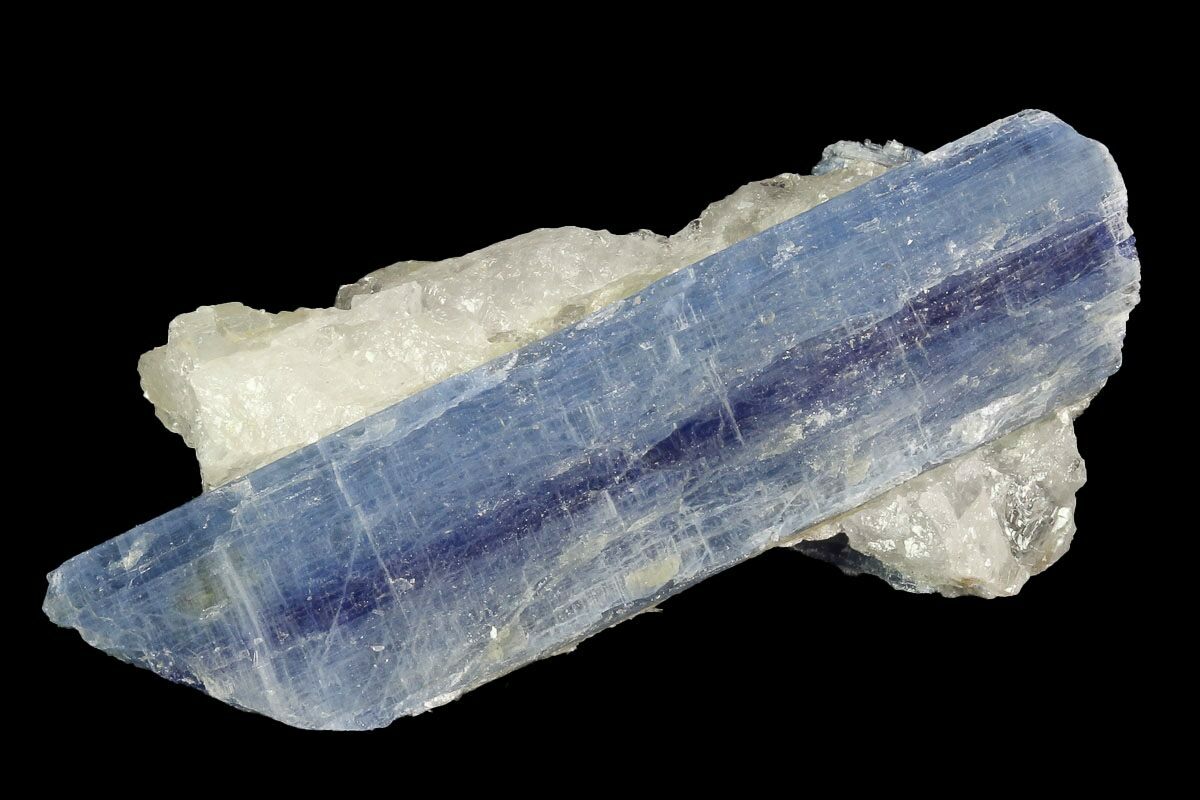
Kyanite crystals are commonly found colorless, blue, orange (only known from one location in Tanzania), green, and black, while in rare cases purple kyanite crystals have been found. Crystals with transparent blue edges and a deep blue streak that runs down the middle are considered the most prized color combination.
Blue Kyanite: The most common color of kyanite. A blue kyanite crystal can be a consistent blue throughout, or can contain zoning in which the crystal will have a streak of deep blue through its center.
Green Kyanite: A green variety of kyanite that can often be found in quartzite. Avery County in North Carolina is a locality that produces these green kyanite crystals.
Teal Kyanite: A teal variety of kyanite that is found in the Umba Valley of Kenya.
Black Kyanite: A black variety of kyanite.
Orange Kyanite: So far only found in Tanzania, this variety of kyanite gains its color from manganese impurities.
Colorless Kyanite: A rare form of kyanite in which the crystal presents no color.
How Is Kyanite Identified?
The elongated columnar structure of the crystal combined with its blue color are often good indicators of the mineral. Another good identifiable characteristic of kyanite is its unique hardness (a mineral's susceptibility to being scratched), which varies based on the direction of scratch testing along the crystal.
Other identifiers are the minerals found associated with the crystal. Aside from the surrounding metamorphic rock, associations of quartz, almandine, biotite, and mica are very common.
Kyanite's Unique Hardness
Kyanite's hardness (Moh's hardness scale) varies depending on the direction it's scratched in. When scratching the crystal parallel to its length, it most often scratches at 4.5 - 5, while scratching perpendicular to its length, the crystal exhibits a hardness of 6.5 - 7. This characteristic of kyanite is what earned the crystal its synonymous name disthene.
What Is Kyanite Used For?
Kyanite can be helpful in explaining the geologic process of a rock formation. When geologists discover kyanite in a location containing metamorphic rock, they can deduce information regarding the depth, temperature, and pressure of the host rock's formation.
Kyanite's heat-resistant properties make it an excellent combination material for the manufacturing of heat-resistant porcelains. Some common items that this kyanite-infused porcelain is used in are sinks and other various bathroom fixtures, porcelain dentures, as a binding agent in cutting/grinding wheels, and even as the porcelain insulators of spark plugs.
It is also often used as a decorative piece, though seldom will it be used as a gemstone since its natural perfect cleavage causes the crystal to break easily, making it difficult to facet. It has also become popular with the metaphysical and healing crystal community as an energy balancing stone.
Reviews