 Reviews


This Specimen has been sold.
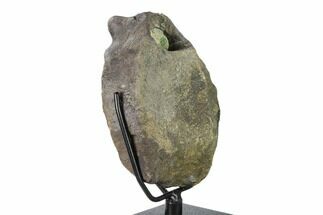
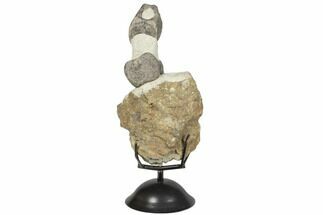

14.8" Ceratopsian (Einiosaurus) Dorsal Vertebra with Stand - Montana


This is an impressive 14.8" tall ceratopsian (Einiosaurus procurvicornis) dorsal vertebra collected from the Two Medicine Formation of Glacier County, Montana. It has been nicely prepared from the hard rock surrounding it. Incredibly, the majority of both transverse processes and both postzygapophyses remained intact with limited repair work.
It sits nicely in a leaned back position on the accompanied custom display stand.
There is about 20% restoration in total which includes about 75% of the spinous process, spots along the distal ends of the transverse processes, the left prezygapophysis, and within repaired cracks where gap fill was required.
It sits nicely in a leaned back position on the accompanied custom display stand.
There is about 20% restoration in total which includes about 75% of the spinous process, spots along the distal ends of the transverse processes, the left prezygapophysis, and within repaired cracks where gap fill was required.
Einiosaurus procurvicornis is a distinctive centrosaurine ceratopsian dinosaur that lived during the Late Cretaceous, approximately 74 - 70 million years ago, in what is now Montana. First described in 1995, its name means “buffalo lizard with a forward-curving horn,” a reference to its most defining feature: a large nasal horn that curves strongly forward and downward. Unlike the long brow horns seen in Triceratops, Einiosaurus possessed reduced supraorbital horns and a broad frill adorned with small, hooked epoccipitals along the margin, giving it a uniquely ornamented skull well suited for species recognition and display.
Fossil evidence indicates that Einiosaurus was a large, quadrupedal herbivore, measuring roughly 4.5 - 6 meters (15 - 20 feet) in length, and lived in social herds on floodplains dominated by rivers and seasonal wetlands. Bone-bed discoveries containing individuals of various ages suggest complex social behavior and possible age-related changes in horn shape, reflecting shifting roles within the herd. As with many ceratopsians, its elaborate cranial ornamentation likely played an important role in visual communication, mating displays, and intraspecific competition, highlighting the remarkable diversity and evolutionary experimentation within horned dinosaurs.
Fossil evidence indicates that Einiosaurus was a large, quadrupedal herbivore, measuring roughly 4.5 - 6 meters (15 - 20 feet) in length, and lived in social herds on floodplains dominated by rivers and seasonal wetlands. Bone-bed discoveries containing individuals of various ages suggest complex social behavior and possible age-related changes in horn shape, reflecting shifting roles within the herd. As with many ceratopsians, its elaborate cranial ornamentation likely played an important role in visual communication, mating displays, and intraspecific competition, highlighting the remarkable diversity and evolutionary experimentation within horned dinosaurs.
About The Two Medicine Formation
The Two Medicine Formation is a geographical formation in Central Montana and Southern Alberta, Canada. The formation is predominantly sandstone laid down by rivers and deltas during the Campanian Age of the Cretaceous, about 80-75 million years ago. Approximately two thousand feet thick on the western edge, it lies on top of the Virgelle Sandstone formation and under the Bearpaw Shale. It is located between the Front Range of the Rocky Mountains and the Sweetgrass Arch, a tectonic fold feature 40-90 miles east of the Front Range.
The Two Medicine is the same age as the Judith River Formation found further east. It was laid down further inland from the Western Interior Seaway, while the Judith River Formation was deposited along the coast. The Two Medicine contains much of the same dinosaur fauna, but fewer reptiles, amphibians, and aquatic fossils.
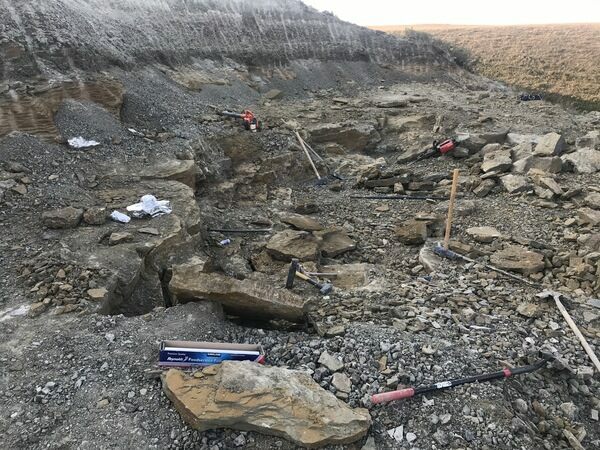
A view of the Two Medicine Formation quarry operated by Northwest Montana Fossils, where much of our Two Medicine dinosaur material has been found.
The Two Medicine Formation is a geographical formation in Central Montana and Southern Alberta, Canada. The formation is predominantly sandstone laid down by rivers and deltas during the Campanian Age of the Cretaceous, about 80-75 million years ago. Approximately two thousand feet thick on the western edge, it lies on top of the Virgelle Sandstone formation and under the Bearpaw Shale. It is located between the Front Range of the Rocky Mountains and the Sweetgrass Arch, a tectonic fold feature 40-90 miles east of the Front Range.
The Two Medicine is the same age as the Judith River Formation found further east. It was laid down further inland from the Western Interior Seaway, while the Judith River Formation was deposited along the coast. The Two Medicine contains much of the same dinosaur fauna, but fewer reptiles, amphibians, and aquatic fossils.
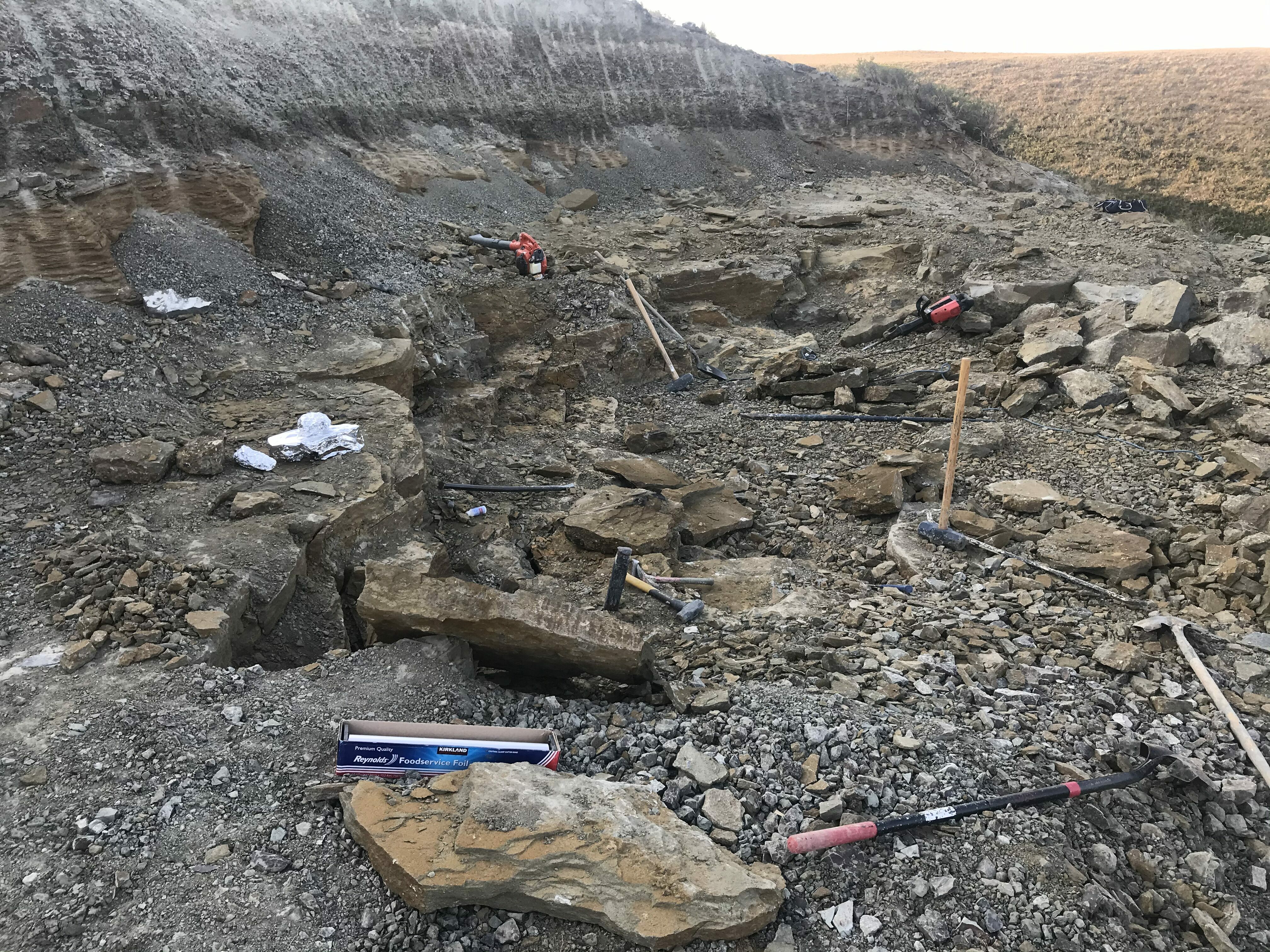
A view of the Two Medicine Formation quarry operated by Northwest Montana Fossils, where much of our Two Medicine dinosaur material has been found.
SPECIES
Einiosaurus procurvicornis

LOCATION
Glacier County, Montana
FORMATION
Two Medicine Formation
SIZE
Vertebra: 14.8 x 9.5", Height on stand: 10.6" tall
CATEGORY
SUB CATEGORY
ITEM
#350851
We guarantee the authenticity of all of our specimens.