 Reviews


This Specimen has been sold.


25" Multiple Fossil Fish (Diplomystus & Knightia) - Wyoming


This is a beautifully prepared natural association of a 15.3" long Diplomystus dentatus fish and a very large 6.5" Knightia eocaena fish. This specimen was collected from Clear Creek Quarry on the Green River Formation, specifically the 18 inch layer (bottom cap) near Kemmerer, Wyoming. They are nicely centered on a 25 x 19.1" rectangular-cut slab of shale.
The rock has been backed and upon request we can add wall mounting hardware to the plate. Otherwise it is accompanied by a metal display stand.
The rock has been backed and upon request we can add wall mounting hardware to the plate. Otherwise it is accompanied by a metal display stand.
About Diplomystus
Diplomystus is an extinct genus of freshwater, ray-finned predators that are distantly related to modern herrings and sardines. Diplomystus has a distinctive jaw that protrudes aggressively outward from the mouth at an angle that allowed it to feed in surface waters and devour such prey as the smaller, schooling Knightia.
50 million years ago in the Eocene (55.8 mya to 33.8 mya), D. dentatus thrived in lakes fed by the Uinta and Rocky Mountain highlands. D. dentatus is uniquely entombed in the fine-grained lime mud of Fossil Lake.
The anoxic conditions at the bottom of Fossil Lake slowed bacterial decomposition, prevented scavengers from disturbing corpses, and, most interestingly, suffocated creatures that ventured into the oxygen-starved aquatic layer. The result is a miraculous exhibition of Eocene biota in a subtropical aquatic community within sycamore forests, teeming with creatures such as freshwater stingrays, dog-sized horses, menacing alligators, early flying bats, and one of the first primates.
By the end of the Eocene, Earth developed icehouse climate characteristics and had a change in atmospheric chemistry. The effects of bolide impacts may also have contributed to the eventual loss of flora and fauna at once verdant latitudes.
Today the wonderfully preserved fossils of Diplomystus and other Fossil Lake fauna are collected in several private quarries around Kemmerer, Wyoming. The best preserved fish fossils come from the coveted 18 Inch Layer. This layer is collected at night under high-powered lights, enhancing the faint signs of fish under the surface indicating underlying fossils. These “ghosted” fish then must go through many hours of manual preparation to remove the overlying rock and reveal the Green River fauna in all of its glory.
Diplomystus is an extinct genus of freshwater, ray-finned predators that are distantly related to modern herrings and sardines. Diplomystus has a distinctive jaw that protrudes aggressively outward from the mouth at an angle that allowed it to feed in surface waters and devour such prey as the smaller, schooling Knightia.
50 million years ago in the Eocene (55.8 mya to 33.8 mya), D. dentatus thrived in lakes fed by the Uinta and Rocky Mountain highlands. D. dentatus is uniquely entombed in the fine-grained lime mud of Fossil Lake.
The anoxic conditions at the bottom of Fossil Lake slowed bacterial decomposition, prevented scavengers from disturbing corpses, and, most interestingly, suffocated creatures that ventured into the oxygen-starved aquatic layer. The result is a miraculous exhibition of Eocene biota in a subtropical aquatic community within sycamore forests, teeming with creatures such as freshwater stingrays, dog-sized horses, menacing alligators, early flying bats, and one of the first primates.
By the end of the Eocene, Earth developed icehouse climate characteristics and had a change in atmospheric chemistry. The effects of bolide impacts may also have contributed to the eventual loss of flora and fauna at once verdant latitudes.
Today the wonderfully preserved fossils of Diplomystus and other Fossil Lake fauna are collected in several private quarries around Kemmerer, Wyoming. The best preserved fish fossils come from the coveted 18 Inch Layer. This layer is collected at night under high-powered lights, enhancing the faint signs of fish under the surface indicating underlying fossils. These “ghosted” fish then must go through many hours of manual preparation to remove the overlying rock and reveal the Green River fauna in all of its glory.
About Knightia
Knightia is an extinct genus of small, schooling, ray-finned fish related to modern herrings and sardines. Abundant in the warm freshwater lakes of the Eocene Green River Formation, they fed on insects, plankton, and tiny fish, while serving as prey for nearly every larger predator in the ecosystem. The most common species, Knightia eocena, reached about 15 cm in length and is celebrated today as the state fossil of Wyoming.
These streamlined fish are recognized by their heavy scales, small conical teeth, and rows of dorsal and ventral scutes along the body. Their fossils are among the most iconic from the Green River Formation—an exceptional 48-million-year-old lake deposit in Wyoming, Colorado, and Utah known for preserving a remarkably detailed snapshot of ancient life in a warm, lake-rich Eocene landscape.
Knightia is an extinct genus of small, schooling, ray-finned fish related to modern herrings and sardines. Abundant in the warm freshwater lakes of the Eocene Green River Formation, they fed on insects, plankton, and tiny fish, while serving as prey for nearly every larger predator in the ecosystem. The most common species, Knightia eocena, reached about 15 cm in length and is celebrated today as the state fossil of Wyoming.
These streamlined fish are recognized by their heavy scales, small conical teeth, and rows of dorsal and ventral scutes along the body. Their fossils are among the most iconic from the Green River Formation—an exceptional 48-million-year-old lake deposit in Wyoming, Colorado, and Utah known for preserving a remarkably detailed snapshot of ancient life in a warm, lake-rich Eocene landscape.
About The 18 Inch Layer Of Fossil Lake
Specimens like this come from the coveted 18 inch layer of the Green River Formation, which produces darker and more detailed fish than the majority on the market. The rock from this layer is much harder and more durable than other layers in the formation, likely due to its initial deposition conditions in deep water. Because of these conditions, fish found in the 18-inch layer can be extracted whole and in excellent condition. This layer is typically collected at night using low-angle light to see the bump in the rock that the fish's backbone creates. They then cut these fish out and take them to a lab where the fish, which may be up to an inch under the surface of the rock, are meticulously extracted under microscope with hand tools.
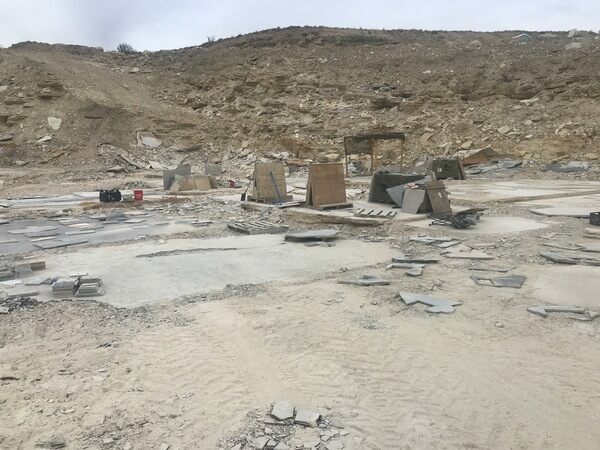
A view of the 18 inch layer of the Green River Formation at the Lindgren quarry near Kemmerer, Wyoming.
Specimens like this come from the coveted 18 inch layer of the Green River Formation, which produces darker and more detailed fish than the majority on the market. The rock from this layer is much harder and more durable than other layers in the formation, likely due to its initial deposition conditions in deep water. Because of these conditions, fish found in the 18-inch layer can be extracted whole and in excellent condition. This layer is typically collected at night using low-angle light to see the bump in the rock that the fish's backbone creates. They then cut these fish out and take them to a lab where the fish, which may be up to an inch under the surface of the rock, are meticulously extracted under microscope with hand tools.
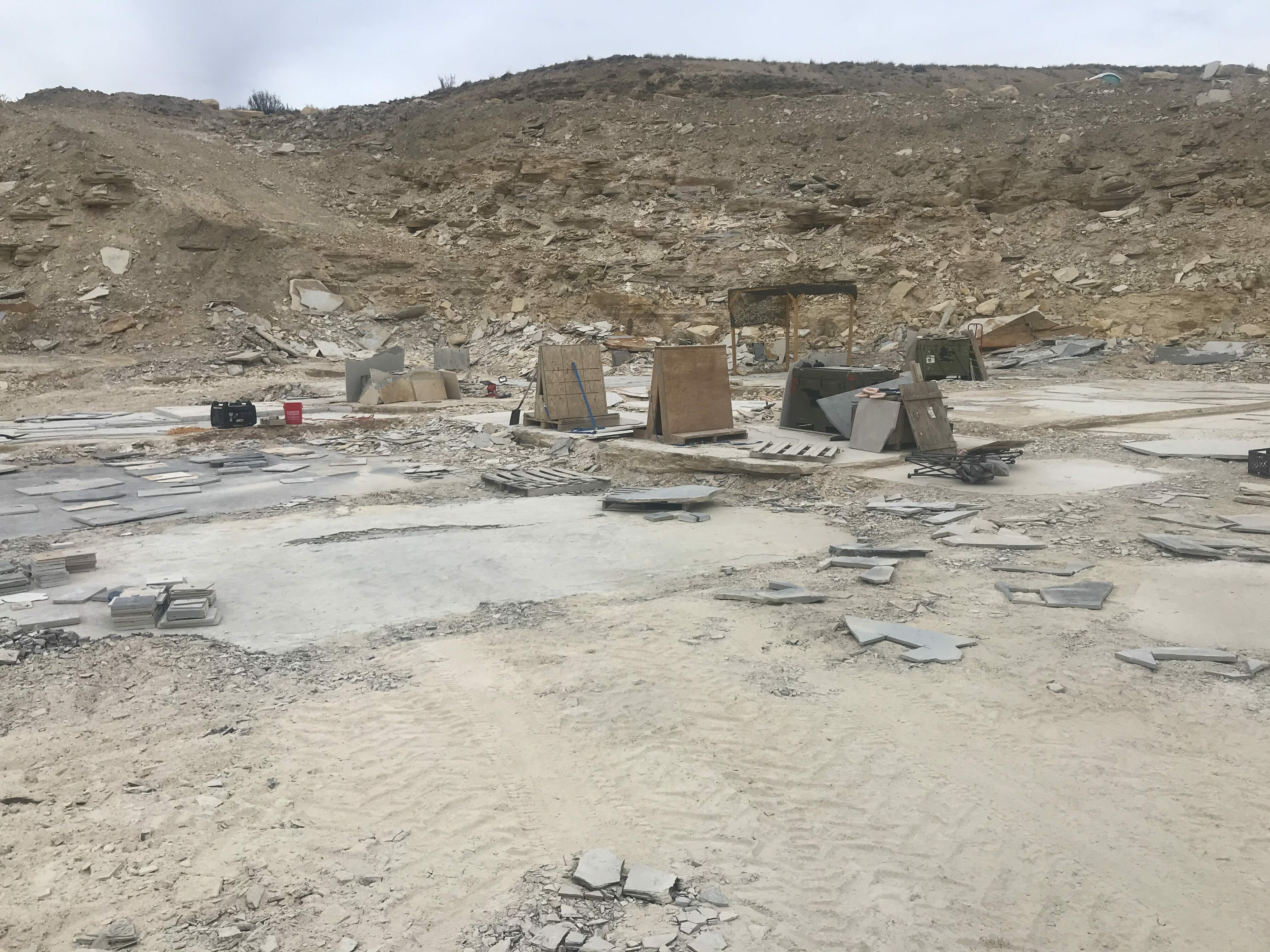
A view of the 18 inch layer of the Green River Formation at the Lindgren quarry near Kemmerer, Wyoming.
SPECIES
Diplomystus dentatus & Knightia eocaena

LOCATION
Clear Creek Quarry, Kemmerer, Wyoming
FORMATION
Green River Formation - 18 Inch Layer
SIZE
Diplomystus: 15.3" long, Entire specimen: 25 x 19.1"
CATEGORY
SUB CATEGORY
ITEM
#314558
We guarantee the authenticity of all of our specimens.


