 Reviews


This Specimen has been sold.


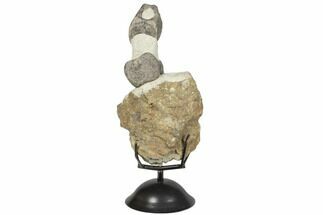
3.7" Fossil Pachycephalosaur Vertebra - Hell Creek Formation, Montana


This is a 3.7" wide vertebra centrum that was collected from our partner's Hell Creek Formation lease in eastern Montana. This vertebra would have been a surface find, explaining the bleached bone coloration around much of the preserved cortical bone. The inferior half of the neural canal remained intact. It is accompanied by an acrylic display stand.
Isolated vertebra of pachycephalosaurs are basically indistinguishable without the full processes present, making it difficult to provide an accurate genus or species to this specimen.
The faces of the body are fairly weathered and the compression of the vertebra over time resulted in some fracturing of the bone. However, there are no repaired cracks or restoration to this vertebra.
Isolated vertebra of pachycephalosaurs are basically indistinguishable without the full processes present, making it difficult to provide an accurate genus or species to this specimen.
The faces of the body are fairly weathered and the compression of the vertebra over time resulted in some fracturing of the bone. However, there are no repaired cracks or restoration to this vertebra.
Pachycephalosaurs are a family of bipedal dinosaurs that lived during the Late Cretaceous and had a distinctive, large, bony dome on top of their skull. This dome was sometimes up to 10 inches thick and was thought to cushion their brain from impacts. Some paleontologists believe this thick skull may have been used for head-butting, much like modern rams, while others contend it may have been a sexual display. They were either an herbivore or omnivore with small leaf-shaped teeth effective for shredding plants.
There are more than a dozen described genera of Pachycephalosaurs, though Pachycephalosaurus from the Hell Creek Formation is the best known.
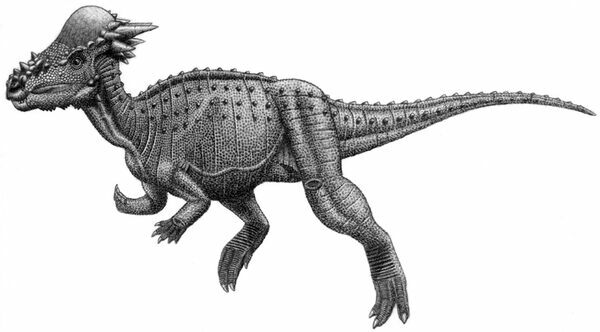
An artist's reconstruction of Pachycephalosaurus. By Jordan Mallon
There are more than a dozen described genera of Pachycephalosaurs, though Pachycephalosaurus from the Hell Creek Formation is the best known.
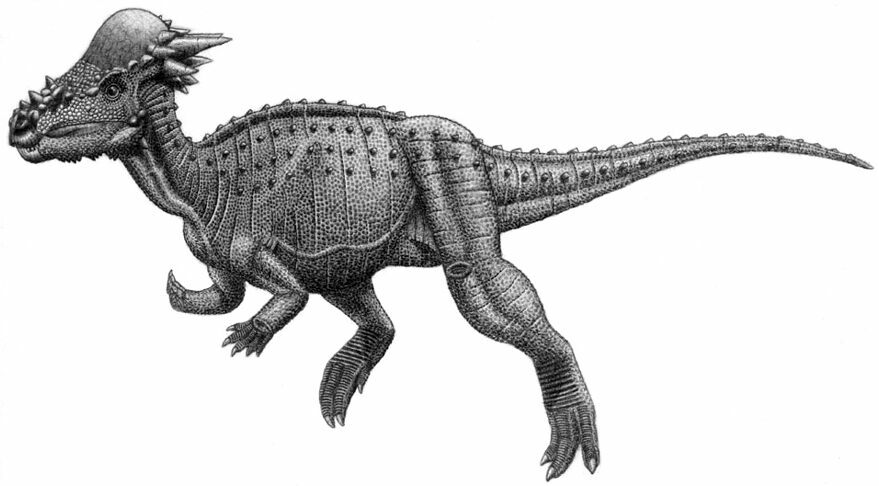
An artist's reconstruction of Pachycephalosaurus. By Jordan Mallon
The Hell Creek Formation
Renowned for both its age and rich sedimentary layers, the Hell Creek Formation is one of the most intensively studied fossil-bearing regions on Earth. To date, scientists have documented 158 genera of animals and 64 genera of plants from its rocks, with new finds emerging regularly. Beyond iconic dinosaurs such as tyrannosaurs, ceratopsians, and hadrosaurs, the formation has produced an extraordinary array of life, including amphibians, reptiles, lizards, snakes, turtles, fish, sharks, birds, and early mammals. Together, these fossils provide the most complete picture of the ecosystems that thrived just before the Cretaceous–Paleogene extinction event.
Renowned for both its age and rich sedimentary layers, the Hell Creek Formation is one of the most intensively studied fossil-bearing regions on Earth. To date, scientists have documented 158 genera of animals and 64 genera of plants from its rocks, with new finds emerging regularly. Beyond iconic dinosaurs such as tyrannosaurs, ceratopsians, and hadrosaurs, the formation has produced an extraordinary array of life, including amphibians, reptiles, lizards, snakes, turtles, fish, sharks, birds, and early mammals. Together, these fossils provide the most complete picture of the ecosystems that thrived just before the Cretaceous–Paleogene extinction event.
SPECIES
Unidentified Pachycephalosaur

LOCATION
Montana
FORMATION
Hell Creek Formation
SIZE
3.7 x 3.25 x 2.7"
CATEGORY
SUB CATEGORY
ITEM
#217202
We guarantee the authenticity of all of our specimens.