Reviews


This Specimen has been sold.


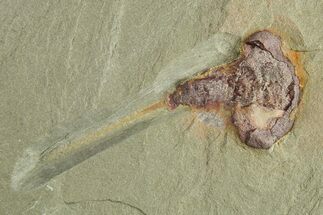
3.7" Pecopteris and Calamites Nodule Pos/Neg - Mazon Creek


This is a 3.7" wide fossil fern (Pecopteris sp.) and horsetail (Calamites sp.) nodule from the Carbondale Formation (Francis Creek Shale) in Illinois. The fossils are preserved inside an ironstone nodule associated with the famous Mazon Creek Lagerstätte. Under magnification the detail of this specimen stands out. Both the positive (convex) and negative (concave) sides of the fossil nodule are included along with a pair of display stands.
Pecopteris is a form classification (taxa) for the leaves of a fern associated with the tree fern Psaronius. It is one of the most common Pennsylvanian age plants and grew up to ten meters (30 feet) tall and produced about 7,000 spores per leaf.
Pecopteris is a form classification (taxa) for the leaves of a fern associated with the tree fern Psaronius. It is one of the most common Pennsylvanian age plants and grew up to ten meters (30 feet) tall and produced about 7,000 spores per leaf.
Calamites is the name (form genus) given to compression, impression, and pith casts of Carboniferous sphenophytes, which were arborescent (tree-like) relatives of modern horestails. Calamites typically grew as medium-sized understory trees in Carboniferous swamps, reaching heights of 20-30 meters (60-100 feet).
Similar to today's horsetails, Calamites species were hollow: however, their trunks contained lignin, and likely resembled bamboo in texture. Calamites may be found as cylindrical casts or elongate compressions and impressions. In either form, Calamites often has regular, evenly-spaced grooves or lines running the length of the specimen, or wide, irregularly-spaced nodes.
In some cylindrical casts, small circular bumps appear along the horizontal nodes. These indicate casts of the pith—the central portion of Calamites inside the wood of the stem. Casts of the bark's inner surface outside of the stem wood do not contain bumps.
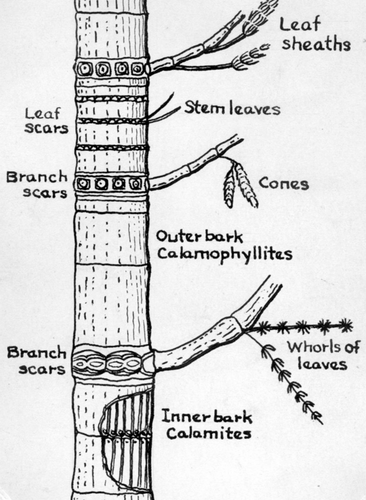
Calamites sketch from the manuscript Fossil Flora and Fauna of the Pennsylvanian Period, Will County, Illinois
Calamites leaves also have their own form genera. They formed in clusters of 8 or more, called whorls, at spaced nodes along stems. Annularia indicate flat, starburst-shaped whorls, but the shapes of the leaves themselves could vary from oval (A. sphenophylloides) to lanceolate or needle-like (A. radiata). Asterophyllites is another form genus of leaf clusters, but unlike Annularia, they curved upward into a sort of cup shape. Both had midline veins, making them easy to distinguish from other sphenophyte leaf clusters.
A third form genus, Sphenophyllum, is given to leaf clusters that are distinctly triangular, with branching veins radiating from their central nodes. Species with Sphenophyllum forms likely grew as shrubs or smaller plants, unlike Calamites forms.
We use these terms to describe the shapes of fossil imprints. Exact species are often difficult to determine, but these form taxa help in distinguishing the prolific species of sphenophytes that defined the Carboniferous Period.
Similar to today's horsetails, Calamites species were hollow: however, their trunks contained lignin, and likely resembled bamboo in texture. Calamites may be found as cylindrical casts or elongate compressions and impressions. In either form, Calamites often has regular, evenly-spaced grooves or lines running the length of the specimen, or wide, irregularly-spaced nodes.
In some cylindrical casts, small circular bumps appear along the horizontal nodes. These indicate casts of the pith—the central portion of Calamites inside the wood of the stem. Casts of the bark's inner surface outside of the stem wood do not contain bumps.
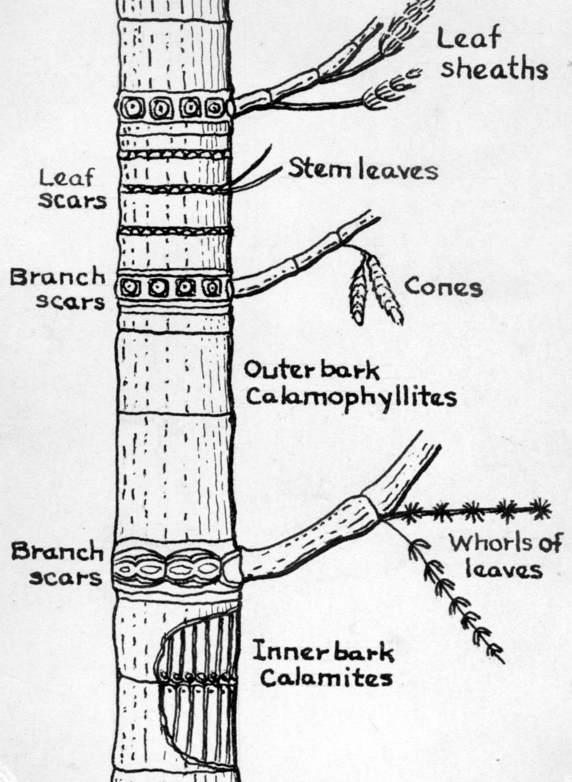
Calamites sketch from the manuscript Fossil Flora and Fauna of the Pennsylvanian Period, Will County, Illinois
Calamites leaves also have their own form genera. They formed in clusters of 8 or more, called whorls, at spaced nodes along stems. Annularia indicate flat, starburst-shaped whorls, but the shapes of the leaves themselves could vary from oval (A. sphenophylloides) to lanceolate or needle-like (A. radiata). Asterophyllites is another form genus of leaf clusters, but unlike Annularia, they curved upward into a sort of cup shape. Both had midline veins, making them easy to distinguish from other sphenophyte leaf clusters.
A third form genus, Sphenophyllum, is given to leaf clusters that are distinctly triangular, with branching veins radiating from their central nodes. Species with Sphenophyllum forms likely grew as shrubs or smaller plants, unlike Calamites forms.
We use these terms to describe the shapes of fossil imprints. Exact species are often difficult to determine, but these form taxa help in distinguishing the prolific species of sphenophytes that defined the Carboniferous Period.
The Mazon Creek fossil beds are a deposit with exceptional fossil preservation, known as a conservation lagerstätte, located in Illinois. This location of late Paleozoic (~307 million years old) biota ranks among the great fossil sites around the world. The large variety of fossils collected here vary between plants and animals, including soft-bodied and insect preservations. Fossils from this site are often quite detailed and are preserved within siderite (iron carbonate) nodules.
Over 500 animal and 200 flora species have been described from Mazon Creek. The event that caused this die-off and preservation is believed to have started with a catastrophic flood event that buried the biota of the modern day Mazon Creek area. The deposition of river-borne silt and clay, brought on by upland erosion and delta progradation, contributed to the incredible preservation of one of the most complete records of Paleozoic biota.
This site has been collected for more than 100 years, and likely will continue to be collected by both professionals and amateurs for many years to come.
Over 500 animal and 200 flora species have been described from Mazon Creek. The event that caused this die-off and preservation is believed to have started with a catastrophic flood event that buried the biota of the modern day Mazon Creek area. The deposition of river-borne silt and clay, brought on by upland erosion and delta progradation, contributed to the incredible preservation of one of the most complete records of Paleozoic biota.
This site has been collected for more than 100 years, and likely will continue to be collected by both professionals and amateurs for many years to come.
SPECIES
Pecopteris sp. & Calamites sp

LOCATION
Illinois
FORMATION
Francis Creek Shale, Carbondale Formation
SIZE
Pecopteris fern: 2.8", Nodule: 3.7 x 3.25"
CATEGORY
SUB CATEGORY
ITEM
#331687
We guarantee the authenticity of all of our specimens.