 Reviews


3.7" Triassic Ammonite (Ceratites praenodosus) Fossil - Germany


This is a 3.7" wide specimen of a Middle Triassic ammonite (Ceratites praenodosus). It comes from the Muschelkalk Formation in Germany. It was found inside of a hard concretion and has been nicely prepared free from the rock. Comes with an acrylic display stand.
The ammonite is free of repair/restoration, though the backside is missing some of the shell.
The ammonite is free of repair/restoration, though the backside is missing some of the shell.
About Ceratites
Ceratites is an extinct genus of ammonoid cephalopods that thrived during the Middle Triassic period, approximately 247 to 237 million years ago. It is one of the most recognizable genera from the order Ceratitida, a group that emerged following the end-Permian mass extinction and played a key role in the recovery of marine ecosystems.
Ceratites is easily identified by its typically discoidal, planispiral shell with ribbed or smooth flanks and a deeply indented suture pattern. Unlike the highly complex, fractal-like sutures of later ammonites, Ceratites features "ceratitic" sutures—characterized by rounded lobes and saw-toothed saddles. This suture pattern is a defining trait of the Ceratitida order and represents an intermediate complexity between the simpler goniatitic sutures of earlier ammonoids and the elaborate ammonitic sutures that evolved later.
Fossils of Ceratites have been found in marine sedimentary deposits across Europe, North Africa, and Asia, with especially well-preserved specimens discovered in Germany's Muschelkalk Formation. These ammonites inhabited shallow, warm epicontinental seas and are believed to have been active swimmers and predatory mollusks, likely feeding on smaller marine animals.
Ceratites is often used as an important index fossil for dating Middle Triassic rocks and provides valuable insights into the evolutionary transition and diversification of ammonoids following the Permian-Triassic extinction event.
Ceratites is an extinct genus of ammonoid cephalopods that thrived during the Middle Triassic period, approximately 247 to 237 million years ago. It is one of the most recognizable genera from the order Ceratitida, a group that emerged following the end-Permian mass extinction and played a key role in the recovery of marine ecosystems.
Ceratites is easily identified by its typically discoidal, planispiral shell with ribbed or smooth flanks and a deeply indented suture pattern. Unlike the highly complex, fractal-like sutures of later ammonites, Ceratites features "ceratitic" sutures—characterized by rounded lobes and saw-toothed saddles. This suture pattern is a defining trait of the Ceratitida order and represents an intermediate complexity between the simpler goniatitic sutures of earlier ammonoids and the elaborate ammonitic sutures that evolved later.
Fossils of Ceratites have been found in marine sedimentary deposits across Europe, North Africa, and Asia, with especially well-preserved specimens discovered in Germany's Muschelkalk Formation. These ammonites inhabited shallow, warm epicontinental seas and are believed to have been active swimmers and predatory mollusks, likely feeding on smaller marine animals.
Ceratites is often used as an important index fossil for dating Middle Triassic rocks and provides valuable insights into the evolutionary transition and diversification of ammonoids following the Permian-Triassic extinction event.
About Ammonites
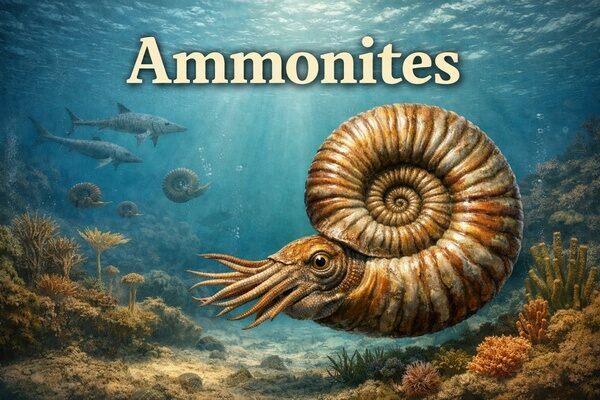
Ammonites were ancient marine cephalopods, similar to today's squids and octopuses, but with a defining feature: their distinctive, tightly coiled spiral shells. These shells, resembling those of modern nautiluses, served as both a protective home and a buoyancy aid, allowing ammonites to navigate the prehistoric seas with ease. First emerging around 240 million years ago in the Triassic Period, ammonites thrived for over 175 million years, adapting through numerous forms and sizes. As predatory creatures, they likely fed on smaller marine organisms, using their tentacles to capture prey. However, their long reign came to an end 65 million years ago at the close of the Cretaceous, coinciding with the mass extinction event that also eliminated the dinosaurs.
Ammonites were ancient marine cephalopods, similar to today's squids and octopuses, but with a defining feature: their distinctive, tightly coiled spiral shells. These shells, resembling those of modern nautiluses, served as both a protective home and a buoyancy aid, allowing ammonites to navigate the prehistoric seas with ease. First emerging around 240 million years ago in the Triassic Period, ammonites thrived for over 175 million years, adapting through numerous forms and sizes. As predatory creatures, they likely fed on smaller marine organisms, using their tentacles to capture prey. However, their long reign came to an end 65 million years ago at the close of the Cretaceous, coinciding with the mass extinction event that also eliminated the dinosaurs.
$125
SPECIES
Ceratites praenodosus

LOCATION
Lindbach, Bavaria, Germany
FORMATION
Muschelkalk Formation
SIZE
Ammonite 3.7" across
CATEGORY
SUB CATEGORY
ITEM
#351230
We guarantee the authenticity of all of our specimens.


