 Reviews


This Specimen has been sold.
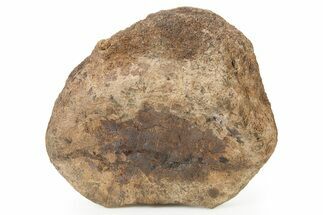
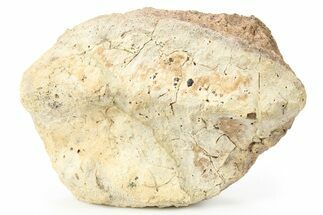

4" Fossil Hadrosaur (Edmontosaurus) Mummified Skin - South Dakota


This is a unique and extremely rare, 4" wide piece of mummified dinosaur skin collected from the Hell Creek Formation in South Dakota. This rare preservation can occur by a combination of factors, including rapid burial, desiccation, and sometimes even the presence of low oxygen environments. This allows the skin to dry out and shrink around the bones, preserving fine details before being encased in sediment.
Typically "dinosaur skin" specimens are skin casts which occur when the dinosaur is covered in sediment soon after death. The sediment then hardens around the skin, creating a negative cast prior to decomposition. The open space following decomposition is then filled in with rock, resulting in a positive cast of the dinosaur's skin. This specimen however is not a skin cast, but something much more rare.
Typically "dinosaur skin" specimens are skin casts which occur when the dinosaur is covered in sediment soon after death. The sediment then hardens around the skin, creating a negative cast prior to decomposition. The open space following decomposition is then filled in with rock, resulting in a positive cast of the dinosaur's skin. This specimen however is not a skin cast, but something much more rare.
It comes with a floating frame display case.
About Edmontosaurus
Edmontosaurus is one of the largest Hadrosaurs, and one of the most widespread: fossil remains have been found across western North America, from Colorado to northern Alaska. This large herbivore was about the same size as the contemporary predator Tyrannosaurus, reaching 39 feet in length and an average weight of about 6 tons. Named after Edmonton, the capital of the Canadian province of Alberta where its first fossils were discovered, Edmontosaurus was a gregarious terrestrial herbivore that ground up low-lying plant material with its large battery of ever-restoring teeth. Numerous skin impressions and mummified specimens show us that Edmontosaurus had scaly skin, and its forelimbs were enclosed in a fleshy "mitten" serving a purpose similar to a hoof. Edmontosaurus was a member of the Saurolophine clade of Hadrosaurs, meaning they had little to nonexistent crests on the backs of their skulls.
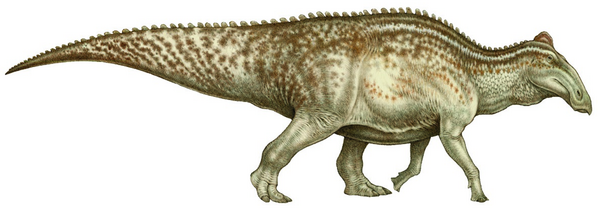
An artists reconstruction of Edmontosaurus. Creative Commons License by Natee Puttapipat
Edmontosaurus is one of the largest Hadrosaurs, and one of the most widespread: fossil remains have been found across western North America, from Colorado to northern Alaska. This large herbivore was about the same size as the contemporary predator Tyrannosaurus, reaching 39 feet in length and an average weight of about 6 tons. Named after Edmonton, the capital of the Canadian province of Alberta where its first fossils were discovered, Edmontosaurus was a gregarious terrestrial herbivore that ground up low-lying plant material with its large battery of ever-restoring teeth. Numerous skin impressions and mummified specimens show us that Edmontosaurus had scaly skin, and its forelimbs were enclosed in a fleshy "mitten" serving a purpose similar to a hoof. Edmontosaurus was a member of the Saurolophine clade of Hadrosaurs, meaning they had little to nonexistent crests on the backs of their skulls.
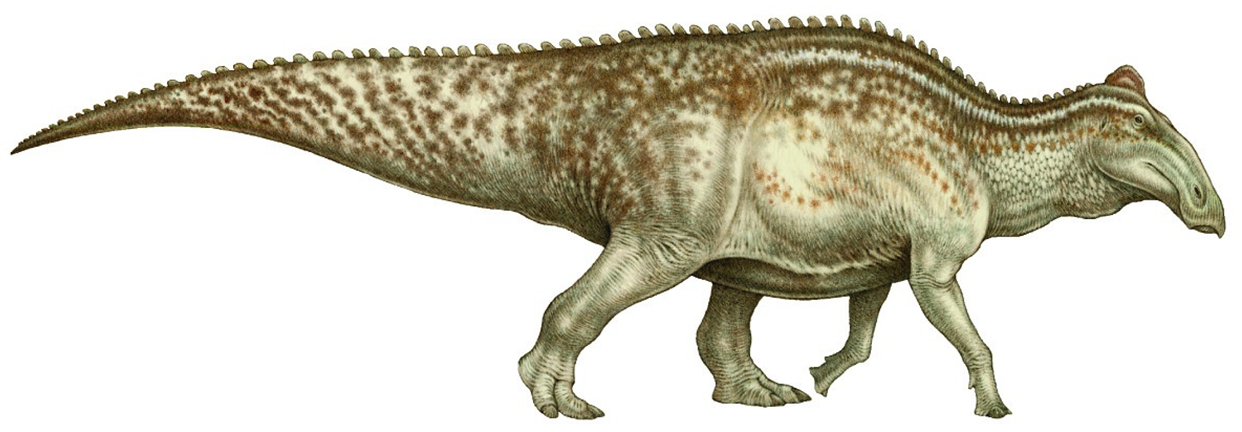
An artists reconstruction of Edmontosaurus. Creative Commons License by Natee Puttapipat
The Hell Creek Formation
Renowned for both its age and rich sedimentary layers, the Hell Creek Formation is one of the most intensively studied fossil-bearing regions on Earth. To date, scientists have documented 158 genera of animals and 64 genera of plants from its rocks, with new finds emerging regularly. Beyond iconic dinosaurs such as tyrannosaurs, ceratopsians, and hadrosaurs, the formation has produced an extraordinary array of life, including amphibians, reptiles, lizards, snakes, turtles, fish, sharks, birds, and early mammals. Together, these fossils provide the most complete picture of the ecosystems that thrived just before the Cretaceous–Paleogene extinction event.
Renowned for both its age and rich sedimentary layers, the Hell Creek Formation is one of the most intensively studied fossil-bearing regions on Earth. To date, scientists have documented 158 genera of animals and 64 genera of plants from its rocks, with new finds emerging regularly. Beyond iconic dinosaurs such as tyrannosaurs, ceratopsians, and hadrosaurs, the formation has produced an extraordinary array of life, including amphibians, reptiles, lizards, snakes, turtles, fish, sharks, birds, and early mammals. Together, these fossils provide the most complete picture of the ecosystems that thrived just before the Cretaceous–Paleogene extinction event.
SPECIES
Edmontosaurus annectens

LOCATION
South Dakota
FORMATION
Hell Creek Formation
SIZE
4 x 2.15"
CATEGORY
ITEM
#330930
We guarantee the authenticity of all of our specimens.


