 Reviews


This Specimen has been sold.


5.25" Detailed Fossil Fish (Cockerellites) - Wyoming


This is a beautifully preserved, 5.25" long Cockerellites (Priscacara) liops fish from the famous Green River Formation. It was collected from Clear Creek Quarry near Kemmerer, Wyoming. It is nicely centered on a rectangular-cut slab of rock.
This specimen includes a display stand.
This specimen includes a display stand.
About Cockerellites
Cockerellites liops is a species of extinct temperate bass found in the Eocene aged Green River Formation of Wyoming. It is characterized by a sunfish-like body and its stout dorsal and anal spines. It was originally placed in the Priscacara genus but was moved to the newly created genus Cockerellites by D. Jordan and H. Hanibal in 1923. There is still some debate among researchers about whether this new genus is valid.
Cockerellites is found in large numbers in mid-lake deposits, representing 5 to 20 percent of the fish unearthed, depending on the layer. It is considerably rarer in shoreline deposits, representing only 1 to 2 percent of the fish found. Because of this, Cockerellites is thought to have been a schooling fish. Fossils have been found at a maximum size of about six inches, but they rarely exceed five inches in length.
At first glance, Cockerellites liops has a very similar appearance to the rarer species Priscacara. Size can often be used as a differentiator, since Cockerellites did not exceed 6 inches while Priscacara serrata is typically found in excess of 6 inches. Cockerellites also has more dorsal and anal fin rays than Priscacara and a much smaller mouth.
Cockerellites liops is a species of extinct temperate bass found in the Eocene aged Green River Formation of Wyoming. It is characterized by a sunfish-like body and its stout dorsal and anal spines. It was originally placed in the Priscacara genus but was moved to the newly created genus Cockerellites by D. Jordan and H. Hanibal in 1923. There is still some debate among researchers about whether this new genus is valid.
Cockerellites is found in large numbers in mid-lake deposits, representing 5 to 20 percent of the fish unearthed, depending on the layer. It is considerably rarer in shoreline deposits, representing only 1 to 2 percent of the fish found. Because of this, Cockerellites is thought to have been a schooling fish. Fossils have been found at a maximum size of about six inches, but they rarely exceed five inches in length.
At first glance, Cockerellites liops has a very similar appearance to the rarer species Priscacara. Size can often be used as a differentiator, since Cockerellites did not exceed 6 inches while Priscacara serrata is typically found in excess of 6 inches. Cockerellites also has more dorsal and anal fin rays than Priscacara and a much smaller mouth.
About The Megalodon Shark
The megalodon was not only the biggest and baddest prehistoric shark that ever lived, it was the largest marine predator in the history of the planet. Today’s great white sharks would be a mere bite-size snack for this monster. It terrorized the diverse ocean waters around the world from 15.9 to 2.6 million years ago, from the late Oligocene to the early Pleistocene. This massive and extinct species of shark was estimated to grow to nearly 60 feet in length and has often been declared the greatest vertebrate predator that ever lived.
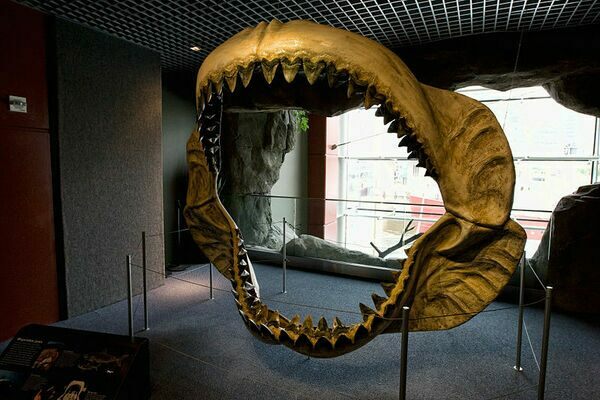
Reconstructed jaws on display at the National Aquarium in Baltimore.
These mega-toothed sharks were a giant and more robust version of the great white. They had 276 teeth in 5 rows and, like today's sharks, shed their teeth throughout their lifetime. The largest megalodon teeth on record reached a staggering 7.5 inches (190mm)! Compare this to the largest great whites, whose teeth top out around 3 inches long. Wow!
Their teeth were bone-crunching and flesh-cutting tools evolved for grasping powerful prey such as baleen whales. Fossil evidence supports that megalodon focused its attack on the hard, bony parts of its prey, such as rib cages, flippers, shoulders, and spines, effectively disabling large whales and harming major organs such as the heart and lungs. This strategy explains their thick, robust teeth.
Megalodon had a cosmopolitan (global) distribution and its giant teeth can be found in deposits throughout the world. Some are collected on land in phosphate deposits, while many are collected from rivers and coastlines after eroding out of the rocks. This contributes to the water-worn, polished appearance of many teeth.
The standard measure for megalodon teeth is slant height, or the longest edge of the tooth. Adult megalodon teeth were typically in the 4 to 5 inch range: teeth over 6 inches are rare and represent super-sized individuals. Only a handful of teeth have ever been found over seven inches.
No one knows for sure why the megalodon went extinct 2.6 million years ago, but the cooling of the climate and gradual disappearance of many of the large whales it relied on for food are suspects.
The megalodon was not only the biggest and baddest prehistoric shark that ever lived, it was the largest marine predator in the history of the planet. Today’s great white sharks would be a mere bite-size snack for this monster. It terrorized the diverse ocean waters around the world from 15.9 to 2.6 million years ago, from the late Oligocene to the early Pleistocene. This massive and extinct species of shark was estimated to grow to nearly 60 feet in length and has often been declared the greatest vertebrate predator that ever lived.
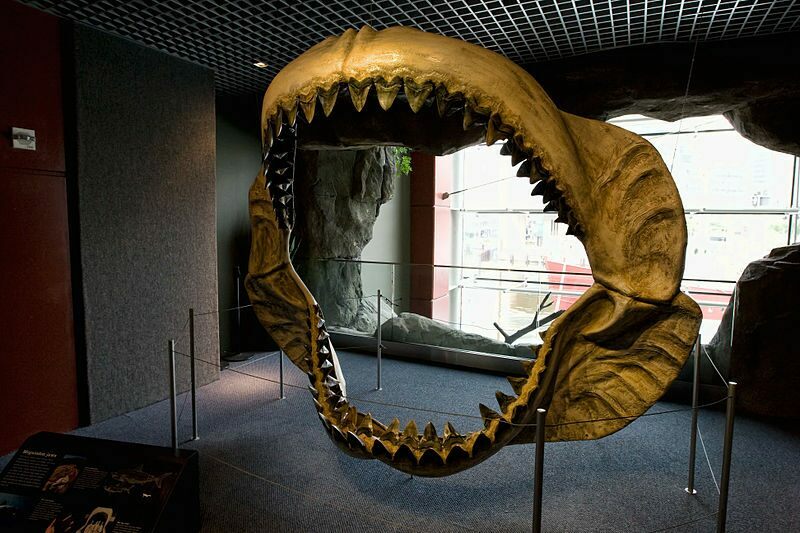
Reconstructed jaws on display at the National Aquarium in Baltimore.
These mega-toothed sharks were a giant and more robust version of the great white. They had 276 teeth in 5 rows and, like today's sharks, shed their teeth throughout their lifetime. The largest megalodon teeth on record reached a staggering 7.5 inches (190mm)! Compare this to the largest great whites, whose teeth top out around 3 inches long. Wow!
Their teeth were bone-crunching and flesh-cutting tools evolved for grasping powerful prey such as baleen whales. Fossil evidence supports that megalodon focused its attack on the hard, bony parts of its prey, such as rib cages, flippers, shoulders, and spines, effectively disabling large whales and harming major organs such as the heart and lungs. This strategy explains their thick, robust teeth.
Megalodon had a cosmopolitan (global) distribution and its giant teeth can be found in deposits throughout the world. Some are collected on land in phosphate deposits, while many are collected from rivers and coastlines after eroding out of the rocks. This contributes to the water-worn, polished appearance of many teeth.
The standard measure for megalodon teeth is slant height, or the longest edge of the tooth. Adult megalodon teeth were typically in the 4 to 5 inch range: teeth over 6 inches are rare and represent super-sized individuals. Only a handful of teeth have ever been found over seven inches.
No one knows for sure why the megalodon went extinct 2.6 million years ago, but the cooling of the climate and gradual disappearance of many of the large whales it relied on for food are suspects.
SPECIES
Cockerellites (Priscacara) liops

LOCATION
Clear Creek Quarry, Kemmerer, Wyoming
FORMATION
Green River Formation, 18 Inch Layer
SIZE
5.25" long on 8.3 x 7.35" rock
CATEGORY
SUB CATEGORY
ITEM
#292416
We guarantee the authenticity of all of our specimens.


