 Reviews


This Specimen has been sold.


6.8" Detailed Fossil Fish (Knightia) with Twig - Large For Species


This is a large, beautifully preserved 6.8" long fossil fish (Knightia eocaena) from the Eocene-aged Green River Formation in Wyoming. It comes out of the famous 18" layer at the Clear Creek Quarry near Kemmerer, Wyoming. An overlying twig fossil has been exposed from the rock as well.
An acrylic display stand will accompany your purchase.
An acrylic display stand will accompany your purchase.
About Knightia
Knightia is an extinct genus of small, schooling, ray-finned fish related to modern herrings and sardines. Abundant in the warm freshwater lakes of the Eocene Green River Formation, they fed on insects, plankton, and tiny fish, while serving as prey for nearly every larger predator in the ecosystem. The most common species, Knightia eocena, reached about 15 cm in length and is celebrated today as the state fossil of Wyoming.
These streamlined fish are recognized by their heavy scales, small conical teeth, and rows of dorsal and ventral scutes along the body. Their fossils are among the most iconic from the Green River Formation—an exceptional 48-million-year-old lake deposit in Wyoming, Colorado, and Utah known for preserving a remarkably detailed snapshot of ancient life in a warm, lake-rich Eocene landscape.
Knightia is an extinct genus of small, schooling, ray-finned fish related to modern herrings and sardines. Abundant in the warm freshwater lakes of the Eocene Green River Formation, they fed on insects, plankton, and tiny fish, while serving as prey for nearly every larger predator in the ecosystem. The most common species, Knightia eocena, reached about 15 cm in length and is celebrated today as the state fossil of Wyoming.
These streamlined fish are recognized by their heavy scales, small conical teeth, and rows of dorsal and ventral scutes along the body. Their fossils are among the most iconic from the Green River Formation—an exceptional 48-million-year-old lake deposit in Wyoming, Colorado, and Utah known for preserving a remarkably detailed snapshot of ancient life in a warm, lake-rich Eocene landscape.
About The 18 Inch Layer Of Fossil Lake
Specimens of this quality come from the coveted 18-inch layer of the Green River Formation, a horizon renowned for producing exceptionally dark, detailed, and well-preserved fossil fish. The limestone from this layer is significantly harder and more durable than that found in many other parts of the formation, likely a result of the deep-water conditions under which it was originally deposited.
These conditions helped preserve fish in remarkable completeness, allowing exceptional specimens to be recovered largely intact. Locating them is a specialized process. The layer is often worked at night using low-angle lighting, which reveals the subtle raised contours created by a fossil fish—particularly the backbone—hidden beneath the surface of the limestone.
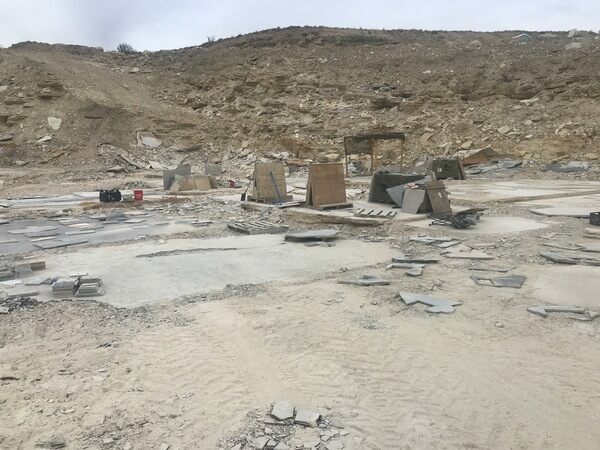
A view of the 18 inch layer of the Green River Formation at the Lindgren quarry near Kemmerer, Wyoming.
Once identified, the surrounding rock is carefully cut away and the specimen is transported to a preparation laboratory. Because the fossil may lie as much as an inch beneath the surface, exposing it requires painstaking work under magnification. Skilled preparators use fine hand tools to gradually remove the overlying limestone, revealing the fossil in extraordinary detail while preserving the delicate bones beneath.
Specimens of this quality come from the coveted 18-inch layer of the Green River Formation, a horizon renowned for producing exceptionally dark, detailed, and well-preserved fossil fish. The limestone from this layer is significantly harder and more durable than that found in many other parts of the formation, likely a result of the deep-water conditions under which it was originally deposited.
These conditions helped preserve fish in remarkable completeness, allowing exceptional specimens to be recovered largely intact. Locating them is a specialized process. The layer is often worked at night using low-angle lighting, which reveals the subtle raised contours created by a fossil fish—particularly the backbone—hidden beneath the surface of the limestone.
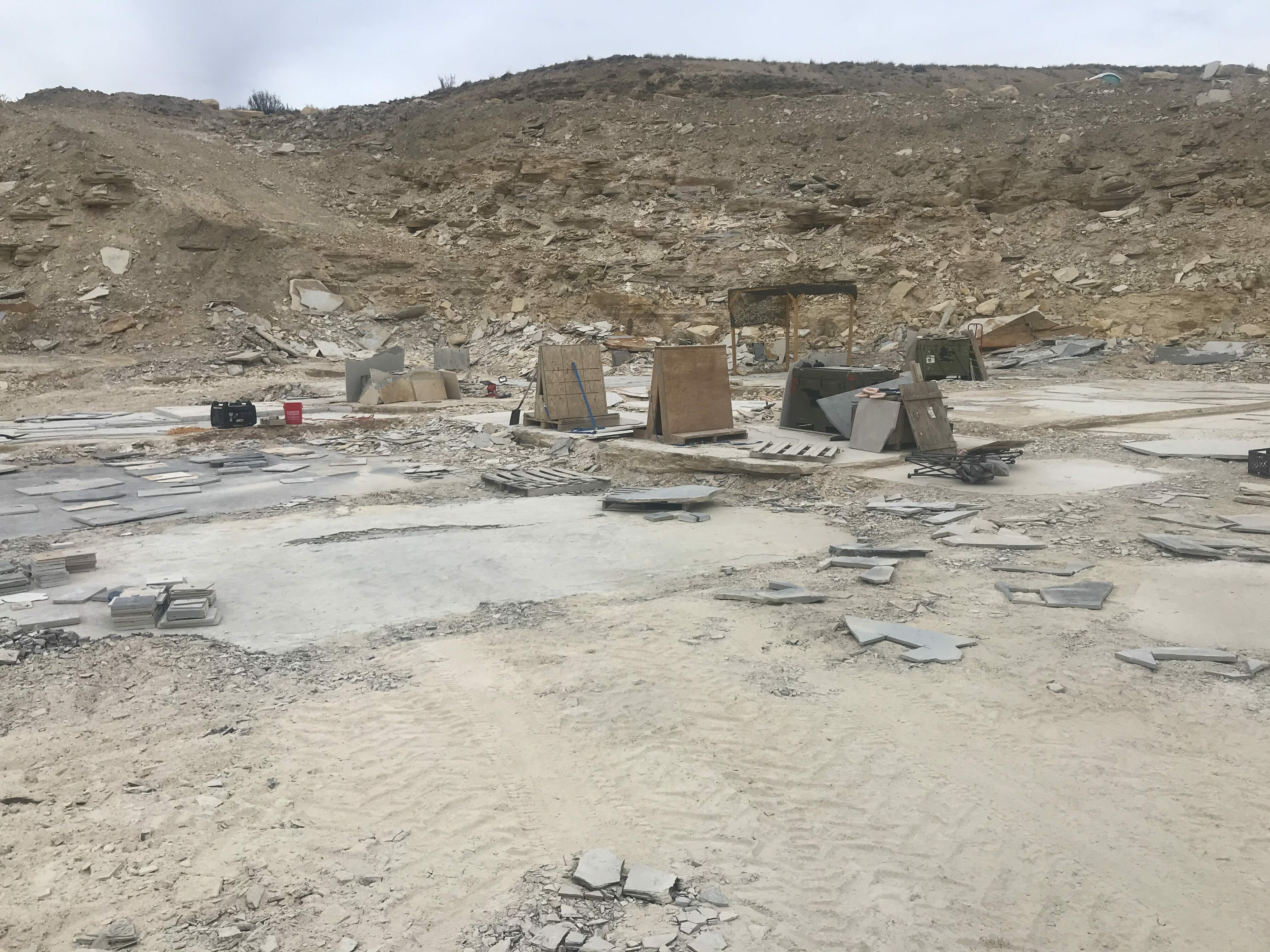
A view of the 18 inch layer of the Green River Formation at the Lindgren quarry near Kemmerer, Wyoming.
Once identified, the surrounding rock is carefully cut away and the specimen is transported to a preparation laboratory. Because the fossil may lie as much as an inch beneath the surface, exposing it requires painstaking work under magnification. Skilled preparators use fine hand tools to gradually remove the overlying limestone, revealing the fossil in extraordinary detail while preserving the delicate bones beneath.
SPECIES
Knightia eocaena

LOCATION
Clear Creek Quarry, Kemmerer, Wyoming
FORMATION
Green River Formation - 18 Inch Layer
SIZE
Fish: 6.8" long, Rock: 9.3 x 7.6"
CATEGORY
SUB CATEGORY
ITEM
#356756
We guarantee the authenticity of all of our specimens.


