 Reviews


This Specimen is on hold.


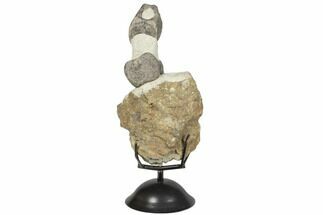
Composite Fossil Hadrosaur Toe (II - 1, 2 & 3) - Montana


This is a set of hadrosaur toe bones (II - 1, 2 & 3) collected from the Hell Creek Formation in Dawson County, Montana. The bones are beautifully articulated, however the toe is a composite, consisting of bones from separate animals. The proximal phalanx (II - 1) is 6.2" long, the middle phalanx (II - 2) is 3.8" wide, and the distal phalanx (II - 3 ungual/claw) measures 3.2 x 2.5".
Since isolated bones are difficult to provide an accurate genus for, to be safe, we have labeled this as coming from an Indeterminate Hadrosaur. That being said, based on abundance the ungual and phalanxes have us leaning towards Edmontosaurus annectens.
The proximal phalanx has a repaired crack about 2" from the distal point of articulation that required gap fill restoration. The middle phalanx has a repaired crack down the middle and restoration to along both points of articulation (about 10% total restoration). The ungual has multiple repaired cracks through it and has undergone significant weathering.
Since isolated bones are difficult to provide an accurate genus for, to be safe, we have labeled this as coming from an Indeterminate Hadrosaur. That being said, based on abundance the ungual and phalanxes have us leaning towards Edmontosaurus annectens.
The proximal phalanx has a repaired crack about 2" from the distal point of articulation that required gap fill restoration. The middle phalanx has a repaired crack down the middle and restoration to along both points of articulation (about 10% total restoration). The ungual has multiple repaired cracks through it and has undergone significant weathering.
Hadrosaurs
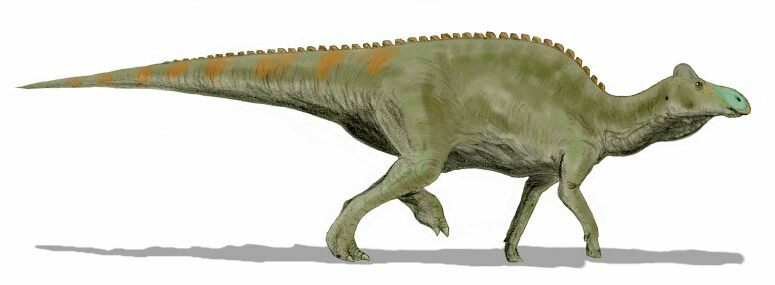
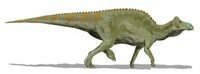 are frequently referred to as duck-billed dinosaurs and are members of the Ornithischian family Hadrosauridae. They were fairly common herbivores that roamed Asia, Europe, and North America during the Upper Cretaceous Period. Many species of Hadrosaurs had distinctive crests on their heads, some of which had air-filled chambers that may have produced a distinct sound. These crests may have been used for both audio and visual display purposes.
The Hell Creek Formation
Renowned for both its age and rich sedimentary layers, the Hell Creek Formation is one of the most intensively studied fossil-bearing regions on Earth. To date, scientists have documented 158 genera of animals and 64 genera of plants from its rocks, with new finds emerging regularly. Beyond iconic dinosaurs such as tyrannosaurs, ceratopsians, and hadrosaurs, the formation has produced an extraordinary array of life, including amphibians, reptiles, lizards, snakes, turtles, fish, sharks, birds, and early mammals. Together, these fossils provide the most complete picture of the ecosystems that thrived just before the Cretaceous–Paleogene extinction event.
Renowned for both its age and rich sedimentary layers, the Hell Creek Formation is one of the most intensively studied fossil-bearing regions on Earth. To date, scientists have documented 158 genera of animals and 64 genera of plants from its rocks, with new finds emerging regularly. Beyond iconic dinosaurs such as tyrannosaurs, ceratopsians, and hadrosaurs, the formation has produced an extraordinary array of life, including amphibians, reptiles, lizards, snakes, turtles, fish, sharks, birds, and early mammals. Together, these fossils provide the most complete picture of the ecosystems that thrived just before the Cretaceous–Paleogene extinction event.
$950
SPECIES
Indeterminate Hadrosaur

LOCATION
Dawson County, Montana
FORMATION
Hell Creek Formation
SIZE
Articulated toe: 11.8" long
CATEGORY
SUB CATEGORY
ITEM
#352098
We guarantee the authenticity of all of our specimens.