 Reviews


Cretaceous Ammonite and Cephalopod Fossil - Montana


This is a 4.1" wide fossil ammonite (Hoploscaphities (Jeletzkytes) brevis) that preserved in association with a heteromorph ammonite cephalopod fossil of the genus Baculites, collected from the Late Cretaceous Pierre Shale of Montana. They have been beautifully prepared from the hard limestone surrounding it.
The specimen stands up nicely on one edge without the need for a display stand. Some of the spines on the ammonite have undergone some restoration.
The specimen stands up nicely on one edge without the need for a display stand. Some of the spines on the ammonite have undergone some restoration.
About Ammonites
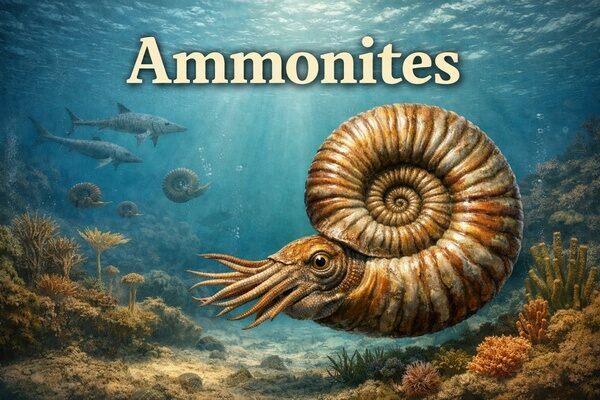
Ammonites were ancient marine cephalopods, similar to today's squids and octopuses, but with a defining feature: their distinctive, tightly coiled spiral shells. These shells, resembling those of modern nautiluses, served as both a protective home and a buoyancy aid, allowing ammonites to navigate the prehistoric seas with ease. First emerging around 240 million years ago in the Triassic Period, ammonites thrived for over 175 million years, adapting through numerous forms and sizes. As predatory creatures, they likely fed on smaller marine organisms, using their tentacles to capture prey. However, their long reign came to an end 65 million years ago at the close of the Cretaceous, coinciding with the mass extinction event that also eliminated the dinosaurs.
Ammonites were ancient marine cephalopods, similar to today's squids and octopuses, but with a defining feature: their distinctive, tightly coiled spiral shells. These shells, resembling those of modern nautiluses, served as both a protective home and a buoyancy aid, allowing ammonites to navigate the prehistoric seas with ease. First emerging around 240 million years ago in the Triassic Period, ammonites thrived for over 175 million years, adapting through numerous forms and sizes. As predatory creatures, they likely fed on smaller marine organisms, using their tentacles to capture prey. However, their long reign came to an end 65 million years ago at the close of the Cretaceous, coinciding with the mass extinction event that also eliminated the dinosaurs.
Baculites ("walking stick rock") is an extinct cephalopod genus with a nearly straight shell, included in the heteromorph ammonites. The genus lived worldwide throughout most of the Late Cretaceous.
As with other ammonites, the shell consisted of a series of camerae, or chambers, connected to the animal by a narrow tube called a siphuncle by which gas content and thereby buoyancy could be regulated, the same way as Nautilus does today.
From shell isotope studies, it is thought that Baculites inhabited the middle part of the water column, not too close to either the bottom or surface of the ocean.
Baculites fossils are very brittle and almost always break. They are most commonly found broken in half or several pieces, usually along suture lines. Individual chambers found this way are sometimes referred to as "stone buffaloes" (due to their shapes), though the Indigenous attribution typically given as part of the story behind the name is likely apocryphal.
As with other ammonites, the shell consisted of a series of camerae, or chambers, connected to the animal by a narrow tube called a siphuncle by which gas content and thereby buoyancy could be regulated, the same way as Nautilus does today.
From shell isotope studies, it is thought that Baculites inhabited the middle part of the water column, not too close to either the bottom or surface of the ocean.
Baculites fossils are very brittle and almost always break. They are most commonly found broken in half or several pieces, usually along suture lines. Individual chambers found this way are sometimes referred to as "stone buffaloes" (due to their shapes), though the Indigenous attribution typically given as part of the story behind the name is likely apocryphal.
$595
SPECIES
Hoploscaphities (Jeletzkytes) brevis & Baculites sp.

LOCATION
Near Musselshell River, Garfield County, Montana
FORMATION
Pierre Shale
SIZE
Ammonite: 4.1" wide, Entire Specimen: 6.4 x 6.2"
CATEGORY
ITEM
#354623
We guarantee the authenticity of all of our specimens.


