Reviews


This Specimen has been sold.


Jurassic Fossil Ammonites, Sea Snail, and Clam - Évrecy, France


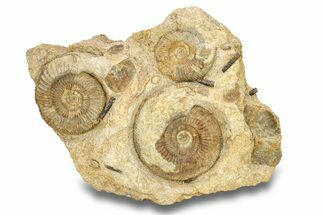
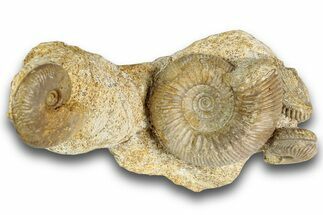
This is a gorgeous, 6.2" tall cluster of naturally associated fossils featuring multiple ammonites, a sea snail shell, and a clam. The ammonites include three Stephanoceras ammonite fossils, an Oppelia subradiata ammonite fossil, a sea snail shell of the species Pyrgotrochus elongatus, and a clam of the species Trigonia costata. This eye-catching specimen was collected from a Middle Jurassic (Bajocian Stage) marine deposit in Évrecy, France. All of the fossils have been meticulously exposed from the rock they were found in to create this unique display.
The cut base allows for presentation without the need for a display stand.
The cut base allows for presentation without the need for a display stand.
About Ammonites
Ammonites were ancient marine cephalopods, similar to today's squids and octopuses, but with a defining feature: their distinctive, tightly coiled spiral shells. These shells, resembling those of modern nautiluses, served as both a protective home and a buoyancy aid, allowing ammonites to navigate the prehistoric seas with ease. First emerging around 240 million years ago in the Triassic Period, ammonites thrived for over 175 million years, adapting through numerous forms and sizes. As predatory creatures, they likely fed on smaller marine organisms, using their tentacles to capture prey. However, their long reign came to an end 65 million years ago at the close of the Cretaceous, coinciding with the mass extinction event that also eliminated the dinosaurs.
Ammonites were ancient marine cephalopods, similar to today's squids and octopuses, but with a defining feature: their distinctive, tightly coiled spiral shells. These shells, resembling those of modern nautiluses, served as both a protective home and a buoyancy aid, allowing ammonites to navigate the prehistoric seas with ease. First emerging around 240 million years ago in the Triassic Period, ammonites thrived for over 175 million years, adapting through numerous forms and sizes. As predatory creatures, they likely fed on smaller marine organisms, using their tentacles to capture prey. However, their long reign came to an end 65 million years ago at the close of the Cretaceous, coinciding with the mass extinction event that also eliminated the dinosaurs.

SPECIES
Stephanoceras sp., Oppelia subradiata, Pyrgotrochus elongatus & Trigonia costata

LOCATION
Évrecy, France
SIZE
Largest Ammonite: 3.95" wide, Entire Specimen: 6.2 x 5.2"
CATEGORY
SUB CATEGORY
ITEM
#367913
We guarantee the authenticity of all of our specimens.