 Reviews


MARTIAN METEORITES FOR SALE
As you might expect, Martian meteorites are quite rare, representing less than 0.5% of all classified meteorites. The combined weight of all of these Mars rocks discovered on Earth is only several hundred kilograms. Superficially, Martian meteorites look very similar to igneous rocks on Earth, so nearly all have been identified from regions naturally devoid of rocks, like sandy deserts (Sahara Desert and Oman) and Antarctic ice sheets.

About Martian Meteorites
Meteorites have been impacting Earth since it formed over 4 billion years ago. Most meteorites are mixtures of stone or nickel-iron that fell to Earth from the Asteroid Belt, but some meteorites can be traced back to impacts on other celestial bodies. Meteorites don’t just hit Earth!
Mars, the Moon, and certain large planetoids in the Asteroid Belt are the sources of some chondritic and achondritic meteorites. Meteorites from these planets are created when meteorites hit their surfaces and blast material out into space past escape velocity. Meteorites from these sources are incredibly rare! Martian meteorites are meteorites that originated from Mars in this way: they have been blasted off of the planet’s surface by an asteroid or meteoroid impact.
Martian meteorites are also called SNCs, pronounced ‘snicks’, named for three prominent witnessed falls named Shergotty, Nakhla, and Chassigny. Of the 70,000 or so known meteorites on Earth, only about 300 are of Martian origin. They are incredibly rare!
What are Martian meteorites composed of?
Almost all Martian meteorites save a few exceptions are basaltic in origin. Basalts are igneous rocks formed from lava (molten rock outside of a planet’s crust) that usually crystallize quickly after contact with either fluid or the atmosphere. On Earth, basalts make up formations like lava tubes, the Hawaiian Islands, and hexagonal columnar clusters like the Giant’s Causeway in Ireland. On Mars, vast volcanic fields of basalt cover portions of its surface, surrounding massive shield volcanoes similar to Kilauea and the other volcanoes that formed the Hawaiian Islands. Mars’s largest volcano, Olympus Mons, is over 70,000 feet tall: that’s over twice the height of Mauna Kea, the Earth’s tallest mountain from its underwater base!
Most Martian meteorites come from basalt that specifically cooled on the planet’s surface. We know this because, as the rocks cooled, they trapped bits of atmospheric gasses within them. These can be analyzed against known measurements of the Martian atmospheric composition first taken by NASA’s Viking orbiter probes in the 1970s. These gas pockets are one of the most reliable ways to determine if a meteorite is indeed Martian.
However, there are some composition exceptions. Perhaps the most famous exception to the surface basalt rule is the Chassigny meteorite, a witnessed fall that hit France in 1815. Unlike surface-cooled basalts, Chassigny’s gas pockets do not match Mars’s atmosphere. The meteorite most likely came from a patch of basalt that cooled from near-surface magma that never broke through the planet’s crust as lava. As a result, Chassigny contains larger olivine crystals than other Martian meteorites, a sign of slower cooling. Because it must have formed underground, the Chassigny meteorite was probably exposed and launched from Mars at the same moment during an asteroid impact.
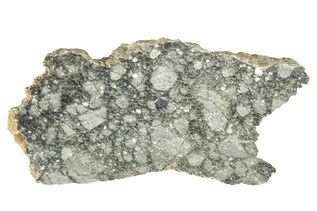
Other Martian meteorites are regolith breccias, a fairly common kind of stony meteorite. Frequent impacts and erosional processes on a planet’s surface will, over billions of years, create a layer of fine-grained material on the surface called regolith. Regolith is what we consider soil: fine-grained particles of rock and dust, from gravel to silt or clay-like textures. Sometimes, impacts are strong enough to melt this regolith, which can cool around fractured pieces of a planet’s crust to create a unique type of rock called breccia. Two prominent Martian meteorites are breccia: NWA 7034 and NWA 7533. They contain igneous, impact melt, and sedimentary clasts, and were likely formed into breccia from a thermal event, such as a pyroclastic eruption or meteorite impact. The heat fused all these clasts to become a single cohesive rock, which was finally launched into orbit by another meteorite impact. Most stony meteorites are this kind of regolith breccia, though they are extremely rare among Martian meteorites.
Because almost all Martian meteorites are basaltic, their origins can be traced to two volcanic regions around its equator: Tharsis and Elysium. Because they are volcanic, the rock there is younger than the rest of the planet and young enough to be the sources of known Martian meteorites, which all crystallized within the last 3 billion years.
How long does it take a Martian meteorite to reach the Earth?
Once a meteorite is launched from its parent body, it can be in outer space for only a few months to millions of years. We can estimate how long a meteorite has been in space quite accurately by measuring the amounts of certain isotopes contained within them called nuclides. These nuclides react when they are exposed to cosmic radiation from the Sun, and begin decaying in Earth’s atmosphere where that radiation is reduced. Scientists can measure the decay of those nuclides to determine how long a meteorite has been in outer space, fully exposed to cosmic rays. Most Martian meteorites were in space for millions of years.
Where and how are Martian meteorites found on Earth?
Meteorites can land anywhere on Earth, but few places have the right conditions to keep them from weathering past the point of recognition. Those places tend to be deserts, where moisture is minimal and the only weathering mechanics tend to be wind ablation (sandblasting). Thus, most known Martian meteorites are sourced from northwestern Africa around the Sahara Desert, the Arabian Peninsula, and Antarctica. Meteorites in Antarctica are found on scientific surveys, while desert-sourced meteorites are often found by locals or professional meteorite hunters.
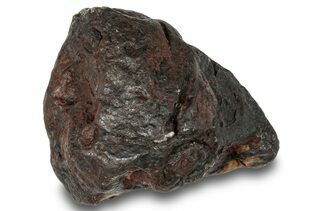
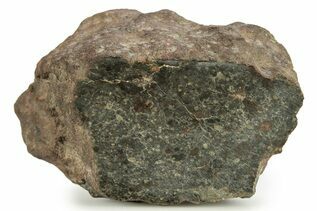
Martian meteorites, like other meteorites, often display key characteristics that distinguish them from terrestrial rocks. Most Martian meteorites have characteristic dark fusion crusts, and slicing often reveals shock features created when they were launched from Mars.
Perhaps the easiest way to find a meteorite is to witness its fall, and plenty of witnessed meteorite falls have been recorded throughout history. Five Martian meteorite falls have been witnessed: Chassigny, which fell in the Champagne region of France in 1815; Shergotty, which fell outside the city of the same name in Bihar, India in 1865; Nakhla, which fell near the town of Abu Hummus in Egypt in 1911; Zagami, which nearly hit a farmer in his field in northern Nigeria in 1962; and lastly, Tissint, which fell near Guelmim-Es-Semara in Morocco in 2011. Since these were witnessed falls, much of their material was recovered quickly. In fact, Tissint was fully recovered only days after its fall, preventing any weathering to affect its fusion-crusted surfaces. This is the only meteorite of the five considered ‘unaltered’ due to that prompt recovery.
NASA’s Dr. Allan Treiman has posed an interesting theory about certain coincidences around Chassigny and Zagami’s falls. Both have similar compositions and fell on nearly the same longitudinal parallel on the same day, October 3rd. Treiman postulates that the Earth’s orbit might sometimes align with a stream of meteoroids ejected from Mars that all came from the same impact site.
How long have we been finding Martian meteorites?
Meteorites have been hitting the Earth’s surface as long as it has existed, and no doubt numerous Martian meteorites have landed here without detection. The first Martian meteorite officially found by humans was the Chassigny meteorite in 1815. Since then, about 300 have been found and classified as Martian.
How much are Martian meteorites worth?
Due to their rarity and origin, Martian meteorite specimens often fetch very high prices from collectors. Multiple factors can determine a meteorite’s value, including its status as a witnessed fall, its composition, its beauty, and the rarity of its material. Polished slices, end-cuts, and individual specimens often sell for hundreds of dollars per gram. Large specimens and pieces of witnessed falls have sold for hundreds of thousands of dollars at auction.
What can we learn from Martian meteorites?
Martian meteorites are the only specimens we have of the Red Planet. Though three rovers are currently active on Mars–NASA’s Curiosity and Perseverance, and the China National Space Administration (CNSA) rover named Zhurong–the samples they have collected cannot be studied by humans until at least the 2030s, when recovery missions will bring the NASA rovers back to Earth. Until they come back, we have meteorites.
These meteorites contain not only information about Mars’s atmosphere and lithosphere, but also give us hints about the planet’s mysterious past. Several prominent Martian meteorites, including Nakhla and Tissint, show signs of weathering and secondary alterations from water. Nakhla was the first Martian meteorite discovered to possess these kinds of traits, and is one of the most studied Martian meteorites. Its composition includes carbonates and hydrous minerals that could only form through deposition, as well as significant amounts of Carbon-13 and deuterium isotopes in different amounts than would be found on Earth. Deuterium, an isotope of hydrogen, forms in association with hydrological processes, and could indicate water was on Mars in the form of oceans, ice reservoirs, or even subterranean layers of permafrost. Other meteorites harbor aqueous features: ALHA 84001, found in Antarctica, revealed a host of interesting features, from carbonates in its own cracks and fissures to polycyclic aromatic hydrocarbons, a type of organic compound that forms in hexagonal lattice structures.
Nakhla also, somewhat controversially, was thought to contain signs of life. Researchers observing the meteorite under electron microscope noticed complex carbonaceous material in cracks and fissures, and postulated that they were biogenic in origin and likely made by ancient bacteria. However, this idea was dismissed due to carbon’s abundance in the universe and lack of further evidence.
Until rovers bring back more samples, meteorites hold all the information we know about Mars’s geological composition and processes. They are beautiful and endlessly valuable pieces of the Red Planet’s history!
Featured Photos

Related Categories