 Reviews

This Specimen has been sold.


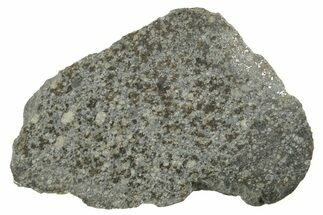
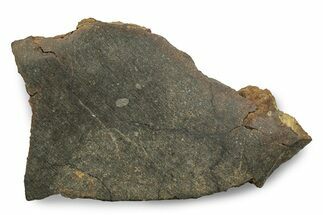
1.33" Bassikounou Chondrite Meteorite (29.56 g) - Witnessed Fall!

This is a 1.33" wide (29.56 gram) piece of the H5 chondrite meteorite Bassikounou. It exploded near the village of Bassikounou in Mauritania in October of 2006. It is a beautiful piece of the solar system's history, displaying an almost pure black crust with a lighter grey interior.
About The Bassikounou Meteorite
Bassikounou is the name given to a chondrite that fell 11 km SE of Bassikounou, in Mauritania on October 16, 2006. A fireball was witnessed in the area, but no records of the direction of movement were recorded. A single stone of 3165 g was found by A. Salem El Moichine, a local resident. According to S. Buhl (Hamburg, Germany), more than 20 specimens were later recovered by locals and meteorite finders. These finds define a 8 km long strewnfield. The total recovered mass is 46.00 kg.
The 3165 g specimen is largely covered by black fusion crust. The interior is light gray. On the surface of the fusion crust there is some adherent soil material, some of which is bright red. Shortly after recovery, the stone was cut into two pieces of 1200 and 1950 g. The larger piece has a rectangular shape and shows indications of flow-lines in the fusion crust. It is a truly stunning window into the beginning of the solar system.
Meteoritical Bulletin: Entry for The Bassikounou Meteorite
Bassikounou is the name given to a chondrite that fell 11 km SE of Bassikounou, in Mauritania on October 16, 2006. A fireball was witnessed in the area, but no records of the direction of movement were recorded. A single stone of 3165 g was found by A. Salem El Moichine, a local resident. According to S. Buhl (Hamburg, Germany), more than 20 specimens were later recovered by locals and meteorite finders. These finds define a 8 km long strewnfield. The total recovered mass is 46.00 kg.
The 3165 g specimen is largely covered by black fusion crust. The interior is light gray. On the surface of the fusion crust there is some adherent soil material, some of which is bright red. Shortly after recovery, the stone was cut into two pieces of 1200 and 1950 g. The larger piece has a rectangular shape and shows indications of flow-lines in the fusion crust. It is a truly stunning window into the beginning of the solar system.
Meteoritical Bulletin: Entry for The Bassikounou Meteorite
About H5 Chondrites
H5 chondrite meteorites belong to the ordinary chondrite group, the most common type of meteorites found on Earth. These meteorites are composed primarily of silicate minerals such as olivine and pyroxene, along with metal and sulfide inclusions. Their "H" classification indicates a high iron content (typically 25-31% by weight), giving them a metallic sheen and making them denser than many other meteorite types.
The "5" in the classification refers to their petrologic grade, signifying a moderate degree of thermal metamorphism. H5 chondrites have experienced significant heating on their parent asteroid, which has recrystallized their original chondritic textures. Despite this, remnants of their primitive origins ca
H5 chondrite meteorites belong to the ordinary chondrite group, the most common type of meteorites found on Earth. These meteorites are composed primarily of silicate minerals such as olivine and pyroxene, along with metal and sulfide inclusions. Their "H" classification indicates a high iron content (typically 25-31% by weight), giving them a metallic sheen and making them denser than many other meteorite types.
The "5" in the classification refers to their petrologic grade, signifying a moderate degree of thermal metamorphism. H5 chondrites have experienced significant heating on their parent asteroid, which has recrystallized their original chondritic textures. Despite this, remnants of their primitive origins ca
About Chondrites
Chondrites are stony (non-metallic) meteorites that have not been modified by either melting or differentiation of the parent body. They are formed when various types of dust and small grains in the early Solar System accreted to form primitive asteroids. Some such bodies are captured in the planet’s gravity well and pulled to the surface. They are by far the most common type of meteorite, representing about 86 percent of all meteorites that have fallen to Earth.
Prominent among the components present in chondrites are the enigmatic chondrules, millimeter-sized spherical objects that originated as freely floating, molten or partially molten droplets in space; most chondrules are rich in the silicate minerals olivine and pyroxene. Chondrites also contain particles of various metals such as nickel, iron, and aluminum. These formed at the very beginning of the solar system and aggregated over time: they are the oldest rocks known on Earth!
Chondrites are divided into about fifteen distinct groups on the basis of their mineralogy, bulk chemical composition, and oxygen isotope compositions. The various chondrite groups likely originated on separate asteroids or groups of related asteroids. Each chondrite group has a distinctive mixture of chondrules, refractory inclusions, matrix (dust), characteristic chondrule sizes, and other components. Other ways of classifying chondrites include weathering and shock. The L chondrite group is the most common of these.
Chondrites are stony (non-metallic) meteorites that have not been modified by either melting or differentiation of the parent body. They are formed when various types of dust and small grains in the early Solar System accreted to form primitive asteroids. Some such bodies are captured in the planet’s gravity well and pulled to the surface. They are by far the most common type of meteorite, representing about 86 percent of all meteorites that have fallen to Earth.
Prominent among the components present in chondrites are the enigmatic chondrules, millimeter-sized spherical objects that originated as freely floating, molten or partially molten droplets in space; most chondrules are rich in the silicate minerals olivine and pyroxene. Chondrites also contain particles of various metals such as nickel, iron, and aluminum. These formed at the very beginning of the solar system and aggregated over time: they are the oldest rocks known on Earth!
Chondrites are divided into about fifteen distinct groups on the basis of their mineralogy, bulk chemical composition, and oxygen isotope compositions. The various chondrite groups likely originated on separate asteroids or groups of related asteroids. Each chondrite group has a distinctive mixture of chondrules, refractory inclusions, matrix (dust), characteristic chondrule sizes, and other components. Other ways of classifying chondrites include weathering and shock. The L chondrite group is the most common of these.
TYPE
H5 Chondrite

LOCATION
Bassikounou, Hodh Ech Chargui, Mauritania
SIZE
1.33 x 1.01", .91" thick, 29.56 grams
CATEGORY
SUB CATEGORY
ITEM
#333023