 Reviews

This Specimen has been sold.


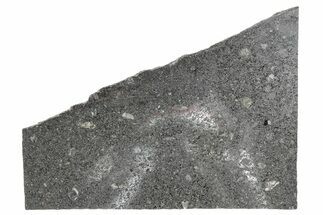
.42" Martian Shergottite Meteorite (.46 g) Slice - NWA 17472

This slice weighs .46 grams. It has been polished on one side to reveal gray pyroxene crystals and shiny maskelynite. Comes in an acrylic display case.
Martian Meteorite NWA 17472
Northwest Africa 17472 is a Martian basaltic shergottite discovered in 2024 in the deserts of Northwest Africa and just classified in 2025. The find consisted of two stones totaling about 4 kilograms, showing patches of weathered fusion crust on the outside and interiors rich with striking gray pyroxene crystals and glassy maskelynite. Classified as an evolved basaltic shergottite, its mineralogy is dominated by clinopyroxene (about half of the rock) and maskelynite (around forty percent), with minor amounts of merrillite, titanomagnetite, ilmenite, and troilite. Under the microscope, the clinopyroxene reveals a complex history of crystallization, from magnesium-rich pigeonite cores to ferropigeonite rims, while elongated maskelynite grains record the effects of intense shock events on Mars that converted plagioclase into glass.
Like other Martian meteorites, NWA 17472 carries a unique geochemical fingerprint that ties it back to the Red Planet. Its textures and compositions are similar to well-studied Martian shergottites such as QUE 94201 and NWA 12335, strengthening the link to igneous activity on Mars. With its high shock stage, moderate terrestrial weathering, and fascinating mineralogy, this meteorite provides a valuable window into the volcanic processes and violent impacts that shaped the Martian surface.
Meteoritical Bulletin: Entry for NWA 17472
Northwest Africa 17472 is a Martian basaltic shergottite discovered in 2024 in the deserts of Northwest Africa and just classified in 2025. The find consisted of two stones totaling about 4 kilograms, showing patches of weathered fusion crust on the outside and interiors rich with striking gray pyroxene crystals and glassy maskelynite. Classified as an evolved basaltic shergottite, its mineralogy is dominated by clinopyroxene (about half of the rock) and maskelynite (around forty percent), with minor amounts of merrillite, titanomagnetite, ilmenite, and troilite. Under the microscope, the clinopyroxene reveals a complex history of crystallization, from magnesium-rich pigeonite cores to ferropigeonite rims, while elongated maskelynite grains record the effects of intense shock events on Mars that converted plagioclase into glass.
Like other Martian meteorites, NWA 17472 carries a unique geochemical fingerprint that ties it back to the Red Planet. Its textures and compositions are similar to well-studied Martian shergottites such as QUE 94201 and NWA 12335, strengthening the link to igneous activity on Mars. With its high shock stage, moderate terrestrial weathering, and fascinating mineralogy, this meteorite provides a valuable window into the volcanic processes and violent impacts that shaped the Martian surface.
Meteoritical Bulletin: Entry for NWA 17472
About Martian Meteorites (Shergottites)
Martian meteorites are rocks that formed on Mars before being ejected due to asteroid impacts, traveling through space and landing on Earth as meteorites. As you might expect, Martian meteorites are quite rare, representing less than 0.5 percent of all classified meteorites. The total mass of all known Martian meteorites is only several hundred kilograms. Superficially, Martian meteorites look very similar to igneous rocks on Earth, so nearly all have been identified from regions naturally devoid of rocks like sandy deserts (Sahara Desert and Oman) and the Antarctic ice sheets.
The achondrite meteorites are subdivided into three classes; shergottites, nakhlites, and chassignites, which together are referred to as the SNC group of meteorites. These meteorites are interpreted as Martian in origin because they have elemental and isotopic compositions similar to rocks and atmospheric gasses on Mars.
Roughly three-quarters of all Martian meteorites can be classified as shergottites. Shergottites are igneous rocks of mafic to ultramafic lithology that may have crystallized as recently as 180 million years ago. This is unusual, since most of the surface of Mars appears to be ancient, and the planet itself is rather small. Because of this, some believe that shergottites are actually much older. This "Shergottite Age Paradox" remains unsolved and is still an area of active research and debate.
Martian meteorites are rocks that formed on Mars before being ejected due to asteroid impacts, traveling through space and landing on Earth as meteorites. As you might expect, Martian meteorites are quite rare, representing less than 0.5 percent of all classified meteorites. The total mass of all known Martian meteorites is only several hundred kilograms. Superficially, Martian meteorites look very similar to igneous rocks on Earth, so nearly all have been identified from regions naturally devoid of rocks like sandy deserts (Sahara Desert and Oman) and the Antarctic ice sheets.
The achondrite meteorites are subdivided into three classes; shergottites, nakhlites, and chassignites, which together are referred to as the SNC group of meteorites. These meteorites are interpreted as Martian in origin because they have elemental and isotopic compositions similar to rocks and atmospheric gasses on Mars.
Roughly three-quarters of all Martian meteorites can be classified as shergottites. Shergottites are igneous rocks of mafic to ultramafic lithology that may have crystallized as recently as 180 million years ago. This is unusual, since most of the surface of Mars appears to be ancient, and the planet itself is rather small. Because of this, some believe that shergottites are actually much older. This "Shergottite Age Paradox" remains unsolved and is still an area of active research and debate.
TYPE
Shergottite
LOCATION
Northwest Africa
SIZE
.42 x .32 x 0.09", Weight: .46 grams
CATEGORY
ITEM
#335299


