 Reviews

This Specimen has been sold.


1.6" Magnetite, Diopside, Garnet & Biotite Association - Afghanistan
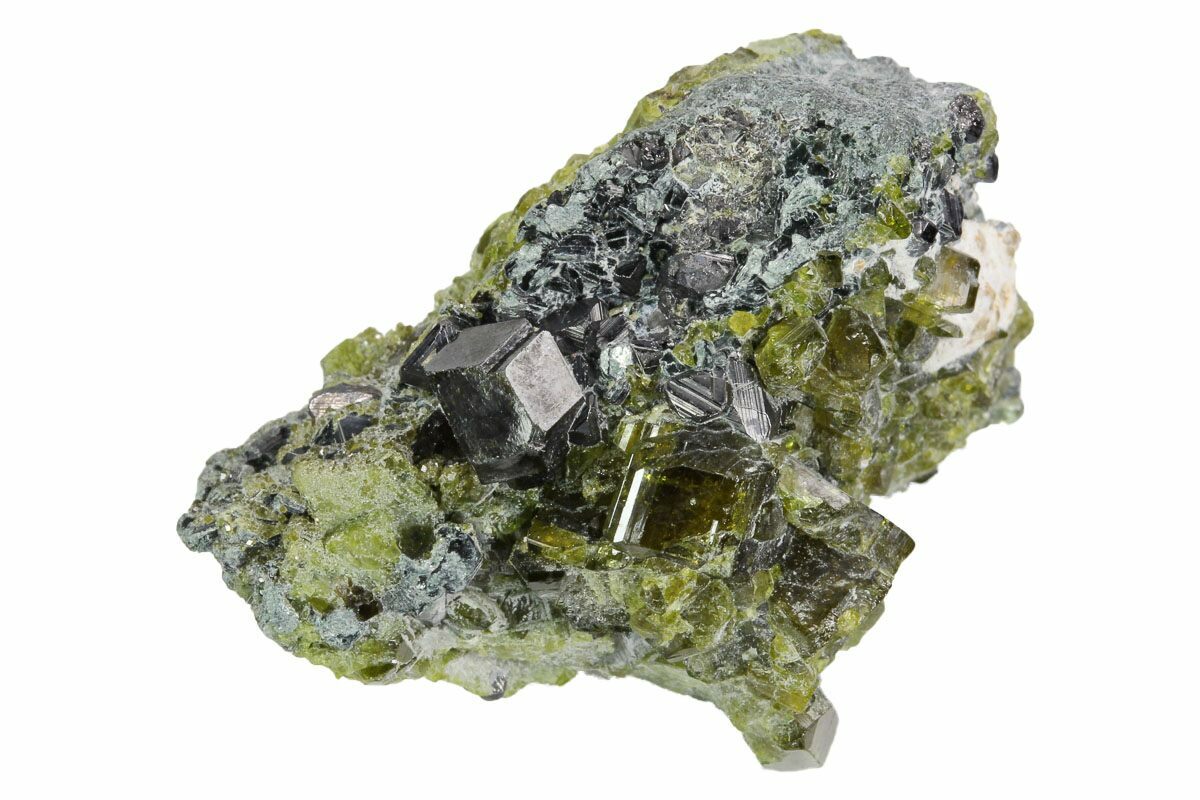
This is a gorgeous, 1.6" wide association of yellow-green diopside crystals, andradite garnets, magnetite crystals and biotite clusters. This mineral association was collected from Khogyani, Afghanistan and is in great condition. The magnetite has wonderful magnetic properties.
About Diopside
Diopside is a pyroxene mineral with the chemical formula MgCaSi₂O₆. It is often found as small green crystals within metamorphic and igneous rocks, though it can vary in color including yellow, brown, and black. It is an important indicator rock when searching for deep-source volcanic pipes that may or may not contain diamonds. Geologists searching for these pipes often look for diopside crystal fragments, since they form in nearly the same atmospheric conditions and locations as diamonds. Diopside with deep green coloration is known as chrome diopside.
Diopside is a pyroxene mineral with the chemical formula MgCaSi₂O₆. It is often found as small green crystals within metamorphic and igneous rocks, though it can vary in color including yellow, brown, and black. It is an important indicator rock when searching for deep-source volcanic pipes that may or may not contain diamonds. Geologists searching for these pipes often look for diopside crystal fragments, since they form in nearly the same atmospheric conditions and locations as diamonds. Diopside with deep green coloration is known as chrome diopside.
About Magnetite
Magnetite is a naturally occurring iron oxide mineral with the chemical formula Fe₃O₄. It is one of the most magnetic minerals found on Earth, a property that has made it historically significant in the development of early navigation tools like the compass. Magnetite typically forms in igneous and metamorphic rocks, and its crystals often appear as octahedrons or granular masses with a metallic luster and a deep black to dark gray color.
The mineral is composed of both ferrous (Fe²⁺) and ferric (Fe³⁺) iron, giving it its strong magnetic characteristics and distinguishing it from other iron oxides such as hematite. It has a Mohs hardness of 5.5–6.5 and a high specific gravity, making it quite dense. Magnetite is an important iron ore and is widely mined for use in steel production.
Besides its industrial value, magnetite is also of interest to collectors due to its striking appearance and magnetic properties. Large or well-formed octahedral crystals are particularly sought after.
Magnetite is a naturally occurring iron oxide mineral with the chemical formula Fe₃O₄. It is one of the most magnetic minerals found on Earth, a property that has made it historically significant in the development of early navigation tools like the compass. Magnetite typically forms in igneous and metamorphic rocks, and its crystals often appear as octahedrons or granular masses with a metallic luster and a deep black to dark gray color.
The mineral is composed of both ferrous (Fe²⁺) and ferric (Fe³⁺) iron, giving it its strong magnetic characteristics and distinguishing it from other iron oxides such as hematite. It has a Mohs hardness of 5.5–6.5 and a high specific gravity, making it quite dense. Magnetite is an important iron ore and is widely mined for use in steel production.
Besides its industrial value, magnetite is also of interest to collectors due to its striking appearance and magnetic properties. Large or well-formed octahedral crystals are particularly sought after.
Andradite is a species of the garnet group, and although not as well-known as some other types of garnets, such as Almandine or pyrope, it is the most lustrous. It tends to be opaque, so most andradite is not gemstone-quality. It occurs in skarns developed in contact-metamorphosed impure limestones or calcic igneous rocks; in chlorite schists and serpentinites; and in alkalic igneous rocks, often titaniferous.
Andradite comes in three varieties: melanite, colored by titanium substitutions for iron in its formula; topazolite, a rare and yellow-green variety; and demantoid, a striking green variety that is one of the world's rarest and most valuable gemstones.
Garnets are nesosilicates with the general formula X3Y2(SiO4)3. There are many species of garnet, including pyrope, almandine, spessartine, uvarovite, andradite, and grossular (varieties of which are hessonite, cinnamon-stone and tsavorite). Garnets are found in a wide variety of colors including red, orange, yellow, green, purple, brown, blue, black, pink, and colorless, though reddish shades are the most common.
Andradite comes in three varieties: melanite, colored by titanium substitutions for iron in its formula; topazolite, a rare and yellow-green variety; and demantoid, a striking green variety that is one of the world's rarest and most valuable gemstones.
Garnets are nesosilicates with the general formula X3Y2(SiO4)3. There are many species of garnet, including pyrope, almandine, spessartine, uvarovite, andradite, and grossular (varieties of which are hessonite, cinnamon-stone and tsavorite). Garnets are found in a wide variety of colors including red, orange, yellow, green, purple, brown, blue, black, pink, and colorless, though reddish shades are the most common.
SPECIES
Magnetite, Diopside, Garnet var. Andradite & Mica var. Biotite
LOCATION
Khogyani, Afghanistan
SIZE
1.6 x 1.1"
CATEGORY
ITEM
#121364


