Reviews

This Specimen has been sold.


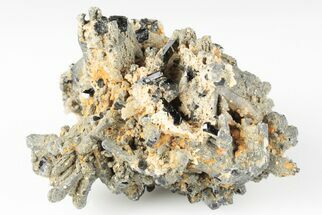
1.8" Beautiful Blue-Green Botallackite Crystal Cluster - England

This is a cluster of beautiful blue-green botallackite crystals on matrix, collected from Cligga Head in Cornwall, England. Botallackite is a rare secondary copper mineral and is named after its type locality, the Botallack Mine in St. Just, Cornwall. It measures 1.8" wide and comes with an acrylic display case.
About Botallackite
Botallackite is a rare and visually striking copper oxychloride mineral best known for its vivid blue-green color and delicate crystal formations. It typically occurs as thin, tabular to fibrous crystals that can form radiating sprays, crusts, or silky aggregates, often coating rock surfaces in copper-rich environments. With a chemical formula of Cu₂(OH)₃Cl, botallackite is closely related to other copper chlorides such as atacamite and paratacamite, but it is far less common and generally forms under very specific, low-temperature conditions.
The mineral was first described in 1865 and named after the famous Botallack Mine in Cornwall, England, a historic copper mine that extended beneath the Atlantic Ocean. Botallackite forms as a secondary mineral through the alteration of primary copper sulfides, particularly in coastal or saline environments where chloride ions are present. Because it is metastable, botallackite often alters over time into more stable copper chloride minerals, making well-preserved specimens especially desirable.
Botallackite is a rare and visually striking copper oxychloride mineral best known for its vivid blue-green color and delicate crystal formations. It typically occurs as thin, tabular to fibrous crystals that can form radiating sprays, crusts, or silky aggregates, often coating rock surfaces in copper-rich environments. With a chemical formula of Cu₂(OH)₃Cl, botallackite is closely related to other copper chlorides such as atacamite and paratacamite, but it is far less common and generally forms under very specific, low-temperature conditions.
The mineral was first described in 1865 and named after the famous Botallack Mine in Cornwall, England, a historic copper mine that extended beneath the Atlantic Ocean. Botallackite forms as a secondary mineral through the alteration of primary copper sulfides, particularly in coastal or saline environments where chloride ions are present. Because it is metastable, botallackite often alters over time into more stable copper chloride minerals, making well-preserved specimens especially desirable.
SPECIES
Botallackite
LOCATION
Cligga Head, Perranporth, Perranzabuloe, Cornwall, England
SIZE
1.8" wide
CATEGORY
ITEM
#309742