Reviews

This Specimen has been sold.


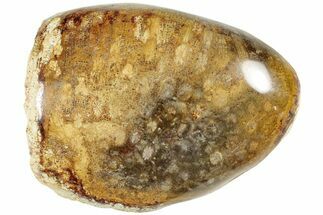
2.1" Natural Ulexite Crystal Formation - California

This is a 2.1" long natural formation of ulexite collected from Kern County, California. It has been left in its rough state, so it doesn't display the optical properties often seen in polished specimens. This piece, however, would be a good candidate for a polishing project.
What Is Ulexite?
Ulexite typically appears as a silky colorless or white, fibrous mineral, sometimes in rounded crystalline masses, but more often in parallel fibers. It is a rather soft mineral, sitting at 2½ on the Mohs scale. Ulexite was named for the German chemist Georg Ludwig Ulex (1811–1883), who first correctly analyzed the species. It is found principally in California and Nevada, but has also been collected in Kazakhstan, and the Tarapacá Region in Chile.
Ulexite, also known as "TV rock" or "television stone," is a natural borate mineral with unique optical properties. When a piece of ulexite is cut with flat polished faces perpendicular to the orientation of the fibers, a good-quality specimen will display an image of whatever surface is adjacent to its other side. The fiber-optic effect is the result of the polarization of light into slow and fast rays within each fiber, the internal reflection of the slow ray and the refraction of the fast ray into the slow ray of an adjacent fiber.
General chemical formula - NaCa[B5O6(OH)6] · 5H2O
Ulexite typically appears as a silky colorless or white, fibrous mineral, sometimes in rounded crystalline masses, but more often in parallel fibers. It is a rather soft mineral, sitting at 2½ on the Mohs scale. Ulexite was named for the German chemist Georg Ludwig Ulex (1811–1883), who first correctly analyzed the species. It is found principally in California and Nevada, but has also been collected in Kazakhstan, and the Tarapacá Region in Chile.
Ulexite, also known as "TV rock" or "television stone," is a natural borate mineral with unique optical properties. When a piece of ulexite is cut with flat polished faces perpendicular to the orientation of the fibers, a good-quality specimen will display an image of whatever surface is adjacent to its other side. The fiber-optic effect is the result of the polarization of light into slow and fast rays within each fiber, the internal reflection of the slow ray and the refraction of the fast ray into the slow ray of an adjacent fiber.
General chemical formula - NaCa[B5O6(OH)6] · 5H2O