 Reviews

This Specimen has been sold.


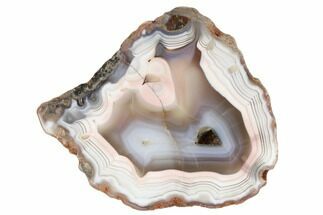
5.5" Colorful Polished Thunderegg Half


This is a gorgeous thunderegg half that has been flawlessly polished to a glossy finish across its flat-cut surface. This unique specimen features a core which is filled with a colorful mixture of banded and waterline agate.
It comes with an acrylic display stand.
It comes with an acrylic display stand.
What Are Thundereggs?
Thundereggs are rounded to irregular geological structures that form within silica-rich volcanic rocks, most commonly rhyolite and related volcanic deposits. Unlike true geodes, thundereggs typically develop as solid or partially filled structures within the host rock and often reveal striking internal patterns when cut and polished. Their interiors can contain agate, chalcedony, opal, quartz, or combinations of these silica minerals, producing intricate banding, contrasting colors, and occasionally crystal-lined cavities. The name “thunderegg” comes from Native American folklore of the Pacific Northwest, where these unusual stones were said to have been thrown by thunder spirits during storms.
Thunderegg formation generally begins with cavities or zones of weakness that develop within cooling volcanic material, commonly through gas bubbles, shrinkage, or other processes associated with volcanic activity. Silica-rich fluids subsequently circulate through fractures and porous areas of the rock, depositing layers of chalcedony and agate within these spaces. Repeated episodes of fluid infiltration can produce the complex banding and patterns characteristic of many thundereggs, while open cavities may later become lined or filled with crystalline quartz. Differences in mineral impurities, fluid chemistry, and successive stages of deposition are responsible for the wide variety of colors and internal structures seen in thundereggs from different localities.
Thundereggs are rounded to irregular geological structures that form within silica-rich volcanic rocks, most commonly rhyolite and related volcanic deposits. Unlike true geodes, thundereggs typically develop as solid or partially filled structures within the host rock and often reveal striking internal patterns when cut and polished. Their interiors can contain agate, chalcedony, opal, quartz, or combinations of these silica minerals, producing intricate banding, contrasting colors, and occasionally crystal-lined cavities. The name “thunderegg” comes from Native American folklore of the Pacific Northwest, where these unusual stones were said to have been thrown by thunder spirits during storms.
Thunderegg formation generally begins with cavities or zones of weakness that develop within cooling volcanic material, commonly through gas bubbles, shrinkage, or other processes associated with volcanic activity. Silica-rich fluids subsequently circulate through fractures and porous areas of the rock, depositing layers of chalcedony and agate within these spaces. Repeated episodes of fluid infiltration can produce the complex banding and patterns characteristic of many thundereggs, while open cavities may later become lined or filled with crystalline quartz. Differences in mineral impurities, fluid chemistry, and successive stages of deposition are responsible for the wide variety of colors and internal structures seen in thundereggs from different localities.
SPECIES
Chalcedony var. Agate
LOCATION
Unknown
SIZE
5.5 x 4.15", up to 1.95" thick
CATEGORY
ITEM
#373454