 Reviews

This Specimen has been sold.


6.6" Free-Standing, Polished Kambaba Jasper - Madagascar
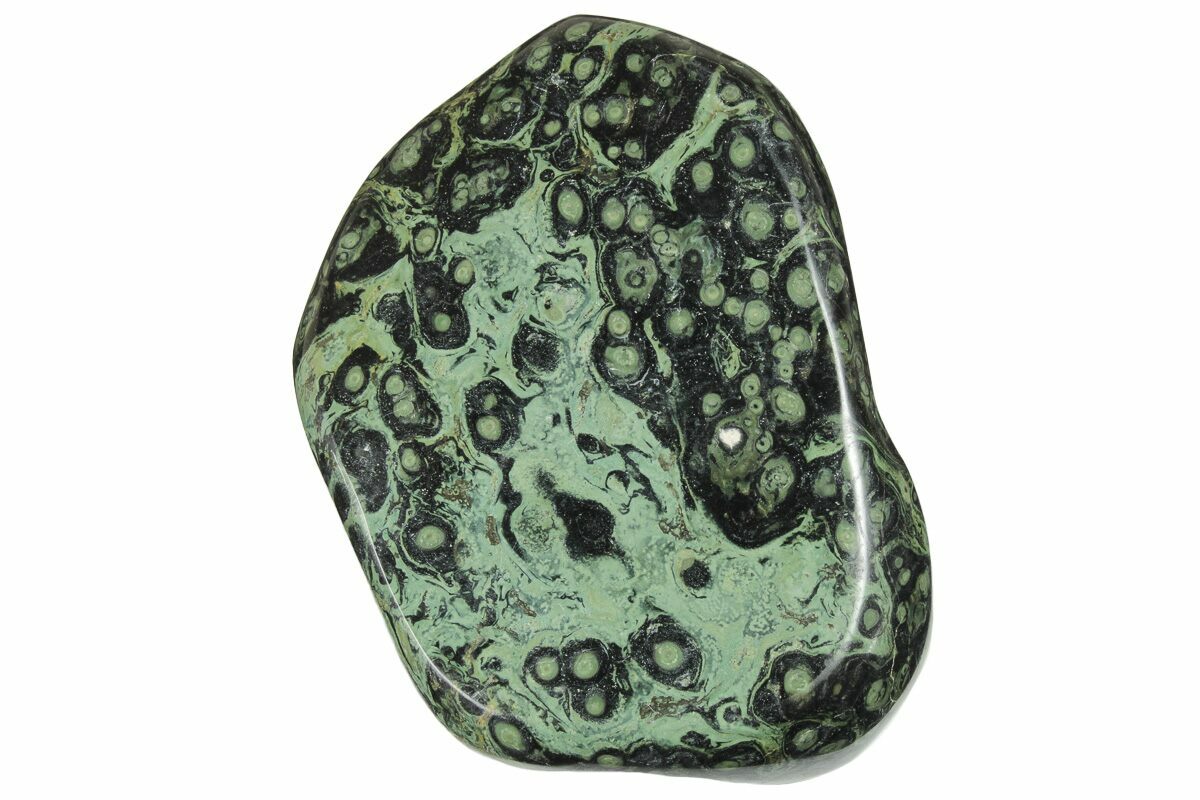
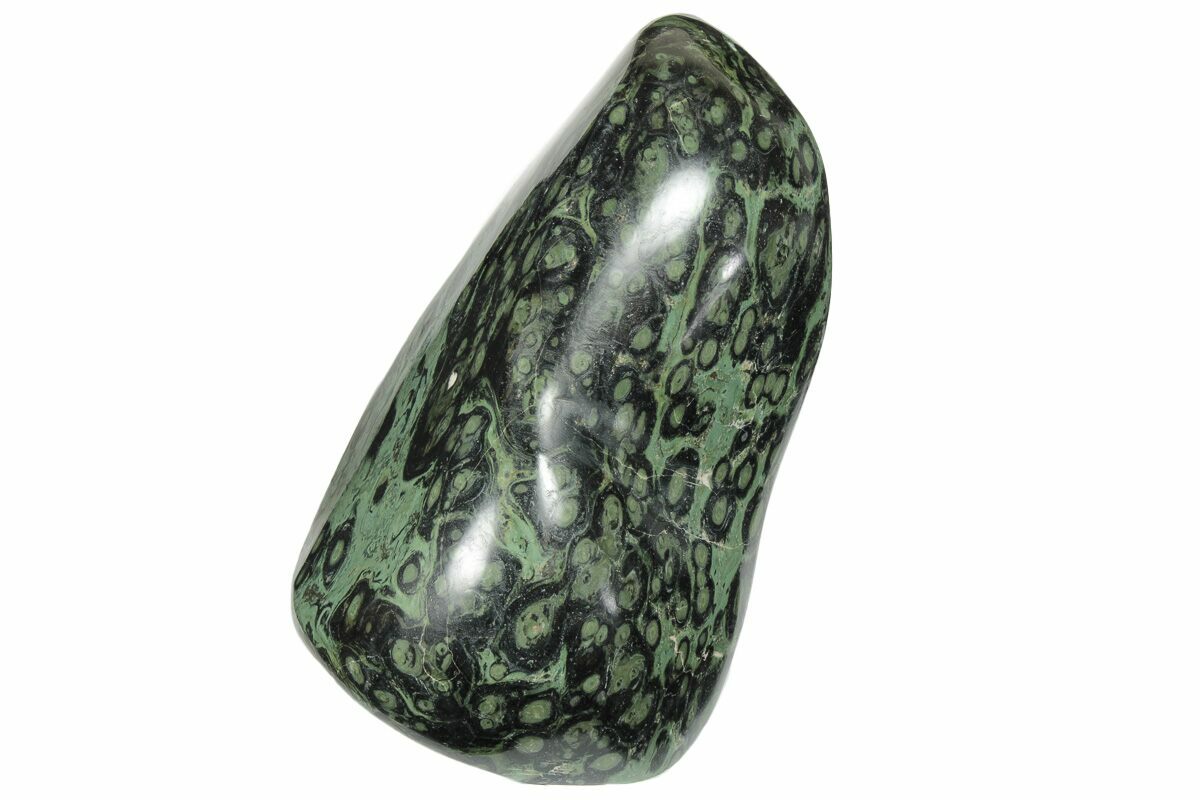
This is a beautiful, hand polished free-standing sculpture made from Kambaba Jasper found in Madagascar. It is 6.6" tall and has dark circular mineral formations throughout the jasper. The base has been cut flat so that it displays nicely on a hard surface and would be suitable as either an indoor or outdoor decorative piece.
About Kambaba Jasper
Kambaba jasper—also known in the trade as “crocodile jasper”—is a striking, green-and-black ornamental stone originating from the west-central Bongolava region of Madagascar. Despite the name, it isn’t a true jasper at all, but a rhyolitic volcanic rock that formed from ancient silica-rich lava flows. Its signature appearance comes from swirling green groundmass punctuated by dark, orbicular structures composed of fine amphibole needle aggregates. These orbs can resemble reptilian or amphibian eyes, which is how the nickname “crocodile jasper” arose.
A long-standing misconception suggests that Kambaba jasper is a stromatolite (a fossilized bacterial mat), but scientific study has shown this is incorrect—its textures are igneous rather than biological in origin. Even so, its bold patterning, deep green coloration, and polishable surface have made it a popular decorative material for carvings, spheres, palm stones, and jewelry. When finished, it displays a dramatic, almost ancient look that highlights the unique geological processes that shaped Madagascar’s volcanic landscapes.
Kambaba jasper—also known in the trade as “crocodile jasper”—is a striking, green-and-black ornamental stone originating from the west-central Bongolava region of Madagascar. Despite the name, it isn’t a true jasper at all, but a rhyolitic volcanic rock that formed from ancient silica-rich lava flows. Its signature appearance comes from swirling green groundmass punctuated by dark, orbicular structures composed of fine amphibole needle aggregates. These orbs can resemble reptilian or amphibian eyes, which is how the nickname “crocodile jasper” arose.
A long-standing misconception suggests that Kambaba jasper is a stromatolite (a fossilized bacterial mat), but scientific study has shown this is incorrect—its textures are igneous rather than biological in origin. Even so, its bold patterning, deep green coloration, and polishable surface have made it a popular decorative material for carvings, spheres, palm stones, and jewelry. When finished, it displays a dramatic, almost ancient look that highlights the unique geological processes that shaped Madagascar’s volcanic landscapes.
About Jasper
Jasper is a term that can be applied to an opaque variety of chalcedony. The opaqueness is due to a higher concentration of impurities mixed with silica/quartz compared to other varieties of silica, such as quartz or agates. Like agate it may form in a wide variety of colors, and is often multi-colored. In most cases, jasper forms when silica-rich fluids permeate throughout a soft sediment or volcanic debris deposit. The fluids then crystallize around the particles/impurities, resulting in a cementation process. Most often, the impurities present determine the coloration of the deposit following solidification, but other factors can play a role in the color of what is now considered a jasper.
Jasper is a term that can be applied to an opaque variety of chalcedony. The opaqueness is due to a higher concentration of impurities mixed with silica/quartz compared to other varieties of silica, such as quartz or agates. Like agate it may form in a wide variety of colors, and is often multi-colored. In most cases, jasper forms when silica-rich fluids permeate throughout a soft sediment or volcanic debris deposit. The fluids then crystallize around the particles/impurities, resulting in a cementation process. Most often, the impurities present determine the coloration of the deposit following solidification, but other factors can play a role in the color of what is now considered a jasper.
SPECIES
Quartz, Pyroxene & Alkali Feldspar Conglomerate
LOCATION
Tsiroanomandidy, West-Central Bongolava, Madagascar
SIZE
6.6 x 5.1"
CATEGORY
SUB CATEGORY
ITEM
#199060


