 Reviews


This Specimen has been sold.


1.48" Dinosaur-Eating Crocodile (Sarcosuchus) Tooth - Niger


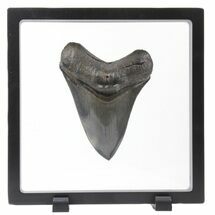
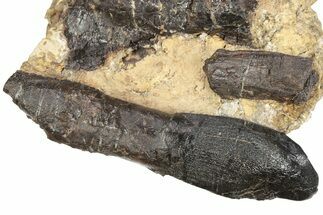
This is a 1.48" long fossil tooth of a monster crocodile (Sarcosuchus imperator). Teeth of this species are only found in the Early Cretaceous (Albian Stage) outcrops of the Elrhaz Formation of Nigeria, though more abundant teeth from other crocodilians are frequently mislabeled as Sarcosuchus.
The tip of this tooth is damaged.
The tip of this tooth is damaged.
It comes with a floating frame display case.
Sarcosuchus was a massive crocodylomorph from the early Cretaceous of North Africa and South America, about 133-112 million years ago. Not a true crocodilian, Sarcosuchus was a member of the crocodylomorpha known as pholidosaurs. Pholidosaurs were similar to modern crocodilians, and are distinguished by their longer and narrower snouts. Additionally, Sarcosuchus was notable for the pronounced bony knob at the end of its snout. Called a bulla, these knobs are similar to those seen in modern crocodilian species. But unlike modern gharials, in which the bulla denotes sex, they are found in every known Sarcosuchus specimen. Sarcosuchus weighed approximately 4.5 tons and measured about 30 feet in length. Unlike its relatives, it was likely a generalist predator, eating any animal unlucky enough to find itself between its jaws.
The Elrhaz formation is an Early Cretaceous fossil formation dating 112-125 million years ago in the Tenere Desert of northeastern Niger. It is mainly known to paleontologists for the Gadoufaoua site, a large fossil deposition painting a picture of the ecology of a wet, green, riverine environment.
The dinosaurs that called this region home include the sail-backed hadrosauriform Ouranosaurus, an herbivore which reached about 28 feet and 2 tons. Nigersaurus, a mid-sized sauropod with a horizontal mouth arranged with dozens of peg-like mowing teeth, would have grazed upon the bounty of greenery in herds that trailed across the landscape. In turn, these large herbivores were hunted by equally large predators.
Eocarcharia was a smaller sized African Carcharodontosaurid, only 20-25 feet long compared to its larger, 40-foot cousins like Giganotosaurus and Carcharodontosaurus. Still, Carcharodontosaurids were formidable predators, hunting with laterally compressed, highly effective cutting teeth. Alongside them were the slightly smaller abelisaurid predator Kryptops. Reaching about 20-23 feet, Kryptops likely used hit and run tactics to wear out prey animals, as opposed to the withering bites delivered by the larger Eocarcharia.
By far the largest predator in the formation, however, was the spinosaurid theropod Suchomimus. Meaning "Crocodile Mimic" for its superficially crocodilian appearance, Suchomimus cleared its competitors' size by a good 10 feet, usually in the realm of 30-35 feet in length and weighing 4 tons. Suchomimus was likely more of a generalist than its spinosaurid cousins. Its body was more suited to wading than to diving. Meanwhile, its size likely made it more than capable of preying on both fish in shallow water and any unfortunate small to mid-sized dinosaurs it may come across.
Notable non-dinosaur fauna from the formation include the super sized Sarcosuchus, a huge crocodylomorph that reached lengths exceeding 30 feet. Other crocodile relatives include the ratlike Araripesuchus, and the broad duck-snouted Anatosuchus. Several fishes called the region their home as well, such as the massive 10- to 15-foot long coelacanth species Mawsonia, and the shark Hybodus.
The dinosaurs that called this region home include the sail-backed hadrosauriform Ouranosaurus, an herbivore which reached about 28 feet and 2 tons. Nigersaurus, a mid-sized sauropod with a horizontal mouth arranged with dozens of peg-like mowing teeth, would have grazed upon the bounty of greenery in herds that trailed across the landscape. In turn, these large herbivores were hunted by equally large predators.
Eocarcharia was a smaller sized African Carcharodontosaurid, only 20-25 feet long compared to its larger, 40-foot cousins like Giganotosaurus and Carcharodontosaurus. Still, Carcharodontosaurids were formidable predators, hunting with laterally compressed, highly effective cutting teeth. Alongside them were the slightly smaller abelisaurid predator Kryptops. Reaching about 20-23 feet, Kryptops likely used hit and run tactics to wear out prey animals, as opposed to the withering bites delivered by the larger Eocarcharia.
By far the largest predator in the formation, however, was the spinosaurid theropod Suchomimus. Meaning "Crocodile Mimic" for its superficially crocodilian appearance, Suchomimus cleared its competitors' size by a good 10 feet, usually in the realm of 30-35 feet in length and weighing 4 tons. Suchomimus was likely more of a generalist than its spinosaurid cousins. Its body was more suited to wading than to diving. Meanwhile, its size likely made it more than capable of preying on both fish in shallow water and any unfortunate small to mid-sized dinosaurs it may come across.
Notable non-dinosaur fauna from the formation include the super sized Sarcosuchus, a huge crocodylomorph that reached lengths exceeding 30 feet. Other crocodile relatives include the ratlike Araripesuchus, and the broad duck-snouted Anatosuchus. Several fishes called the region their home as well, such as the massive 10- to 15-foot long coelacanth species Mawsonia, and the shark Hybodus.
SPECIES
Sarcosuchus imperator (Broin & Taquet, 1966)

LOCATION
Téneré Desert, Niger
FORMATION
Elrhaz Formation
SIZE
1.48" long
CATEGORY
SUB CATEGORY
ITEM
#282118
We guarantee the authenticity of all of our specimens.