Reviews


1.00" Fossil Iguanodontid (I. bernissartensis) Tooth - England


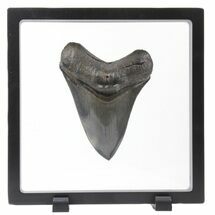
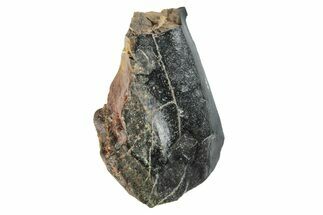
This is the tooth of Iguanodon bernissartensis, an iguanodontid known to have roamed Belgium, England, Spain, and Germany. It was collected from the Isle of Wight in England and is 1.00" long and shows feeding wear at its tip. British dinosaur material is extremely hard to come by and this is a fantastic collector piece.
Comes with a riker display case. There is a repaired crack about 1/4" from the basal end.
Comes with a riker display case. There is a repaired crack about 1/4" from the basal end.
About Iguanodon
Iguanodon was a large, herbivorous dinosaur that lived during the Early Cretaceous period, approximately 125 million years ago. It belonged to the group of dinosaurs called ornithopods, known for their bird-like, bipedal stance. Iguanodon was among the first dinosaurs to be discovered and named, with fossils first identified in the early 19th century. It is recognizable for its robust, bulky body, long tail, and a distinctive thumb spike, which likely served as a defense mechanism against predators or as a tool for foraging.
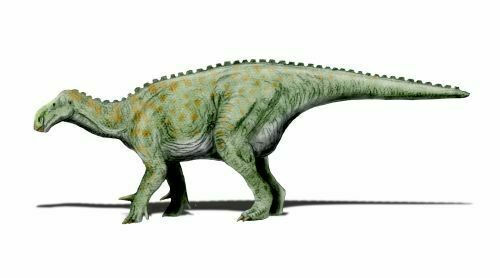
An artist's rendering of Iguanodon, by Nobu Tamura http://paleoexhibit.blogspot.com
Typically reaching lengths of about 30 feet and weighing up to 5 tons, Iguanodon had strong hind legs, allowing it to move both bipedally and quadrupedally, depending on the situation. Its broad, beaked mouth was well-suited for cropping vegetation, and its grinding teeth suggest it primarily ate tough plants. The discovery of Iguanodon provided crucial insights into the diversity and evolution of dinosaurs, marking it as a significant find in paleontology.
The name is derived from 'Iguana', a modern reptile, and 'don', meaning tooth. Scientists used to believe that two species of Iguanodon were found on the Isle of Wight, but one species has been moved off into another genus.
Iguanodon was a large, herbivorous dinosaur that lived during the Early Cretaceous period, approximately 125 million years ago. It belonged to the group of dinosaurs called ornithopods, known for their bird-like, bipedal stance. Iguanodon was among the first dinosaurs to be discovered and named, with fossils first identified in the early 19th century. It is recognizable for its robust, bulky body, long tail, and a distinctive thumb spike, which likely served as a defense mechanism against predators or as a tool for foraging.
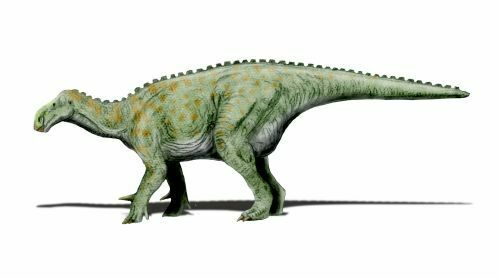
An artist's rendering of Iguanodon, by Nobu Tamura http://paleoexhibit.blogspot.com
Typically reaching lengths of about 30 feet and weighing up to 5 tons, Iguanodon had strong hind legs, allowing it to move both bipedally and quadrupedally, depending on the situation. Its broad, beaked mouth was well-suited for cropping vegetation, and its grinding teeth suggest it primarily ate tough plants. The discovery of Iguanodon provided crucial insights into the diversity and evolution of dinosaurs, marking it as a significant find in paleontology.
The name is derived from 'Iguana', a modern reptile, and 'don', meaning tooth. Scientists used to believe that two species of Iguanodon were found on the Isle of Wight, but one species has been moved off into another genus.
About Isle Of Wight Fossil Deposits
The Isle of Wight, located off the southern coast of England, is one of the world’s most renowned fossil sites, particularly for dinosaur discoveries from the Early Cretaceous period, roughly 125 million years ago. The island’s rich fossil deposits are found mainly along its southern and eastern coastlines, where eroding cliffs and beaches reveal layers of sedimentary rock full of prehistoric treasures. The geology consists of formations like the Wessex Formation, known for preserving dinosaur bones, footprints, and plant fossils, and the Vectis Formation, which includes both terrestrial and freshwater deposits, suggesting a mix of environments from ancient floodplains to lakes and swamps.
Some of the most notable finds on the Isle of Wight include fossils of large herbivorous dinosaurs such as Iguanodon, as well as predators like Neovenator and Baryonyx. These discoveries have contributed significantly to our understanding of Early Cretaceous ecosystems and dinosaur diversity in Europe. Fossils of fish, turtles, crocodiles, and pterosaurs have also been uncovered, alongside fossilized plants, creating a picture of a lush, semi-tropical landscape that once covered the area. Today, the Isle of Wight attracts paleontologists and enthusiasts alike, with its beaches providing a rich hunting ground for fossils that continue to emerge from the cliffs, especially after storms or heavy rains.
The Isle of Wight, located off the southern coast of England, is one of the world’s most renowned fossil sites, particularly for dinosaur discoveries from the Early Cretaceous period, roughly 125 million years ago. The island’s rich fossil deposits are found mainly along its southern and eastern coastlines, where eroding cliffs and beaches reveal layers of sedimentary rock full of prehistoric treasures. The geology consists of formations like the Wessex Formation, known for preserving dinosaur bones, footprints, and plant fossils, and the Vectis Formation, which includes both terrestrial and freshwater deposits, suggesting a mix of environments from ancient floodplains to lakes and swamps.
Some of the most notable finds on the Isle of Wight include fossils of large herbivorous dinosaurs such as Iguanodon, as well as predators like Neovenator and Baryonyx. These discoveries have contributed significantly to our understanding of Early Cretaceous ecosystems and dinosaur diversity in Europe. Fossils of fish, turtles, crocodiles, and pterosaurs have also been uncovered, alongside fossilized plants, creating a picture of a lush, semi-tropical landscape that once covered the area. Today, the Isle of Wight attracts paleontologists and enthusiasts alike, with its beaches providing a rich hunting ground for fossils that continue to emerge from the cliffs, especially after storms or heavy rains.
$1,250
SPECIES
Iguanodon bernissartensis

LOCATION
Atherfield, Isle of Wight, England
FORMATION
Wessex Formation - Wealden Group
SIZE
1.00" long (longest measurement)
CATEGORY
SUB CATEGORY
ITEM
#352102
We guarantee the authenticity of all of our specimens.