 Reviews


This Specimen has been sold.


12.2" Giant Ogyginus Trilobite Fossil - Arouca, Portugal


This is a giant, 12.2" long Ogyginus forteyi from Arouca, Portugal. It comes from the Canelas Quarry which has produced a mega-fauna of Middle Ordovician trilobites. The quarry is now a UNESCO geopark, so no no material will be coming onto the market from this location.
The Canelas Slate Quarry in northern Portugal (now Arouca UNESCO Global Geopark) is world-famous for its extraordinary Middle Ordovician (Darriwilian, ~460 million years ago) trilobite fauna, including some of the largest trilobites ever discovered. Preserved within the dark, fine-grained slates of the Valongo Formation, these fossils often split cleanly across bedding planes, revealing remarkably complete specimens. Giant species such as Ogyginus forteyi and Hungioides bohemicus reached impressive sizes, with some individuals measuring well over half a meter in length. The exceptional preservation is attributed to quiet, offshore marine conditions with low oxygen at the seafloor, which limited scavenging and decay.
The Canelas Slate Quarry in northern Portugal (now Arouca UNESCO Global Geopark) is world-famous for its extraordinary Middle Ordovician (Darriwilian, ~460 million years ago) trilobite fauna, including some of the largest trilobites ever discovered. Preserved within the dark, fine-grained slates of the Valongo Formation, these fossils often split cleanly across bedding planes, revealing remarkably complete specimens. Giant species such as Ogyginus forteyi and Hungioides bohemicus reached impressive sizes, with some individuals measuring well over half a meter in length. The exceptional preservation is attributed to quiet, offshore marine conditions with low oxygen at the seafloor, which limited scavenging and decay.
About Trilobites
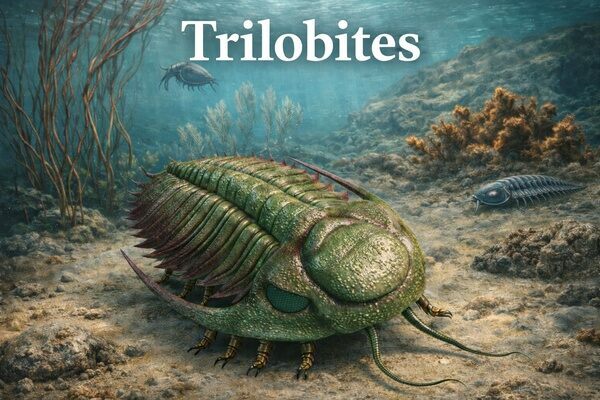
Trilobites were a very diverse group of extinct marine arthropods. They first appeared in the fossil record in the Early Cambrian (521 million years ago) and went extinct during the Permian mass extinction (250 million years ago). They were one of the most successful of the early animals on our planet: over 25,000 species have been described, filling nearly every evolutionary niche. Due in large part to their hard exoskeletons (shells), they left an excellent fossil record.
Trilobites were a very diverse group of extinct marine arthropods. They first appeared in the fossil record in the Early Cambrian (521 million years ago) and went extinct during the Permian mass extinction (250 million years ago). They were one of the most successful of the early animals on our planet: over 25,000 species have been described, filling nearly every evolutionary niche. Due in large part to their hard exoskeletons (shells), they left an excellent fossil record.
SPECIES
Ogyginus forteyi (Rábano, 1989)

LOCATION
Canelas Slate Quarry, Arouca, Portugal
FORMATION
Valongo Formation
SIZE
12.2" long on 12 x 12.8" shale
CATEGORY
ITEM
#351323
We guarantee the authenticity of all of our specimens.


