 Reviews


This Specimen has been sold.


2.3" Stalk-Eyed Asaphus Kowalewskii Trilobite - Russia


This is a 2.3" long, stalk-eyed trilobite (Asaphus kowalewskii) that looks like it is ready to crawl off of the limestone. It is Middle Ordovician in age and was collected at the Vilpovitsy quarry in the St. Petersburg region of Russia. The stalk eyes likely allowed it to survey its surroundings while remaining buried in the mud.
There is very minimal restoration (about 3-4%, primarily at the base of the eye-stalks) on the shell of this excellent specimen. The limestone has been cut flat on oner edge to allow for display on an even surface.
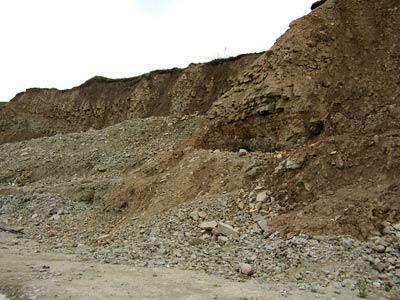
Photo of the Vilpovitsy quarry near St. Petersburg, Russia, where this trilobite was found.
There is very minimal restoration (about 3-4%, primarily at the base of the eye-stalks) on the shell of this excellent specimen. The limestone has been cut flat on oner edge to allow for display on an even surface.
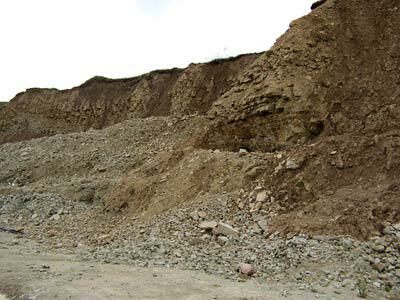
Photo of the Vilpovitsy quarry near St. Petersburg, Russia, where this trilobite was found.
About Trilobites
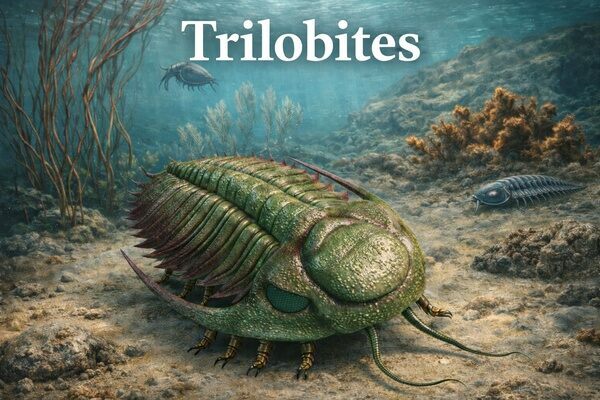
Trilobites were a very diverse group of extinct marine arthropods. They first appeared in the fossil record in the Early Cambrian (521 million years ago) and went extinct during the Permian mass extinction (250 million years ago). They were one of the most successful of the early animals on our planet: over 25,000 species have been described, filling nearly every evolutionary niche. Due in large part to their hard exoskeletons (shells), they left an excellent fossil record.
Trilobites were a very diverse group of extinct marine arthropods. They first appeared in the fossil record in the Early Cambrian (521 million years ago) and went extinct during the Permian mass extinction (250 million years ago). They were one of the most successful of the early animals on our planet: over 25,000 species have been described, filling nearly every evolutionary niche. Due in large part to their hard exoskeletons (shells), they left an excellent fossil record.
SPECIES
Asaphus kowalewskii

LOCATION
Vilpovitsy quarry, St. Petersburg region, Russia
FORMATION
Asery level
SIZE
2.3" long (not including stalks)
CATEGORY
SUB CATEGORY
ITEM
#237031
We guarantee the authenticity of all of our specimens.


