 Reviews


5.2" Fossil Iguanodon Pes Phalanx (Toe Bone) - Isle of Wight, England


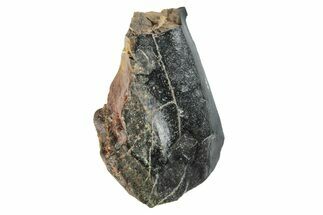
This is a beefy phalanx (toe bone) from an adult iguanodontid (Iguanodon sp. indet.) known to have roamed Belgium, England, Spain, and Germany. It was collected from the Isle of Wight in England. It's beautifully intact with no repair or restoration required following prep. British dinosaur material is extremely hard to come by and this is a fantastic collector piece.
The dimensions of this incredible specimen are 5.2 x 4.7 x 3.7". There is weathering along the anterior and posterior points of articulation, exposing the intricate bone cells.
The dimensions of this incredible specimen are 5.2 x 4.7 x 3.7". There is weathering along the anterior and posterior points of articulation, exposing the intricate bone cells.
Iguanodontians are a large clade of herbivorous dinosaurs that can be found all over the world. They are among some of the first dinosaurs ever discovered and remain well-known and recognized today. Its members span from the earlier iguanodonts of the early Cretaceous, with large "thumb spikes", to the hadrosaurids of the late Cretaceous. Iguanodontian dinosaurs were often bipedal, but some became quadrupedal in their adult stages as their bodies grew larger, browsing for vegetation on powerful back legs and shorter arms ending in fleshy "mittens" that looked a bit like hooves. This has earned them their nicknames as "dinosaurian cows".
As long as these dinosaurs have been discovered, they have been part of the popular imagination and interest in prehistoric life. Walt Disney Studios released the film Dinosaur in 2000, featuring iguanodons in startlingly lifelike detail. This clade even helped inspire the look of classic movie monster Godzilla!
Notable genera in this clade include the flagship Iguanodon, its first described member, Hadrosaurs, Camptosaurus, and Dryosaurus.
As long as these dinosaurs have been discovered, they have been part of the popular imagination and interest in prehistoric life. Walt Disney Studios released the film Dinosaur in 2000, featuring iguanodons in startlingly lifelike detail. This clade even helped inspire the look of classic movie monster Godzilla!
Notable genera in this clade include the flagship Iguanodon, its first described member, Hadrosaurs, Camptosaurus, and Dryosaurus.
About Isle Of Wight Fossil Deposits
The Isle of Wight, located off the southern coast of England, is one of the world’s most renowned fossil sites, particularly for dinosaur discoveries from the Early Cretaceous period, roughly 125 million years ago. The island’s rich fossil deposits are found mainly along its southern and eastern coastlines, where eroding cliffs and beaches reveal layers of sedimentary rock full of prehistoric treasures. The geology consists of formations like the Wessex Formation, known for preserving dinosaur bones, footprints, and plant fossils, and the Vectis Formation, which includes both terrestrial and freshwater deposits, suggesting a mix of environments from ancient floodplains to lakes and swamps.
Some of the most notable finds on the Isle of Wight include fossils of large herbivorous dinosaurs such as Iguanodon, as well as predators like Neovenator and Baryonyx. These discoveries have contributed significantly to our understanding of Early Cretaceous ecosystems and dinosaur diversity in Europe. Fossils of fish, turtles, crocodiles, and pterosaurs have also been uncovered, alongside fossilized plants, creating a picture of a lush, semi-tropical landscape that once covered the area. Today, the Isle of Wight attracts paleontologists and enthusiasts alike, with its beaches providing a rich hunting ground for fossils that continue to emerge from the cliffs, especially after storms or heavy rains.
The Isle of Wight, located off the southern coast of England, is one of the world’s most renowned fossil sites, particularly for dinosaur discoveries from the Early Cretaceous period, roughly 125 million years ago. The island’s rich fossil deposits are found mainly along its southern and eastern coastlines, where eroding cliffs and beaches reveal layers of sedimentary rock full of prehistoric treasures. The geology consists of formations like the Wessex Formation, known for preserving dinosaur bones, footprints, and plant fossils, and the Vectis Formation, which includes both terrestrial and freshwater deposits, suggesting a mix of environments from ancient floodplains to lakes and swamps.
Some of the most notable finds on the Isle of Wight include fossils of large herbivorous dinosaurs such as Iguanodon, as well as predators like Neovenator and Baryonyx. These discoveries have contributed significantly to our understanding of Early Cretaceous ecosystems and dinosaur diversity in Europe. Fossils of fish, turtles, crocodiles, and pterosaurs have also been uncovered, alongside fossilized plants, creating a picture of a lush, semi-tropical landscape that once covered the area. Today, the Isle of Wight attracts paleontologists and enthusiasts alike, with its beaches providing a rich hunting ground for fossils that continue to emerge from the cliffs, especially after storms or heavy rains.
$2,950
SPECIES
Iguanodon sp. indet.

LOCATION
Atherfield, Isle of Wight, England
FORMATION
Wessex Formation - Wealden Group
SIZE
5.2 x 4.7 x 3.7"
CATEGORY
SUB CATEGORY
ITEM
#354085
We guarantee the authenticity of all of our specimens.