 Reviews


This Specimen has been sold.


7.3" Partial Fossil Crocodilian (Dyrosaurus) Rostrum - Morocco


This is a 7.3" long section of the upper and lower jaws of an Early Eocene crocodilian (Dyrosaurus maghribensis). The specimen was collected from the phosphate deposits in the Oulad Abdoun Basin of Morocco.
There are a few cracks through this skull section that have been stabilized with glue. Many of these cracks required additional gap fill restoration. Most of the teeth exhibit signs of repair and some may have been placed in the jaw for a more complete presentation. There are several tooth roots preserved within their pockets and a couple unerupted teeth, though there are twenty crowns still very visible.
This specimen is accompanied by an acrylic display stand.
There are a few cracks through this skull section that have been stabilized with glue. Many of these cracks required additional gap fill restoration. Most of the teeth exhibit signs of repair and some may have been placed in the jaw for a more complete presentation. There are several tooth roots preserved within their pockets and a couple unerupted teeth, though there are twenty crowns still very visible.
This specimen is accompanied by an acrylic display stand.
Dyrosaurus is a genus of extinct crocodylomorph that lived during the early Eocene in what is now north Africa. It grew up to 19 feet (6 meters) long and had jaws filled with many thin, recurved teeth, which would have been optimal for catching fish. There are two described species: Dyrosaurus phosphaticus and Dyrosaurus maghribensis, of which the latter is found exclusively in the phosphate deposits of the Oulad Abdoun Basin in Morocco.
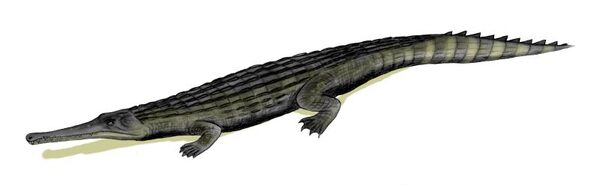
An artist's reconstruction of Dyrosaurus. By Nobu Tamura (Creative Commons License)
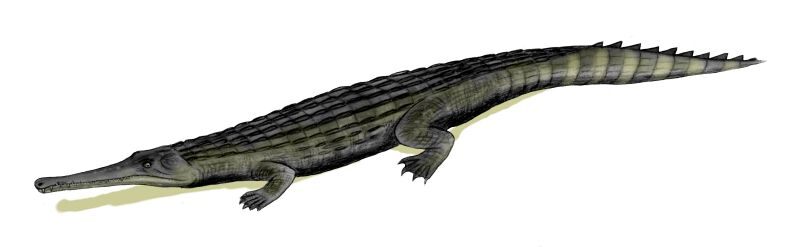
An artist's reconstruction of Dyrosaurus. By Nobu Tamura (Creative Commons License)
About the Oulad Abdoun Basin
The Oulad Abdoun Basin in central Morocco is one of the most famous phosphate deposit regions in the world, not only for its economic importance but also for its extraordinary fossil wealth. Formed during the Late Cretaceous to Paleogene, these marine phosphate layers record a time when northern Africa was covered by a warm, shallow sea teeming with life.
What makes the Oulad Abdoun deposits especially significant is the remarkable preservation and diversity of vertebrate fossils found within the phosphate beds. The basin is renowned for producing abundant remains of marine reptiles such as mosasaurs and plesiosaurs, along with fossil sharks, rays, bony fish, and turtles. These fossils typically occur as isolated teeth, bones, and partial skeletons concentrated within the phosphatic sediments. Today, many of these specimens are collected as a byproduct of large-scale phosphate mining operations—rescued before the rock is processed and crushed—ultimately saving them from certain destruction in the rock crushers and preserving an extraordinary record of ancient marine life.
The Oulad Abdoun Basin in central Morocco is one of the most famous phosphate deposit regions in the world, not only for its economic importance but also for its extraordinary fossil wealth. Formed during the Late Cretaceous to Paleogene, these marine phosphate layers record a time when northern Africa was covered by a warm, shallow sea teeming with life.
What makes the Oulad Abdoun deposits especially significant is the remarkable preservation and diversity of vertebrate fossils found within the phosphate beds. The basin is renowned for producing abundant remains of marine reptiles such as mosasaurs and plesiosaurs, along with fossil sharks, rays, bony fish, and turtles. These fossils typically occur as isolated teeth, bones, and partial skeletons concentrated within the phosphatic sediments. Today, many of these specimens are collected as a byproduct of large-scale phosphate mining operations—rescued before the rock is processed and crushed—ultimately saving them from certain destruction in the rock crushers and preserving an extraordinary record of ancient marine life.
SPECIES
Dyrosaurus maghribensis
AGE

LOCATION
Oulad Abdoun Basin, Morocco
FORMATION
Phosphate Deposits
SIZE
7.3" long, 3.1" wide
CATEGORY
SUB CATEGORY
ITEM
#220677
We guarantee the authenticity of all of our specimens.


