 Reviews


This Specimen has been sold.


.77" Pyritized Triarthrus Trilobite With Eggs & Ovarian Network!


This is an incredible, pyritized specimen of the trilobite Triarthrus eatoni preserving appendages, antennae, and even EGGS! Until recently little had been known about the reproduction of these iconic Paleozoic arthropods, and never before have unambiguous eggs or genitalia been found preserved. Trilobites from a single layer of the a quarry in the Whetstone Gulf Formation of New York, were found to have associated eggs still in place. The eggs are spherical to elliptical in shape, about 200 µm in size, and are clustered in the genal area of the cephalon. The location of the eggs is consistent with where modern female horseshoe crabs release their unfertilized eggs.
Below is a link to the paper published years ago on this amazing find.
Pyritized in situ trilobite eggs from the Ordovician of New York (Lorraine Group): Implications for trilobite reproductive biology
A great article on this discovery can be found below.
Wow! Fossilized trilobite eggs!
This Triarthrus specimen measures .77" long (including antennae) and is preserved dorsally. Eggs can be seen on one side of its head, and on the other is what's presumed to be an ovarian network that produces the eggs. A really cool specimen!
Included with this specimen are printed copies of the two cropped in photos seen above.
Below is a link to the paper published years ago on this amazing find.
Pyritized in situ trilobite eggs from the Ordovician of New York (Lorraine Group): Implications for trilobite reproductive biology
A great article on this discovery can be found below.
Wow! Fossilized trilobite eggs!
About Pyritized Triarthrus Trilobites
Localities capable of preserving trilobites with soft-bodied anatomy are extraordinarily rare. Among the most famous of these is the historic Beecher’s Trilobite Bed, part of the Upper Ordovician Lorraine Group of New York, from which this specimen originates.
Beecher’s Trilobite Bed is renowned for its exceptional preservation, capturing details far beyond the typical mineralized exoskeletons seen at most fossil sites. Under unique conditions of rapid burial and oxygen-depleted (anoxic) seafloor sediments, trilobites and other organisms were sealed off from decay and scavenging almost instantly.
In this environment, soft tissues—normally lost to time—were chemically replaced by pyrite (iron sulfide) in a process known as pyritization. This remarkable mode of preservation records fine anatomical details such as limbs, antennae, digestive structures, and other soft-bodied features rarely seen in the trilobite fossil record.
Localities capable of preserving trilobites with soft-bodied anatomy are extraordinarily rare. Among the most famous of these is the historic Beecher’s Trilobite Bed, part of the Upper Ordovician Lorraine Group of New York, from which this specimen originates.
Beecher’s Trilobite Bed is renowned for its exceptional preservation, capturing details far beyond the typical mineralized exoskeletons seen at most fossil sites. Under unique conditions of rapid burial and oxygen-depleted (anoxic) seafloor sediments, trilobites and other organisms were sealed off from decay and scavenging almost instantly.
In this environment, soft tissues—normally lost to time—were chemically replaced by pyrite (iron sulfide) in a process known as pyritization. This remarkable mode of preservation records fine anatomical details such as limbs, antennae, digestive structures, and other soft-bodied features rarely seen in the trilobite fossil record.
This Triarthrus specimen measures .77" long (including antennae) and is preserved dorsally. Eggs can be seen on one side of its head, and on the other is what's presumed to be an ovarian network that produces the eggs. A really cool specimen!
Included with this specimen are printed copies of the two cropped in photos seen above.
About Trilobites
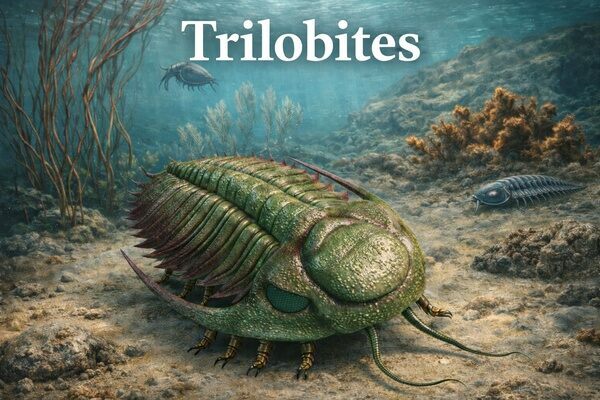
Trilobites were a very diverse group of extinct marine arthropods. They first appeared in the fossil record in the Early Cambrian (521 million years ago) and went extinct during the Permian mass extinction (250 million years ago). They were one of the most successful of the early animals on our planet: over 25,000 species have been described, filling nearly every evolutionary niche. Due in large part to their hard exoskeletons (shells), they left an excellent fossil record.
Trilobites were a very diverse group of extinct marine arthropods. They first appeared in the fossil record in the Early Cambrian (521 million years ago) and went extinct during the Permian mass extinction (250 million years ago). They were one of the most successful of the early animals on our planet: over 25,000 species have been described, filling nearly every evolutionary niche. Due in large part to their hard exoskeletons (shells), they left an excellent fossil record.
SPECIES
Triarthrus eatoni
AGE

LOCATION
Lewis County, NY
FORMATION
Whetstone Gulf Formation, Lorraine Group
SIZE
Trilobite .77" long on 4 x 3.4" shale
CATEGORY
SUB CATEGORY
ITEM
#293173
We guarantee the authenticity of all of our specimens.


