 Reviews


This Specimen has been sold.

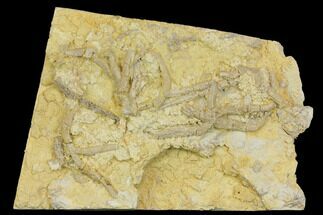

8.4" Cluster Of Ordovician Brittle Star Fossils - Morocco


This is an attractive cluster of three finely detailed Ordovician-aged brittle star fossils (*Ophiura* sp.) from the Kataoua Formation of Morocco. The fossils are naturally associated on an 8.4 x 7.5" section of limestone, creating an impressive display piece.
Their distinctive rusty-orange coloration is natural, resulting from the oxidation of pyrite (iron sulfide) associated with their preservation. The limestone has been carefully etched along the outlines of the brittle stars using an air scribe, enhancing their contrast with the surrounding matrix while leaving the fossils and surrounding rock largely intact.
Includes an acrylic display stand.
About Brittle Stars
Brittle stars are echinoderms, making them relatives of starfish, sea urchins, and crinoids. Unlike true starfish, brittle stars typically have long, flexible arms that are sharply distinct from the central body disc. They use these arms to move across the seafloor, capture food particles, and interact with their environment. Fossil brittle stars are much less commonly encountered than many other marine fossils because their delicate skeletons are prone to disarticulation after death, making well-preserved examples especially desirable.
The Kataoua Formation of Morocco is known for producing exceptional Ordovician marine fossils, including echinoderms, trilobites, and other seafloor-dwelling organisms. This specimen offers a striking look at an ancient brittle star from a marine ecosystem that existed roughly 450 million years ago.
SPECIES
Ophiura sp.
AGE

LOCATION
Kaid rami, Morocco
FORMATION
Kataoua Formation
SIZE
Rock 8.4 x 7.5", Largest Brittle Star 4.5" wide
CATEGORY
SUB CATEGORY
ITEM
#385635
We guarantee the authenticity of all of our specimens.


