 Reviews


This Specimen has been sold.


Jurassic Ammonites, Brachiopod, Belemnite & Sea Snail Fossils - France


This is a stunning, 7.3" wide natural association of fossil ammonites, a brachiopod, a belemnite rostrum, and sea snail shells. The fossils include four ammonites of the species Chondroceras evolvenscens, a rare ammonite of the genus Poecilomorphus, a brachiopod of the genus Sphaerothris, a belemnite rostrum from Belemnopsis canaliculata, and two sea snail (Obornella granulata) shells. This incredible fossil specimen was collected from a Middle Jurassic (Bajocian Stage) marine deposit in Évrecy, France. All of the fossils have been exposed in high relief from the rock they were found in.
Comes with an acrylic display stand to assist with presentation.
Comes with an acrylic display stand to assist with presentation.
About Ammonites
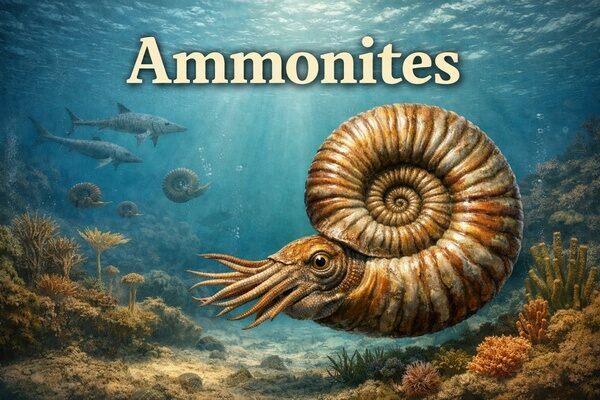
Ammonites were ancient marine cephalopods, similar to today's squids and octopuses, but with a defining feature: their distinctive, tightly coiled spiral shells. These shells, resembling those of modern nautiluses, served as both a protective home and a buoyancy aid, allowing ammonites to navigate the prehistoric seas with ease. First emerging around 240 million years ago in the Triassic Period, ammonites thrived for over 175 million years, adapting through numerous forms and sizes. As predatory creatures, they likely fed on smaller marine organisms, using their tentacles to capture prey. However, their long reign came to an end 65 million years ago at the close of the Cretaceous, coinciding with the mass extinction event that also eliminated the dinosaurs.
Ammonites were ancient marine cephalopods, similar to today's squids and octopuses, but with a defining feature: their distinctive, tightly coiled spiral shells. These shells, resembling those of modern nautiluses, served as both a protective home and a buoyancy aid, allowing ammonites to navigate the prehistoric seas with ease. First emerging around 240 million years ago in the Triassic Period, ammonites thrived for over 175 million years, adapting through numerous forms and sizes. As predatory creatures, they likely fed on smaller marine organisms, using their tentacles to capture prey. However, their long reign came to an end 65 million years ago at the close of the Cretaceous, coinciding with the mass extinction event that also eliminated the dinosaurs.
Belemnites are probably the most well known extinct cephalopod after the ammonites. They lived during the Jurassic and Cretaceous periods and are fairly common fossils found throughout the world. They had a hard, internal, cone-shaped structure that is often preserved as a fossil, though it is not technically a shell. They had ten arms but, unlike modern squid, these arms had small hooks instead of suckers.
SPECIES
Chondroceras evolvenscens, Poecilomorphus sp. Sphaerothris sp., Belemnopsis canaliculata & Obornella granulata

LOCATION
Évrecy, France
SIZE
Largest Ammonite: 1.5" wide, Entire Specimen: 7.3 x 3.5"
CATEGORY
SUB CATEGORY
ITEM
#367912
We guarantee the authenticity of all of our specimens.


