 Reviews


This Specimen has been sold.


Serrated, .67" Dromaeosaurid Theropod (Acheroraptor) Tooth - Montana


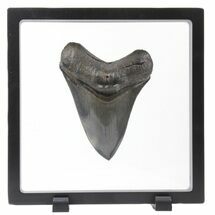
This is a .67" long dromaeosaurid theropod (Acheroraptor temertyorum) tooth from the Hell Creek Formation in Montana. At .67" long it's quite large for these raptor teeth, it has great enamel preservation, fine serrations, well defined ridges, and a sharp tip. Comes in an acrylic display case.
About Acheroraptor
Acheroraptor temertyorum was described in 2013 from upper and lower jaw bones containing teeth. The teeth have been known for decades, but no diagnostic material had been recovered. Acheroraptor lived in the Cretaceous period 67-66 million years ago and were relatively large for a raptors. They resembled Asian velociraptors more closely than other North American Dromaeosaurs.
Smaller theropods like Acheraptor typically did not use their teeth for killing, so their teeth are much smaller in size in relation to their skulls when compared to larger theropods that used their teeth as the primary killing tool.
Acheroraptor teeth are like tiny, slightly curved daggers with rounded serrations, with larger posterior serrations than anterior. The most distinguishing features are their apicobasal ridges, running from the base of the tooth to the apex.
Many of the raptor teeth found in the Hell Creek Formation show morphological differences often attributed to taxa from other formations of different ages. Among those are Saurornitholestes, Richardoestesia gilmorei, Richardoestesia isosceles, and Paronychodon. Remains of all of these species are fragmentary and some known only from teeth: there is no evidence they lived in the Hell Creek Formation.
A 2013 study found that Acheroraptor was the only dromaeosaurid from the Hell Creek Formation and concluded that dromaeosaurid teeth formerly attributed to other taxa should be identified as Acheroraptor. Any other identification is not supported scientifically until associated skeletal remains are found to indicate otherwise.
Acheroraptor temertyorum was described in 2013 from upper and lower jaw bones containing teeth. The teeth have been known for decades, but no diagnostic material had been recovered. Acheroraptor lived in the Cretaceous period 67-66 million years ago and were relatively large for a raptors. They resembled Asian velociraptors more closely than other North American Dromaeosaurs.
Smaller theropods like Acheraptor typically did not use their teeth for killing, so their teeth are much smaller in size in relation to their skulls when compared to larger theropods that used their teeth as the primary killing tool.
Acheroraptor teeth are like tiny, slightly curved daggers with rounded serrations, with larger posterior serrations than anterior. The most distinguishing features are their apicobasal ridges, running from the base of the tooth to the apex.
Many of the raptor teeth found in the Hell Creek Formation show morphological differences often attributed to taxa from other formations of different ages. Among those are Saurornitholestes, Richardoestesia gilmorei, Richardoestesia isosceles, and Paronychodon. Remains of all of these species are fragmentary and some known only from teeth: there is no evidence they lived in the Hell Creek Formation.
A 2013 study found that Acheroraptor was the only dromaeosaurid from the Hell Creek Formation and concluded that dromaeosaurid teeth formerly attributed to other taxa should be identified as Acheroraptor. Any other identification is not supported scientifically until associated skeletal remains are found to indicate otherwise.
The Hell Creek Formation
Renowned for both its age and rich sedimentary layers, the Hell Creek Formation is one of the most intensively studied fossil-bearing regions on Earth. To date, scientists have documented 158 genera of animals and 64 genera of plants from its rocks, with new finds emerging regularly. Beyond iconic dinosaurs such as tyrannosaurs, ceratopsians, and hadrosaurs, the formation has produced an extraordinary array of life, including amphibians, reptiles, lizards, snakes, turtles, fish, sharks, birds, and early mammals. Together, these fossils provide the most complete picture of the ecosystems that thrived just before the Cretaceous–Paleogene extinction event.
Renowned for both its age and rich sedimentary layers, the Hell Creek Formation is one of the most intensively studied fossil-bearing regions on Earth. To date, scientists have documented 158 genera of animals and 64 genera of plants from its rocks, with new finds emerging regularly. Beyond iconic dinosaurs such as tyrannosaurs, ceratopsians, and hadrosaurs, the formation has produced an extraordinary array of life, including amphibians, reptiles, lizards, snakes, turtles, fish, sharks, birds, and early mammals. Together, these fossils provide the most complete picture of the ecosystems that thrived just before the Cretaceous–Paleogene extinction event.
SPECIES
Acheroraptor temertyorum

LOCATION
Private Ranch, Eastern Montana
FORMATION
Hell Creek Formation
SIZE
.67" long (straightline)
CATEGORY
SUB CATEGORY
ITEM
#204047
We guarantee the authenticity of all of our specimens.