 Reviews

This Specimen has been sold.


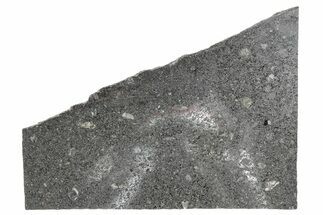
1.42" Polished Pallasite Meteorite (4.6 g) Slice - NWA 16799 (Prov)


This 1.42" wide (4.6 gram) sliced and polished piece of pallasite meteorite comes from Northwest Africa. It's part of a new, small find that has yet to be formally documented. The thin slicing of the pallasite beautifully highlights the olivine (forsterite) crystals' translucency when backlit. This specimen has been coated with a thin layer of epoxy to prevent rusting.
Comes with an acrylic display stand.
The thin slicing of this meteorite makes it relatively fragile. Please be careful when removing the specimen from packaging.
Comes with an acrylic display stand.
The thin slicing of this meteorite makes it relatively fragile. Please be careful when removing the specimen from packaging.
About Pallasites
Pallasite meteorites are a class of stony-iron meteorites. They were once believed to have originated at the core-mantle boundary of asteroids that shattered through impacts, but a recent hypothesis is that they are a mixture of core and mantle minerals.
Pallasite meteorites consist of olivine (peridot) crystals surrounded by iron-nickel matrix. Upon acid etching, some pallasites display interweaving structures known as Widmanstätten patterns (or Thomson lines) in the metallic matrix. These structures are iron-nickel alloy crystals, typically kamacite and taenite, that cooled over millions of years in the vacuum of space.
Pallasites are quite rare: only about 200 are known, and only four have had observed falls. This represents less than 0.2% of all classified meteorites!
Pallasite meteorites are a class of stony-iron meteorites. They were once believed to have originated at the core-mantle boundary of asteroids that shattered through impacts, but a recent hypothesis is that they are a mixture of core and mantle minerals.
Pallasite meteorites consist of olivine (peridot) crystals surrounded by iron-nickel matrix. Upon acid etching, some pallasites display interweaving structures known as Widmanstätten patterns (or Thomson lines) in the metallic matrix. These structures are iron-nickel alloy crystals, typically kamacite and taenite, that cooled over millions of years in the vacuum of space.
Pallasites are quite rare: only about 200 are known, and only four have had observed falls. This represents less than 0.2% of all classified meteorites!
TYPE
Pallasite
LOCATION
Northwest Africa
SIZE
Size: 1.42 x .75", .1" thick, Weight: 4.6 grams
CATEGORY
ITEM
#303848