Reviews

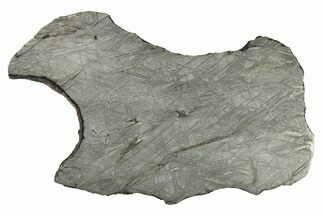
2.48" Etched Toluca Iron Meteorite (61.78 g) Slice - Mexico

This is a gorgeous, 2.48" wide (61.78 gram) etched slice of the Toluca iron meteorite from Mexico. It shows very nice Widmanstätten patterns on the cut and polished face.
Iron Meteorite Care - Important!
Iron meteorites can be susceptible to rusting and deterioration due to moisture in the atmosphere; proper care includes avoiding handling them with your bare hands, as the oils form your skin can affect the metal, and especially keeping them in moisture-free environments. This is particularly important in areas with high humidity, such as Florida. All iron meteorite material we sell has been stabilized in some way, which will help with this issue, but care still needs to be taken to keep your treasure in good condition. Keep iron meteorites stored in a moisture-free environment, preferably with a corrosion inhibitor such as an enclosed display case with a dehumidifier or desiccants.
It's suggested that you inspect your specimen at least once a month, looking specifically for spots that appear discolored (brown or yellow in hue). If a rust spot develops, immediate attention is required to prevent it from spreading. It can be treated by gently rubbing the spot with a cotton swab dipped in CLR (Calcium, Lime, and Rust remover). Repeat this process until the rust color is removed. The meteorite should then be rinsed with alcohol (100% pure is best).
Following this process, it is safe to bake the meteorite for about an hour at 200˚ F (150˚ F for stony-iron meteorites like pallasites) to remove any remaining moisture. Be careful when removing it from the oven as the metal will be hot. A bath in ATF (automatic transmission fluid) or high quality, light oil is suggested while the meteorite is still hot. Once cooled, remove any excess fluid and place it back in its moisture free environment.
Iron meteorites can be susceptible to rusting and deterioration due to moisture in the atmosphere; proper care includes avoiding handling them with your bare hands, as the oils form your skin can affect the metal, and especially keeping them in moisture-free environments. This is particularly important in areas with high humidity, such as Florida. All iron meteorite material we sell has been stabilized in some way, which will help with this issue, but care still needs to be taken to keep your treasure in good condition. Keep iron meteorites stored in a moisture-free environment, preferably with a corrosion inhibitor such as an enclosed display case with a dehumidifier or desiccants.
It's suggested that you inspect your specimen at least once a month, looking specifically for spots that appear discolored (brown or yellow in hue). If a rust spot develops, immediate attention is required to prevent it from spreading. It can be treated by gently rubbing the spot with a cotton swab dipped in CLR (Calcium, Lime, and Rust remover). Repeat this process until the rust color is removed. The meteorite should then be rinsed with alcohol (100% pure is best).
Following this process, it is safe to bake the meteorite for about an hour at 200˚ F (150˚ F for stony-iron meteorites like pallasites) to remove any remaining moisture. Be careful when removing it from the oven as the metal will be hot. A bath in ATF (automatic transmission fluid) or high quality, light oil is suggested while the meteorite is still hot. Once cooled, remove any excess fluid and place it back in its moisture free environment.
The Toluca Meteorite
The Toluca meteorite is a coarse octahedrite (Iron, IAB-sLL) meteorite, one of the oldest known meteorites on Earth. It fell in south-central Mexico as early as 50 to 60,000 years ago near the present-day city of Toluca. It was likely used by local peoples to craft tools and weapons, and was recognized as a meteorite by the West in 1776. Its main mass is held in Mexico City.
When etched, this meteorite displays wonderful, interlocking Widmanstätten lines. It can also contain dark nodules of silica in places.
The Toluca meteorite is a coarse octahedrite (Iron, IAB-sLL) meteorite, one of the oldest known meteorites on Earth. It fell in south-central Mexico as early as 50 to 60,000 years ago near the present-day city of Toluca. It was likely used by local peoples to craft tools and weapons, and was recognized as a meteorite by the West in 1776. Its main mass is held in Mexico City.
When etched, this meteorite displays wonderful, interlocking Widmanstätten lines. It can also contain dark nodules of silica in places.
About Iron Meteorites
Iron type meteorites are composed primarily of iron and nickel, and are the remnants of differential cores torn apart at the beginning of the solar system. These metallic meteorites are often the easiest to identify after millions of years post-impact because they are quite different from terrestrial material, especially when it comes to their mass-to-surface area ratio. They are exceptionally heavy for their size since iron is a high-density metal: this is also why the Earth's core is nickel-iron. As planets form, the densest metals form gravitational centers, bringing more and more material into their gravitational pull. In the solar system's rocky planets, these dense materials are most often nickel and iron.
Most iron meteorites have distinctive, geometric patterns called Widmanstätten patterns, which become visible when the meteorite is cut and acid etched. These patterns are criss-crossing bands of the iron-nickel alloys kamacite and taenite that slowly crystalized as the core of the meteorites' parent bodies slowly cooled. Such large alloy crystallizations for mover millions of years and do not occur naturally on Earth, further proving that iron meteorites come from extraterrestrial bodies.
Iron type meteorites are composed primarily of iron and nickel, and are the remnants of differential cores torn apart at the beginning of the solar system. These metallic meteorites are often the easiest to identify after millions of years post-impact because they are quite different from terrestrial material, especially when it comes to their mass-to-surface area ratio. They are exceptionally heavy for their size since iron is a high-density metal: this is also why the Earth's core is nickel-iron. As planets form, the densest metals form gravitational centers, bringing more and more material into their gravitational pull. In the solar system's rocky planets, these dense materials are most often nickel and iron.
Most iron meteorites have distinctive, geometric patterns called Widmanstätten patterns, which become visible when the meteorite is cut and acid etched. These patterns are criss-crossing bands of the iron-nickel alloys kamacite and taenite that slowly crystalized as the core of the meteorites' parent bodies slowly cooled. Such large alloy crystallizations for mover millions of years and do not occur naturally on Earth, further proving that iron meteorites come from extraterrestrial bodies.
$155
TYPE
Iron, IAB (sLL)
AGE

LOCATION
Near Toluca, Xiquipilco, Mexico
SIZE
2.48 x 2.33 x .10", Weight: 61.78 grams
CATEGORY
SUB CATEGORY
ITEM
#346492