 Reviews

This Specimen has been sold.


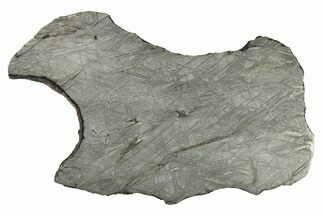
4.11" Etched Odessa Iron Meteorite Slice (48.3 g) - Texas

This is a 4.11" wide (48.3 grams) piece of the Odessa iron meteorite collected in Ector County, Texas. It has been nicely cut and etched into a slice to display the complex Widmanstätten pattern.
About The Odessa Iron Meteorite
The Odessa iron meteorite is an iron octahedrite (IAB-MG) meteorite collected in 1922 within Ector County, Texas. A total of approximately 1.6 tons of meteorite fragments were collected in and around the Odessa Crater in Texas, which was the second recognized impact crater in the United States. This crater is estimated to be about 63,500 years old and was found by a rancher who stumbled upon it while looking for a lost calf.
It is believed that the meteor broke into two significant fragments. The larger would be responsible for the main crater, and the smaller for the eastern part of the crater. Data suggests that these pieces had a near simultaneous impact, which would create the strange shape of the crater. According to extensive geological research by A&M Graduate Charles Edward Stanford, the original crater was approximately 394 Ft. in diameter, and approximately 115 Ft. in depth.
Meteoritical Bulletin: Entry for Odessa (Iron)
The Odessa iron meteorite is an iron octahedrite (IAB-MG) meteorite collected in 1922 within Ector County, Texas. A total of approximately 1.6 tons of meteorite fragments were collected in and around the Odessa Crater in Texas, which was the second recognized impact crater in the United States. This crater is estimated to be about 63,500 years old and was found by a rancher who stumbled upon it while looking for a lost calf.
It is believed that the meteor broke into two significant fragments. The larger would be responsible for the main crater, and the smaller for the eastern part of the crater. Data suggests that these pieces had a near simultaneous impact, which would create the strange shape of the crater. According to extensive geological research by A&M Graduate Charles Edward Stanford, the original crater was approximately 394 Ft. in diameter, and approximately 115 Ft. in depth.
Meteoritical Bulletin: Entry for Odessa (Iron)
About Iron Meteorites
Iron type meteorites are composed primarily of iron and nickel, and are the remnants of differential cores torn apart at the beginning of the solar system. These metallic meteorites are often the easiest to identify after millions of years post-impact because they are quite different from terrestrial material, especially when it comes to their mass-to-surface area ratio. They are exceptionally heavy for their size since iron is a high-density metal: this is also why the Earth's core is nickel-iron. As planets form, the densest metals form gravitational centers, bringing more and more material into their gravitational pull. In the solar system's rocky planets, these dense materials are most often nickel and iron.
Most iron meteorites have distinctive, geometric patterns called Widmanstätten patterns, which become visible when the meteorite is cut and acid etched. These patterns are criss-crossing bands of the iron-nickel alloys kamacite and taenite that slowly crystalized as the core of the meteorites' parent bodies slowly cooled. Such large alloy crystallizations for mover millions of years and do not occur naturally on Earth, further proving that iron meteorites come from extraterrestrial bodies.
Iron type meteorites are composed primarily of iron and nickel, and are the remnants of differential cores torn apart at the beginning of the solar system. These metallic meteorites are often the easiest to identify after millions of years post-impact because they are quite different from terrestrial material, especially when it comes to their mass-to-surface area ratio. They are exceptionally heavy for their size since iron is a high-density metal: this is also why the Earth's core is nickel-iron. As planets form, the densest metals form gravitational centers, bringing more and more material into their gravitational pull. In the solar system's rocky planets, these dense materials are most often nickel and iron.
Most iron meteorites have distinctive, geometric patterns called Widmanstätten patterns, which become visible when the meteorite is cut and acid etched. These patterns are criss-crossing bands of the iron-nickel alloys kamacite and taenite that slowly crystalized as the core of the meteorites' parent bodies slowly cooled. Such large alloy crystallizations for mover millions of years and do not occur naturally on Earth, further proving that iron meteorites come from extraterrestrial bodies.
TYPE
Iron (IAB-MG)
AGE

LOCATION
Ector County, Texas
SIZE
4.11 x 1.58", .10" thick, Weight: 48.3 grams
CATEGORY
SUB CATEGORY
ITEM
#329365