 Reviews

This Specimen has been sold.


.4" Meteorite (IIIAB) Fragment (0.33 g) - Wabar
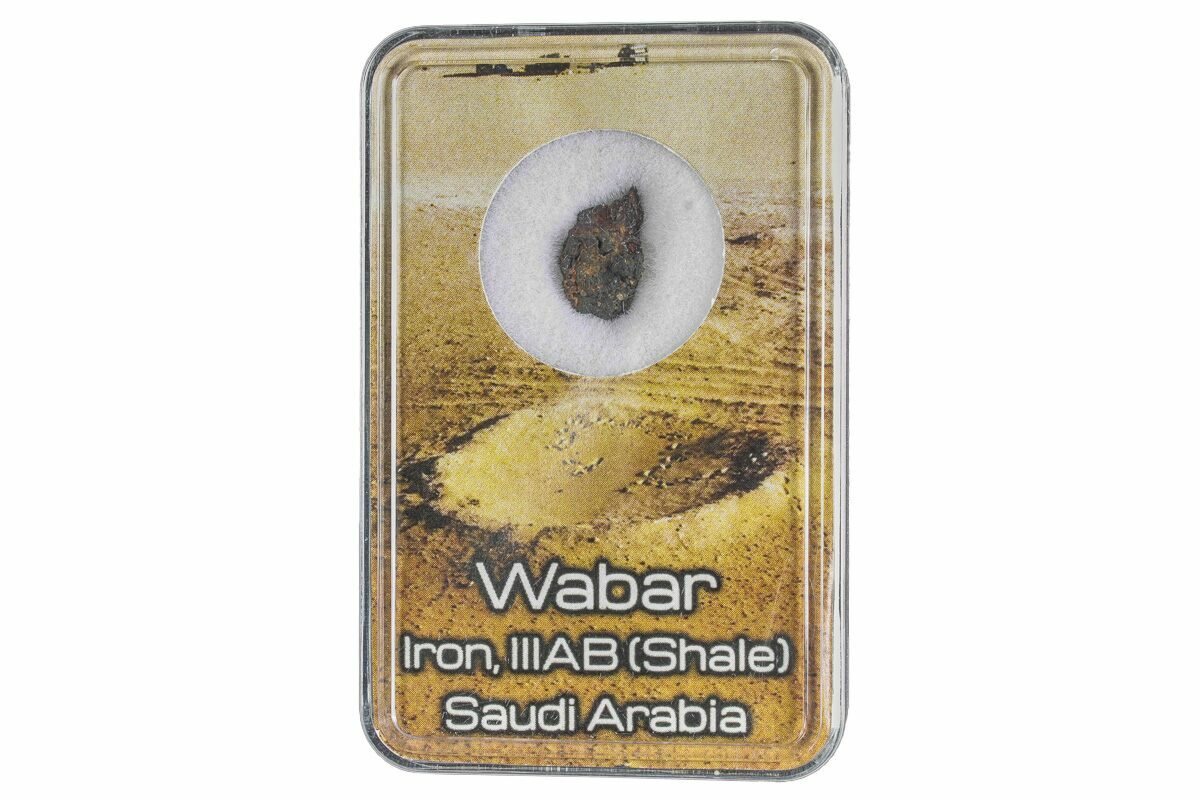
This is a .4" wide (0.33 gram) piece of the Wabar iron meteorite from the famous craters of Saudi Arabia's desolate Rub'al Khali desert. It comes with the pictured acrylic display case.
Iron Meteorite Care - Important!
Iron meteorites can be susceptible to rusting and deterioration due to moisture in the atmosphere; proper care includes avoiding handling them with your bare hands, as the oils form your skin can affect the metal, and especially keeping them in moisture-free environments. This is particularly important in areas with high humidity, such as Florida. All iron meteorite material we sell has been stabilized in some way, which will help with this issue, but care still needs to be taken to keep your treasure in good condition. Keep iron meteorites stored in a moisture-free environment, preferably with a corrosion inhibitor such as an enclosed display case with a dehumidifier or desiccants.
It's suggested that you inspect your specimen at least once a month, looking specifically for spots that appear discolored (brown or yellow in hue). If a rust spot develops, immediate attention is required to prevent it from spreading. It can be treated by gently rubbing the spot with a cotton swab dipped in CLR (Calcium, Lime, and Rust remover). Repeat this process until the rust color is removed. The meteorite should then be rinsed with alcohol (100% pure is best).
Following this process, it is safe to bake the meteorite for about an hour at 200˚ F (150˚ F for stony-iron meteorites like pallasites) to remove any remaining moisture. Be careful when removing it from the oven as the metal will be hot. A bath in ATF (automatic transmission fluid) or high quality, light oil is suggested while the meteorite is still hot. Once cooled, remove any excess fluid and place it back in its moisture free environment.
Iron meteorites can be susceptible to rusting and deterioration due to moisture in the atmosphere; proper care includes avoiding handling them with your bare hands, as the oils form your skin can affect the metal, and especially keeping them in moisture-free environments. This is particularly important in areas with high humidity, such as Florida. All iron meteorite material we sell has been stabilized in some way, which will help with this issue, but care still needs to be taken to keep your treasure in good condition. Keep iron meteorites stored in a moisture-free environment, preferably with a corrosion inhibitor such as an enclosed display case with a dehumidifier or desiccants.
It's suggested that you inspect your specimen at least once a month, looking specifically for spots that appear discolored (brown or yellow in hue). If a rust spot develops, immediate attention is required to prevent it from spreading. It can be treated by gently rubbing the spot with a cotton swab dipped in CLR (Calcium, Lime, and Rust remover). Repeat this process until the rust color is removed. The meteorite should then be rinsed with alcohol (100% pure is best).
Following this process, it is safe to bake the meteorite for about an hour at 200˚ F (150˚ F for stony-iron meteorites like pallasites) to remove any remaining moisture. Be careful when removing it from the oven as the metal will be hot. A bath in ATF (automatic transmission fluid) or high quality, light oil is suggested while the meteorite is still hot. Once cooled, remove any excess fluid and place it back in its moisture free environment.
Wabar is an iron (IIIAB) meteorite found in eastern Saudi Arabia. They were first knwon in the West when British explorer Harry St John Philby stumbled upon the craters in 1932 in the large stretch of open desert known locally as Rub'al Khali. He was searching for the mythical city of Ubar, mentioned in the Quran, when he found three large craters containing white sandstone impactites, black impact glass, and iron meteorites. Local Bedouin groups had referred to the craters as Al Hadida, or "place of iron", and had reported finding iron masses the size of camels in the area. At first St John Philby thought he found an ancient volcano, but the samples he brought back to England were verified as meteorites.
The Wabar meteorite itself likely fell sometime during the 19th century, consistent with some eyewitness accounts from Arab communities in 1863 or 1891. The area is now largely inaccessible due to the sheer harshness and desolation of the area, regional political instability, and the slow march of sand as it has filled in the craters themselves. As such, material can no longer be collected from the site.
Though material can no longer be collected, collectors can find a great deal of interesting specimens from the site. Black glass impactites, known as Wabar pearls, can be frequently found, as well as fresh or oxidized fragments of meteorite. Sliced and etched meteorite specimens often display fine Widmanstätten patterns.
The Wabar meteorite itself likely fell sometime during the 19th century, consistent with some eyewitness accounts from Arab communities in 1863 or 1891. The area is now largely inaccessible due to the sheer harshness and desolation of the area, regional political instability, and the slow march of sand as it has filled in the craters themselves. As such, material can no longer be collected from the site.
Though material can no longer be collected, collectors can find a great deal of interesting specimens from the site. Black glass impactites, known as Wabar pearls, can be frequently found, as well as fresh or oxidized fragments of meteorite. Sliced and etched meteorite specimens often display fine Widmanstätten patterns.
About Iron Meteorites
Iron type meteorites are composed primarily of iron and nickel, and are the remnants of differential cores torn apart at the beginning of the solar system. These metallic meteorites are often the easiest to identify after millions of years post-impact because they are quite different from terrestrial material, especially when it comes to their mass-to-surface area ratio. They are exceptionally heavy for their size since iron is a high-density metal: this is also why the Earth's core is nickel-iron. As planets form, the densest metals form gravitational centers, bringing more and more material into their gravitational pull. In the solar system's rocky planets, these dense materials are most often nickel and iron.
Most iron meteorites have distinctive, geometric patterns called Widmanstätten patterns, which become visible when the meteorite is cut and acid etched. These patterns are criss-crossing bands of the iron-nickel alloys kamacite and taenite that slowly crystalized as the core of the meteorites' parent bodies slowly cooled. Such large alloy crystallizations for mover millions of years and do not occur naturally on Earth, further proving that iron meteorites come from extraterrestrial bodies.
Iron type meteorites are composed primarily of iron and nickel, and are the remnants of differential cores torn apart at the beginning of the solar system. These metallic meteorites are often the easiest to identify after millions of years post-impact because they are quite different from terrestrial material, especially when it comes to their mass-to-surface area ratio. They are exceptionally heavy for their size since iron is a high-density metal: this is also why the Earth's core is nickel-iron. As planets form, the densest metals form gravitational centers, bringing more and more material into their gravitational pull. In the solar system's rocky planets, these dense materials are most often nickel and iron.
Most iron meteorites have distinctive, geometric patterns called Widmanstätten patterns, which become visible when the meteorite is cut and acid etched. These patterns are criss-crossing bands of the iron-nickel alloys kamacite and taenite that slowly crystalized as the core of the meteorites' parent bodies slowly cooled. Such large alloy crystallizations for mover millions of years and do not occur naturally on Earth, further proving that iron meteorites come from extraterrestrial bodies.
TYPE
Iron (Fine Octahedrite, IIIAB)
AGE

LOCATION
Rub'al Khali, Saudi Arabia
SIZE
.4" wide, Weight: 0.33 grams
CATEGORY
ITEM
#285952


