 Reviews

This Specimen has been sold.


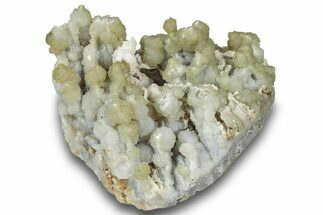
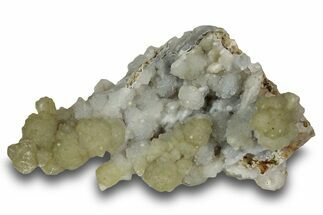
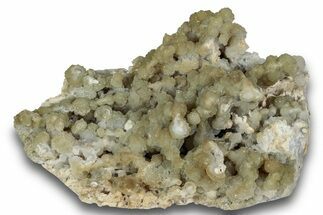
1.5" Botryoidal Yellow Fluorite on Quartz & Amethyst - India


This is a unique formation of vibrant yellow fluorite, collected from Madhya Pradesh, India. It formed in botryoidal fashion over a bed of quartz crystals and chalcedony. One edge of the specimen has been cut flat for presentation.
Under shortwave ultraviolet light, the fluorite exhibits a white fluorescence.
Under shortwave ultraviolet light, the fluorite exhibits a white fluorescence.
About Botryoidal Fluorite From India
Botryoidal fluorite from Madhya Pradesh, India forms smooth, grape-like mounds of translucent yellow to yellow-brown fluorite draped over a sparkling bed of quartz and amethyst crystals. The fluorite grows in rounded hemispheres made of tightly packed, radiating micro-crystals, giving the surface a softly glossy, almost waxy sheen that contrasts beautifully with the sharp, glassy faces of the underlying quartz points and purple amethyst tips.
These specimens typically come from localities such as Tekhdi and Khadakwadi in Madhya Pradesh, where mineral-rich fluids filled cavities in volcanic or sedimentary rocks and deposited successive layers of fluorite and silica. As conditions shifted, amethystine quartz lined the cavity first, followed by botryoidal fluorite that coated the geode walls and sometimes bridges across the opening. The result is an eye-catching combination piece: warm botryoidal fluorite “bubbles” perched on a vivid amethyst and quartz matrix, prized both for its rarity and striking color contrast.
Botryoidal fluorite from Madhya Pradesh, India forms smooth, grape-like mounds of translucent yellow to yellow-brown fluorite draped over a sparkling bed of quartz and amethyst crystals. The fluorite grows in rounded hemispheres made of tightly packed, radiating micro-crystals, giving the surface a softly glossy, almost waxy sheen that contrasts beautifully with the sharp, glassy faces of the underlying quartz points and purple amethyst tips.
These specimens typically come from localities such as Tekhdi and Khadakwadi in Madhya Pradesh, where mineral-rich fluids filled cavities in volcanic or sedimentary rocks and deposited successive layers of fluorite and silica. As conditions shifted, amethystine quartz lined the cavity first, followed by botryoidal fluorite that coated the geode walls and sometimes bridges across the opening. The result is an eye-catching combination piece: warm botryoidal fluorite “bubbles” perched on a vivid amethyst and quartz matrix, prized both for its rarity and striking color contrast.
About Amethyst
Amethyst is a purple variety of quartz (SiO2) that owes its violet color to natural gamma irradiation, iron impurities, and the presence of trace elements, which result in complex crystal lattice substitutions. It is considered a semi-precious gemstone, and just two centuries ago was considered to have a value on par with diamonds, sapphires, and rubies. The largest and best known amethyst deposits occur in southern Brazil and Uruguay, where they are found in hydrothermally-formed geodes, but many localities around the world produce an amazing variety of amethyst crystals and formations. They are almost always formed in medium- to high-temperature geological settings.
Amethyst is a purple variety of quartz (SiO2) that owes its violet color to natural gamma irradiation, iron impurities, and the presence of trace elements, which result in complex crystal lattice substitutions. It is considered a semi-precious gemstone, and just two centuries ago was considered to have a value on par with diamonds, sapphires, and rubies. The largest and best known amethyst deposits occur in southern Brazil and Uruguay, where they are found in hydrothermally-formed geodes, but many localities around the world produce an amazing variety of amethyst crystals and formations. They are almost always formed in medium- to high-temperature geological settings.
SPECIES
Fluorite, Quartz var. Chalcedony, Quartz & Quartz var. Amethyst
LOCATION
Madhya Pradesh, India
SIZE
Entire specimen: 1.5 x 1.4", Fluorite: 1" wide
CATEGORY
ITEM
#342388