 Reviews

Fluorite - Mineral & Crystal Guide
Fluorite is one of the most captivating minerals on Earth — not because it is especially rare, but because it seems almost unreal. In the right light, fluorite can glow like a lantern. It can appear purple as twilight, green as sea glass, blue as arctic ice, or golden as honey. Some specimens even shift color depending on the angle or illumination, and many fluoresce brilliantly under ultraviolet light, giving the mineral its almost magical reputation.
What makes fluorite so remarkable is that it feels like a bridge between science and fantasy. Its crystals often form in perfect cubes so sharp and symmetrical they look manufactured rather than natural, as though they were carved by geometry itself deep inside the Earth. Yet at the same time, fluorite is fragile — soft enough to scratch with a knife, delicate enough to cleave cleanly into shimmering octahedrons. It is a mineral of contradictions: precise but ephemeral, radiant but breakable.
Fluorite is also one of the most scientifically influential gemstones in history. In fact, the phenomenon of fluorescence — the eerie glow some minerals display under ultraviolet light — was named directly after fluorite, because early researchers were astonished by the way it seemed to hold light inside itself. Even today, few minerals put on such a dramatic show under UV illumination, glowing blue, violet, green, or even white like ghost fire.
Despite its beauty, fluorite is far more than a collector’s treasure. It has quietly shaped human technology for centuries. Long before it was prized for display cabinets, it was used in metal smelting, helping iron and steel flow more smoothly — a role so important that its name comes from the Latin fluere, meaning “to flow.” Fluorite has been essential in the production of steel, aluminum, and modern fluorine chemicals, making it one of the most significant industrial minerals on Earth.
Often found filling veins in ancient rock, fluorite is a storyteller: each crystal records a chapter of hydrothermal activity, shifting temperatures, and trace elements that paint it in impossible hues. Many specimens reveal intricate color zoning — layers of purple fading into clear crystal, or bands of green and blue that formed as underground fluids changed chemistry over time. To hold a fluorite crystal is to hold a frozen moment of Earth's deep interior, a radiant archive of heat, pressure, and mineral-rich waters moving through stone.
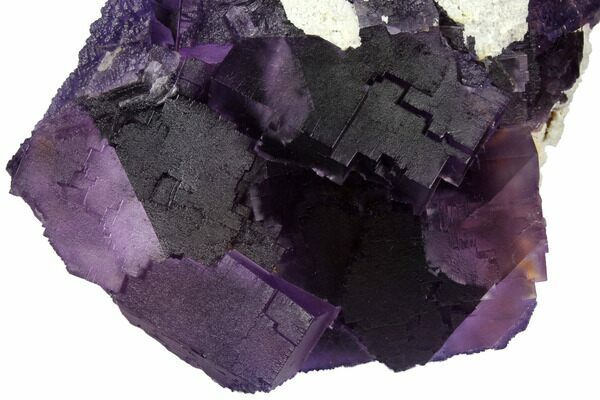
Grape juice colored cubic fluorite from the Cave-In-Rock mining district of Illinois
Chemical Formula: CaF₂ (Calcium Fluoride)
Mineral Class: Halide
Crystal System: Isometric (Cubic)
Hardness (Mohs): 4
Luster: Vitreous to pearly
Transparency: Transparent to translucent
Cleavage: Perfect in four directions (octahedral cleavage)
Streak: White
Specific Gravity: ~3.1–3.2
Fluorescence: Common, often vivid blue or purple under UV
Common Colors: Purple, green, blue, yellow, clear, pink, multicolored
Commonly Associated Minerals: Quartz, calcite, barite, galena, sphalerite, pyrite
Fluorite most commonly forms in hydrothermal environments, meaning it grows from hot, mineral-rich fluids that move through fractures, cracks, and open cavities deep underground. These fluids are often connected to nearby magma bodies or to groundwater that has been heated as it circulates through layers of rock. As the fluids travel, they dissolve chemical elements from the surrounding stone and carry them along like an underground mineral soup.
Over time, as these hot solutions cool or their chemistry changes, calcium and fluorine begin to combine and crystallize into fluorite. This process often occurs alongside the formation of other vein minerals, particularly sulfide ores and carbonates. That is why fluorite is so frequently found in association with lead and zinc deposits, growing side by side with minerals such as galena, sphalerite, and calcite in ancient hydrothermal veins.
Although fluorite is famous for its vivid colors, pure fluorite is actually colorless, as clear as glass. The spectacular purples, greens, blues, and golden hues that collectors prize come from subtle impurities and structural imperfections within the crystal lattice. Tiny trace elements such as yttrium, iron, or rare earth elements can influence how the crystal absorbs and reflects light. In other cases, long-term exposure to natural radiation alters the crystal structure, creating what are known as color centers, where missing atoms or defects change the way light passes through the mineral.
Fluorite is celebrated for its beautifully precise crystal shapes, often forming with such clean edges and symmetry that they look almost sculpted or carefully cut by hand. These naturally occurring geometric structures are one of the reasons fluorite is so beloved by collectors and mineral enthusiasts alike. Common crystal habits include:
Cubic fluorite is the most common and iconic crystal habit of this mineral, instantly recognizable by its perfectly symmetrical, cube-shaped crystals. This form develops because fluorite’s internal atomic structure naturally favors growth along three equal axes, producing sharp right angles and smooth, flat faces. Cubic fluorite typically forms in hydrothermal veins, limestone cavities, and mineral-rich fractures where warm fluids deposit calcium and fluoride ions as they cool. When conditions remain stable and space is available, crystals can grow slowly and evenly into well-defined cubes, sometimes appearing as single crystals or stacked clusters
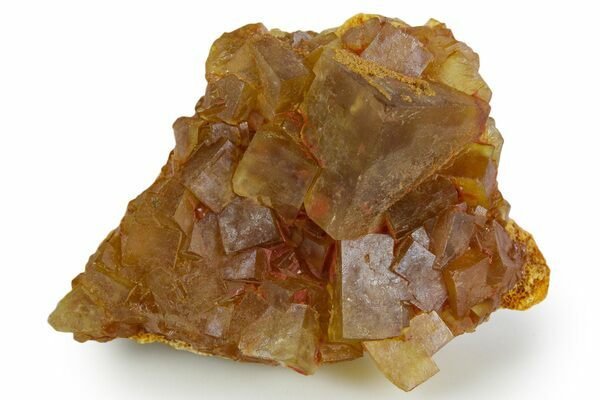
Cubic yellow fluorite crystals from Morocco.
Octahedral fluorite is an eye-catching crystal habit in which the mineral forms eight triangular faces, creating a sharp, pyramid-like geometry. Although fluorite is best known for its cubic crystals, octahedral shapes can develop when growth conditions change during crystallization. This habit often forms in hydrothermal environments where mineral-rich fluids cool and deposit fluorite in open cavities or fractures. Variations in temperature, pressure, or chemical composition can cause the crystal to grow more strongly along different directions, favoring octahedral faces over cubic ones. In some cases, octahedral fluorite can also appear through natural cleavage, since fluorite breaks easily along octahedral planes.
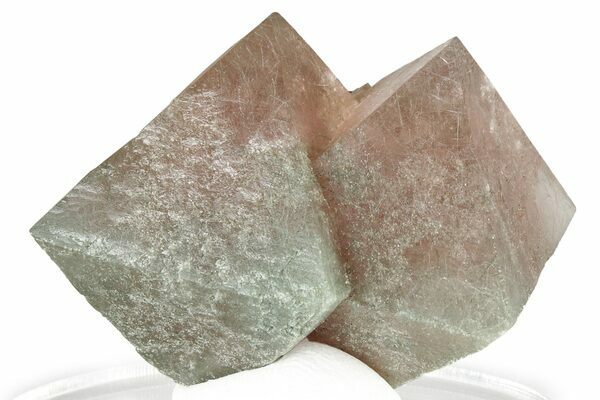
Pink octahedral fluorite with byssolite inclusions from Inner Mongolia
Dodecahedral fluorite is a distinctive and less common crystal habit that showcases the mineral’s ability to form beyond its classic cubic shape. In this habit, fluorite crystals develop with twelve flat faces, creating a geometric form known as a dodecahedron. This shape typically forms when growth conditions within the mineral’s environment shift—such as changes in temperature, pressure, or the chemistry of the surrounding hydrothermal fluids. Under certain conditions, the crystal’s growth rates along different axes become unbalanced, favoring the development of additional faces instead of the usual cube. Dodecahedral fluorite often grows in veins or cavities where space and fluid chemistry allow slow, uninterrupted crystallization.
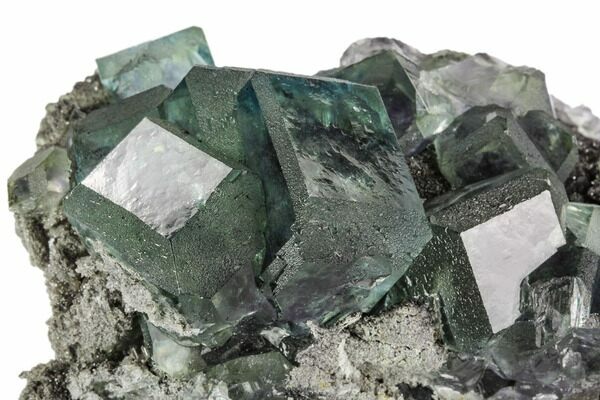
Glassy, dodecahedral fluorite crystals from China.
Unlike fluorite that grows into distinct cubic crystals, massive granular fluorite forms as a compact aggregate of many tiny interlocking grains. This structure typically develops when fluorite precipitates from mineral-rich hydrothermal fluids moving through veins, fractures, or porous rock layers. As the fluids cool or react with surrounding minerals, fluorite is deposited rapidly in dense masses rather than slowly forming individual crystal faces. Over time, these grains fuse together into solid, often colorful bodies that can range from translucent to opaque.
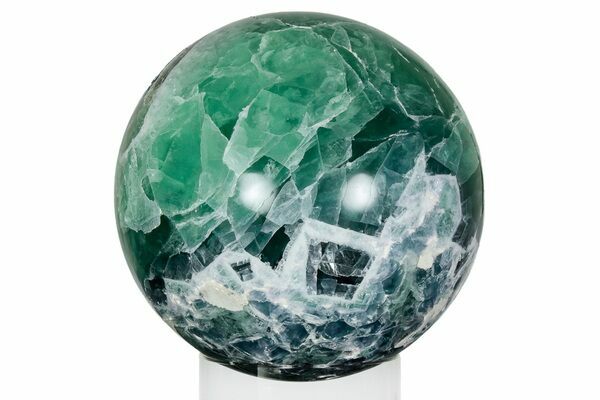
A polished sphere of massive fluorite from Mexico.
Unlike the sharp cubic crystals fluorite is famous for, botryoidal fluorite develops in smooth, rounded clusters that resemble bunches of grapes. These forms typically grow when fluorite-rich mineral solutions seep into open spaces within rocks—such as cavities, fractures, or geodes—under low-pressure conditions. Instead of building large, well-defined crystal faces, the mineral precipitates in layers over many tiny growth points, gradually creating a bubbly, globular surface. Over time, repeated pulses of mineral-rich fluids and subtle changes in temperature or chemistry can enhance the rounded texture.
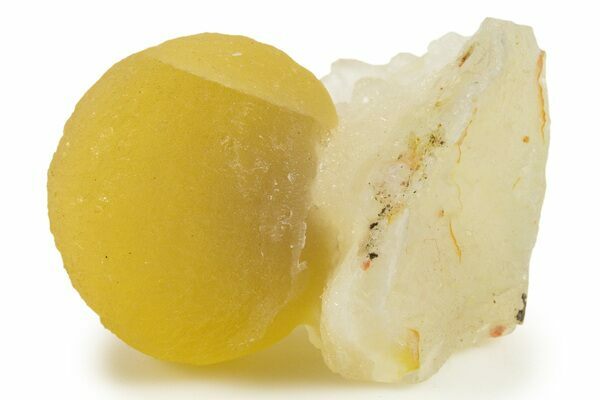
Botryoidal yellow fluorite on quartz from India.
Because fluorite has perfect octahedral cleavage, crystals can break cleanly into triangular shapes, a feature that has fascinated mineralogists for centuries. Large, undamaged cubes with deep color are among the most collectible mineral specimens in the world.
One of the most mesmerizing features fluorite can display is something that feels almost like a secret hidden inside the crystal itself: color zoning and phantom growth. These internal patterns are far more than simple decoration. They are geological records preserved in perfect clarity, revealing how the crystal formed over time and how the underground world around it changed as it grew.
Fluorite is especially famous for these effects because it often forms in hydrothermal environments where mineral-rich fluids are constantly evolving. As a result, fluorite crystals do not always develop as a single uniform color. Instead, they often grow in stages, capturing shifting chemistry like pages in a diary written deep within the Earth.
Color zoning refers to distinct layers, bands, or regions of color within a single fluorite crystal. A cube may appear richly purple at its edges but pale or even clear in its center. Another specimen may show a green core surrounded by blue outer zones, or multiple concentric layers that seem to radiate inward like a crystal rainbow. These patterns form because fluorite grows from fluids whose temperature, pressure, and chemical composition can change repeatedly over long periods of time.
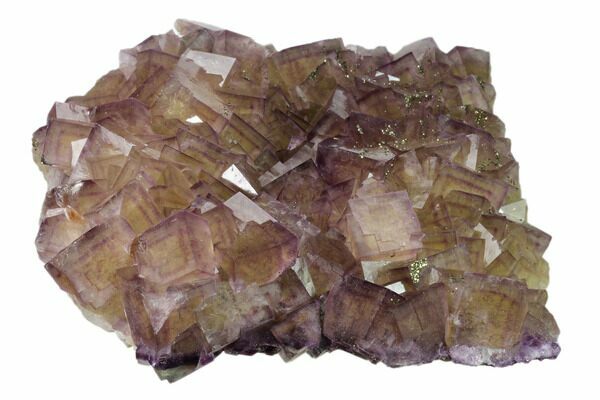
Cubic fluorite crystals from the Yaogangxian Mine in China with multiple phantoms clearly visible in the crystals.
The colors in fluorite are often influenced by tiny trace impurities, such as rare earth elements or iron, as well as by radiation exposure and subtle structural defects in the crystal lattice. Even slight shifts in the chemical “ingredients” entering the growing crystal can alter its color dramatically. In some specimens, zoning appears as darker rims, concentrated cores, banded stripes, or striking geometric patterns that perfectly follow the mineral’s cubic symmetry. Few minerals display zoning as vividly and cleanly as fluorite, which is why zoned cubes are so highly prized by collectors.
Even more mysterious than zoning is the phenomenon known as phantom growth, sometimes called phantom crystals. A phantom forms when a crystal begins growing, then pauses, and later resumes growth again. The earlier stage becomes trapped inside the later stage, preserved like a ghostly outline within the finished crystal. In fluorite, this can look like a smaller cube floating inside a larger one, or faint internal edges marking the boundaries of an earlier form. These ghost-like structures are essentially fossilized growth surfaces, the crystal’s former shape preserved within its final body.
Phantoms usually develop when growth conditions change abruptly. A drop in temperature, a shift in fluid chemistry, a pause in mineral deposition, or the introduction of tiny inclusions can all interrupt crystal growth. Imagine a fluorite cube forming quietly inside a cavity underground. Then the flow of mineral-rich fluid slows or stops, allowing a thin layer of impurities or microscopic particles to settle on the crystal’s surface. When the fluid returns and fluorite begins growing again, that earlier surface is sealed inside, frozen forever as a phantom.
Fluorite’s story is deeply intertwined with the rise of both industry and science, but its relationship with humanity began long before modern mineralogy gave it a name. For thousands of years, people encountered fluorite not as a chemical compound or an ore, but as something far more mysterious: a stone of color and light, unlike any other pulled from the earth.
In the ancient world, fluorite was often mistaken for other precious materials because of its glassy brilliance and vivid hues. The Romans, who prized decorative stones, carved fluorite into small vessels, beads, and ornamental objects. Some of these artifacts survive today, their banded purples and greens still glowing faintly across centuries. To ancient hands, fluorite must have seemed like frozen liquid color — a mineral that looked more like a captured sunset than a product of stone.
Across the world in China, fluorite was also carved and polished, valued not for hardness like jade, but for its luminous beauty. Even in these early uses, fluorite carried a kind of dual identity: fragile, yet treasured; soft, yet radiant. But fluorite’s destiny was never limited to ornament. Deep underground, it often appeared alongside metallic ores, and miners began to notice something practical about it. When added to molten rock during smelting, fluorite made stubborn metals behave differently. It helped impurities melt away. It encouraged the mixture to flow.
This property would change everything...
By the Middle Ages, fluorite had become quietly essential to European metallurgy. Smelters learned that adding fluorite to iron ore acted like a purifier, lowering the melting point of unwanted material and allowing cleaner metal to be extracted.
This is where fluorite’s name was born.
The mineral was eventually derived from the Latin verb fluere, meaning “to flow.” It was literally the stone that helped fire and metal move more smoothly, a mineral assistant to the furnace. Long before scientists understood its chemistry, fluorite was already shaping the industrial world, hidden in the background of foundries and metalworks.
Fluorite entered the scientific spotlight in the late 18th century, during the great age of mineral classification, when natural philosophers began systematically naming and studying Earth’s materials. In 1797, the mineral was formally described and named by Italian mineralogist Carlo Antonio Galeani Napione, who recognized fluorite as a distinct species rather than a mere curiosity of the mines. Soon, chemists realized that fluorite held something even more significant: it was the primary natural source of fluorine, one of the most reactive elements known.
But fluorine was not easily tamed.
Throughout the 1800s, scientists across Europe attempted to isolate the element from fluorite-derived compounds. The work was extraordinarily dangerous. Fluorine’s compounds burned skin, damaged lungs, and corroded glass and metal alike. Several early researchers were seriously injured or killed in the pursuit. Fluorite, beautiful and innocent-looking, had become the gateway to one of chemistry’s most volatile discoveries. When fluorine was finally isolated successfully in 1886 by Henri Moissan, it was considered one of the great triumphs of modern chemistry — and fluorite stood at the center of that achievement.
While industry valued fluorite for its role in furnaces, scientists began to value it for something entirely different: its relationship with light. Fluorite crystals possess unusually low dispersion, meaning they do not split light into rainbow fringes as strongly as ordinary glass. This made fluorite incredibly valuable in precision optics.
By the 19th and 20th centuries, fluorite was being used in:
High-quality microscope lenses
Advanced telescopes
Camera optics requiring extreme clarity
Even today, synthetic fluorite is used in some of the finest optical systems on Earth — and beyond it. Fluorite has helped humans see deeper into the microscopic world, farther into the stars, and more clearly through the distortions of ordinary glass.
Fluorite also holds a rare honor: it gave its name to an entire scientific phenomenon.
In the early 1800s, researchers noticed that certain fluorite specimens seemed to glow under specific lighting conditions. This strange internal radiance became one of the great curiosities of mineral physics. Eventually, the phenomenon was named fluorescence, directly after fluorite itself. To this day, fluorite remains one of the most famous fluorescent minerals, often glowing blue, violet, or green under ultraviolet light — like hidden fire awakened from within the crystal.
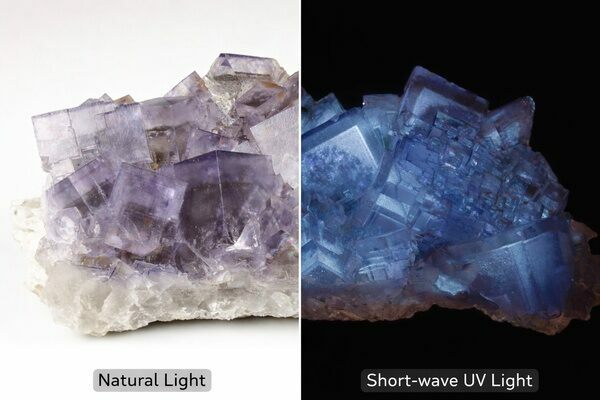
The same fluorite specimen, one side pictured under natural light and the other under short-wave UV light showing its fluorescence.
In England, fluorite found another cultural role through the rare variety known as Blue John, mined in Derbyshire. With its swirling bands of purple and yellow, Blue John became a prized ornamental material in the 18th and 19th centuries. Victorian craftsmen turned it into vases, chalices, urns, and jewelry that were displayed in aristocratic homes like treasures of the Earth.
Because the material is fragile and the deposits limited, true Blue John remains rare today — a mineral that is as much a piece of cultural history as geology.
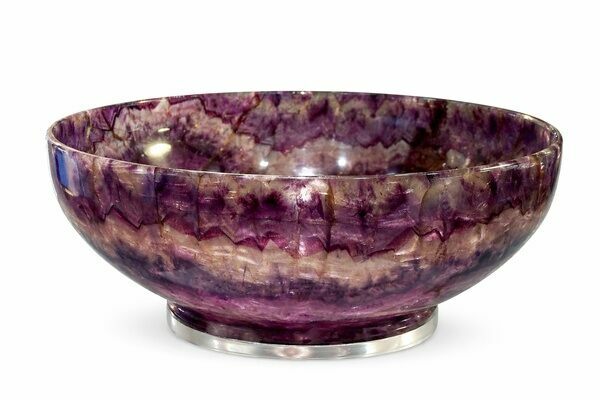
Bowl made from Derbyshire Blue John. Located Castleton Visitor Centre, Derbyshire.
Today, fluorite is no longer only a curiosity of collectors or an accessory of historic smelters. It is one of the most important industrial minerals in the modern world. The majority of fluorite mined today is used to produce hydrofluoric acid, the foundation of modern fluorine chemistry.
Modern applications include:
Steel manufacturing, where fluorite remains a critical flux
Aluminum production
Refrigerants and cooling systems
Pharmaceutical chemistry
Fluoropolymers such as Teflon
Electronics and lithium battery processing
High-performance optics and laser systems
In other words, fluorite touches daily life in ways most people never realize: in the metals that build cities, the chemicals that power industry, and the lenses that shape science.
Fluorite occurs on nearly every continent, but certain regions have produced specimens so distinctive and so historically important that they have become legendary among collectors and mineralogists. Each locality tells a different story — of ancient hydrothermal fluids, ore-rich veins, and the human pursuit of both beauty and industry. Some deposits are known for jewel-like cubes, others for fluorescent brilliance, and others for their deep connection to mining history.
One of the most historically significant fluorite regions in North America, the Illinois–Kentucky Fluorspar District was once among the world’s most productive sources of fluorspar. For much of the 19th and 20th centuries, this area supplied enormous quantities of fluorite for steelmaking and chemical production, helping fuel American industry. Collectors, however, remember it for something else entirely: its stunning specimens. Fluorite from this district often forms rich purple, blue, or golden cubes, sometimes with dramatic zoning or phantom growth patterns. Many classic American museum specimens trace their origins to these mines, where fluorite crystallized alongside calcite, sphalerite, galena, and barite in ancient ore veins.
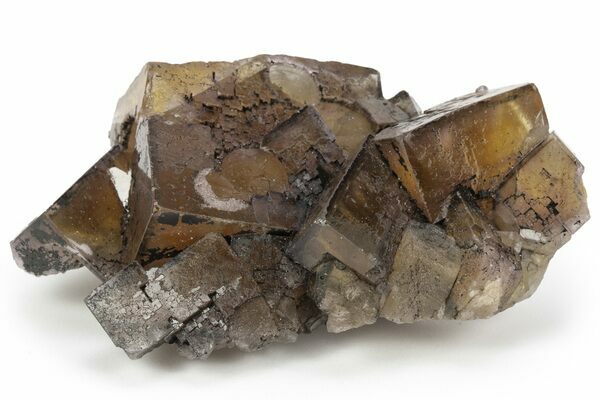
Yellow cubic fluorite from the Cave-In-Rock mining area of Illinois.
Weardale, located in County Durham, is one of England’s most beloved fluorite-producing regions and has yielded some of the finest European specimens for generations. The fluorite here is famous for its vivid green and purple cubes, often perched elegantly on sparkling quartz. Weardale specimens are prized for their sharp crystal form, clarity, and strong color saturation, making them favorites among collectors worldwide. Mining in the region has a long history tied to lead and zinc extraction, and fluorite was often recovered as a secondary treasure. Even today, Weardale fluorite remains iconic — a symbol of Britain’s rich mineral heritage and the beauty hidden within its ancient hills.
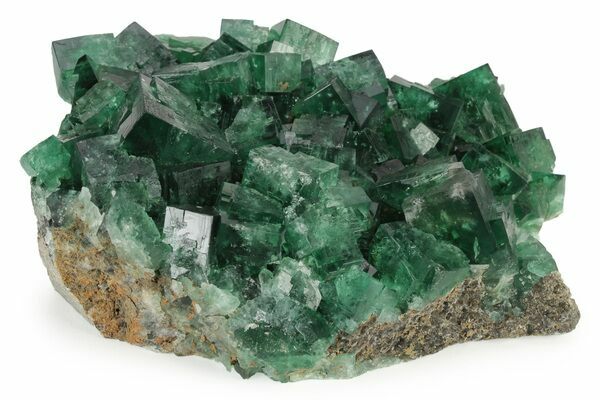
A cluster of highly fluorescent, green fluorite from the Weardale area of England.
Few fluorite localities are as culturally famous as the Blue John deposits of Derbyshire. Blue John is a rare, banded variety of fluorite with swirling layers of purple, cream, and golden-yellow, found almost exclusively in the Castleton area. For centuries, it has been mined not for industrial purposes but for ornamental stonework, reaching peak popularity during the Victorian era. Craftsmen turned Blue John into vases, goblets, candlesticks, and elaborate decorative objects that became symbols of wealth and taste. Because the deposits are small and fragile, only limited mining occurs today, and genuine Blue John is increasingly rare — a mineral that occupies a unique space between geology, art, and British history.
Dalnegorsk, in Russia’s Far East, is renowned among mineral collectors for producing some of the most spectacular fluorite crystals ever discovered. The region’s complex ore deposits have yielded intensely colored fluorite cubes, often deep violet, emerald green, or smoky blue, sometimes reaching impressive sizes with exceptional transparency. Dalnegorsk fluorite commonly occurs in association with quartz, calcite, and metallic sulfides, creating striking contrast between bright crystal faces and rugged matrix. Specimens from this locality are often considered world-class, prized for their sharp geometry and vivid coloration. The mines of Dalnegorsk have long been important sources of lead, zinc, and boron minerals, but fluorite remains one of their most dazzling contributions to mineral collecting.
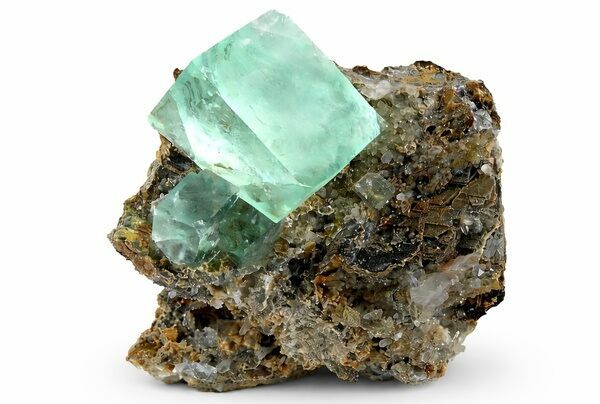
A green fluorite cube on matrix from Dalnegorsk, Russia.
China has become the dominant modern source of fine fluorite specimens, and the deposits of Inner Mongolia — especially the Huanggang mining district — are among the most celebrated. Fluorite from this region often forms in beautiful pastel shades: soft purples, icy blues, mint greens, and occasionally golden tones. Many specimens show intricate zoning, with cubes displaying multiple colors within a single crystal. Inner Mongolian fluorite frequently occurs with quartz, calcite, and sulfide minerals, forming complex, highly aesthetic clusters. Over the past few decades, these localities have transformed the global collector market, producing an extraordinary abundance of high-quality specimens that rival the classics of Europe and America.
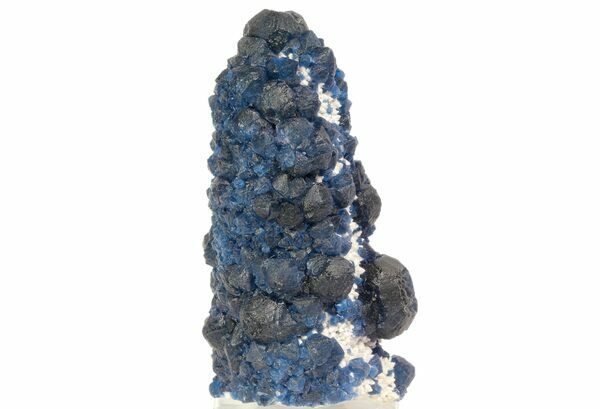
Blue fluorite on a milky quartz crystal from Huanggang Mine, Inner Mongolia
The Elmwood Mine is one of the great mineral treasures of the United States, famous not only for fluorite but for an entire suite of world-class crystals. Best known for spectacular calcite and sphalerite, Elmwood has also produced fluorite in rich purple cubes, often associated with sparkling calcite scalenohedrons or metallic sulfides. The fluorite here is prized for its luster and well-formed crystals, sometimes showing subtle zoning or phantom layers. Elmwood represents the intersection of industrial mining and mineral beauty — a working mine that unexpectedly became one of America’s premier sources of museum-quality specimens.
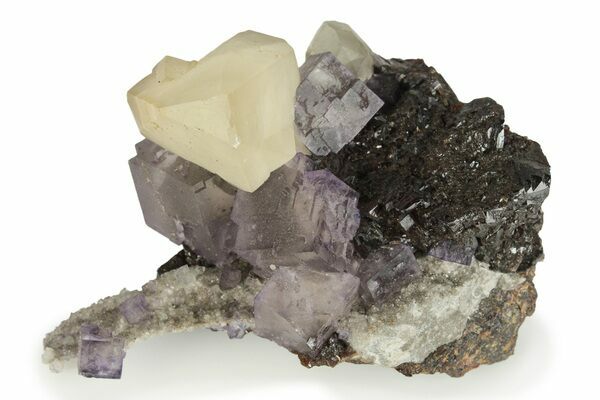
Purple, cubic fluorite associated with sphalerite and calcite from the Elmwood Mine.
The fluorite mines of Asturias, particularly near Berbes, have produced some of the most intensely colored fluorite in Europe. Spanish fluorite is renowned for its almost neon greens, vibrant blues, and richly saturated purples, often forming perfectly sharp cubes with exceptional clarity. Many specimens from this region are highly fluorescent as well, adding another layer of appeal. The Asturias deposits formed in hydrothermal veins, often alongside barite and sulfides, and have been mined for both industrial fluorspar and collector-grade crystals. Today, Berbes fluorite is considered among the finest in the world, instantly recognizable for its electric color and crisp crystal form.
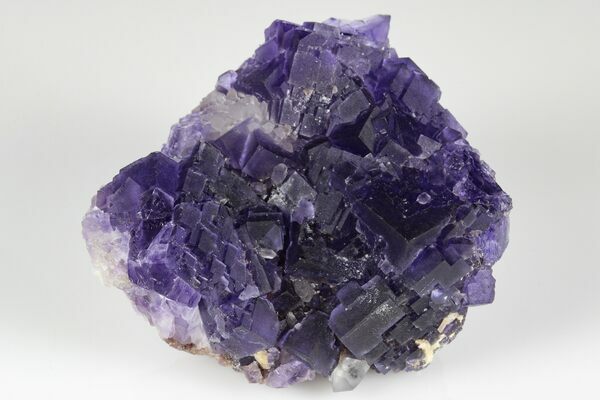
Cubic, purple fluorite from the mine near Berbes, Spain.
Okorusu Mine in Namibia is legendary for producing fluorite specimens with extraordinary fluorescence and vivid coloration. The crystals here are often bright green, purple, or color-zoned, forming clusters of cubes that glow intensely under ultraviolet light. Okorusu fluorite is especially prized by collectors of fluorescent minerals, as some specimens display strong multi-stage responses under both shortwave and longwave UV. The deposit occurs within a carbonatite-related geological setting, making it somewhat unusual compared to many vein-hosted fluorite localities. Okorusu has produced some of the most visually dramatic fluorite specimens on Earth — crystals that seem almost alive when exposed to ultraviolet illumination.
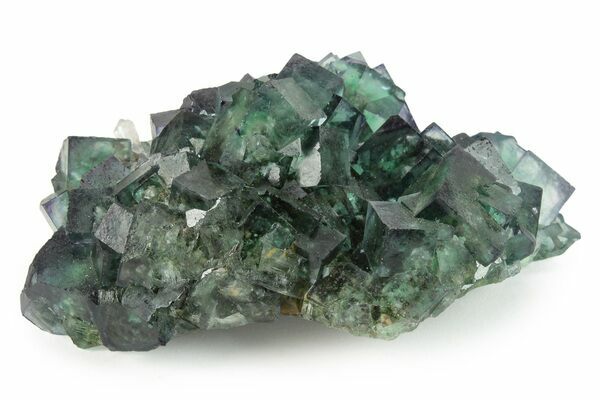
Green cubic fluorite crystals with purple edges from the Okorusu Mine.
Fluorite may look like a mineral carved from pure color and light, but despite its striking beauty, it is also surprisingly delicate. Compared to many other popular collector minerals, fluorite requires thoughtful handling and proper storage to preserve both its crystal form and its vivid coloration.
One of the most important things to understand about fluorite is its relative softness. With a Mohs hardness of only 4, fluorite can be scratched more easily than quartz, feldspar, or most common gemstone minerals. Even casual contact with harder specimens in a collection drawer can leave marks on fluorite’s smooth crystal faces. Because of this, fluorite is best stored separately or in padded displays where it will not rub against harder minerals.
Fluorite is also famous for its perfect cleavage, meaning it can break cleanly along internal planes. While this cleavage contributes to fluorite’s geometric beauty, it also makes the mineral vulnerable to damage from drops or sudden impacts. A crystal that appears sturdy may fracture sharply if bumped, so collectors often handle fluorite with extra care, supporting specimens from underneath rather than gripping them tightly at the edges.
Another key aspect of fluorite care involves light exposure. Many fluorite specimens, particularly those with intense purple, blue, or green coloration, can gradually fade when left in direct sunlight for long periods. This happens because some of fluorite’s colors are produced by radiation-related color centers within the crystal lattice, and prolonged ultraviolet exposure from sunlight can destabilize these centers over time. For this reason, fluorite is best displayed away from bright windows or harsh natural light. Soft indoor lighting is usually ideal for long-term preservation.
Temperature and environmental conditions also matter. Fluorite should be protected from extreme heat, sudden temperature changes, and high humidity, especially if it occurs alongside delicate associated minerals. Some fluorite is thermoluminescent and sensitive to heat, and rapid shifts in temperature can sometimes encourage cracking along cleavage planes.
Cleaning fluorite should always be done gently. Harsh chemical cleaners or acidic solutions should be avoided, as fluorite can be damaged by acids and is often found with other minerals that may react even more strongly. The safest method is usually a soft brush or gentle air blower to remove dust, rather than water soaking or abrasive scrubbing.
What makes fluorite so remarkable is that it feels like a bridge between science and fantasy. Its crystals often form in perfect cubes so sharp and symmetrical they look manufactured rather than natural, as though they were carved by geometry itself deep inside the Earth. Yet at the same time, fluorite is fragile — soft enough to scratch with a knife, delicate enough to cleave cleanly into shimmering octahedrons. It is a mineral of contradictions: precise but ephemeral, radiant but breakable.

Fluorite is also one of the most scientifically influential gemstones in history. In fact, the phenomenon of fluorescence — the eerie glow some minerals display under ultraviolet light — was named directly after fluorite, because early researchers were astonished by the way it seemed to hold light inside itself. Even today, few minerals put on such a dramatic show under UV illumination, glowing blue, violet, green, or even white like ghost fire.
Despite its beauty, fluorite is far more than a collector’s treasure. It has quietly shaped human technology for centuries. Long before it was prized for display cabinets, it was used in metal smelting, helping iron and steel flow more smoothly — a role so important that its name comes from the Latin fluere, meaning “to flow.” Fluorite has been essential in the production of steel, aluminum, and modern fluorine chemicals, making it one of the most significant industrial minerals on Earth.
Often found filling veins in ancient rock, fluorite is a storyteller: each crystal records a chapter of hydrothermal activity, shifting temperatures, and trace elements that paint it in impossible hues. Many specimens reveal intricate color zoning — layers of purple fading into clear crystal, or bands of green and blue that formed as underground fluids changed chemistry over time. To hold a fluorite crystal is to hold a frozen moment of Earth's deep interior, a radiant archive of heat, pressure, and mineral-rich waters moving through stone.
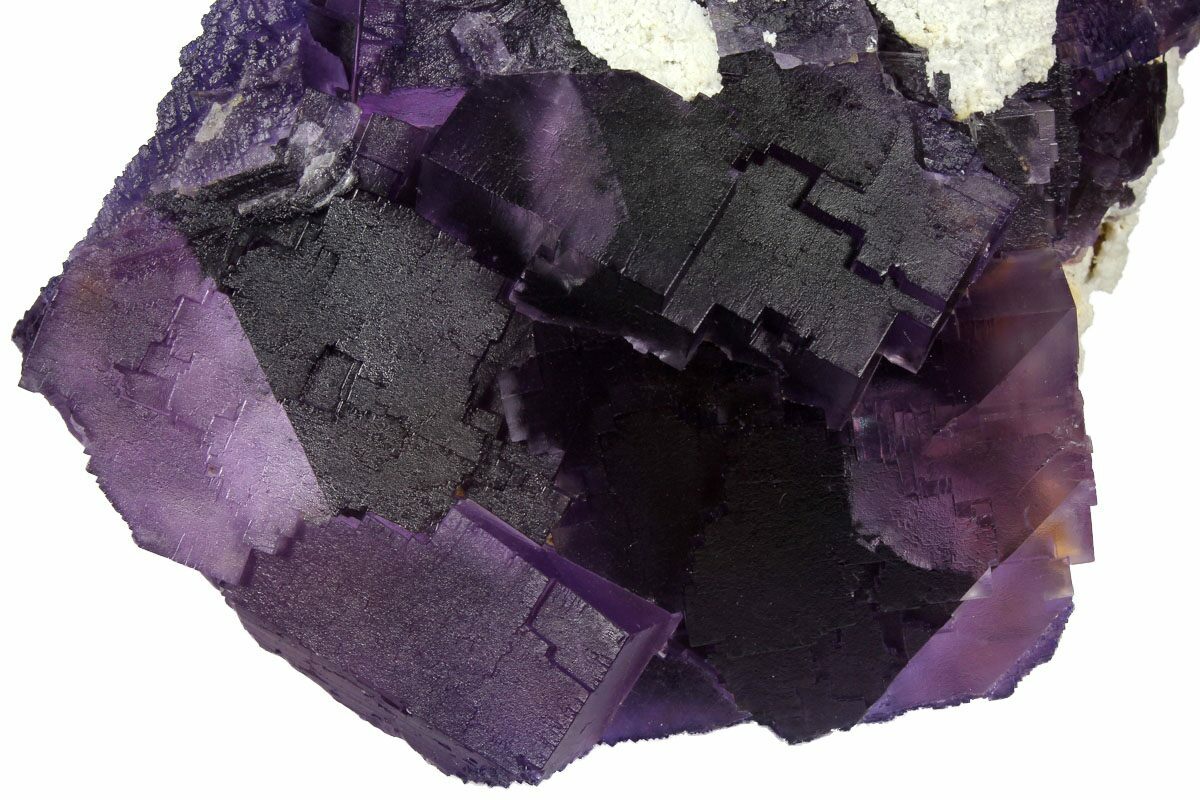
Grape juice colored cubic fluorite from the Cave-In-Rock mining district of Illinois
Key Properties
How Fluorite Forms — And Where Its Colors Come From
Fluorite most commonly forms in hydrothermal environments, meaning it grows from hot, mineral-rich fluids that move through fractures, cracks, and open cavities deep underground. These fluids are often connected to nearby magma bodies or to groundwater that has been heated as it circulates through layers of rock. As the fluids travel, they dissolve chemical elements from the surrounding stone and carry them along like an underground mineral soup.
Over time, as these hot solutions cool or their chemistry changes, calcium and fluorine begin to combine and crystallize into fluorite. This process often occurs alongside the formation of other vein minerals, particularly sulfide ores and carbonates. That is why fluorite is so frequently found in association with lead and zinc deposits, growing side by side with minerals such as galena, sphalerite, and calcite in ancient hydrothermal veins.
Although fluorite is famous for its vivid colors, pure fluorite is actually colorless, as clear as glass. The spectacular purples, greens, blues, and golden hues that collectors prize come from subtle impurities and structural imperfections within the crystal lattice. Tiny trace elements such as yttrium, iron, or rare earth elements can influence how the crystal absorbs and reflects light. In other cases, long-term exposure to natural radiation alters the crystal structure, creating what are known as color centers, where missing atoms or defects change the way light passes through the mineral.
Crystal Habits of Fluorite
Fluorite is celebrated for its beautifully precise crystal shapes, often forming with such clean edges and symmetry that they look almost sculpted or carefully cut by hand. These naturally occurring geometric structures are one of the reasons fluorite is so beloved by collectors and mineral enthusiasts alike. Common crystal habits include:
Cubic Crystals
Cubic fluorite is the most common and iconic crystal habit of this mineral, instantly recognizable by its perfectly symmetrical, cube-shaped crystals. This form develops because fluorite’s internal atomic structure naturally favors growth along three equal axes, producing sharp right angles and smooth, flat faces. Cubic fluorite typically forms in hydrothermal veins, limestone cavities, and mineral-rich fractures where warm fluids deposit calcium and fluoride ions as they cool. When conditions remain stable and space is available, crystals can grow slowly and evenly into well-defined cubes, sometimes appearing as single crystals or stacked clusters
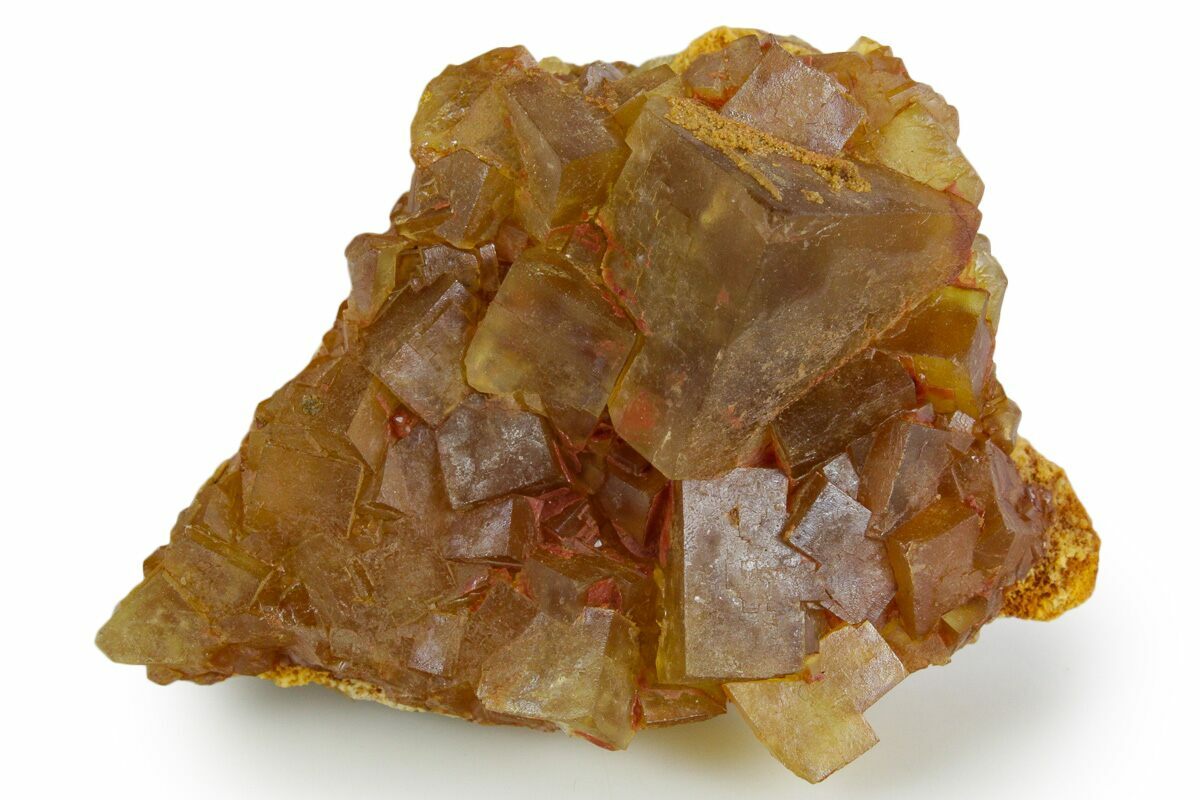
Cubic yellow fluorite crystals from Morocco.
Octahedral Crystals
Octahedral fluorite is an eye-catching crystal habit in which the mineral forms eight triangular faces, creating a sharp, pyramid-like geometry. Although fluorite is best known for its cubic crystals, octahedral shapes can develop when growth conditions change during crystallization. This habit often forms in hydrothermal environments where mineral-rich fluids cool and deposit fluorite in open cavities or fractures. Variations in temperature, pressure, or chemical composition can cause the crystal to grow more strongly along different directions, favoring octahedral faces over cubic ones. In some cases, octahedral fluorite can also appear through natural cleavage, since fluorite breaks easily along octahedral planes.
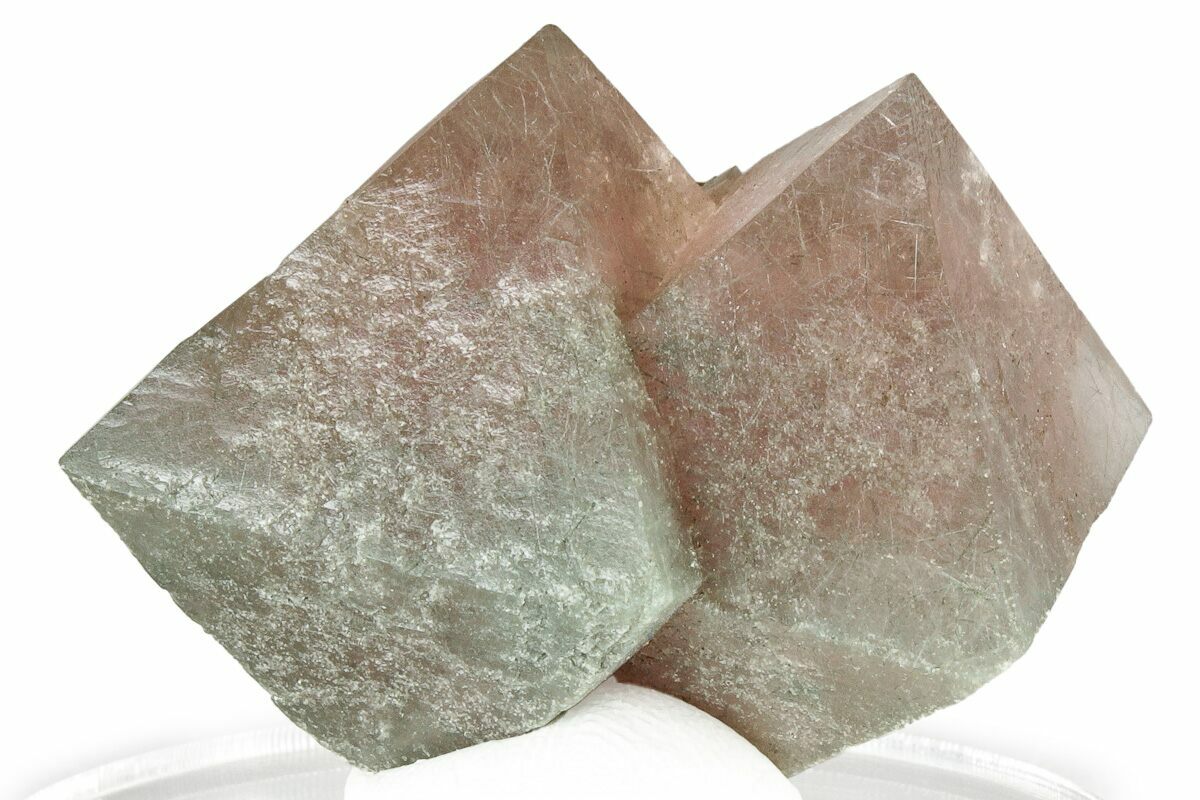
Pink octahedral fluorite with byssolite inclusions from Inner Mongolia
Dodecahedral Crystals
Dodecahedral fluorite is a distinctive and less common crystal habit that showcases the mineral’s ability to form beyond its classic cubic shape. In this habit, fluorite crystals develop with twelve flat faces, creating a geometric form known as a dodecahedron. This shape typically forms when growth conditions within the mineral’s environment shift—such as changes in temperature, pressure, or the chemistry of the surrounding hydrothermal fluids. Under certain conditions, the crystal’s growth rates along different axes become unbalanced, favoring the development of additional faces instead of the usual cube. Dodecahedral fluorite often grows in veins or cavities where space and fluid chemistry allow slow, uninterrupted crystallization.
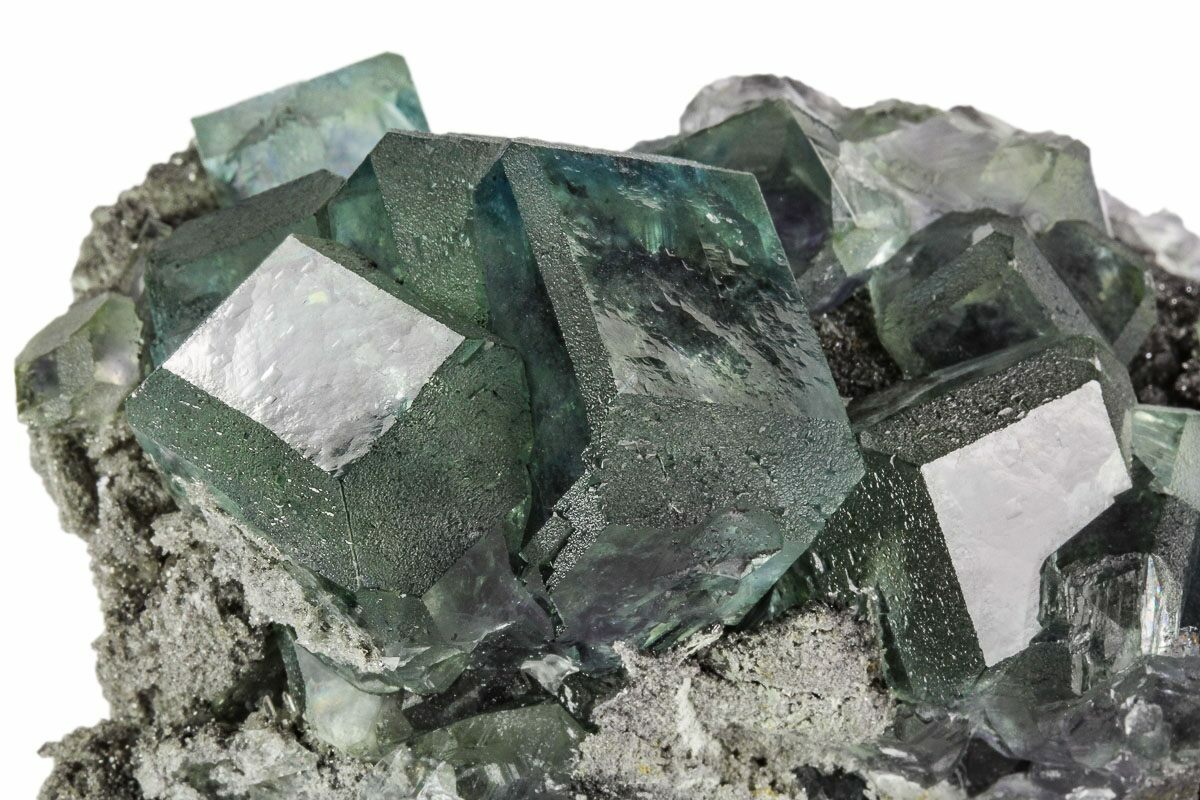
Glassy, dodecahedral fluorite crystals from China.
Massive Granular Fluorite
Unlike fluorite that grows into distinct cubic crystals, massive granular fluorite forms as a compact aggregate of many tiny interlocking grains. This structure typically develops when fluorite precipitates from mineral-rich hydrothermal fluids moving through veins, fractures, or porous rock layers. As the fluids cool or react with surrounding minerals, fluorite is deposited rapidly in dense masses rather than slowly forming individual crystal faces. Over time, these grains fuse together into solid, often colorful bodies that can range from translucent to opaque.
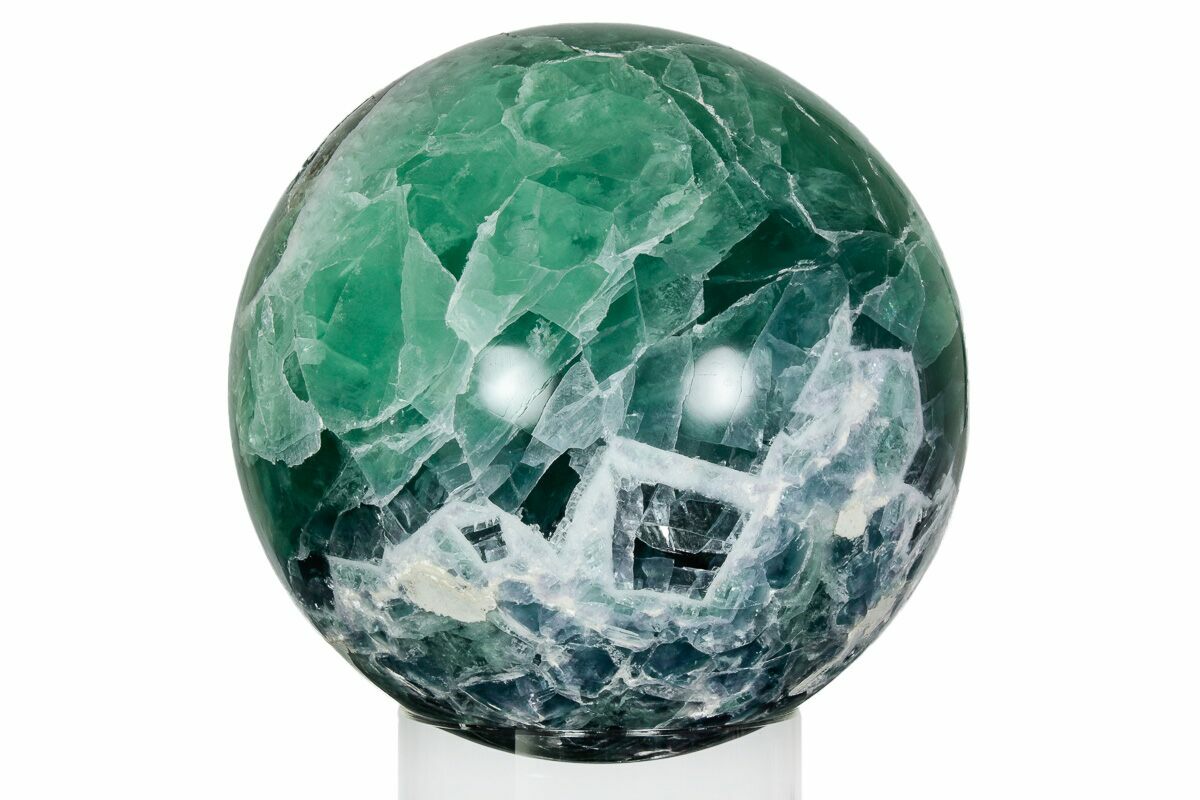
A polished sphere of massive fluorite from Mexico.
Botryoidal or Globular Aggregates
Unlike the sharp cubic crystals fluorite is famous for, botryoidal fluorite develops in smooth, rounded clusters that resemble bunches of grapes. These forms typically grow when fluorite-rich mineral solutions seep into open spaces within rocks—such as cavities, fractures, or geodes—under low-pressure conditions. Instead of building large, well-defined crystal faces, the mineral precipitates in layers over many tiny growth points, gradually creating a bubbly, globular surface. Over time, repeated pulses of mineral-rich fluids and subtle changes in temperature or chemistry can enhance the rounded texture.
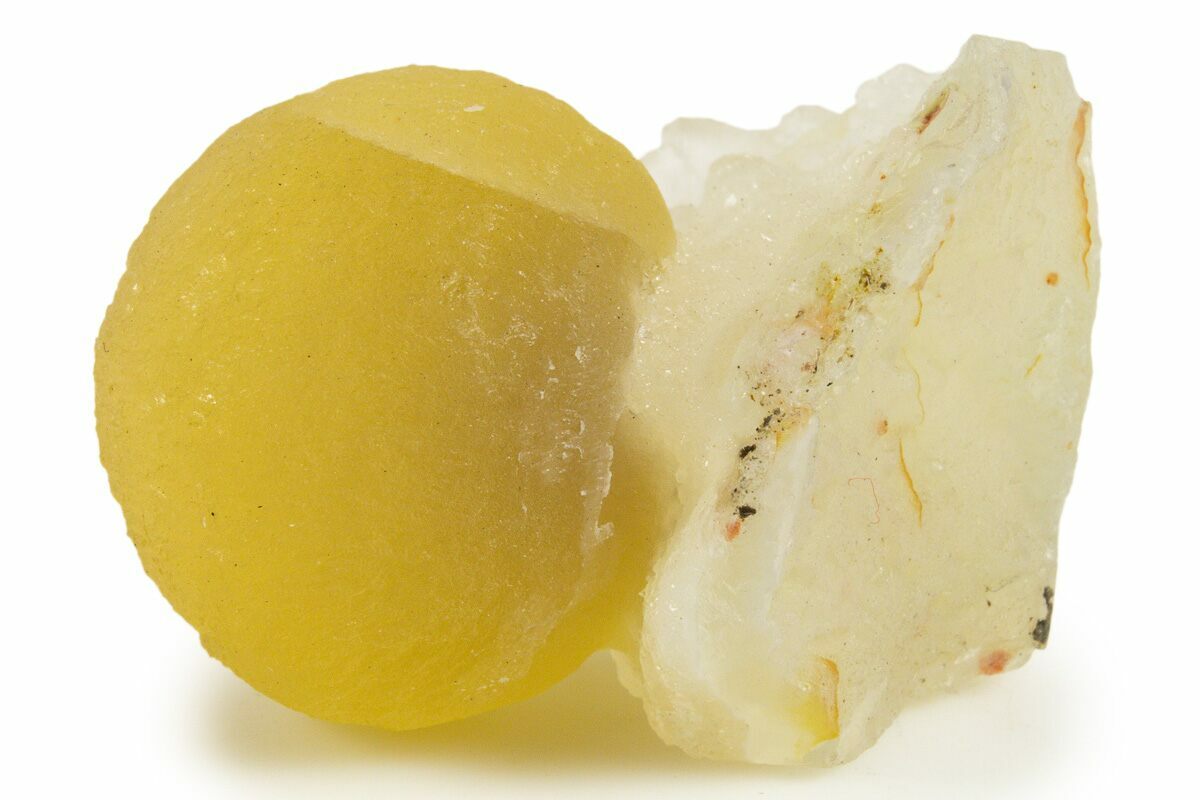
Botryoidal yellow fluorite on quartz from India.
Because fluorite has perfect octahedral cleavage, crystals can break cleanly into triangular shapes, a feature that has fascinated mineralogists for centuries. Large, undamaged cubes with deep color are among the most collectible mineral specimens in the world.
Zoning and Phantoms in Fluorite Crystals
One of the most mesmerizing features fluorite can display is something that feels almost like a secret hidden inside the crystal itself: color zoning and phantom growth. These internal patterns are far more than simple decoration. They are geological records preserved in perfect clarity, revealing how the crystal formed over time and how the underground world around it changed as it grew.
Fluorite is especially famous for these effects because it often forms in hydrothermal environments where mineral-rich fluids are constantly evolving. As a result, fluorite crystals do not always develop as a single uniform color. Instead, they often grow in stages, capturing shifting chemistry like pages in a diary written deep within the Earth.
Color zoning refers to distinct layers, bands, or regions of color within a single fluorite crystal. A cube may appear richly purple at its edges but pale or even clear in its center. Another specimen may show a green core surrounded by blue outer zones, or multiple concentric layers that seem to radiate inward like a crystal rainbow. These patterns form because fluorite grows from fluids whose temperature, pressure, and chemical composition can change repeatedly over long periods of time.
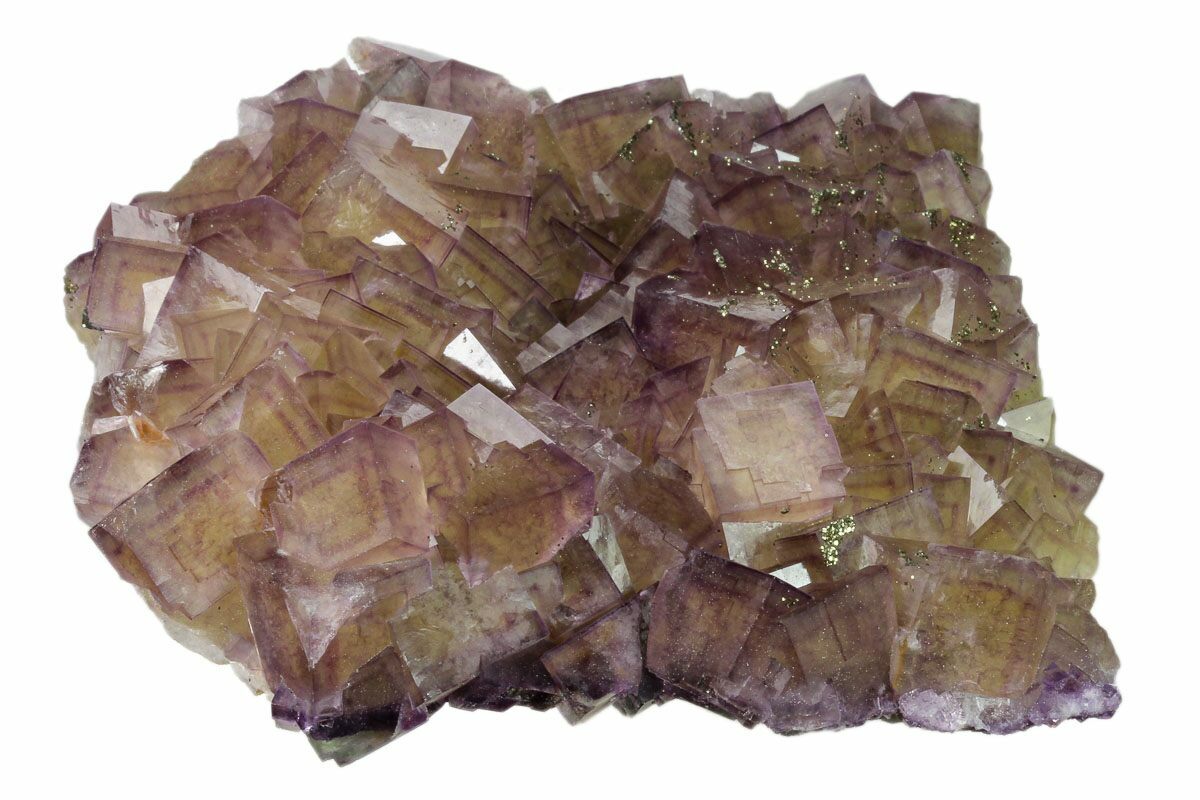
Cubic fluorite crystals from the Yaogangxian Mine in China with multiple phantoms clearly visible in the crystals.
The colors in fluorite are often influenced by tiny trace impurities, such as rare earth elements or iron, as well as by radiation exposure and subtle structural defects in the crystal lattice. Even slight shifts in the chemical “ingredients” entering the growing crystal can alter its color dramatically. In some specimens, zoning appears as darker rims, concentrated cores, banded stripes, or striking geometric patterns that perfectly follow the mineral’s cubic symmetry. Few minerals display zoning as vividly and cleanly as fluorite, which is why zoned cubes are so highly prized by collectors.
Even more mysterious than zoning is the phenomenon known as phantom growth, sometimes called phantom crystals. A phantom forms when a crystal begins growing, then pauses, and later resumes growth again. The earlier stage becomes trapped inside the later stage, preserved like a ghostly outline within the finished crystal. In fluorite, this can look like a smaller cube floating inside a larger one, or faint internal edges marking the boundaries of an earlier form. These ghost-like structures are essentially fossilized growth surfaces, the crystal’s former shape preserved within its final body.
Phantoms usually develop when growth conditions change abruptly. A drop in temperature, a shift in fluid chemistry, a pause in mineral deposition, or the introduction of tiny inclusions can all interrupt crystal growth. Imagine a fluorite cube forming quietly inside a cavity underground. Then the flow of mineral-rich fluid slows or stops, allowing a thin layer of impurities or microscopic particles to settle on the crystal’s surface. When the fluid returns and fluorite begins growing again, that earlier surface is sealed inside, frozen forever as a phantom.
History & Uses Of Fluorite
Fluorite’s story is deeply intertwined with the rise of both industry and science, but its relationship with humanity began long before modern mineralogy gave it a name. For thousands of years, people encountered fluorite not as a chemical compound or an ore, but as something far more mysterious: a stone of color and light, unlike any other pulled from the earth.
In the ancient world, fluorite was often mistaken for other precious materials because of its glassy brilliance and vivid hues. The Romans, who prized decorative stones, carved fluorite into small vessels, beads, and ornamental objects. Some of these artifacts survive today, their banded purples and greens still glowing faintly across centuries. To ancient hands, fluorite must have seemed like frozen liquid color — a mineral that looked more like a captured sunset than a product of stone.
Across the world in China, fluorite was also carved and polished, valued not for hardness like jade, but for its luminous beauty. Even in these early uses, fluorite carried a kind of dual identity: fragile, yet treasured; soft, yet radiant. But fluorite’s destiny was never limited to ornament. Deep underground, it often appeared alongside metallic ores, and miners began to notice something practical about it. When added to molten rock during smelting, fluorite made stubborn metals behave differently. It helped impurities melt away. It encouraged the mixture to flow.
This property would change everything...
The Stone That Made Metal Flow
By the Middle Ages, fluorite had become quietly essential to European metallurgy. Smelters learned that adding fluorite to iron ore acted like a purifier, lowering the melting point of unwanted material and allowing cleaner metal to be extracted.
This is where fluorite’s name was born.
The mineral was eventually derived from the Latin verb fluere, meaning “to flow.” It was literally the stone that helped fire and metal move more smoothly, a mineral assistant to the furnace. Long before scientists understood its chemistry, fluorite was already shaping the industrial world, hidden in the background of foundries and metalworks.
Naming Fluorite and the Birth of Fluorine
Fluorite entered the scientific spotlight in the late 18th century, during the great age of mineral classification, when natural philosophers began systematically naming and studying Earth’s materials. In 1797, the mineral was formally described and named by Italian mineralogist Carlo Antonio Galeani Napione, who recognized fluorite as a distinct species rather than a mere curiosity of the mines. Soon, chemists realized that fluorite held something even more significant: it was the primary natural source of fluorine, one of the most reactive elements known.
But fluorine was not easily tamed.
Throughout the 1800s, scientists across Europe attempted to isolate the element from fluorite-derived compounds. The work was extraordinarily dangerous. Fluorine’s compounds burned skin, damaged lungs, and corroded glass and metal alike. Several early researchers were seriously injured or killed in the pursuit. Fluorite, beautiful and innocent-looking, had become the gateway to one of chemistry’s most volatile discoveries. When fluorine was finally isolated successfully in 1886 by Henri Moissan, it was considered one of the great triumphs of modern chemistry — and fluorite stood at the center of that achievement.
Fluorite and the Dawn of Optical Science
While industry valued fluorite for its role in furnaces, scientists began to value it for something entirely different: its relationship with light. Fluorite crystals possess unusually low dispersion, meaning they do not split light into rainbow fringes as strongly as ordinary glass. This made fluorite incredibly valuable in precision optics.
By the 19th and 20th centuries, fluorite was being used in:
Even today, synthetic fluorite is used in some of the finest optical systems on Earth — and beyond it. Fluorite has helped humans see deeper into the microscopic world, farther into the stars, and more clearly through the distortions of ordinary glass.
A Mineral That Gave Its Name to Fluorescence
Fluorite also holds a rare honor: it gave its name to an entire scientific phenomenon.
In the early 1800s, researchers noticed that certain fluorite specimens seemed to glow under specific lighting conditions. This strange internal radiance became one of the great curiosities of mineral physics. Eventually, the phenomenon was named fluorescence, directly after fluorite itself. To this day, fluorite remains one of the most famous fluorescent minerals, often glowing blue, violet, or green under ultraviolet light — like hidden fire awakened from within the crystal.
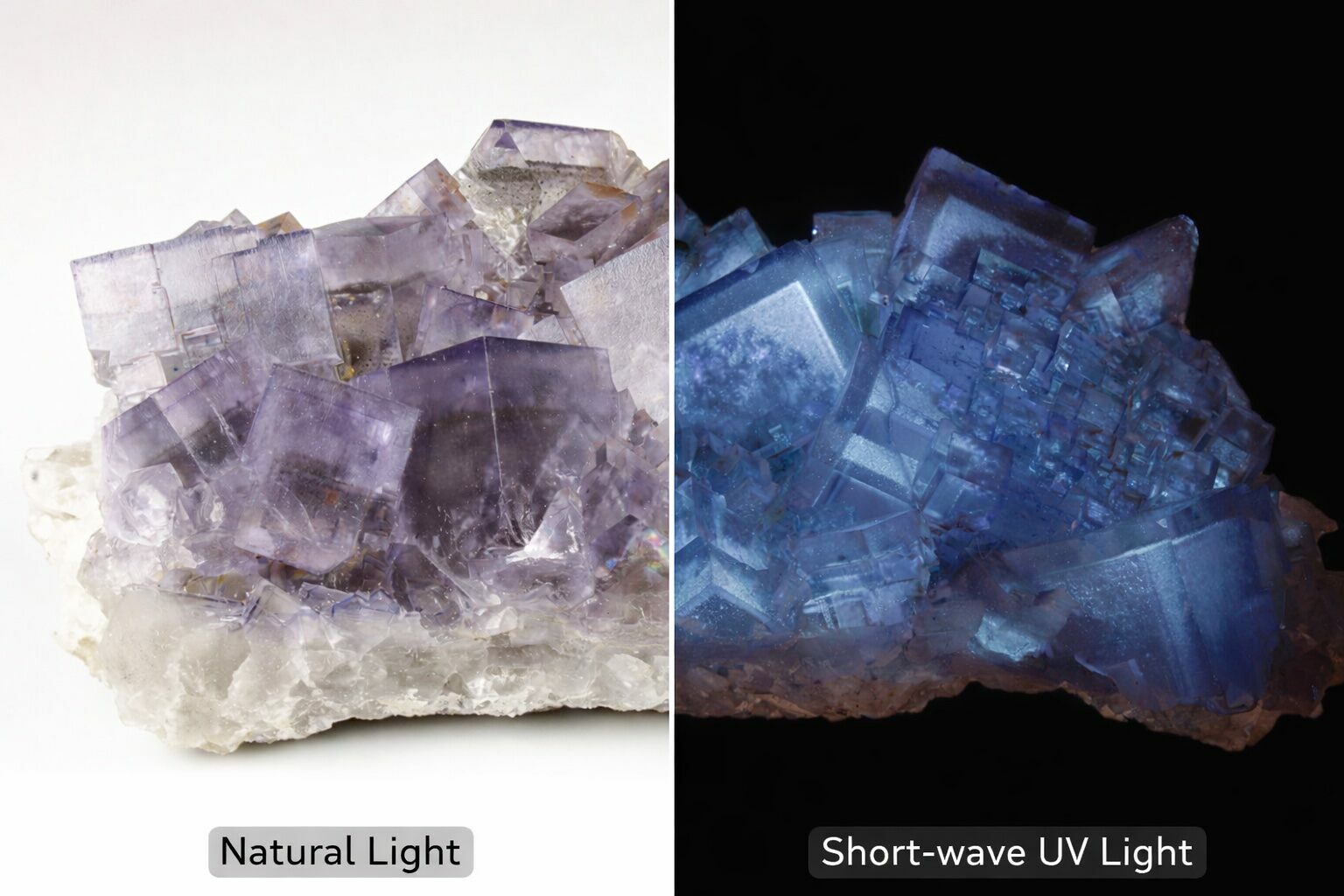
The same fluorite specimen, one side pictured under natural light and the other under short-wave UV light showing its fluorescence.
Historic Decorative Stone: Blue John
In England, fluorite found another cultural role through the rare variety known as Blue John, mined in Derbyshire. With its swirling bands of purple and yellow, Blue John became a prized ornamental material in the 18th and 19th centuries. Victorian craftsmen turned it into vases, chalices, urns, and jewelry that were displayed in aristocratic homes like treasures of the Earth.
Because the material is fragile and the deposits limited, true Blue John remains rare today — a mineral that is as much a piece of cultural history as geology.
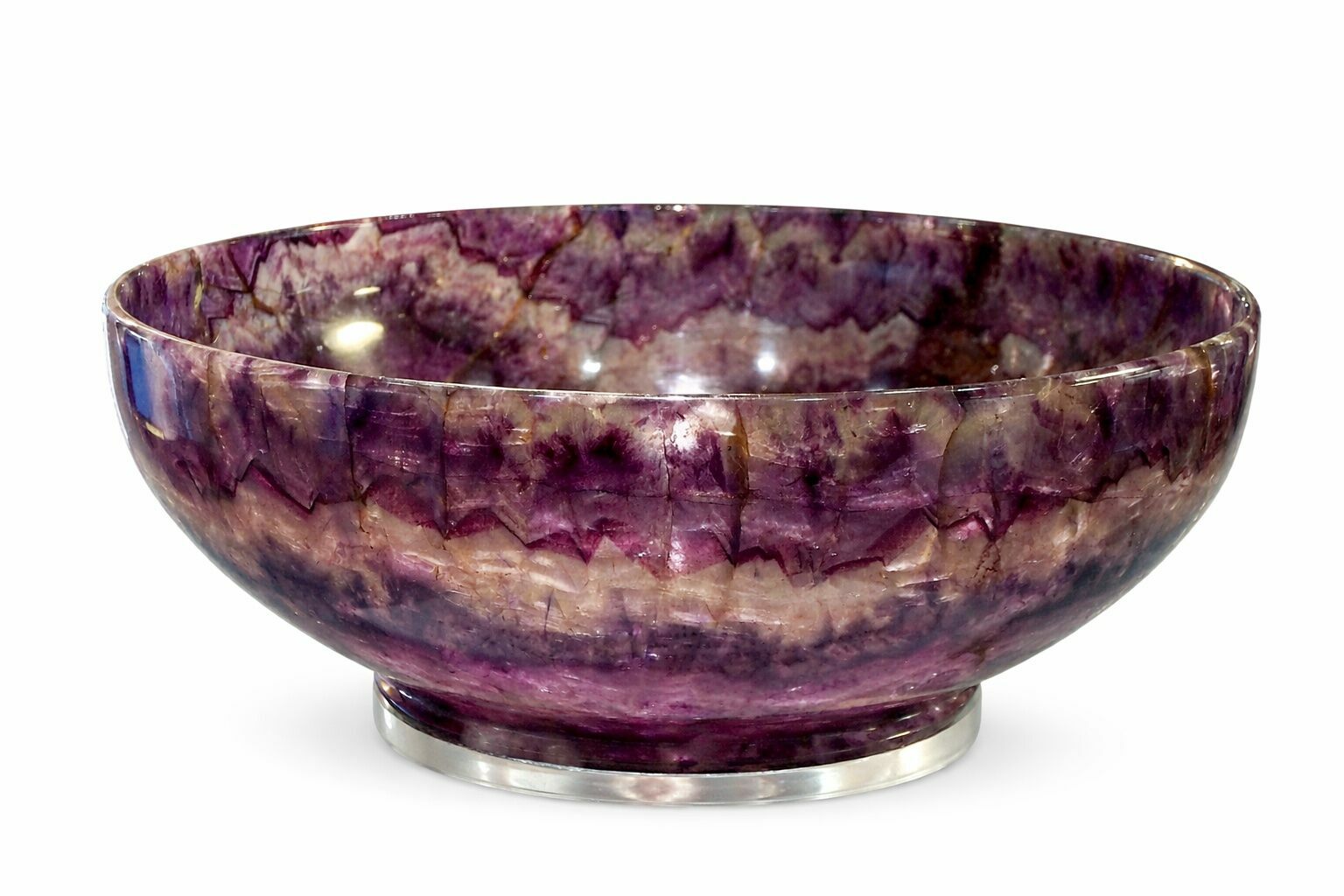
Bowl made from Derbyshire Blue John. Located Castleton Visitor Centre, Derbyshire.
Modern Uses: The Industrial Backbone of Fluorite
Today, fluorite is no longer only a curiosity of collectors or an accessory of historic smelters. It is one of the most important industrial minerals in the modern world. The majority of fluorite mined today is used to produce hydrofluoric acid, the foundation of modern fluorine chemistry.
Modern applications include:
In other words, fluorite touches daily life in ways most people never realize: in the metals that build cities, the chemicals that power industry, and the lenses that shape science.
Key Localities of Fluorite
Fluorite occurs on nearly every continent, but certain regions have produced specimens so distinctive and so historically important that they have become legendary among collectors and mineralogists. Each locality tells a different story — of ancient hydrothermal fluids, ore-rich veins, and the human pursuit of both beauty and industry. Some deposits are known for jewel-like cubes, others for fluorescent brilliance, and others for their deep connection to mining history.
Illinois–Kentucky Fluorspar District, USA
One of the most historically significant fluorite regions in North America, the Illinois–Kentucky Fluorspar District was once among the world’s most productive sources of fluorspar. For much of the 19th and 20th centuries, this area supplied enormous quantities of fluorite for steelmaking and chemical production, helping fuel American industry. Collectors, however, remember it for something else entirely: its stunning specimens. Fluorite from this district often forms rich purple, blue, or golden cubes, sometimes with dramatic zoning or phantom growth patterns. Many classic American museum specimens trace their origins to these mines, where fluorite crystallized alongside calcite, sphalerite, galena, and barite in ancient ore veins.
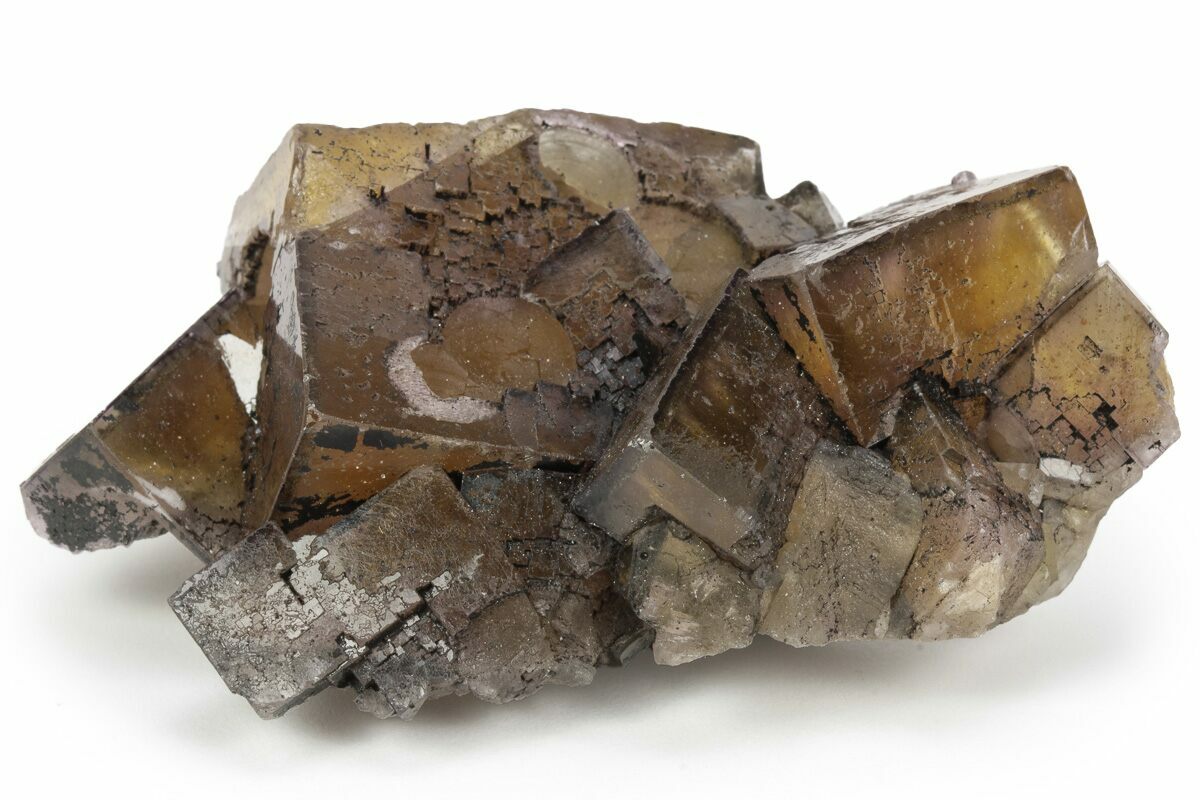
Yellow cubic fluorite from the Cave-In-Rock mining area of Illinois.
Weardale, England
Weardale, located in County Durham, is one of England’s most beloved fluorite-producing regions and has yielded some of the finest European specimens for generations. The fluorite here is famous for its vivid green and purple cubes, often perched elegantly on sparkling quartz. Weardale specimens are prized for their sharp crystal form, clarity, and strong color saturation, making them favorites among collectors worldwide. Mining in the region has a long history tied to lead and zinc extraction, and fluorite was often recovered as a secondary treasure. Even today, Weardale fluorite remains iconic — a symbol of Britain’s rich mineral heritage and the beauty hidden within its ancient hills.
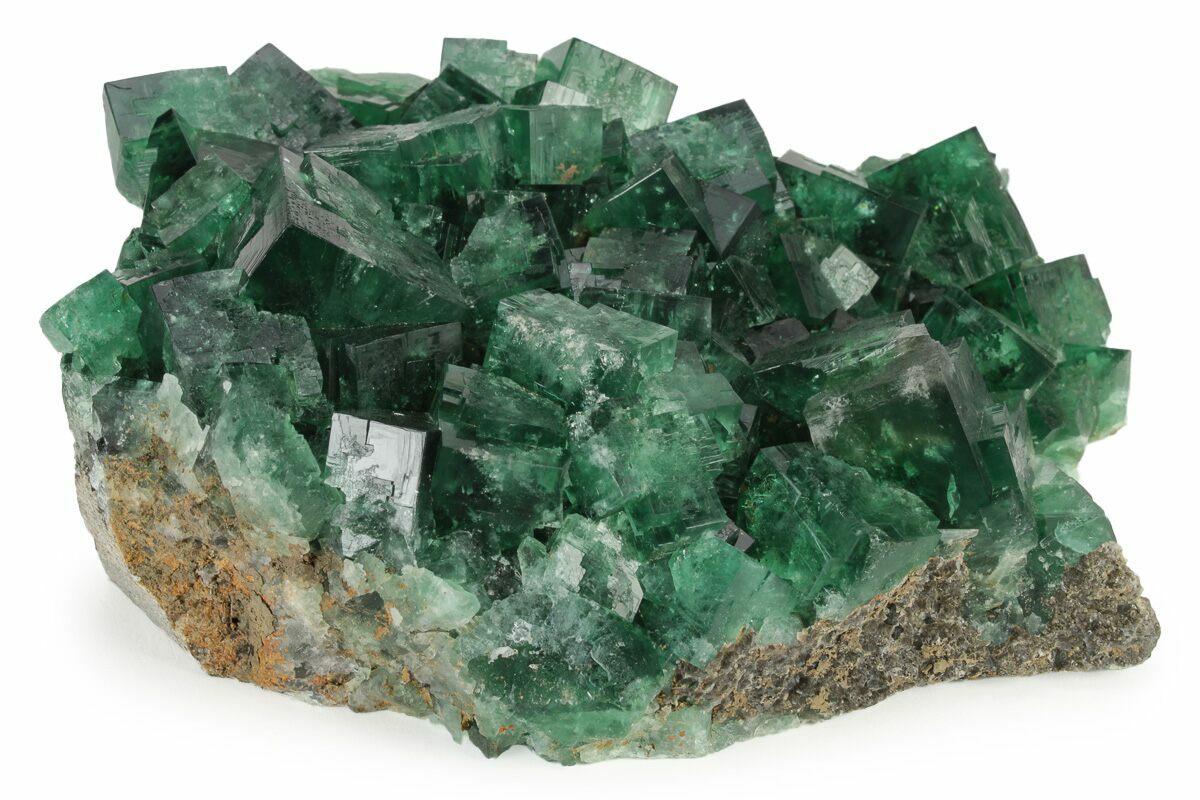
A cluster of highly fluorescent, green fluorite from the Weardale area of England.
Blue John Cavern, Derbyshire, England
Few fluorite localities are as culturally famous as the Blue John deposits of Derbyshire. Blue John is a rare, banded variety of fluorite with swirling layers of purple, cream, and golden-yellow, found almost exclusively in the Castleton area. For centuries, it has been mined not for industrial purposes but for ornamental stonework, reaching peak popularity during the Victorian era. Craftsmen turned Blue John into vases, goblets, candlesticks, and elaborate decorative objects that became symbols of wealth and taste. Because the deposits are small and fragile, only limited mining occurs today, and genuine Blue John is increasingly rare — a mineral that occupies a unique space between geology, art, and British history.
Dalnegorsk, Russia
Dalnegorsk, in Russia’s Far East, is renowned among mineral collectors for producing some of the most spectacular fluorite crystals ever discovered. The region’s complex ore deposits have yielded intensely colored fluorite cubes, often deep violet, emerald green, or smoky blue, sometimes reaching impressive sizes with exceptional transparency. Dalnegorsk fluorite commonly occurs in association with quartz, calcite, and metallic sulfides, creating striking contrast between bright crystal faces and rugged matrix. Specimens from this locality are often considered world-class, prized for their sharp geometry and vivid coloration. The mines of Dalnegorsk have long been important sources of lead, zinc, and boron minerals, but fluorite remains one of their most dazzling contributions to mineral collecting.
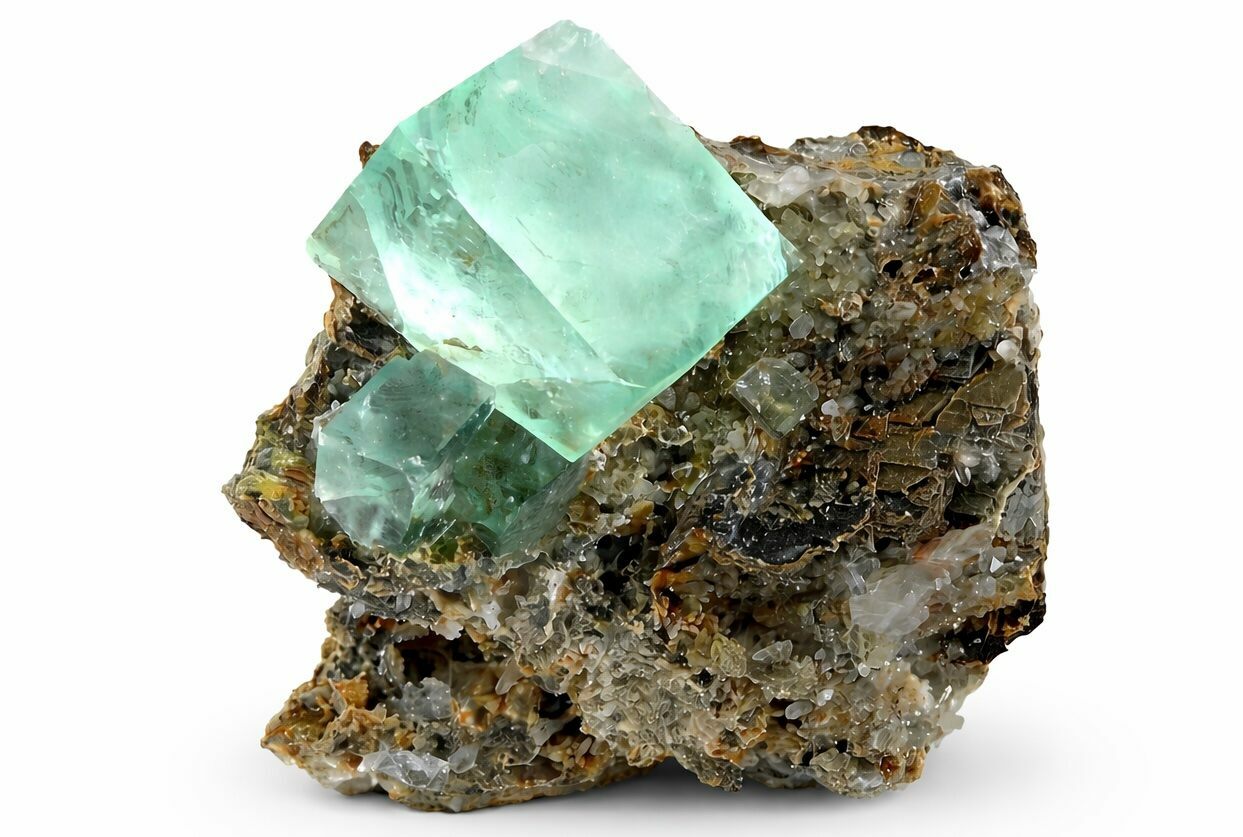
A green fluorite cube on matrix from Dalnegorsk, Russia.
Huanggang and Inner Mongolia, China
China has become the dominant modern source of fine fluorite specimens, and the deposits of Inner Mongolia — especially the Huanggang mining district — are among the most celebrated. Fluorite from this region often forms in beautiful pastel shades: soft purples, icy blues, mint greens, and occasionally golden tones. Many specimens show intricate zoning, with cubes displaying multiple colors within a single crystal. Inner Mongolian fluorite frequently occurs with quartz, calcite, and sulfide minerals, forming complex, highly aesthetic clusters. Over the past few decades, these localities have transformed the global collector market, producing an extraordinary abundance of high-quality specimens that rival the classics of Europe and America.
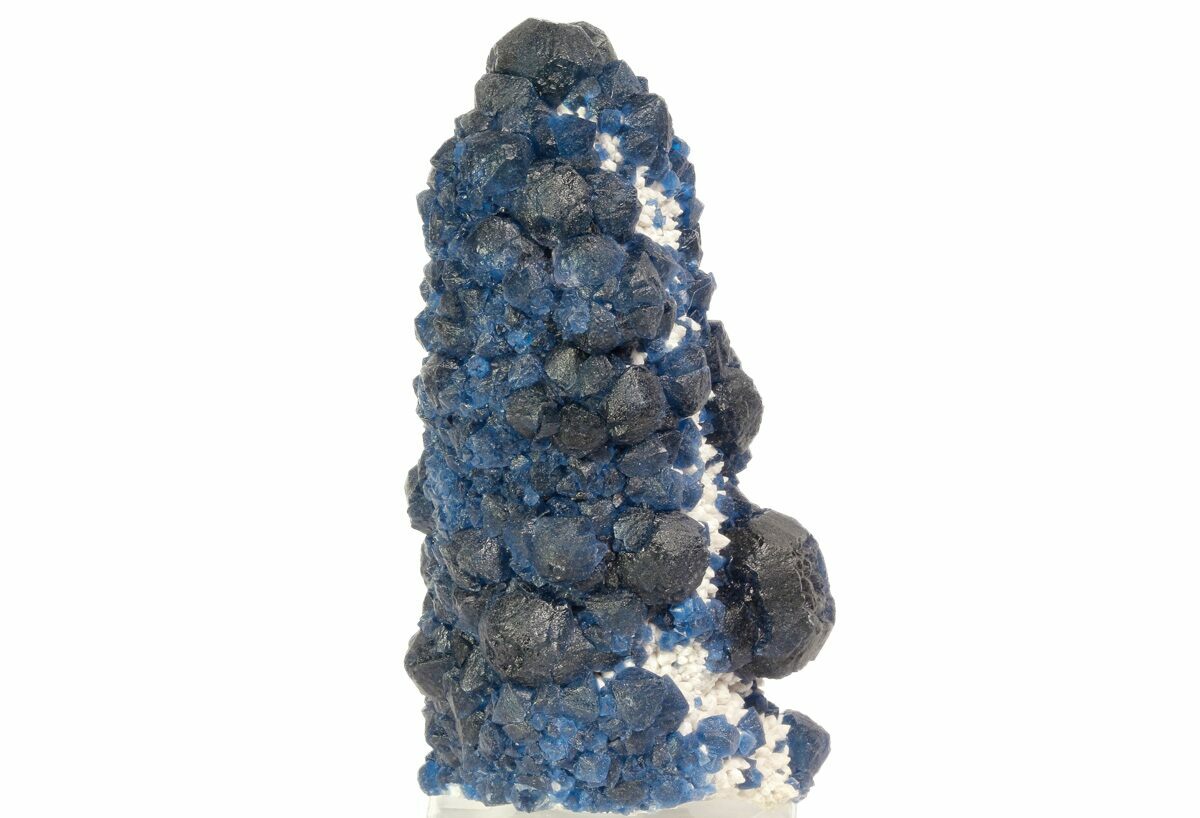
Blue fluorite on a milky quartz crystal from Huanggang Mine, Inner Mongolia
Elmwood Mine, Tennessee, USA
The Elmwood Mine is one of the great mineral treasures of the United States, famous not only for fluorite but for an entire suite of world-class crystals. Best known for spectacular calcite and sphalerite, Elmwood has also produced fluorite in rich purple cubes, often associated with sparkling calcite scalenohedrons or metallic sulfides. The fluorite here is prized for its luster and well-formed crystals, sometimes showing subtle zoning or phantom layers. Elmwood represents the intersection of industrial mining and mineral beauty — a working mine that unexpectedly became one of America’s premier sources of museum-quality specimens.
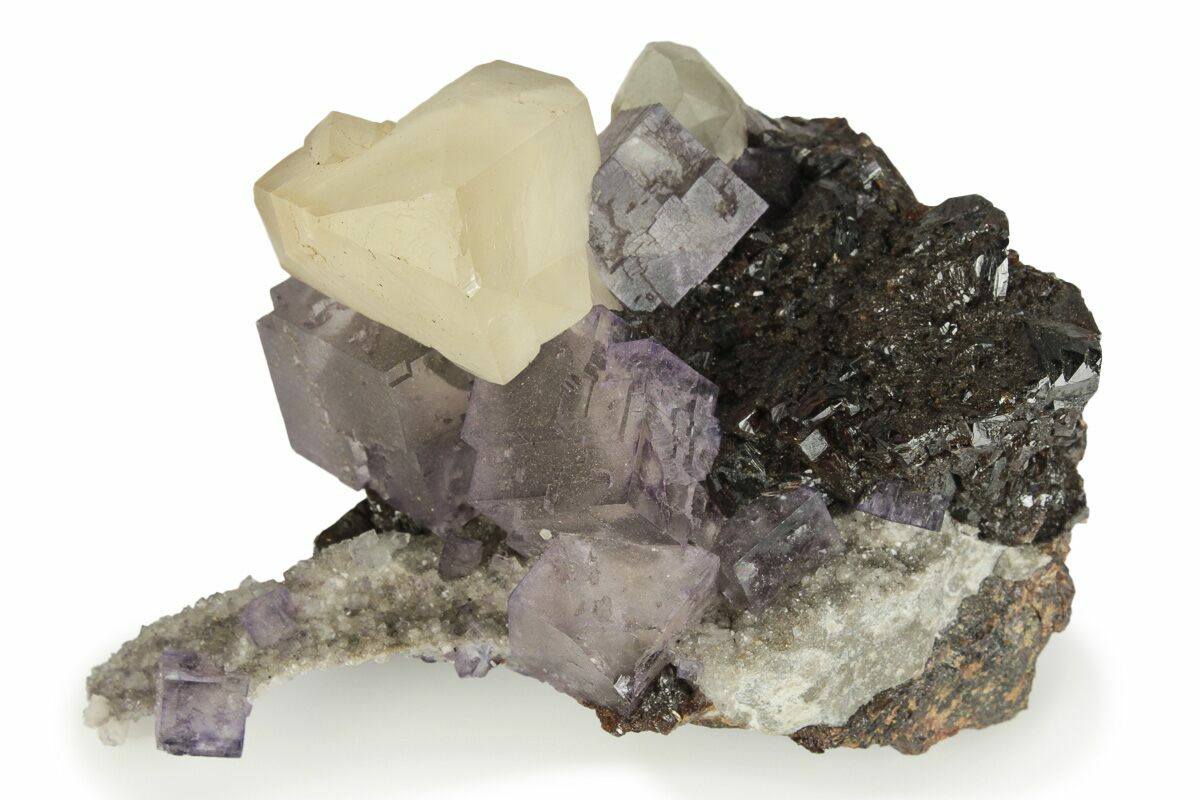
Purple, cubic fluorite associated with sphalerite and calcite from the Elmwood Mine.
Berbes, Asturias, Spain
The fluorite mines of Asturias, particularly near Berbes, have produced some of the most intensely colored fluorite in Europe. Spanish fluorite is renowned for its almost neon greens, vibrant blues, and richly saturated purples, often forming perfectly sharp cubes with exceptional clarity. Many specimens from this region are highly fluorescent as well, adding another layer of appeal. The Asturias deposits formed in hydrothermal veins, often alongside barite and sulfides, and have been mined for both industrial fluorspar and collector-grade crystals. Today, Berbes fluorite is considered among the finest in the world, instantly recognizable for its electric color and crisp crystal form.
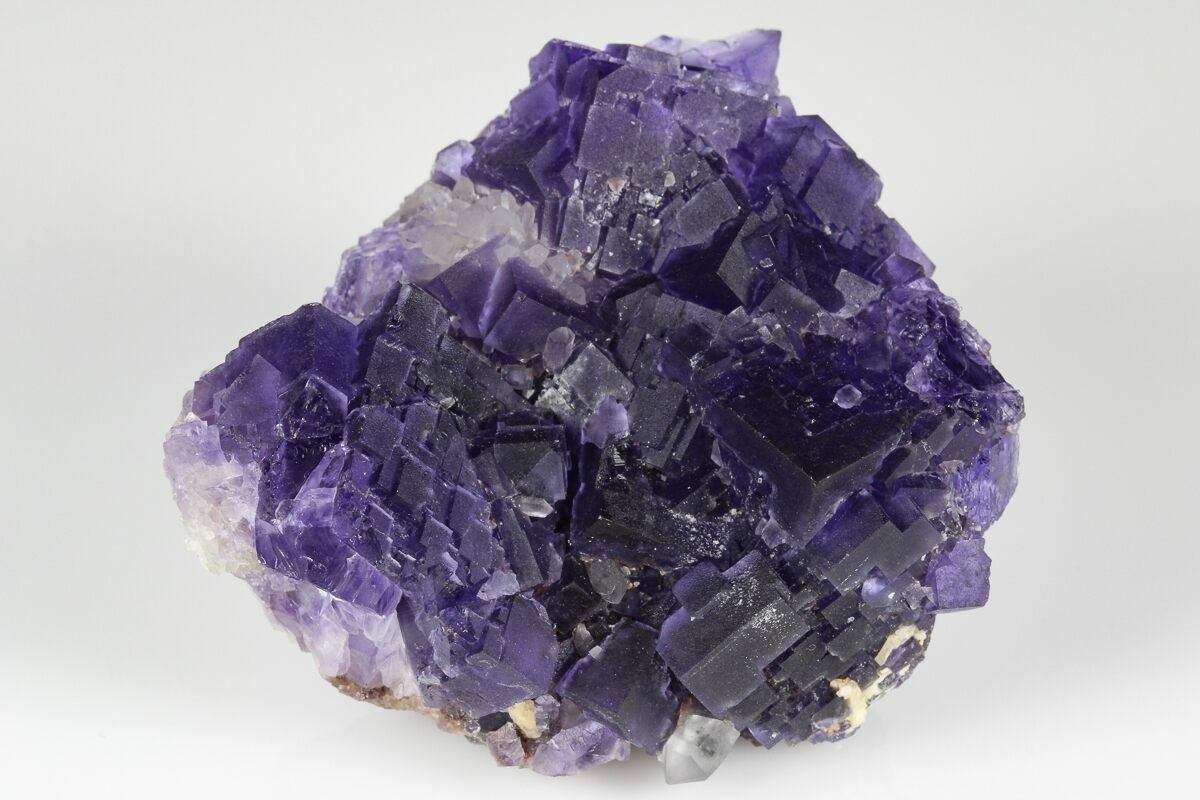
Cubic, purple fluorite from the mine near Berbes, Spain.
Namibia (Okorusu Mine)
Okorusu Mine in Namibia is legendary for producing fluorite specimens with extraordinary fluorescence and vivid coloration. The crystals here are often bright green, purple, or color-zoned, forming clusters of cubes that glow intensely under ultraviolet light. Okorusu fluorite is especially prized by collectors of fluorescent minerals, as some specimens display strong multi-stage responses under both shortwave and longwave UV. The deposit occurs within a carbonatite-related geological setting, making it somewhat unusual compared to many vein-hosted fluorite localities. Okorusu has produced some of the most visually dramatic fluorite specimens on Earth — crystals that seem almost alive when exposed to ultraviolet illumination.
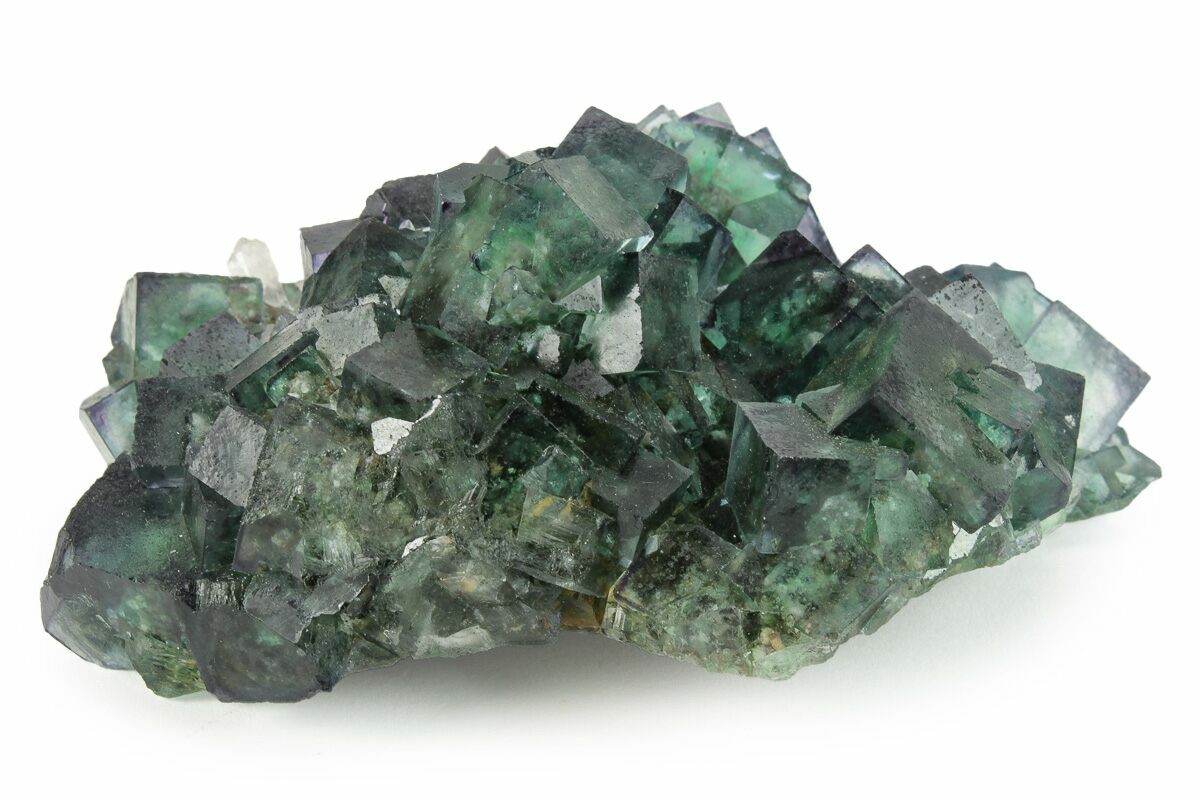
Green cubic fluorite crystals with purple edges from the Okorusu Mine.
Handling and Care of Fluorite
Fluorite may look like a mineral carved from pure color and light, but despite its striking beauty, it is also surprisingly delicate. Compared to many other popular collector minerals, fluorite requires thoughtful handling and proper storage to preserve both its crystal form and its vivid coloration.
One of the most important things to understand about fluorite is its relative softness. With a Mohs hardness of only 4, fluorite can be scratched more easily than quartz, feldspar, or most common gemstone minerals. Even casual contact with harder specimens in a collection drawer can leave marks on fluorite’s smooth crystal faces. Because of this, fluorite is best stored separately or in padded displays where it will not rub against harder minerals.
Fluorite is also famous for its perfect cleavage, meaning it can break cleanly along internal planes. While this cleavage contributes to fluorite’s geometric beauty, it also makes the mineral vulnerable to damage from drops or sudden impacts. A crystal that appears sturdy may fracture sharply if bumped, so collectors often handle fluorite with extra care, supporting specimens from underneath rather than gripping them tightly at the edges.
Another key aspect of fluorite care involves light exposure. Many fluorite specimens, particularly those with intense purple, blue, or green coloration, can gradually fade when left in direct sunlight for long periods. This happens because some of fluorite’s colors are produced by radiation-related color centers within the crystal lattice, and prolonged ultraviolet exposure from sunlight can destabilize these centers over time. For this reason, fluorite is best displayed away from bright windows or harsh natural light. Soft indoor lighting is usually ideal for long-term preservation.
Temperature and environmental conditions also matter. Fluorite should be protected from extreme heat, sudden temperature changes, and high humidity, especially if it occurs alongside delicate associated minerals. Some fluorite is thermoluminescent and sensitive to heat, and rapid shifts in temperature can sometimes encourage cracking along cleavage planes.
Cleaning fluorite should always be done gently. Harsh chemical cleaners or acidic solutions should be avoided, as fluorite can be damaged by acids and is often found with other minerals that may react even more strongly. The safest method is usually a soft brush or gentle air blower to remove dust, rather than water soaking or abrasive scrubbing.


