 Reviews

This Specimen has been sold.
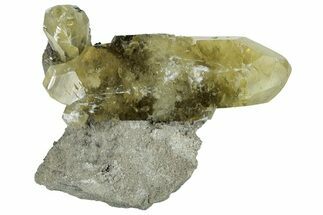
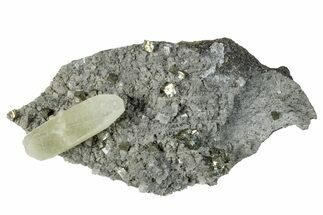
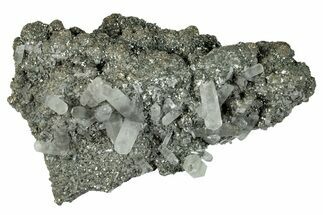
10.7" Double-Terminated Yellow Calcite Crystals on Matrix - Missouri


This is a gorgeous, 10.7" wide cluster of double-terminated yellow calcite crystals scattered across their natural matrix. The calcites show exceptional luster and clarity, with pristine terminations on the majority of the crystals. This mineral specimen was collected from the Sweetwater Mine in Reynolds County, Missouri, a site known for its stunning mineral associations. Aggregations of iridescent chalcopyrite can be around the periphery and underside of the matrix.
The specimen sits nicely on a flat surface without the need for a display stand.
The specimen sits nicely on a flat surface without the need for a display stand.
About Calcite Crystals
Calcite crystals are a form of calcium carbonate (CaCO₃) known for their diverse shapes, transparency, and vibrant range of colors. They typically form in rhombohedral, scalenohedral, or prismatic shapes, often with well-defined, sharp edges and glossy surfaces. Calcite crystals are often translucent or transparent, sometimes displaying a double refraction effect where objects viewed through the crystal appear doubled. They can appear in various colors—white, clear, yellow, pink, blue, green, and orange—depending on impurities or trace minerals.
A notable characteristic of calcite is its reaction with weak acids like vinegar, which causes it to effervesce, or fizz, as it releases carbon dioxide. This property makes calcite crystals a key tool in geological identification and studies. Calcite forms in many environments, from sedimentary rocks like limestone and marble to hydrothermal veins.
Calcite crystals are a form of calcium carbonate (CaCO₃) known for their diverse shapes, transparency, and vibrant range of colors. They typically form in rhombohedral, scalenohedral, or prismatic shapes, often with well-defined, sharp edges and glossy surfaces. Calcite crystals are often translucent or transparent, sometimes displaying a double refraction effect where objects viewed through the crystal appear doubled. They can appear in various colors—white, clear, yellow, pink, blue, green, and orange—depending on impurities or trace minerals.
A notable characteristic of calcite is its reaction with weak acids like vinegar, which causes it to effervesce, or fizz, as it releases carbon dioxide. This property makes calcite crystals a key tool in geological identification and studies. Calcite forms in many environments, from sedimentary rocks like limestone and marble to hydrothermal veins.
SPECIES
Calcite & Chalcopyrite
LOCATION
Sweetwater Mine, Viburnum Trend, Reynolds County, Missouri
SIZE
Entire specimen: 10.7 x 5.4"
CATEGORY
ITEM
#353651


