 Reviews

This Specimen has been sold.


2.15" Sparkling Dioptase Crystals on Calcite - N'tola Mine, Congo
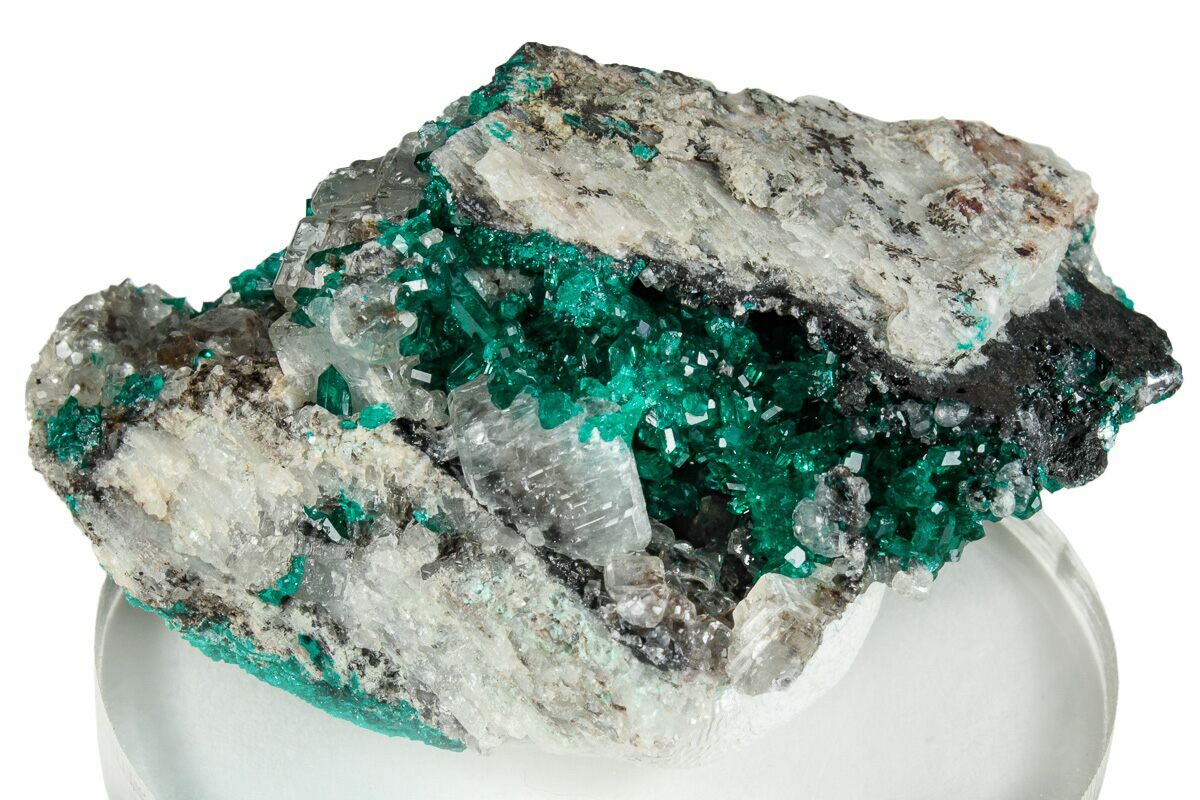
This is a beautiful cluster of sparkling dioptase crystals with some underlying, lustrous calcite with fluorescent properties, collected from the N'tola Mine of the Republic of the Congo. This mine has been closed since 2019, so this material is old stock. The entire specimen is 2.15" wide and the dioptase is a lustrous, emerald-green color.
It has been mounted to an acrylic display base with mineral tack. Under shortwave ultraviolet light, the calcite crystals exhibit a vibrant orange fluorescence.
It has been mounted to an acrylic display base with mineral tack. Under shortwave ultraviolet light, the calcite crystals exhibit a vibrant orange fluorescence.
About Dioptase
Dioptase is a showstopper in the mineral world—an electrifying copper silicate known for its mesmerizing, emerald-green color that seems to glow from within. Its vivid hues rival even the finest emeralds, but it’s the crystal clarity and intense brilliance that make collectors’ hearts race. Found in arid, copper-rich environments like the deserts of Namibia and Kazakhstan, dioptase forms stunning prismatic crystals that sparkle like tiny green beacons against contrasting matrix rock. While too soft for most jewelry, it’s a favorite among mineral collectors and museums for its sheer visual impact. Dioptase isn’t just a mineral—it’s nature’s answer to green fire in crystal form.
Dioptase is a showstopper in the mineral world—an electrifying copper silicate known for its mesmerizing, emerald-green color that seems to glow from within. Its vivid hues rival even the finest emeralds, but it’s the crystal clarity and intense brilliance that make collectors’ hearts race. Found in arid, copper-rich environments like the deserts of Namibia and Kazakhstan, dioptase forms stunning prismatic crystals that sparkle like tiny green beacons against contrasting matrix rock. While too soft for most jewelry, it’s a favorite among mineral collectors and museums for its sheer visual impact. Dioptase isn’t just a mineral—it’s nature’s answer to green fire in crystal form.
About Mimetite
Mimetite is a rare lead arsenate chloride mineral, often found in shades ranging from bright yellow to orange, brown, and occasionally green. Its crystals form in a hexagonal structure, typically appearing as prismatic or rounded barrel shapes, though they can also form in botryoidal or globular clusters. This mineral belongs to the apatite group and is closely related to pyromorphite and vanadinite, with which it can sometimes be found in mixed forms. Mimetite's vibrant colors and crystal formations make it a popular specimen among mineral collectors, as it is often highly aesthetic and eye-catching.
This mineral is usually found in the oxidized zones of lead ore deposits, commonly associated with minerals such as galena, wulfenite, and cerussite. It can be found in notable deposits worldwide, including locations in Mexico, Namibia, and Australia, where large and well-formed specimens have been unearthed. Mimetite crystals are relatively fragile due to their lead and arsenic content, requiring careful handling. Despite its appeal, mimetite is not used in jewelry or as a decorative stone because of its toxic elements, making it mainly a collector's mineral.
Mimetite is a rare lead arsenate chloride mineral, often found in shades ranging from bright yellow to orange, brown, and occasionally green. Its crystals form in a hexagonal structure, typically appearing as prismatic or rounded barrel shapes, though they can also form in botryoidal or globular clusters. This mineral belongs to the apatite group and is closely related to pyromorphite and vanadinite, with which it can sometimes be found in mixed forms. Mimetite's vibrant colors and crystal formations make it a popular specimen among mineral collectors, as it is often highly aesthetic and eye-catching.
This mineral is usually found in the oxidized zones of lead ore deposits, commonly associated with minerals such as galena, wulfenite, and cerussite. It can be found in notable deposits worldwide, including locations in Mexico, Namibia, and Australia, where large and well-formed specimens have been unearthed. Mimetite crystals are relatively fragile due to their lead and arsenic content, requiring careful handling. Despite its appeal, mimetite is not used in jewelry or as a decorative stone because of its toxic elements, making it mainly a collector's mineral.
SPECIES
Dioptase & Mimetite
LOCATION
N'tola Mine, Mindouli, Mindouli District, Pool Department, Republic of the Congo
SIZE
2.15 x 1.4"
CATEGORY
ITEM
#256951


