 Reviews

Dioptase – Mineral & Crystal Guide
Dioptase is widely regarded as one of the most breathtakingly beautiful copper minerals ever discovered, celebrated for a color so vivid and saturated that it is almost impossible to ignore. Its intense, electric emerald-green hue rivals — and in some cases surpasses — the finest emeralds in brilliance and purity of color. When light strikes a well-formed crystal, it seems to glow from within, radiating a rich, jewel-toned green that instantly captures attention.
Chemically classified as a hydrated copper cyclosilicate (Cu₆Si₆O₁₈·6H₂O), dioptase forms in the oxidized zones of copper deposits where silica-rich solutions meet carbonate host rock. The copper content is responsible for its extraordinary coloration, producing a deep, saturated green that can appear almost neon under strong light. Transparent to translucent crystals display a vitreous luster that enhances their gemstone-like appeal, while sharp crystal faces reflect light with dazzling intensity.
Crystallizing in the trigonal system, dioptase commonly develops as sharply defined rhombohedral crystals. These can form sparkling druses that blanket matrix rock or stand as dramatic, individually terminated prisms rising from contrasting white calcite. The visual contrast between luminous green crystals and pale limestone or calcite matrix is one of the most striking aesthetics in the mineral world, making fine specimens highly prized among collectors.
It is no surprise that when vibrant green crystals were first discovered in Central Asia in the late 1700s, miners believed they had uncovered emerald. Only later did mineralogists determine that this softer, more fragile material represented an entirely new species, formally described in 1797 by René Just Haüy. Despite its slightly lower hardness of 5 on the Mohs scale and its perfect cleavage — traits that limit its use in everyday jewelry — dioptase possesses a gem-quality beauty that few minerals can rival.
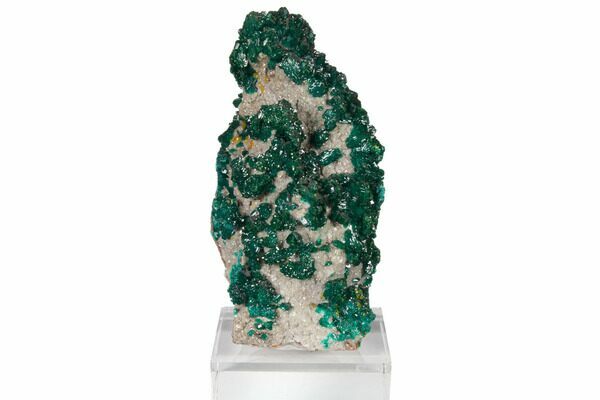
A beautiful association of dioptase crystals and mimetite from the Ntola Mine of the Republic of Congo.
Major deposits in Kazakhstan, Namibia’s famed Tsumeb Mine, and the Democratic Republic of Congo have produced specimens of exceptional quality, some with crystals large enough to facet. Yet even the smallest crystals seem to pulse with color.
Dioptase is more than just a copper mineral — it is a natural masterpiece, combining scientific intrigue with a color so rich and pure that it stands among the most stunning greens found in the mineral kingdom.
Chemical Classification: Hydrated copper silicate
Crystal System: Trigonal, typically forming elongated, six-sided prisms
Color: Intense emerald-green to blue-green
Luster: Vitreous to sub-adamantine (glassy and bright)
Hardness: Approximately 5 on the Mohs scale
Specific Gravity: Around 3.3
Cleavage: Perfect in three directions
Transparency: Transparent to translucent
Commonly Associated Minerals: Malachite, Azurite, Calcite, Dolomite, Chrysocolla, Smithsonite, Cerussite, Hemimorphite, Willemite, Mottramite, Plancheite, Shattuckite
The history of dioptase is filled with confusion, discovery, and scientific intrigue — a story that spans ancient artistry, 18th-century scientific debate, and modern mineral collecting.
In the late 1700s, copper miners working in what is now Kazakhstan (near the Altyn-Tyube deposit east of the Aral Sea) uncovered intensely green crystals lining cavities in limestone and copper-rich veins. Their brilliant emerald-green color led many to believe they had discovered a new source of emerald. Specimens were sent to Russia and Europe, where early naturalists initially classified them as emerald or another green beryl variety.
However, closer examination revealed inconsistencies. The crystals were softer than emerald, had different crystal habits, and did not share emerald’s hexagonal structure. The decisive work came in 1797, when the French mineralogist René Just Haüy, often called the “Father of Crystallography,” studied the crystals’ cleavage and internal structure. Haüy demonstrated that the mineral possessed perfect rhombohedral cleavage and physical properties distinct from beryl, proving it was an entirely new mineral species.
Haüy named the mineral dioptase, from the Greek words dia (“through”) and optos (“visible”), meaning “visible through.” The name refers to the way its internal cleavage planes and crystal separations can be seen through transparent crystals — a feature that fascinated early crystallographers and helped establish it as a textbook example in mineralogical study.
Long before its formal scientific identification, dioptase appears to have been valued for its vivid green pigment. Archaeological discoveries suggest that finely ground dioptase may have been used as a copper-based pigment in ancient decorative art. Small fragments and inlays attributed to dioptase have been found in prehistoric contexts in Central Asia and the Middle East, where copper minerals were widely used for ornamentation. Its intense color made it a desirable decorative stone even if its identity was not understood.
The original Central Asian deposits became known as the Kirghiz Steppe deposits in early mineralogical literature. Mining in the region focused primarily on copper, with dioptase occurring as a secondary mineral in the oxidized zones of copper deposits. Because dioptase forms in the oxidation zone of copper sulfide deposits, it was never mined as a primary ore mineral, but rather collected as a byproduct.
Throughout the 19th century, specimens from Kazakhstan became highly prized among European collectors. Museums and aristocratic mineral cabinets sought large, transparent crystals mounted on contrasting limestone or calcite matrix.
In the late 19th and 20th centuries, additional notable dioptase deposits were discovered:
Tsumeb, Namibia – Perhaps the most famous modern locality. The Tsumeb Mine produced world-class dioptase crystals throughout the 20th century, often in association with calcite and other copper minerals. These specimens set the standard for crystal quality and remain highly sought after.
Democratic Republic of Congo – The Mindouli and Renéville deposits yielded exceptionally bright, gemmy crystals.
Arizona, USA – Smaller occurrences in copper mining districts.
Chile and Peru – Additional secondary copper deposits produced collectible material.
The discovery of these localities solidified dioptase’s status as one of the most spectacular secondary copper minerals known.
Dioptase is primarily a collector’s mineral, treasured for its extraordinary color and sharply defined crystal forms. Fine specimens are often considered centerpieces in advanced mineral collections and can command significant prices due to their relative rarity and aesthetic appeal. Although dioptase is occasionally faceted, it is not a practical jewelry stone because of its moderate hardness and perfect cleavage. With a Mohs hardness of only 5 and a tendency to split along cleavage planes, it is vulnerable to scratching and breakage. Even standard gem-cleaning methods can damage it, which is why most cut stones are created strictly for display rather than everyday wear.
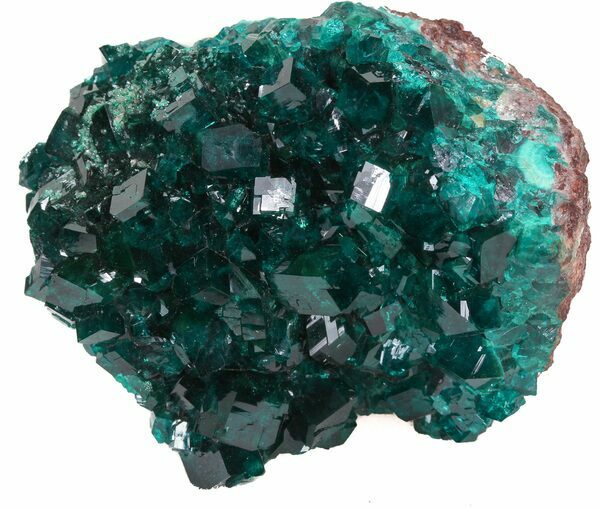
A cluster of vibrant, emerald-green dioptase crystals perched on quartz from the Congo.
Historically, finely ground dioptase was sometimes used as a green pigment thanks to its remarkably rich and saturated color. However, because it contains copper, the dust can be hazardous if inhaled or ingested. As awareness of these risks increased, its use as a pigment declined and was largely discontinued.
Much of dioptase’s enduring appeal lies in its extraordinary visual presence. Its color can rival — and in some cases even surpass — that of emerald, displaying a vivid, saturated green that seems almost illuminated. Transparent crystals often appear to glow from within when exposed to light, giving them a luminous quality that few minerals possess. Dioptase also forms only under specific and relatively uncommon geological conditions in the oxidized zones of copper deposits where silica-rich fluids interact with carbonate rocks. This rarity adds to its mystique and desirability.

Chemically classified as a hydrated copper cyclosilicate (Cu₆Si₆O₁₈·6H₂O), dioptase forms in the oxidized zones of copper deposits where silica-rich solutions meet carbonate host rock. The copper content is responsible for its extraordinary coloration, producing a deep, saturated green that can appear almost neon under strong light. Transparent to translucent crystals display a vitreous luster that enhances their gemstone-like appeal, while sharp crystal faces reflect light with dazzling intensity.
Crystallizing in the trigonal system, dioptase commonly develops as sharply defined rhombohedral crystals. These can form sparkling druses that blanket matrix rock or stand as dramatic, individually terminated prisms rising from contrasting white calcite. The visual contrast between luminous green crystals and pale limestone or calcite matrix is one of the most striking aesthetics in the mineral world, making fine specimens highly prized among collectors.
It is no surprise that when vibrant green crystals were first discovered in Central Asia in the late 1700s, miners believed they had uncovered emerald. Only later did mineralogists determine that this softer, more fragile material represented an entirely new species, formally described in 1797 by René Just Haüy. Despite its slightly lower hardness of 5 on the Mohs scale and its perfect cleavage — traits that limit its use in everyday jewelry — dioptase possesses a gem-quality beauty that few minerals can rival.
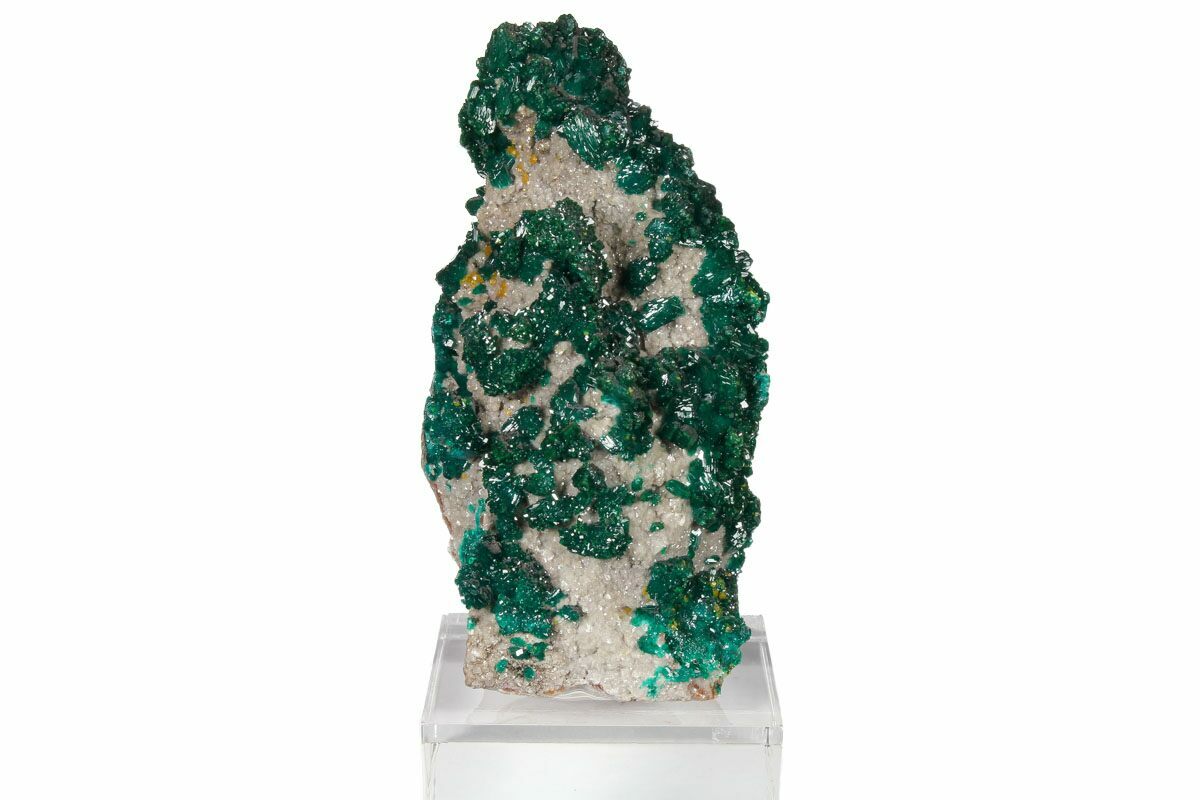
A beautiful association of dioptase crystals and mimetite from the Ntola Mine of the Republic of Congo.
Major deposits in Kazakhstan, Namibia’s famed Tsumeb Mine, and the Democratic Republic of Congo have produced specimens of exceptional quality, some with crystals large enough to facet. Yet even the smallest crystals seem to pulse with color.
Dioptase is more than just a copper mineral — it is a natural masterpiece, combining scientific intrigue with a color so rich and pure that it stands among the most stunning greens found in the mineral kingdom.
Physical Properties
Origins & History Of Dioptase
The history of dioptase is filled with confusion, discovery, and scientific intrigue — a story that spans ancient artistry, 18th-century scientific debate, and modern mineral collecting.
In the late 1700s, copper miners working in what is now Kazakhstan (near the Altyn-Tyube deposit east of the Aral Sea) uncovered intensely green crystals lining cavities in limestone and copper-rich veins. Their brilliant emerald-green color led many to believe they had discovered a new source of emerald. Specimens were sent to Russia and Europe, where early naturalists initially classified them as emerald or another green beryl variety.
However, closer examination revealed inconsistencies. The crystals were softer than emerald, had different crystal habits, and did not share emerald’s hexagonal structure. The decisive work came in 1797, when the French mineralogist René Just Haüy, often called the “Father of Crystallography,” studied the crystals’ cleavage and internal structure. Haüy demonstrated that the mineral possessed perfect rhombohedral cleavage and physical properties distinct from beryl, proving it was an entirely new mineral species.
Haüy named the mineral dioptase, from the Greek words dia (“through”) and optos (“visible”), meaning “visible through.” The name refers to the way its internal cleavage planes and crystal separations can be seen through transparent crystals — a feature that fascinated early crystallographers and helped establish it as a textbook example in mineralogical study.
Ancient Use Before Scientific Recognition
Long before its formal scientific identification, dioptase appears to have been valued for its vivid green pigment. Archaeological discoveries suggest that finely ground dioptase may have been used as a copper-based pigment in ancient decorative art. Small fragments and inlays attributed to dioptase have been found in prehistoric contexts in Central Asia and the Middle East, where copper minerals were widely used for ornamentation. Its intense color made it a desirable decorative stone even if its identity was not understood.
Early Mining History
The original Central Asian deposits became known as the Kirghiz Steppe deposits in early mineralogical literature. Mining in the region focused primarily on copper, with dioptase occurring as a secondary mineral in the oxidized zones of copper deposits. Because dioptase forms in the oxidation zone of copper sulfide deposits, it was never mined as a primary ore mineral, but rather collected as a byproduct.
Throughout the 19th century, specimens from Kazakhstan became highly prized among European collectors. Museums and aristocratic mineral cabinets sought large, transparent crystals mounted on contrasting limestone or calcite matrix.
Expansion of Localities
In the late 19th and 20th centuries, additional notable dioptase deposits were discovered:
The discovery of these localities solidified dioptase’s status as one of the most spectacular secondary copper minerals known.
Uses: Collectors, Gems, and Historical Significance
Dioptase is primarily a collector’s mineral, treasured for its extraordinary color and sharply defined crystal forms. Fine specimens are often considered centerpieces in advanced mineral collections and can command significant prices due to their relative rarity and aesthetic appeal. Although dioptase is occasionally faceted, it is not a practical jewelry stone because of its moderate hardness and perfect cleavage. With a Mohs hardness of only 5 and a tendency to split along cleavage planes, it is vulnerable to scratching and breakage. Even standard gem-cleaning methods can damage it, which is why most cut stones are created strictly for display rather than everyday wear.
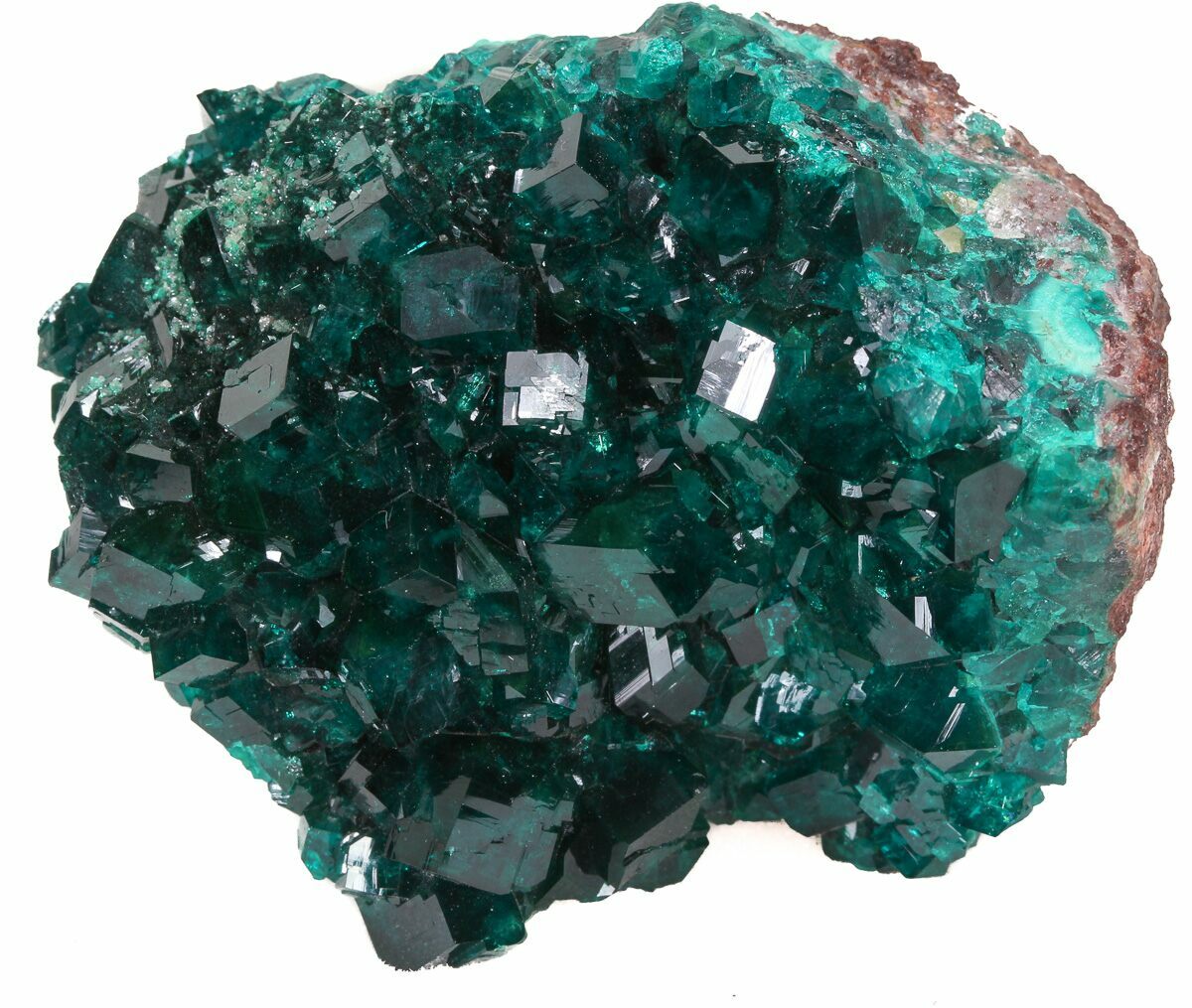
A cluster of vibrant, emerald-green dioptase crystals perched on quartz from the Congo.
Historically, finely ground dioptase was sometimes used as a green pigment thanks to its remarkably rich and saturated color. However, because it contains copper, the dust can be hazardous if inhaled or ingested. As awareness of these risks increased, its use as a pigment declined and was largely discontinued.
Much of dioptase’s enduring appeal lies in its extraordinary visual presence. Its color can rival — and in some cases even surpass — that of emerald, displaying a vivid, saturated green that seems almost illuminated. Transparent crystals often appear to glow from within when exposed to light, giving them a luminous quality that few minerals possess. Dioptase also forms only under specific and relatively uncommon geological conditions in the oxidized zones of copper deposits where silica-rich fluids interact with carbonate rocks. This rarity adds to its mystique and desirability.


