 Reviews

This Specimen has been sold.


2.4" Amethyst Crystal - Thunder Bay, Ontario
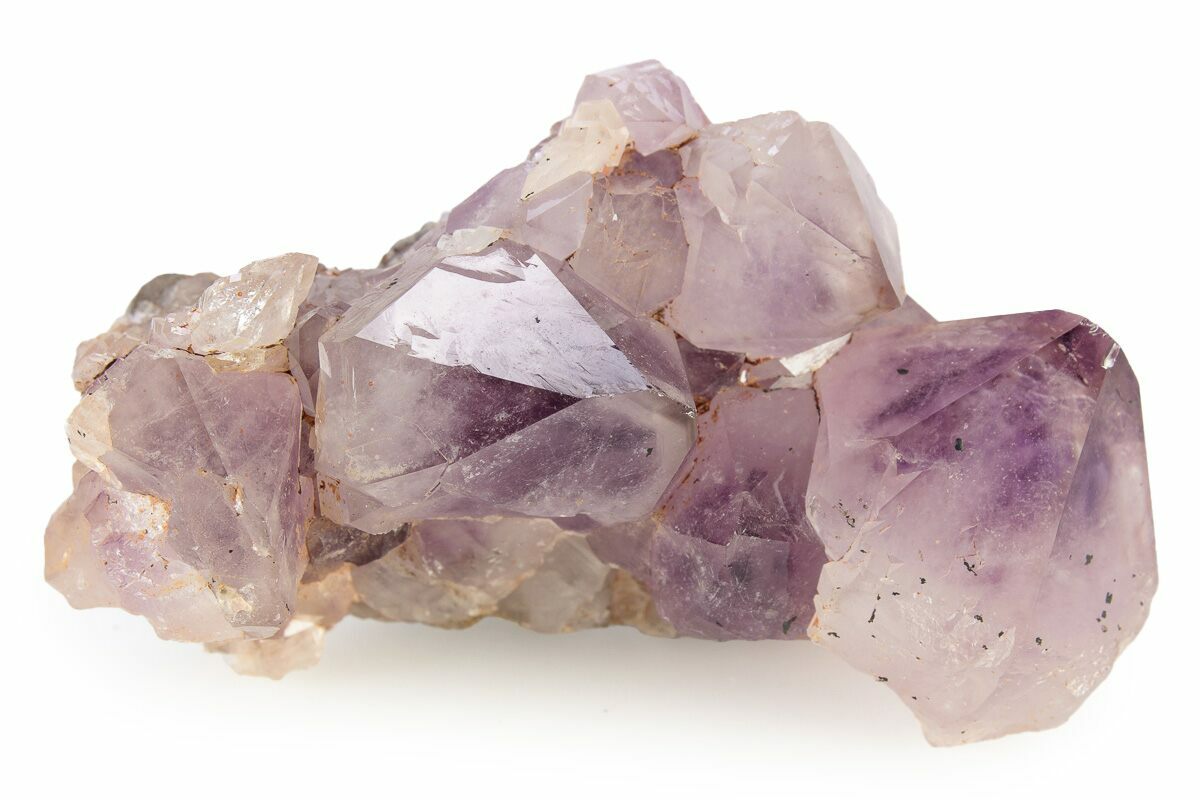
This is an amethyst crystal collected from the Purple Mountain Mine near Thunder Bay, Ontario.
About Thunder Bay Amethyst
Amethyst from the Thunder Bay region of Ontario is renowned for its vivid color and striking inclusions, making it one of the most recognizable amethyst varieties in North America. The deposits were first discovered in the 1950s during road construction roughly 30 miles northeast of Thunder Bay, revealing extensive veins and pockets of quartz within ancient volcanic rock. By the 1960s, several mines were in operation, and the area quickly became a major source of high-quality amethyst for both collectors and lapidary use.
Thunder Bay amethyst is known for its impressive color range, spanning from soft, lavender hues to deep, nearly black tones referred to as “black amethyst.” What sets this locality apart, however, is its distinctive red hematite inclusions. These appear as microscopic disks, spherules, or dust-like clouds suspended within the quartz, creating brilliant flashes of red and orange when the crystals catch the light. In some specimens, the hematite is so pervasive that whole sections—and occasionally entire crystals—take on a warm reddish glow. This combination of rich purple quartz and iron-derived coloration gives Thunder Bay amethyst its unmistakable and highly sought-after appearance.
Amethyst from the Thunder Bay region of Ontario is renowned for its vivid color and striking inclusions, making it one of the most recognizable amethyst varieties in North America. The deposits were first discovered in the 1950s during road construction roughly 30 miles northeast of Thunder Bay, revealing extensive veins and pockets of quartz within ancient volcanic rock. By the 1960s, several mines were in operation, and the area quickly became a major source of high-quality amethyst for both collectors and lapidary use.
Thunder Bay amethyst is known for its impressive color range, spanning from soft, lavender hues to deep, nearly black tones referred to as “black amethyst.” What sets this locality apart, however, is its distinctive red hematite inclusions. These appear as microscopic disks, spherules, or dust-like clouds suspended within the quartz, creating brilliant flashes of red and orange when the crystals catch the light. In some specimens, the hematite is so pervasive that whole sections—and occasionally entire crystals—take on a warm reddish glow. This combination of rich purple quartz and iron-derived coloration gives Thunder Bay amethyst its unmistakable and highly sought-after appearance.
About Quartz
Quartz is the name given to silicon dioxide (SiO2) and is the second most abundant mineral in the Earth's crust. Quartz crystals generally grow in silica-rich environments--usually igneous rocks or hydrothermal environments like geothermal waters--at temperatures between 100°C and 450°C, and usually under very high pressure. In either case, crystals will precipitate as temperatures cool, just as ice gradually forms when water freezes. Quartz veins are formed when open fissures are filled with hot water during the closing stages of mountain formation: these veins can be hundreds of millions of years old.
Quartz is the name given to silicon dioxide (SiO2) and is the second most abundant mineral in the Earth's crust. Quartz crystals generally grow in silica-rich environments--usually igneous rocks or hydrothermal environments like geothermal waters--at temperatures between 100°C and 450°C, and usually under very high pressure. In either case, crystals will precipitate as temperatures cool, just as ice gradually forms when water freezes. Quartz veins are formed when open fissures are filled with hot water during the closing stages of mountain formation: these veins can be hundreds of millions of years old.
SPECIES
Quartz var. Amethyst
LOCATION
Purple Mountain Mine, Thunder Bay, Ontario, Canada
SIZE
2.4" long
CATEGORY
SUB CATEGORY
ITEM
#251652


