 Reviews

This Specimen has been sold.


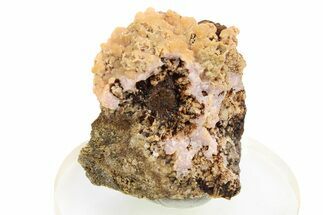
3.5" Calcite on Goethite Pseudomorphs after Gypsum - Mexico

This is a classic pseudomorph specimen out of the Santa Eulalia Mining District of Chihuahua, Mexico. It's a formation of botryoidal goethite pseudomorphed after gypsum, with a layer of calcite crystals coating the goethite. This occurrence required the gypsum to first crystallize, be overgrown with goethite, and later dissolve, leaving behind a hollow cast. The specimen measures 3.5" wide and is accompanied by an acrylic display stand.
About Goethite
Goethite is an iron-bearing hydroxide mineral composed primarily of iron(III) oxide-hydroxide (FeO(OH)). It commonly forms as a weathering product of iron-rich minerals and is one of the primary components of rust and limonite. Goethite often develops in botryoidal, stalactitic, or massive forms, though it can also occur as acicular or needle-like crystals. Its color ranges from yellow-brown to reddish-brown or black, with a dull to submetallic luster. This mineral is widespread in soil and sedimentary environments and frequently associated with hematite, magnetite, and quartz. Named after the German poet and philosopher Johann Wolfgang von Goethe, goethite has been used historically as a pigment and remains a significant iron ore in some regions.
Goethite is an iron-bearing hydroxide mineral composed primarily of iron(III) oxide-hydroxide (FeO(OH)). It commonly forms as a weathering product of iron-rich minerals and is one of the primary components of rust and limonite. Goethite often develops in botryoidal, stalactitic, or massive forms, though it can also occur as acicular or needle-like crystals. Its color ranges from yellow-brown to reddish-brown or black, with a dull to submetallic luster. This mineral is widespread in soil and sedimentary environments and frequently associated with hematite, magnetite, and quartz. Named after the German poet and philosopher Johann Wolfgang von Goethe, goethite has been used historically as a pigment and remains a significant iron ore in some regions.
About Calcite Crystals
Calcite crystals are a form of calcium carbonate (CaCO₃) known for their diverse shapes, transparency, and vibrant range of colors. They typically form in rhombohedral, scalenohedral, or prismatic shapes, often with well-defined, sharp edges and glossy surfaces. Calcite crystals are often translucent or transparent, sometimes displaying a double refraction effect where objects viewed through the crystal appear doubled. They can appear in various colors—white, clear, yellow, pink, blue, green, and orange—depending on impurities or trace minerals.
A notable characteristic of calcite is its reaction with weak acids like vinegar, which causes it to effervesce, or fizz, as it releases carbon dioxide. This property makes calcite crystals a key tool in geological identification and studies. Calcite forms in many environments, from sedimentary rocks like limestone and marble to hydrothermal veins.
Calcite crystals are a form of calcium carbonate (CaCO₃) known for their diverse shapes, transparency, and vibrant range of colors. They typically form in rhombohedral, scalenohedral, or prismatic shapes, often with well-defined, sharp edges and glossy surfaces. Calcite crystals are often translucent or transparent, sometimes displaying a double refraction effect where objects viewed through the crystal appear doubled. They can appear in various colors—white, clear, yellow, pink, blue, green, and orange—depending on impurities or trace minerals.
A notable characteristic of calcite is its reaction with weak acids like vinegar, which causes it to effervesce, or fizz, as it releases carbon dioxide. This property makes calcite crystals a key tool in geological identification and studies. Calcite forms in many environments, from sedimentary rocks like limestone and marble to hydrothermal veins.
SPECIES
Calcite & Goethite
LOCATION
Santa Eulalia Mining District, Chihuahua, Mexico
SIZE
Entire specimen 3.5 x 2.1"
CATEGORY
ITEM
#330398