 Reviews

This Specimen has been sold.


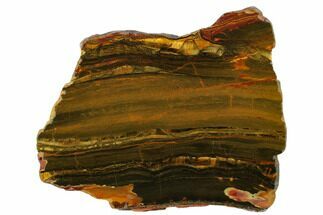
4" Polished Tiger Iron Slab - South Africa


This is a beautiful, 4" wide slab of tiger iron with bands of tiger's eye, collected from Prieska, South Africa. It has been cut into an aesthetically pleasing rectangle and polished all the way around to a glossy finish.
It comes with an acrylic display stand.
It comes with an acrylic display stand.
About Tiger Iron
Tiger Iron is composed mainly of tiger's eye, red jasper, and black hematite in an undulating banded pattern. It is mined primarily in two large deposits, one in South Africa and the other in Western Australia. Both deposits are over 2 billion years old!
Many believe tiger iron should technically be considered a stromatolite formed by ancient cyanobacteria over two billion years ago. One theory holds that tiger iron is a typical stromatolite that has undergone mineral replacement with iron oxide. Another theory suggests that microbes formed the banded iron directly while the stromatolite was being formed.
Even if tiger iron doesn't end up technically being a stromatolite, its formation along with the formation of other Precambrian banded iron formations is indirectly due to the cyanobacteria that formed stromatolites. Oxygen was not present in the early atmosphere, but arose as a byproduct of photosynthesis by cyanobacteria. This oxygen, combined with dissolved iron in Earth's oceans, formed insoluble iron oxides. This precipitated out and formed thin layers on the ocean floor. The bands within the tiger iron could then represent cyclical (seasonal?) variations in oxygen levels within Earth's oceans.
It is assumed that the Earth's first seas were extremely acidic, containing vast amounts of dissolved nickel and iron. As photosynthetic organisms generated oxygen, the available iron in the Earth's oceans precipitated out as iron oxides. At a suspected tipping point the oceans became permanently oxygenated and small variations in oxygen production produced periods of free oxygen in surface waters, alternating with periods of iron oxide deposition.
Tiger iron is gorgeous to look at and even more impressive when you consider its very existence as evidence of life on earth several billion years ago!
Tiger Iron is composed mainly of tiger's eye, red jasper, and black hematite in an undulating banded pattern. It is mined primarily in two large deposits, one in South Africa and the other in Western Australia. Both deposits are over 2 billion years old!
Many believe tiger iron should technically be considered a stromatolite formed by ancient cyanobacteria over two billion years ago. One theory holds that tiger iron is a typical stromatolite that has undergone mineral replacement with iron oxide. Another theory suggests that microbes formed the banded iron directly while the stromatolite was being formed.
Even if tiger iron doesn't end up technically being a stromatolite, its formation along with the formation of other Precambrian banded iron formations is indirectly due to the cyanobacteria that formed stromatolites. Oxygen was not present in the early atmosphere, but arose as a byproduct of photosynthesis by cyanobacteria. This oxygen, combined with dissolved iron in Earth's oceans, formed insoluble iron oxides. This precipitated out and formed thin layers on the ocean floor. The bands within the tiger iron could then represent cyclical (seasonal?) variations in oxygen levels within Earth's oceans.
It is assumed that the Earth's first seas were extremely acidic, containing vast amounts of dissolved nickel and iron. As photosynthetic organisms generated oxygen, the available iron in the Earth's oceans precipitated out as iron oxides. At a suspected tipping point the oceans became permanently oxygenated and small variations in oxygen production produced periods of free oxygen in surface waters, alternating with periods of iron oxide deposition.
Tiger iron is gorgeous to look at and even more impressive when you consider its very existence as evidence of life on earth several billion years ago!
About Tiger's Eye
Tiger's Eye, or Tiger Eye, is a gorgeous chatoyant gemstone with alternating bands of golden to red-brown color and a silky luster. It has a fascinating and constantly shifting light effect where the gold and brown bands appear to keep reversing as the stone is moved relative to the light source.
Tiger's eye is actually a variety of quartz made chatoyant by subparallel inter-growth with altered amphibole fibers turned into limonite. It is primarily used for ornamental and lapidary purposes. Primary sources of tiger's eye are South Africa, Australia, and China.
Tiger's Eye, or Tiger Eye, is a gorgeous chatoyant gemstone with alternating bands of golden to red-brown color and a silky luster. It has a fascinating and constantly shifting light effect where the gold and brown bands appear to keep reversing as the stone is moved relative to the light source.
Tiger's eye is actually a variety of quartz made chatoyant by subparallel inter-growth with altered amphibole fibers turned into limonite. It is primarily used for ornamental and lapidary purposes. Primary sources of tiger's eye are South Africa, Australia, and China.
SPECIES
Tiger Iron
LOCATION
Prieska, Northern Cape Province, South Africa
SIZE
4 x 2.4", .3" thick
CATEGORY
ITEM
#357110