 Reviews

Tiger’s Eye: Mineral & Crystal Guide
Few minerals captivate the imagination quite like tiger’s eye. With a silky luster and a luminous band of light that glides across its surface as it moves, tiger’s eye appears almost alive—like the watchful gaze of a great cat prowling through tall grass at dusk. This remarkable gemstone has fascinated people for centuries, not only for its beauty but for the unusual geological story hidden within its golden-brown bands.
At first glance, tiger’s eye looks like a polished piece of satin stone or even wood caught mid-transformation. Tilt it under a light and a bright streak seems to slide across the surface, a phenomenon known as chatoyancy, from the French word œil de chat, meaning “cat’s eye.” This optical effect is shared with only a select group of gemstones, and in tiger’s eye, it is so vivid and bold that it gives the stone its unmistakable character. The effect is caused by parallel fibrous structures within the stone that reflect light in a concentrated band—like sunlight glancing off brushed silk.
Despite its fibrous appearance, tiger’s eye is not a fibrous mineral in the traditional sense. It is actually a variety of quartz—one of the most abundant minerals on Earth—but its structure forms through a more complex process than simple replacement. While it was once widely described as a pseudomorph after crocidolite (a blue fibrous amphibole), more recent research shows that tiger’s eye likely develops through a crack-seal growth mechanism, where quartz and crocidolite fibers grow together in repeated microscopic fractures. This process creates the parallel fibrous bands responsible for its silky texture and chatoyant “cat’s eye” effect, rather than preserving the exact structure of a fully replaced earlier mineral.
Its colors range from honey-gold and caramel brown to deep reddish hues and even rich blue-gray. When cut and polished, tiger’s eye is typically shaped into cabochons (smooth, domed stones) to best display its shimmering band of light. Large blocks are often carved into spheres, towers, and ornamental objects, where the chatoyancy creates dramatic visual effects.
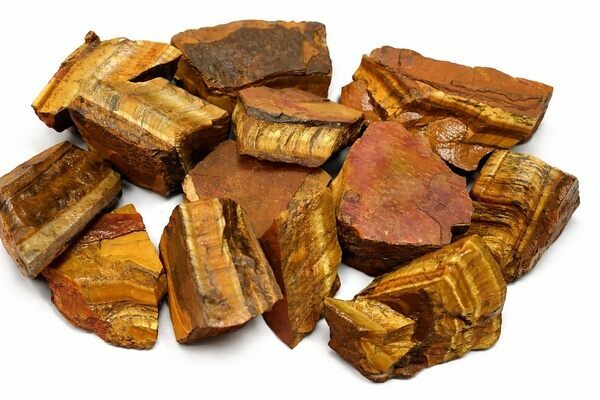
Rough, unpolished pieces of Tiger's Eye from South Africa
Tiger’s eye is also surprisingly tough. With a hardness of 7 on the Mohs scale, it resists scratching and holds up well in jewelry, making it a popular gemstone for rings, pendants, and bracelets. Unlike many delicate chatoyant gems, tiger’s eye is relatively affordable and widely available, allowing collectors and jewelry enthusiasts to enjoy its beauty without rarity-driven prices.
Beyond its physical properties, tiger’s eye has carried symbolic weight through cultures and centuries. It has been worn as a talisman, carried as a protective charm, and admired as a stone of courage and strength. But its true story—its geological origin, historical journey, and global distribution—is just as compelling as its shimmering surface.
Mineral Type: Variety of quartz (silicon dioxide, SiO₂)
Crystal System: Trigonal (microcrystalline quartz)
Color: Golden-brown, yellow-brown, reddish-brown, blue-gray
Luster: Silky to vitreous
Transparency: Opaque
Hardness: 7 on the Mohs scale
Specific Gravity: Approximately 2.64–2.71
Cleavage: None
Fracture: Conchoidal
Optical Phenomenon: Chatoyancy (cat’s-eye effect)
Streak: White
Commonly Associated Minerals: Crocidolite, quartz, hematite, goethite, jasper
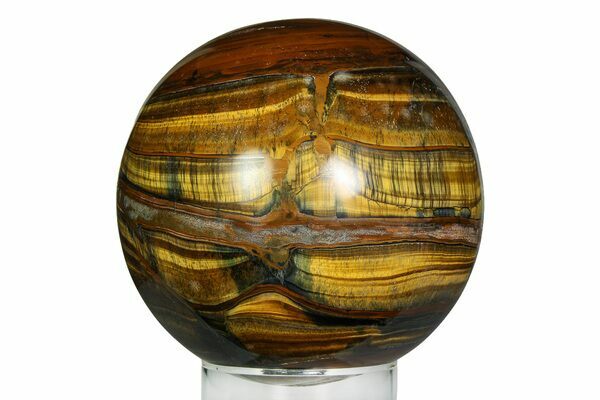
A high quality sphere of polished tiger's eye.
Tiger’s eye has long fascinated both collectors and scientists—not just for its striking look, but for the unique way it forms deep within the Earth. Earlier theories held that tiger’s eye was simply a pseudomorph: quartz slowly replacing the fibrous mineral crocidolite (a form of blue asbestos), while preserving its original structure. In that model, the quartz would take over the space once occupied by crocidolite, and oxidation of the iron in the crocidolite would produce the rich golden and reddish-brown colors typical of tiger’s eye.
However, more recent microscopic studies of South African specimens have shown that tiger’s eye often doesn’t show evidence of classic pseudomorphic replacement. Instead, it appears to form through a discontinuous crack-seal mechanism. In this process, tiny fractures develop in quartz-rich rocks that contain some crocidolite. Water rich in silica and other necessary minerals seeps into these cracks. As the crack fills, quartz begins to grow along the crack surfaces while new crocidolite fibers also grow from bits of crocidolite already present on the crack walls. The rock then cracks again, typically along the same surface, and the cycle repeats.
This series of crack-seal events produces alternating bands of quartz and discontinuous, angled crocidolite fibers. Over time, as iron in the crocidolite oxidizes (essentially rusting), the familiar golden and brown colors develop, with the quartz and fiber alignment producing the signature silky shimmer known as chatoyancy or the “cat’s eye” effect.
In simpler terms, tiger’s eye forms when microscopic cracks in silica-bearing rocks repeatedly fill with quartz and crocidolite fibers under heat and pressure. These bands and the resulting oxidation give the stone its distinctive layered look and light-reflecting sheen—making it both a geological curiosity and a beloved gemstone.
Tiger’s eye has likely been known since antiquity, though its early history blends with legend. The Romans are believed to have carried tiger’s eye into battle as a protective talisman, believing it granted courage and clarity under pressure. Its resemblance to the eye of a tiger—a creature associated with strength, vigilance, and power—made it a natural symbol of protection.
The name “tiger’s eye” refers directly to its appearance. When polished, the golden bands and shifting light closely resemble the iris and pupil of a tiger. The name was popularized in Europe during the 19th century as mineral collecting and gem cutting expanded.
The most significant deposits were discovered in South Africa during the late 1800s, particularly in the Northern Cape Province. These finds brought tiger’s eye into the global gemstone market. By the early 20th century, it had become a popular ornamental stone used in jewelry, carvings, and decorative objects.
Throughout history, tiger’s eye has been used for:
Jewelry: Cabochons, beads, rings, pendants, cufflinks
Carvings: Spheres, animals, obelisks, bowls
Cameos and seals: Particularly during the Victorian era
Architectural decoration: Inlays and small ornamental features
Metaphysical practices: Believed by some to promote courage, focus, and grounding

A tiger's eye bracelet
During the Victorian period, tiger’s eye jewelry was fashionable among men, especially in signet rings and watch fobs. Its masculine tones and durability made it particularly appealing. In modern times, tiger’s eye remains a staple in both jewelry and mineral collections. Its affordability, durability, and dramatic appearance ensure steady demand. While it is not rare, high-quality pieces with strong chatoyancy and clean, well-defined bands are highly prized.
Tiger’s eye is far more diverse than its classic golden-brown form might suggest. Variations in chemistry, oxidation, and geological conditions give rise to several distinct types, each with its own colors, patterns, and visual character.
Marra Mamba is a striking variety from Western Australia. It features bands of golden tiger’s eye interlayered with red jasper and hematite. The result is a vibrant combination of metallic sheen and deep red earth tones. Marra Mamba forms in iron-rich sedimentary environments and is highly sought after for cabochons and decorative slabs.
Nellite is a rare combination of tiger’s eye and pietersite, typically showing a mix of golden and blue fibers. Found primarily in Namibia, nellite can display swirling patterns rather than the straight bands typical of standard tiger’s eye. It often has more dramatic, chaotic chatoyancy.
Blue tiger’s eye represents an earlier stage in the oxidation process. It retains the blue-gray color of the original crocidolite fibers. The chatoyancy is often softer and more subtle than the golden variety, with a cool, steel-blue shimmer.
Red tiger’s eye can occur naturally through further oxidation of iron, though much of the material on the market has been heat-treated to enhance or produce the red coloration. It displays warm mahogany and deep rust tones while retaining strong chatoyancy.
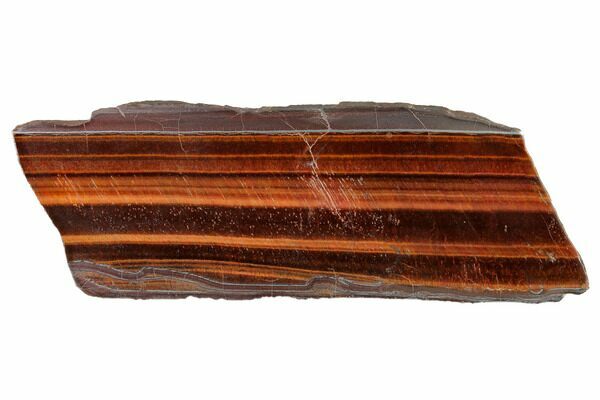
A slab of red tiger's eye from South Africa
Tiger’s eye is found in several regions around the world, but only a handful of localities have produced material in significant quantity or exceptional quality. These deposits, often associated with ancient iron formations, each offer tiger’s eye with distinctive colors, patterns, and geological character.
South Africa is the world’s most important source of tiger’s eye. Deposits near Griquatown and Kuruman have produced vast quantities of high-quality material since the late 19th century. The region’s banded iron formations provided ideal conditions for crocidolite formation and subsequent quartz replacement. South African tiger’s eye is known for its strong golden color and bold, straight chatoyant bands.
Western Australia is famous for Marra Mamba tiger’s eye. Found within ancient iron formations, this material combines tiger’s eye with jasper and hematite. The contrasting red and gold layers make it especially popular with lapidaries. The Pilbara region’s geology, rich in iron deposits, has created some of the most visually striking specimens.
Namibia produces blue tiger’s eye (hawk’s eye), nellite, and pietersite. Deposits are often associated with metamorphosed iron formations. Namibian material is especially valued for its vibrant blue hues and complex patterns. Nellite from this region is considered rare and collectible.
India is a significant producer of tiger’s eye for the global bead and carving market. While much of the rough material may originate elsewhere, India is known for cutting and polishing large volumes of tiger’s eye into beads, spheres, and decorative objects. Some local deposits also exist.
Small deposits of tiger’s eye have been found in parts of California and Arizona, though they are not commercially significant compared to African sources. Specimens from these localities are mainly of interest to regional collectors.
Often mistaken for a simple variation of tiger’s eye, tiger iron is actually a distinct and far more complex rock. While tiger’s eye is a single mineral variety (quartz replacing crocidolite), tiger iron is a banded metamorphic rock composed of multiple minerals layered together. Its dramatic appearance—metallic silver-gray, deep red, and shimmering gold bands—makes it one of the most visually striking ornamental stones in the mineral world.
Tiger iron is primarily made up of three main components:
Tiger’s eye (golden chatoyant quartz)
Red jasper
Hematite (metallic iron oxide)
These materials occur in alternating layers, often tightly folded or banded. The result is a stone that combines the silky shimmer of tiger’s eye, the earthy opacity of jasper, and the reflective metallic luster of hematite—all in one specimen.
Unlike tiger’s eye, which forms through the pseudomorphic replacement of crocidolite by quartz, tiger iron represents an original sedimentary layering of iron-rich minerals that later underwent metamorphism (heat and pressure). The tiger’s eye portions within tiger iron formed in the same way as standalone tiger’s eye deposits, but they remain interlayered with jasper and hematite instead of occurring as relatively pure quartz masses.
Tiger iron is most famously found in the Pilbara region of Western Australia, where vast banded iron formations date back more than 2.5 billion years. These ancient deposits contain some of the world’s most striking examples, often cut into slabs, spheres, and cabochons to showcase their natural banding.
At first glance, tiger’s eye looks like a polished piece of satin stone or even wood caught mid-transformation. Tilt it under a light and a bright streak seems to slide across the surface, a phenomenon known as chatoyancy, from the French word œil de chat, meaning “cat’s eye.” This optical effect is shared with only a select group of gemstones, and in tiger’s eye, it is so vivid and bold that it gives the stone its unmistakable character. The effect is caused by parallel fibrous structures within the stone that reflect light in a concentrated band—like sunlight glancing off brushed silk.

Despite its fibrous appearance, tiger’s eye is not a fibrous mineral in the traditional sense. It is actually a variety of quartz—one of the most abundant minerals on Earth—but its structure forms through a more complex process than simple replacement. While it was once widely described as a pseudomorph after crocidolite (a blue fibrous amphibole), more recent research shows that tiger’s eye likely develops through a crack-seal growth mechanism, where quartz and crocidolite fibers grow together in repeated microscopic fractures. This process creates the parallel fibrous bands responsible for its silky texture and chatoyant “cat’s eye” effect, rather than preserving the exact structure of a fully replaced earlier mineral.
Its colors range from honey-gold and caramel brown to deep reddish hues and even rich blue-gray. When cut and polished, tiger’s eye is typically shaped into cabochons (smooth, domed stones) to best display its shimmering band of light. Large blocks are often carved into spheres, towers, and ornamental objects, where the chatoyancy creates dramatic visual effects.
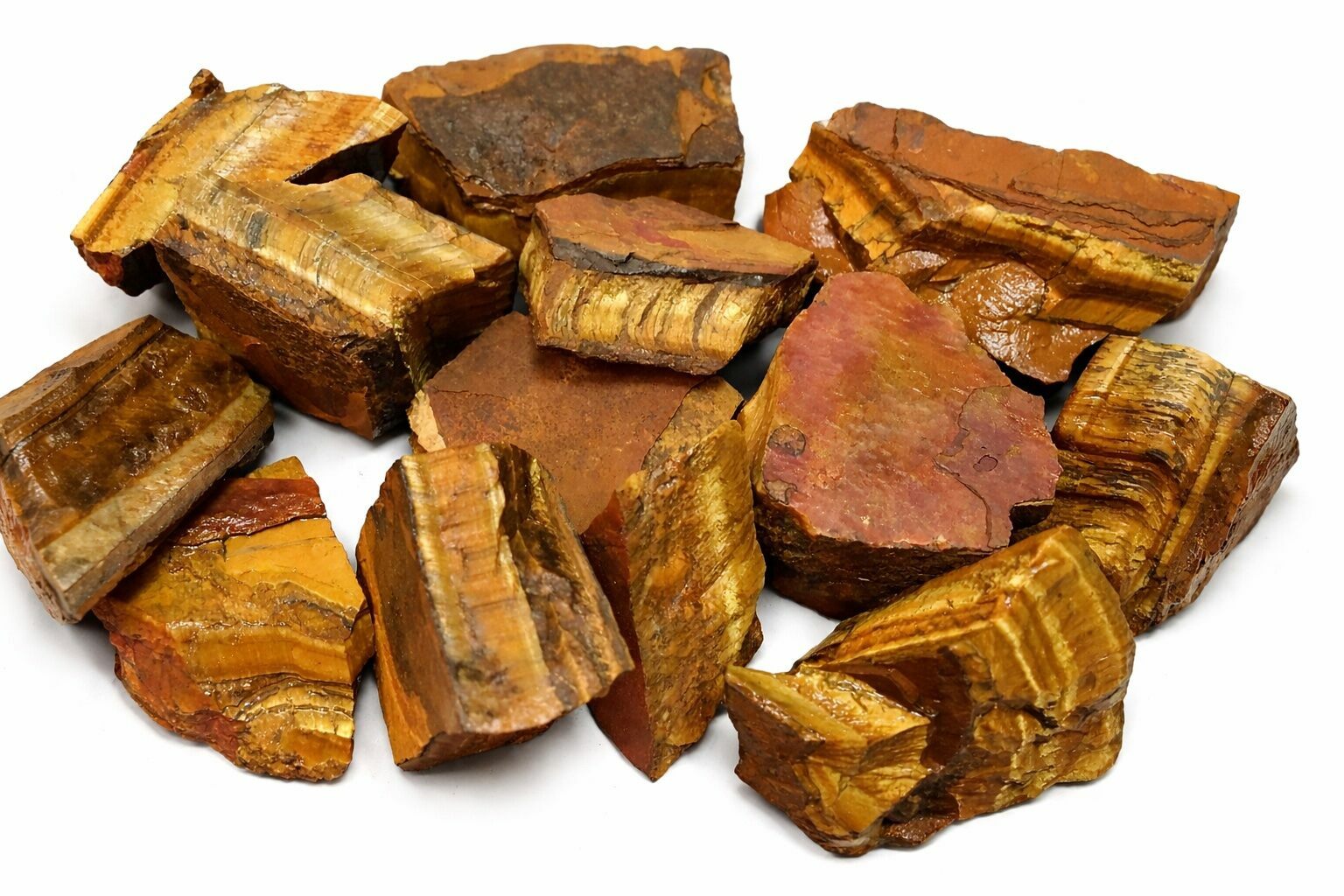
Rough, unpolished pieces of Tiger's Eye from South Africa
Tiger’s eye is also surprisingly tough. With a hardness of 7 on the Mohs scale, it resists scratching and holds up well in jewelry, making it a popular gemstone for rings, pendants, and bracelets. Unlike many delicate chatoyant gems, tiger’s eye is relatively affordable and widely available, allowing collectors and jewelry enthusiasts to enjoy its beauty without rarity-driven prices.
Beyond its physical properties, tiger’s eye has carried symbolic weight through cultures and centuries. It has been worn as a talisman, carried as a protective charm, and admired as a stone of courage and strength. But its true story—its geological origin, historical journey, and global distribution—is just as compelling as its shimmering surface.
Properties of Tiger’s Eye
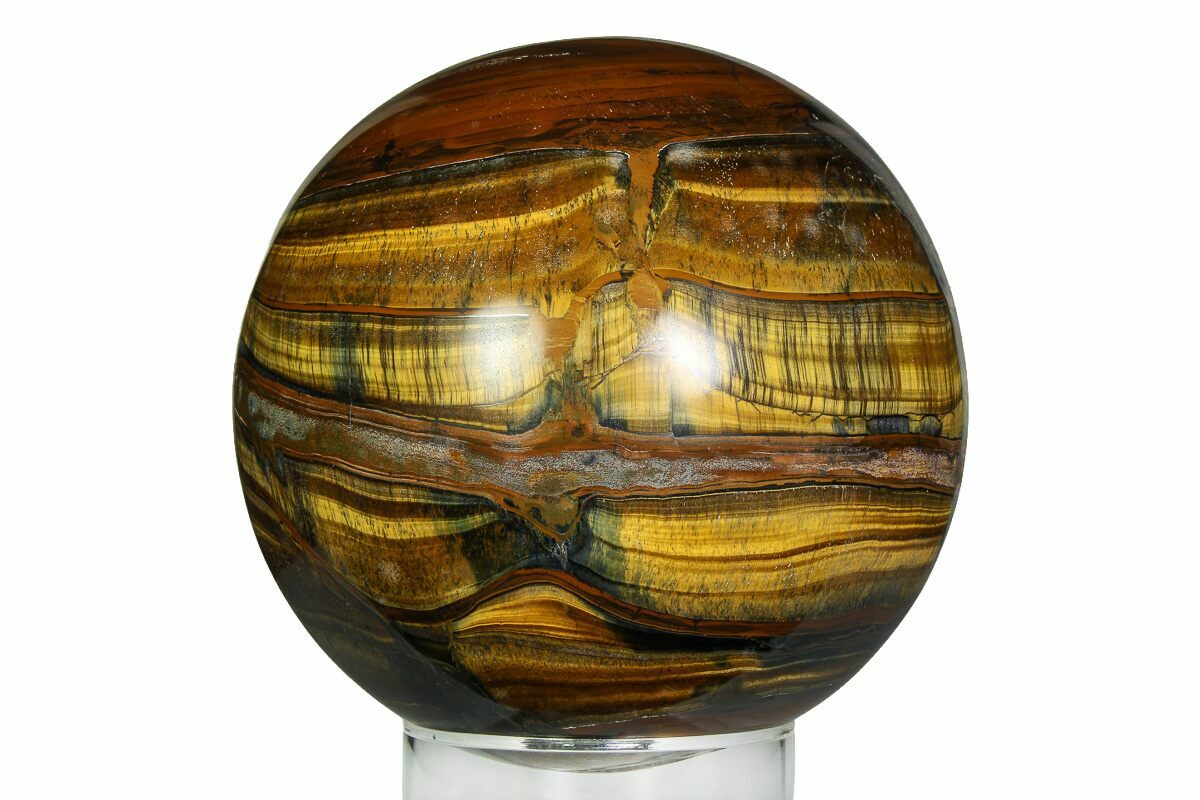
A high quality sphere of polished tiger's eye.
How Tiger’s Eye Is Formed
Tiger’s eye has long fascinated both collectors and scientists—not just for its striking look, but for the unique way it forms deep within the Earth. Earlier theories held that tiger’s eye was simply a pseudomorph: quartz slowly replacing the fibrous mineral crocidolite (a form of blue asbestos), while preserving its original structure. In that model, the quartz would take over the space once occupied by crocidolite, and oxidation of the iron in the crocidolite would produce the rich golden and reddish-brown colors typical of tiger’s eye.
However, more recent microscopic studies of South African specimens have shown that tiger’s eye often doesn’t show evidence of classic pseudomorphic replacement. Instead, it appears to form through a discontinuous crack-seal mechanism. In this process, tiny fractures develop in quartz-rich rocks that contain some crocidolite. Water rich in silica and other necessary minerals seeps into these cracks. As the crack fills, quartz begins to grow along the crack surfaces while new crocidolite fibers also grow from bits of crocidolite already present on the crack walls. The rock then cracks again, typically along the same surface, and the cycle repeats.
This series of crack-seal events produces alternating bands of quartz and discontinuous, angled crocidolite fibers. Over time, as iron in the crocidolite oxidizes (essentially rusting), the familiar golden and brown colors develop, with the quartz and fiber alignment producing the signature silky shimmer known as chatoyancy or the “cat’s eye” effect.
In simpler terms, tiger’s eye forms when microscopic cracks in silica-bearing rocks repeatedly fill with quartz and crocidolite fibers under heat and pressure. These bands and the resulting oxidation give the stone its distinctive layered look and light-reflecting sheen—making it both a geological curiosity and a beloved gemstone.
History, Discovery, Naming & Uses
Tiger’s eye has likely been known since antiquity, though its early history blends with legend. The Romans are believed to have carried tiger’s eye into battle as a protective talisman, believing it granted courage and clarity under pressure. Its resemblance to the eye of a tiger—a creature associated with strength, vigilance, and power—made it a natural symbol of protection.
The name “tiger’s eye” refers directly to its appearance. When polished, the golden bands and shifting light closely resemble the iris and pupil of a tiger. The name was popularized in Europe during the 19th century as mineral collecting and gem cutting expanded.
The most significant deposits were discovered in South Africa during the late 1800s, particularly in the Northern Cape Province. These finds brought tiger’s eye into the global gemstone market. By the early 20th century, it had become a popular ornamental stone used in jewelry, carvings, and decorative objects.
Throughout history, tiger’s eye has been used for:

A tiger's eye bracelet
During the Victorian period, tiger’s eye jewelry was fashionable among men, especially in signet rings and watch fobs. Its masculine tones and durability made it particularly appealing. In modern times, tiger’s eye remains a staple in both jewelry and mineral collections. Its affordability, durability, and dramatic appearance ensure steady demand. While it is not rare, high-quality pieces with strong chatoyancy and clean, well-defined bands are highly prized.
Special Types of Tiger’s Eye
Tiger’s eye is far more diverse than its classic golden-brown form might suggest. Variations in chemistry, oxidation, and geological conditions give rise to several distinct types, each with its own colors, patterns, and visual character.
Marra Mamba Tiger’s Eye
Marra Mamba is a striking variety from Western Australia. It features bands of golden tiger’s eye interlayered with red jasper and hematite. The result is a vibrant combination of metallic sheen and deep red earth tones. Marra Mamba forms in iron-rich sedimentary environments and is highly sought after for cabochons and decorative slabs.

Nellite (Lion’s Eye)
Nellite is a rare combination of tiger’s eye and pietersite, typically showing a mix of golden and blue fibers. Found primarily in Namibia, nellite can display swirling patterns rather than the straight bands typical of standard tiger’s eye. It often has more dramatic, chaotic chatoyancy.

Blue Tiger’s Eye (Hawk’s Eye)
Blue tiger’s eye represents an earlier stage in the oxidation process. It retains the blue-gray color of the original crocidolite fibers. The chatoyancy is often softer and more subtle than the golden variety, with a cool, steel-blue shimmer.

Red Tiger’s Eye
Red tiger’s eye can occur naturally through further oxidation of iron, though much of the material on the market has been heat-treated to enhance or produce the red coloration. It displays warm mahogany and deep rust tones while retaining strong chatoyancy.
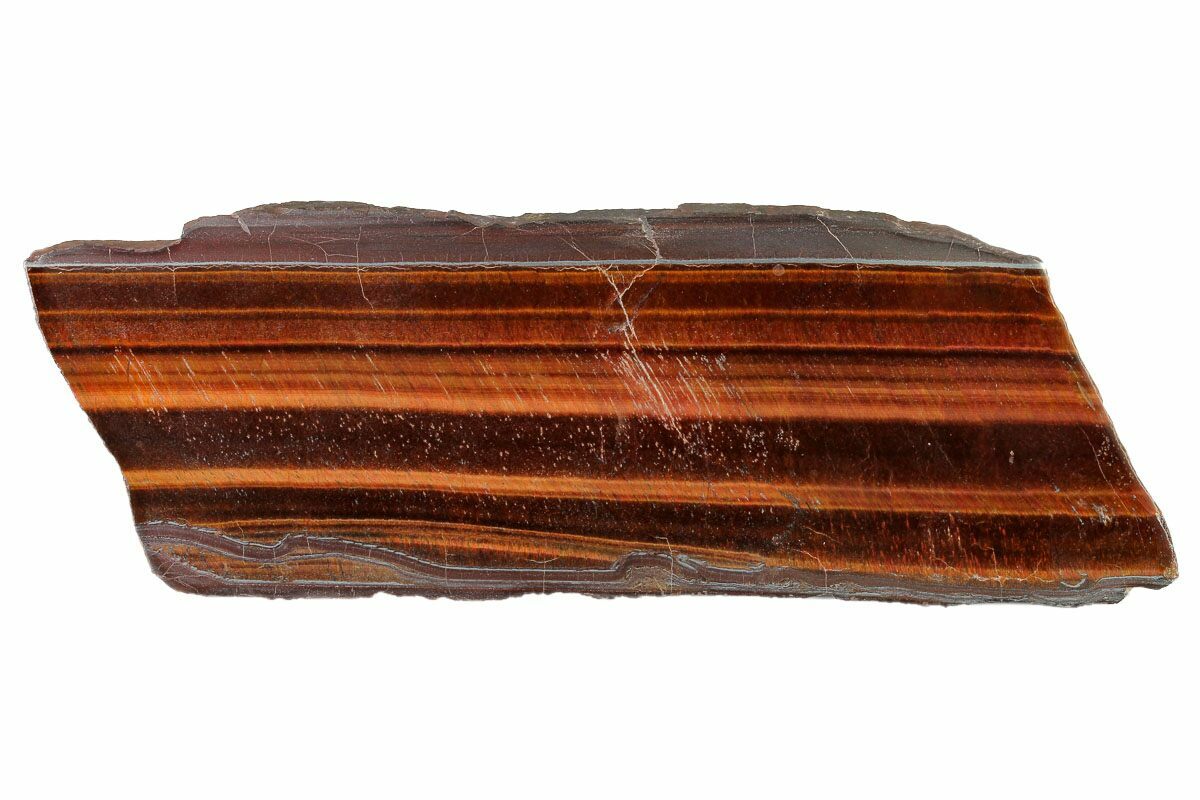
A slab of red tiger's eye from South Africa
Key Collecting Localities
Tiger’s eye is found in several regions around the world, but only a handful of localities have produced material in significant quantity or exceptional quality. These deposits, often associated with ancient iron formations, each offer tiger’s eye with distinctive colors, patterns, and geological character.
Northern Cape Province, South Africa
South Africa is the world’s most important source of tiger’s eye. Deposits near Griquatown and Kuruman have produced vast quantities of high-quality material since the late 19th century. The region’s banded iron formations provided ideal conditions for crocidolite formation and subsequent quartz replacement. South African tiger’s eye is known for its strong golden color and bold, straight chatoyant bands.
Western Australia (Pilbara Region)
Western Australia is famous for Marra Mamba tiger’s eye. Found within ancient iron formations, this material combines tiger’s eye with jasper and hematite. The contrasting red and gold layers make it especially popular with lapidaries. The Pilbara region’s geology, rich in iron deposits, has created some of the most visually striking specimens.
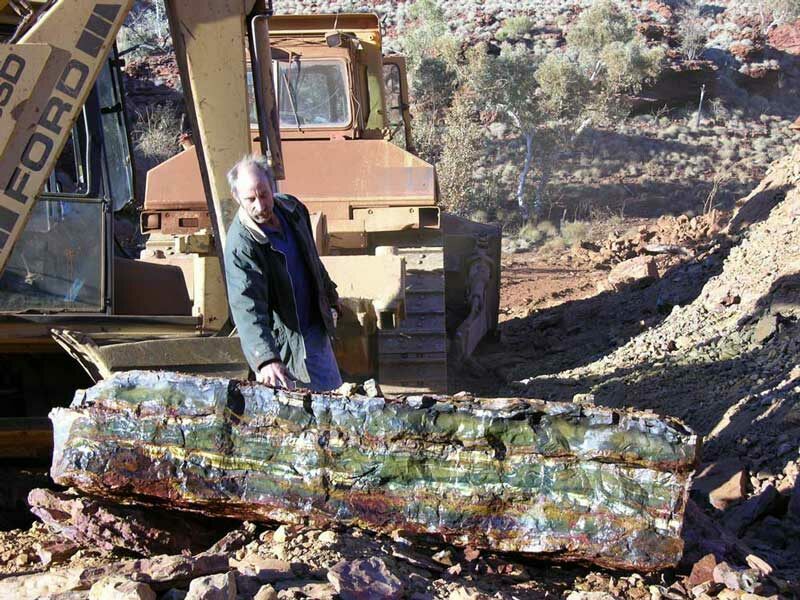
Namibia
Namibia produces blue tiger’s eye (hawk’s eye), nellite, and pietersite. Deposits are often associated with metamorphosed iron formations. Namibian material is especially valued for its vibrant blue hues and complex patterns. Nellite from this region is considered rare and collectible.
India
India is a significant producer of tiger’s eye for the global bead and carving market. While much of the rough material may originate elsewhere, India is known for cutting and polishing large volumes of tiger’s eye into beads, spheres, and decorative objects. Some local deposits also exist.
United States (California and Arizona)
Small deposits of tiger’s eye have been found in parts of California and Arizona, though they are not commercially significant compared to African sources. Specimens from these localities are mainly of interest to regional collectors.
Tiger Iron: A Related Stone With Bold Personality
Often mistaken for a simple variation of tiger’s eye, tiger iron is actually a distinct and far more complex rock. While tiger’s eye is a single mineral variety (quartz replacing crocidolite), tiger iron is a banded metamorphic rock composed of multiple minerals layered together. Its dramatic appearance—metallic silver-gray, deep red, and shimmering gold bands—makes it one of the most visually striking ornamental stones in the mineral world.

Tiger iron is primarily made up of three main components:
These materials occur in alternating layers, often tightly folded or banded. The result is a stone that combines the silky shimmer of tiger’s eye, the earthy opacity of jasper, and the reflective metallic luster of hematite—all in one specimen.
Unlike tiger’s eye, which forms through the pseudomorphic replacement of crocidolite by quartz, tiger iron represents an original sedimentary layering of iron-rich minerals that later underwent metamorphism (heat and pressure). The tiger’s eye portions within tiger iron formed in the same way as standalone tiger’s eye deposits, but they remain interlayered with jasper and hematite instead of occurring as relatively pure quartz masses.
Tiger iron is most famously found in the Pilbara region of Western Australia, where vast banded iron formations date back more than 2.5 billion years. These ancient deposits contain some of the world’s most striking examples, often cut into slabs, spheres, and cabochons to showcase their natural banding.


