 Reviews

This Specimen has been sold.
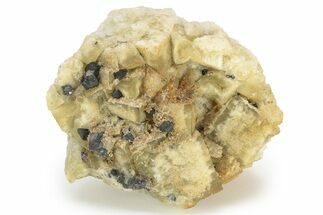
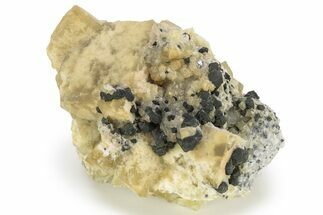

8.2" Pyrite Crystals with Quartz on Calcite - Fluorescent!

This specimen contains whitish quartz dusted with small pyrite crystals, all enshrouding clear calcite and a few small pockets of fluorite, collected from the El Hammam Mine in Morocco. The calcite fluoresces a lovely bright pink under both short and long-wave UV lighting.
About Quartz
Quartz is the name given to silicon dioxide (SiO2) and is the second most abundant mineral in the Earth's crust. Quartz crystals generally grow in silica-rich environments--usually igneous rocks or hydrothermal environments like geothermal waters--at temperatures between 100°C and 450°C, and usually under very high pressure. In either case, crystals will precipitate as temperatures cool, just as ice gradually forms when water freezes. Quartz veins are formed when open fissures are filled with hot water during the closing stages of mountain formation: these veins can be hundreds of millions of years old.
Quartz is the name given to silicon dioxide (SiO2) and is the second most abundant mineral in the Earth's crust. Quartz crystals generally grow in silica-rich environments--usually igneous rocks or hydrothermal environments like geothermal waters--at temperatures between 100°C and 450°C, and usually under very high pressure. In either case, crystals will precipitate as temperatures cool, just as ice gradually forms when water freezes. Quartz veins are formed when open fissures are filled with hot water during the closing stages of mountain formation: these veins can be hundreds of millions of years old.
About Calcite Crystals
Calcite crystals are a form of calcium carbonate (CaCO₃) known for their diverse shapes, transparency, and vibrant range of colors. They typically form in rhombohedral, scalenohedral, or prismatic shapes, often with well-defined, sharp edges and glossy surfaces. Calcite crystals are often translucent or transparent, sometimes displaying a double refraction effect where objects viewed through the crystal appear doubled. They can appear in various colors—white, clear, yellow, pink, blue, green, and orange—depending on impurities or trace minerals.
A notable characteristic of calcite is its reaction with weak acids like vinegar, which causes it to effervesce, or fizz, as it releases carbon dioxide. This property makes calcite crystals a key tool in geological identification and studies. Calcite forms in many environments, from sedimentary rocks like limestone and marble to hydrothermal veins.
Calcite crystals are a form of calcium carbonate (CaCO₃) known for their diverse shapes, transparency, and vibrant range of colors. They typically form in rhombohedral, scalenohedral, or prismatic shapes, often with well-defined, sharp edges and glossy surfaces. Calcite crystals are often translucent or transparent, sometimes displaying a double refraction effect where objects viewed through the crystal appear doubled. They can appear in various colors—white, clear, yellow, pink, blue, green, and orange—depending on impurities or trace minerals.
A notable characteristic of calcite is its reaction with weak acids like vinegar, which causes it to effervesce, or fizz, as it releases carbon dioxide. This property makes calcite crystals a key tool in geological identification and studies. Calcite forms in many environments, from sedimentary rocks like limestone and marble to hydrothermal veins.
SPECIES
Calcite, Pyrite & Quartz
LOCATION
El Hammam, Meknès, Morocco
SIZE
8.2 x 5.8"
CATEGORY
ITEM
#257172


