 Reviews

This Specimen has been sold.


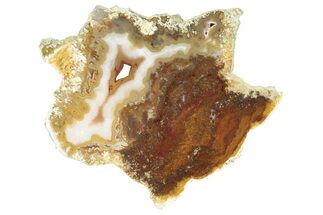
8.6" Free-Standing Polished Porphyry Stone Section - Western Australia


This is an 8.6" wide, polished section of porphyry stone collected near the town of Cue in Western Australia. The polished face measures 8.7 x 7.75" and the base has been cut flat making for a gorgeous decorative display.
About Porphyry
Porphyry is not a mineral but rather a type of igneous rock characterized by a distinct texture. It features large, well-formed crystals—typically of quartz, feldspar, or other minerals—embedded in a fine-grained or glassy matrix. This two-stage cooling process, where magma cools slowly underground before erupting and cooling rapidly at the surface, gives porphyry its signature "spotted" or "salt-and-pepper" appearance.
Porphyry rocks are geologically significant, especially as hosts for major ore deposits. Copper, molybdenum, and gold are often mined from porphyry deposits, which form when mineral-rich fluids concentrate in fractures around large igneous intrusions. These deposits are among the most important sources of these metals worldwide. Historically, porphyry with a rich purple hue was prized by ancient civilizations for use in sculpture and imperial architecture, particularly in Egypt and Rome.
Porphyry is not a mineral but rather a type of igneous rock characterized by a distinct texture. It features large, well-formed crystals—typically of quartz, feldspar, or other minerals—embedded in a fine-grained or glassy matrix. This two-stage cooling process, where magma cools slowly underground before erupting and cooling rapidly at the surface, gives porphyry its signature "spotted" or "salt-and-pepper" appearance.
Porphyry rocks are geologically significant, especially as hosts for major ore deposits. Copper, molybdenum, and gold are often mined from porphyry deposits, which form when mineral-rich fluids concentrate in fractures around large igneous intrusions. These deposits are among the most important sources of these metals worldwide. Historically, porphyry with a rich purple hue was prized by ancient civilizations for use in sculpture and imperial architecture, particularly in Egypt and Rome.
SPECIES
Clinozoisite & Colerite
LOCATION
Mindoolah, Near Cue, Western Australia
SIZE
Size: 8.6 x 7.75", up to 2.6" thick, Weight: 9 3/5 lbs
CATEGORY
ITEM
#239751