 Reviews

Crinoids: The Fossil Sea Lilies That Inspired Alien
Long before dinosaurs walked the land, before coral reefs took their modern form, and before fish ruled the seas, crinoids reigned over ancient oceans like living chandeliers. Their fossils—often found as stacks of stone discs or beautifully preserved crowns—are remnants of a marine world so alien that it feels closer to science fiction than natural history. In fact, the resemblance is no coincidence: the eerie, grasping anatomy of crinoids helped inspire the design of the Xenomorphs in James Cameron’s Aliens, lending prehistoric sea creatures a permanent place in pop culture’s imagination.
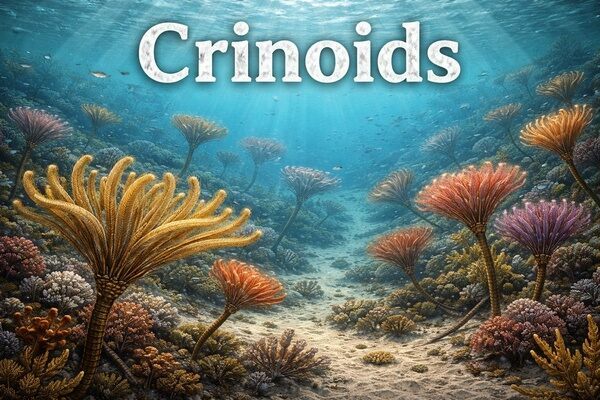
A reconstruction of an ancient seafloor during the Paleozoic Era, where towering crinoids—often called sea lilies—formed dense underwater forests, filtering nutrients from warm, shallow seas hundreds of millions of years ago.
Often called sea lilies because of their graceful, flower-like appearance, crinoids are not plants at all. They are animals—members of the echinoderm family, making them relatives of starfish, sea urchins, and sand dollars. Their lineage stretches back more than 480 million years, making crinoids among the oldest complex animals still alive today. At their peak during the Paleozoic Era, they were so abundant that entire limestone formations across North America and Europe are composed largely of their skeletal remains.
A living crinoid was both elegant and efficient. From a central body called the calyx, dozens of feathery arms radiated outward, each lined with tiny tube feet used to capture plankton drifting past in ocean currents. Many species anchored themselves to the seafloor with long, jointed stalks, swaying gently like underwater flowers. Others abandoned their stalks entirely, becoming free-moving feather stars capable of crawling—or even swimming—through the water with slow, pulsing motions that feel uncannily alive.
It’s this combination of beauty and strangeness that makes crinoids so captivating. Their five-fold symmetry, segmented skeletons, and grasping arms look almost engineered, as if designed by an artist rather than shaped by evolution. When James Cameron and his team were developing the biomechanical horror of the Aliens franchise, crinoids—along with other echinoderms—served as inspiration for creatures that felt organic, ancient, and unsettling. Few people realize that some of the most iconic movie monsters owe their look to animals that once thrived hundreds of millions of years ago on Earth.
Crinoids also boast some truly astonishing records. The longest known crinoid stem ever discovered measured nearly 130 feet long, far larger than any species alive today. While modern oceans still host around 700 living species, ancient seas once supported thousands, forming dense underwater forests that provided shelter and food for countless other organisms.
Most crinoid fossils are found as individual columnals—disc-shaped segments from the stalk that separated after death and scattered across the seafloor. Complete fossils, with arms and crowns intact, are rare and prized, often preserved only when rapid burial protected them from decay and scavengers. These exceptional specimens give us a glimpse of what ancient oceans truly looked like.
From medieval legends that mistook crinoid fossils for holy beads, to Hollywood science fiction that borrowed their unsettling beauty, crinoids bridge the gap between deep time and modern imagination. Every crinoid fossil is more than a piece of stone—it’s a fragment of an ancient world that was as strange, dramatic, and awe-inspiring as anything ever dreamed up on screen.
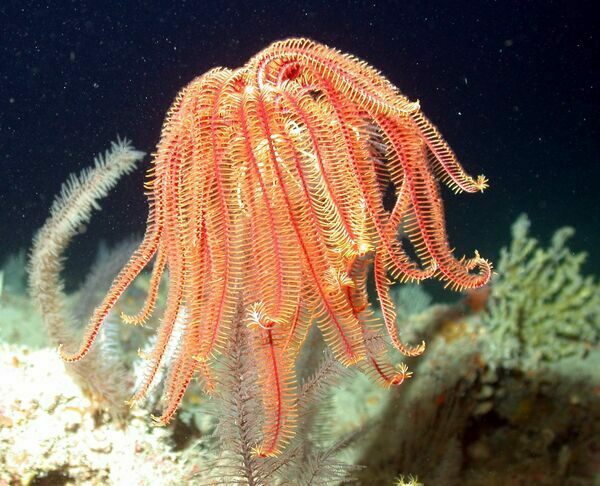
A modern day stalked crinoid in the Gulf of Mexico. Photo from NOAA library.
Scientists suggest two possibilities for the origin of crinoids. The first hypothesis suggests that crinoids evolved from the blastozoan eocrinoids and cystoids. Eocrinoids were from the Early Cambrian and were the earliest echinoderms with a stalk, and arms. The group Gogiida is often referenced and is recognized by its vase-shaped body. Cystoids had stems and were similar to crinoids, but had 3 ambulacral areas on the outside of an ovoid body. A difference between the anatomy of crinoids and blastoids is that blastoids have a flower bud-shaped compartment that holds the vital organs and is called a theca, rather than a calyx. A crinoid calyx is cup-shaped. The calcareous plates that protect the outside of the theca and calyx are often referred to as thecal plates. These plates are used to identify species. The term is also used to describe dinoflagellate anatomy.
Another hypothesis is that crinoids evolved from edrioasteroids. Edrioasteroidea may have emerged as early as the Ediacaran. These organisms had a theca and 5 ambulacral arms in the body wall. It is difficult to define the exact origin for the crinoids because all possible ancestral groups share key traits such as directly attaching to substrates. Other traits include radial symmetry and calcareous plates.
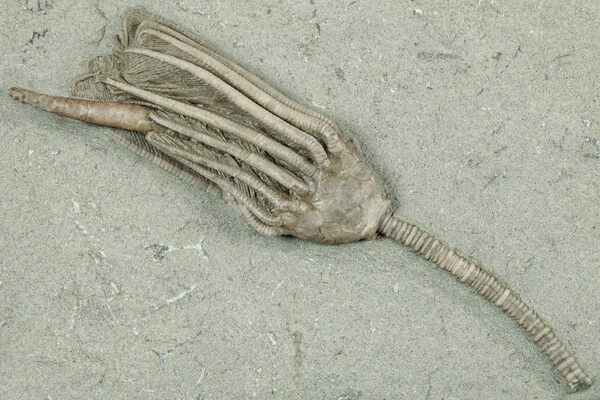
An exquisite 340 million year old fossil crinoid (Macrocrinus mundulus) from Crawfordsville, Indiana.
The Ordovician was the first period that crinoids experienced adaptive radiation. The second period of adaptive radiation occurred in the Triassic, following the Permian mass extinction (250 mya). Flexible arms and motility became widespread in the Triassic. The traits are believed to have evolved due to pressure from predators such as benthic echinoids.
Crinoids were not the only successful stalked and filter-feeding echinoderms of the Paleozoic. Blastoids were also highly diverse and abundant. Crinoids were their most diverse in the Paleozoic, peaking in abundance and diversity in the Mississippian. Blastoids, however well suited to the Paleozoic, did not survive through the end of the Permian. Crinoids evolved new survival strategies for the environments of the Mesozoic.
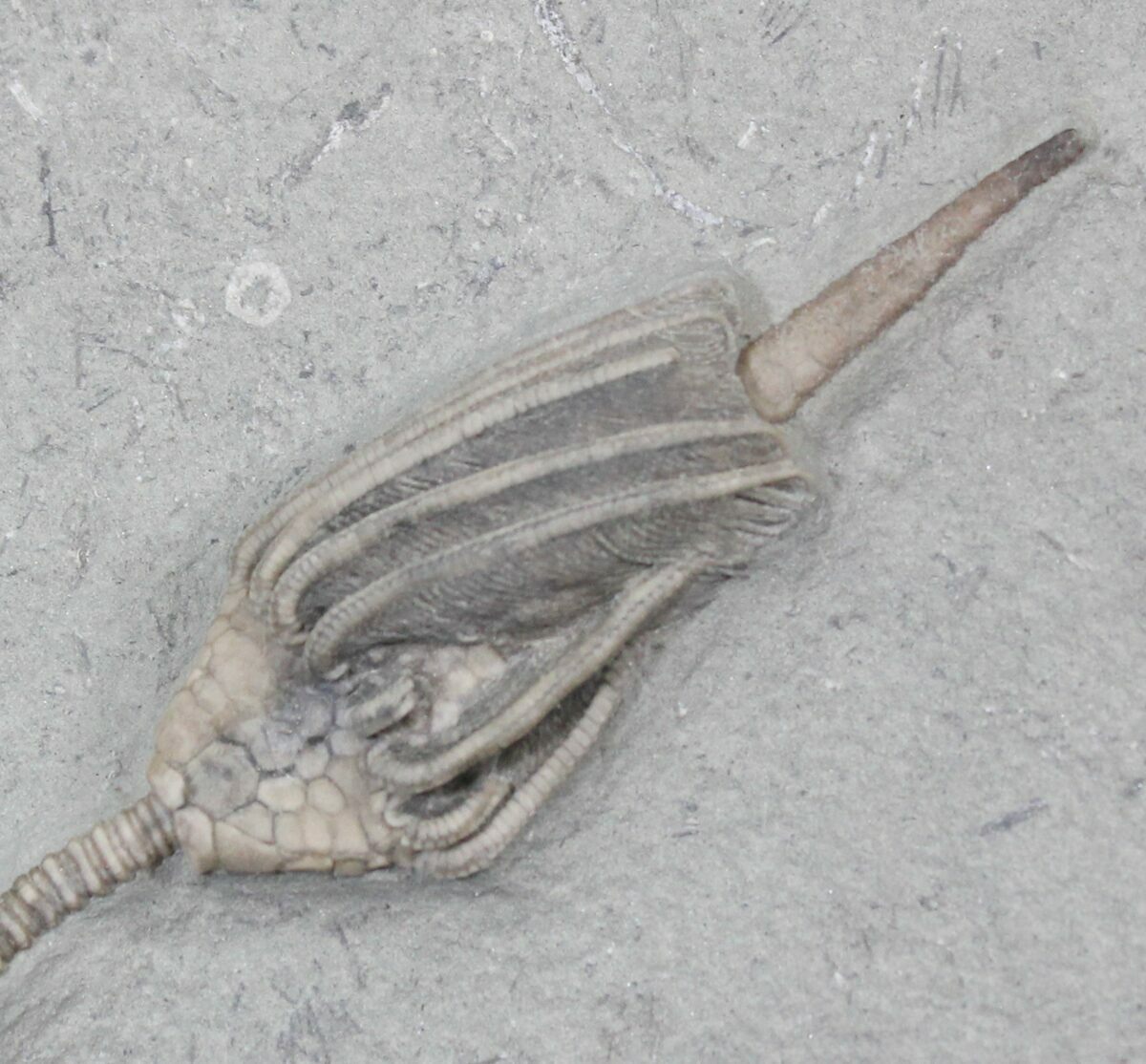
Crinoids have the pentaradial symmetry that is a characteristic of echinoderms. The three main sections of a crinoid give it the lily-like appearance. These sections are the segmented column or stem, the calyx where the body cavity and digestion occurs, and the arms which filter food from the environment. Most crinoids live attached to substrate, though there are free swimming species in the fossil record. There are several crinoid species alive today which swim freely as adults.
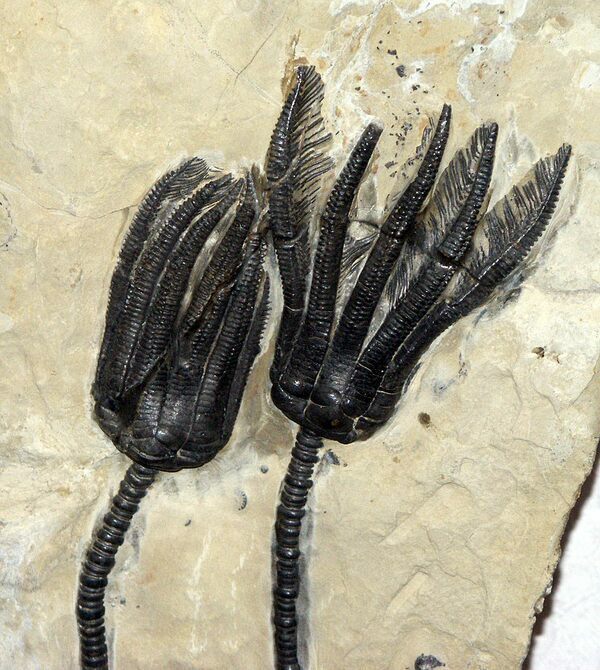
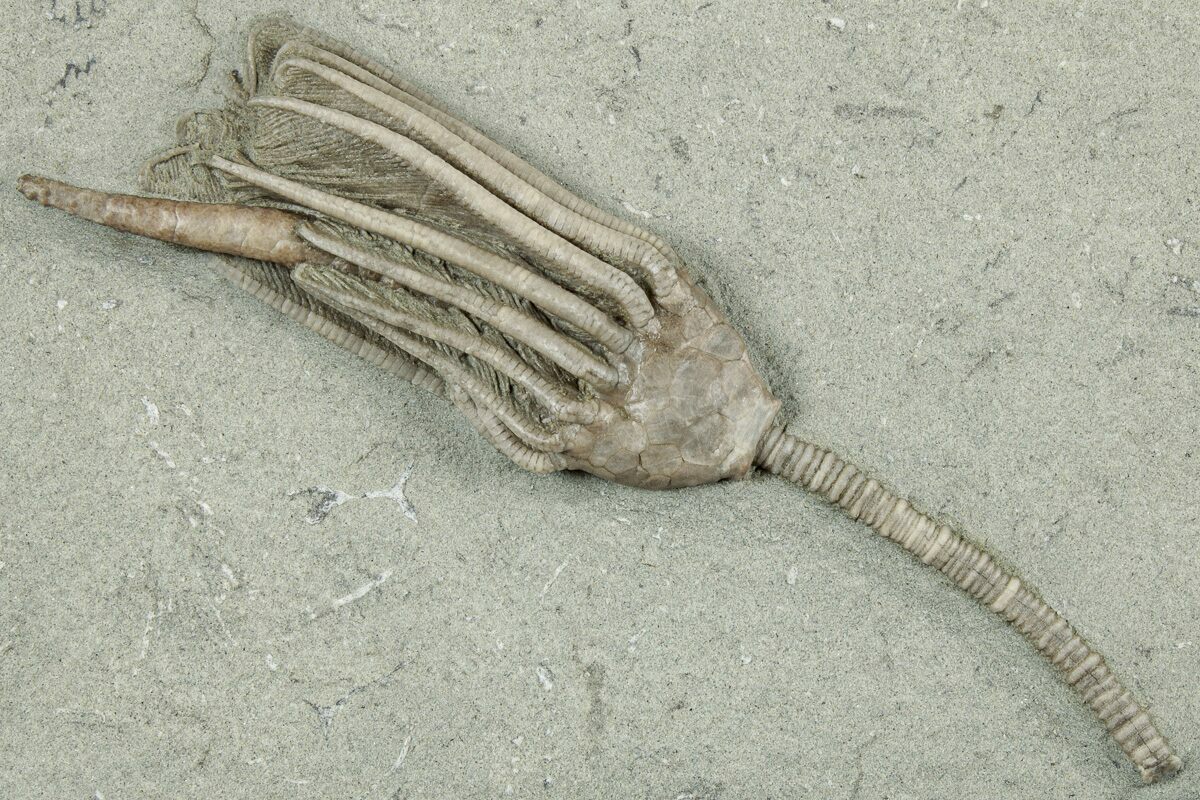
A fossil of a typical crinoid, showing (from bottom to top) the stem, calyx, and arms with cirri
Crinoids can very basically be described as upside-down starfish with a stems. The stem of a crinoid extends down from what would be the top of a starfish, leaving the mouth of the organism opening skyward, with the arms splayed out. However, crinoid arms look articulated and feathery. The stalk extends down from the aboral surface of the calyx. The stalk column has holdfasts which attach the animal to substrate. A holdfast does just as its name implies. Many living species have a vestigial stalk.
Stalked crinoids have been observed moving, but not on ocean currents. In 2005, a living species of stalked crinoid near Grand Bahama Island was observed moving itself across the sea floor. Before the recording, the fastest motion on record was 2 ft/hr, though some scientists think that faster speeds are possible. Paleozoic crinoids were stationary. Motility developed later in response to predation.
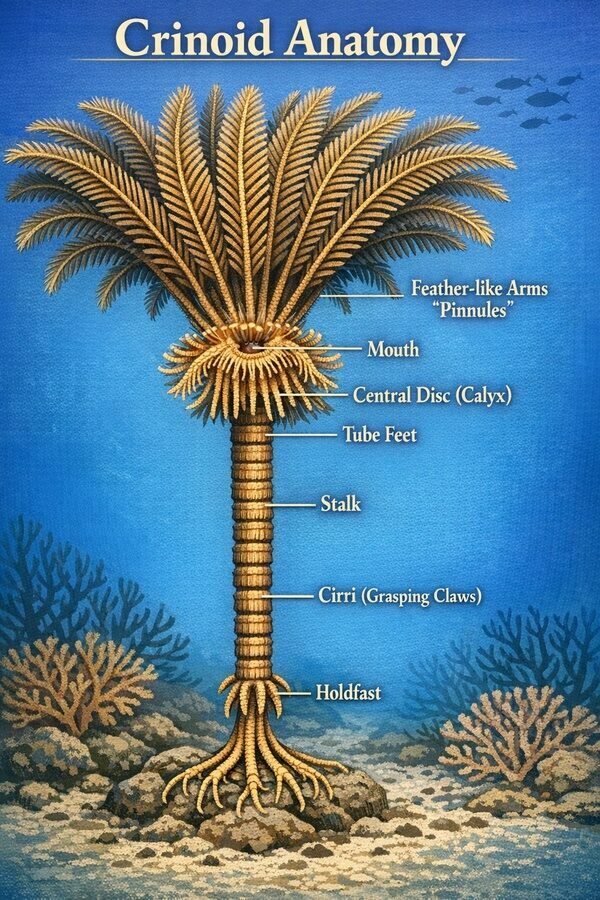
Diagram: Crinoid Anatomy
The crinoid column is also called a stem or stalk. The stem is made from disc-shaped pieces of endoskeleton which are stacked upon each other and are hollow in the middle. They are held together by ligaments which decomposed rapidly after death. The hollow shapes inside of the discs include: elliptical, circular, pentagonal, and star-shaped. Column discs which are square-shaped have 5 holes in them. Fossil discs are commonly found in Paleozoic limestone deposits.
The stem is constructed from a biomineral complex made from calcium carbonate crystals in a sponge-like microstructure. The three-dimensional microstructure is called stereom. In the embryo, the stereom is produced by mesenchymal cells, which makes stereom an endoskeletal feature of echinoderms. The calcium carbonate crystals which are aligned in the stereom structure, plus the stereom lattice, together create what are called ossicles. Sclerocytes excrete ossicles. Ossicles are held together by collagenous ligaments and are covered by epidermis. The ligaments provide a variety of postures for the organism without using extra muscular energy. Though covered by tissue, the ossicles of echinoderms have the function of an exoskeleton.
Some species have special appendages emerging from the bottom of the calyx or along the stem. These appendages are not used for feeding, but are types of holdfasts. They are called cirri. Cirri are used for attaching crinoids to different things, perhaps even to other crinoids. Cirri can be embedded into mud to stabilize the column. Cirri have different characteristics depending on the species. Cirri can act as a hook, or wrap around an object. Another type of holdfast is a button-like place on the bottom of the stem that can strongly adhere to substrate such as coral.
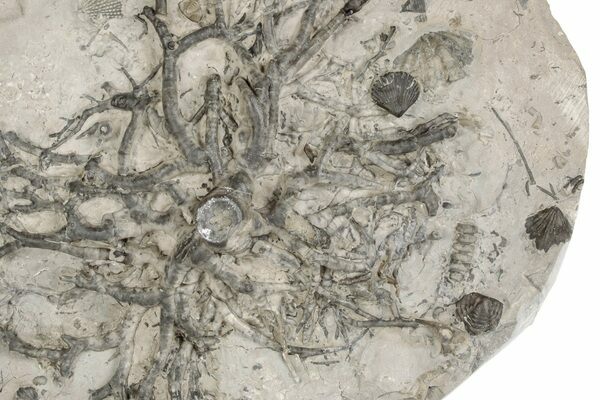
A fossilized holdfast of the crinoid Eucalyptocrinites which would have anchored it to the substrate.
The arms, or brachials, of the crinoid can splay open for filter feeding. There are typically five arms found on the fossil types, though some living species can have many more arms- always in multiples of five. Smaller ossicles form the structure of the arms. The arms of the crinoid have tube feet and cilia on them which move food along the ambulacral canal of each arm. From each canal, food is transported by cilia into the mouth. The arms and calyx are called the crown.
The calyx is a cup-shaped body part which contains the u-shaped digestive system and the organs for reproduction. Five sided, calcareous plates create the lower cup of the calyx. The plates are in rows of five and radiate around the calyx. The mouth is atop the dorsal cup, and the anus is beside it. The tegmen is the skyward surface of the calyx. The tegmen has five ambulacral areas which includes a deep groove in each area. Arms extend from the grooved areas. Tube feet are arranged along pinnules which project from the jointed arms. The visual effect makes the arms appear feathery and allows the crinoid to comb the water for suspended food. The hydraulic pressure in each tube foot is controlled with a water vascular system connected to the body cavity.
The body cavity consists of connective tissue and narrow canals which extend into the arms and column. The haemal system of crinoids is a network of fluid filled sinuses. These sinuses are placed among the connective tissue. A group of sinuses surround the oesophogus. The fluid filled spaces extend toward the bottom of the calyx where glandular tissue is located. These spaces are where nutrients are transported to cells of the body. The sinuses also act as an excretory and respiratory system. Tube feet are thinly walled and allow oxygen to be absorbed by crinoids. Coelomocytes are phagocytic cells and are responsible for capturing waste.
The tube feet which project from the pinnules are coated with sticky mucus. The mucus captures particles of food that floats by. Once a food particle is captured, the tube feet move the particle into the ambulacral groove. From inside the groove, cilia move mucus and the particle toward the mouth.
There is an observed correlation, in some living species, with the number of branches on the arms pertaining to the abundance of food in the habitat. The more rich the food supply, the fewer the number of arms needed to obtain food. Ancient crinoids typically had 5 arms, though living species predominantly have arms which divide into two branches, which results in 10 arms.
Crinoids do not have a stomach, so food particles go from mouth to short esophagus and then to intestine. The intestine makes a single curve on the inside of the calyx and ends with a rectum and an anus at the margin of the tegmen.
Crinoids consumed bits of matter and small organisms. Nutrients were obtained from diatoms, plankton, detritus, larva, and anything that was the appropriate size to be trapped by the pinnules and moved into the ambulacral canal.
The nervous system of a crinoid consists of a nerve ring around the mouth with nerves that extend to each arm. There is another ring with branched nerves to each arm that is associated with senses, and a third network with a neural mass at the base of the calyx with extensions to each arm and the stalk. The third nerve network controls motor action.
Crinoids are male or female (dioecious). Crinoids have genital canals that produce gametes, but they do not have gonads. The canals are in some of the pinnules which break open to release sperm and eggs. The fertilized eggs eventually hatch in the water. The larva is barrel-shaped with ciliated bands and sensory hairs.. These are known as vitellaria larvae. The larva settles and attaches to substrate with an adhesive gland. Metamorphosis begins and the larva becomes a stalked adult. Crinoids living today can reproduce in about 10 to 16 months, and even the free-swimming species sometimes mature on the stalk before breaking away.
Crinoids were very successful in the Paleozoic. They were most abundant and diverse in the Mississippian when several continents were covered with shallow seas. Thick layers of limestone stratigraphy throughout North America and Europe are full of crinoid stems.
In the Ordovician, which began about 488 mya, sea levels were at an all-time high. The globe north of the equator was almost completely ocean. The supercontinent Gondwana was oriented in the southern hemisphere and it contained most of the land. The Taconic Orogeny is a notable event which occurred on a subduction zone as a volcanic island arc collided with the North American continent. The remnants of this collision are seen in eastern New York and Connecticut. The orogeny waned to conclusion in the Silurian. This event is significant to crinoid preservation. The erosion of the sediments produced by the orogeny supplied the surrounding sea with mud and clay which preserved fauna during bursts of undersea mudslides and rapid storm deposition.
Between 450 mya and 440 mya, there were two periods of extinction that together form the second largest mass extinction that has occurred on the planet. Triggers included the tectonic movement of Gondwana which had moved to the south polar region. A drop in CO2 levels also occurred. The result was a cooling of the planet which allowed the formation of glaciers. The glaciations then caused periodic drops in sea levels which adversely affected life living on the continental shelves.
The Silurian began about 444 mya. It was a warmer period, with fewer glaciations and higher sea levels, though glaciers still persisted on a united Gondwana in the southern hemisphere. The supercontinent Euramerica formed at the equator. Jawed and bony fish appeared in the seas, while vascular plants emerged on land. The climate was warmer and more stable than in the Ordovician.
The Devonian began 416-419 mya. In the Devonian, Euramerica and Gondwana became closer together and the climate was warm. Sea levels were high and shallow reefs and coral communities were abundant. The Devonian is known as the Age of Fish.
Plate tectonics continued to alter the continental landscape and crinoids continued to diversify and populate ocean habitats throughout the Carboniferous. The supercontinent Pangaea was along the equator in the Permian (299-250 mya).
At the beginning of the Permian, sea levels were relatively low and shallow marine habitats would have been greatly reduced. The climate was warming, though. As a result, glaciers that were present at the beginning of the Permian had disappeared by its end. The enormous landmasses promoted extreme variations in climate. At the end of the Permian, 90 percent of life in the sea had gone extinct. Crinoids emerged from the extinction as a few surviving groups. They adapted and diversified, and their descendants survive today.
Though crinoids are best known from the fossil record, they are far from extinct. Against all odds, these ancient animals survived multiple mass extinctions and still inhabit Earth’s oceans today—quietly thriving in places rarely seen by human eyes. Modern crinoids are living relics, offering a rare, direct connection between today’s seas and marine ecosystems that existed hundreds of millions of years ago.
Today, there are roughly 700 known living species of crinoids, most belonging to a group known as feather stars. Unlike many of their fossil ancestors, the majority of modern crinoids are unstalked, having shed their long stems during evolution. Instead of anchoring permanently to the seafloor, feather stars use claw-like appendages called cirri to grasp rocks, corals, or sponges—or to release their grip and crawl away when threatened. Some species can even swim short distances by rhythmically waving their arms, an eerie sight that reinforces their alien appearance.
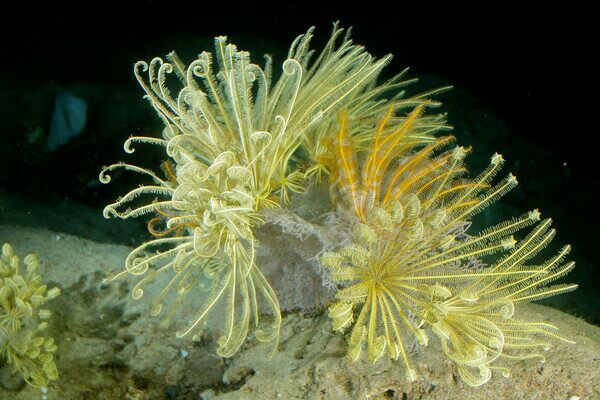
Brightly colored crinoids rest atop deep-sea black coral (Antipathes sp.) almost 300 meters (984 feet) beneath the waters off Roatán, Honduras.
Modern crinoids are found primarily in deep marine environments, often hundreds to thousands of feet below the surface, where stable conditions resemble ancient oceans. They are especially abundant in the Indo-Pacific region, but species also occur in the Caribbean, Atlantic, and Southern Oceans. A small number of stalked crinoids—once thought to be long extinct—still survive in deep waters, earning them the nickname living fossils.
The scientific rediscovery of living crinoids occurred in the 18th and 19th centuries, when deep-sea exploration expanded beyond coastal waters. Early naturalists were astonished to find animals nearly identical to Paleozoic fossils alive in modern seas. Expeditions such as the HMS Challenger voyage in the 1870s confirmed that crinoids were not just remnants of stone, but active participants in today’s marine ecosystems.
Modern crinoids remind us that extinction is not always the final chapter. While their ancient forests vanished long ago, their descendants still drift, cling, and feed in the darkness of the deep—silent survivors from one of Earth’s oldest animal lineages.
Crawfordsville, Indiana, is widely regarded as one of the most important crinoid fossil localities in the world. The Mississippian-aged deposits of the region, dating to approximately 340 million years ago, have yielded an extraordinary diversity of crinoids, with more than 200 described species known from the area. This remarkable diversity makes Crawfordsville a cornerstone of crinoid taxonomy and paleontological research.
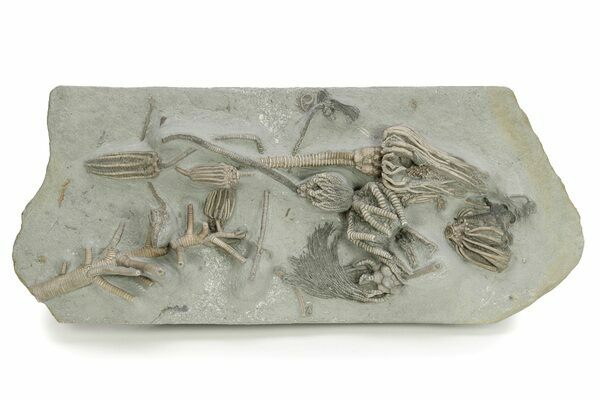
A spectacular plate of 8 crinoid species from Crawfordsville showing the diversity of this fossil site.
What truly sets Crawfordsville apart is the quality of preservation. Many crinoids are found fully articulated, with crowns, arms, calyxes, and stems intact and preserved in lifelike feeding positions. These fossils are thought to have been rapidly buried by submarine mudflows or storm-driven sediment events, freezing entire communities in place. Crawfordsville specimens became foundational to crinoid research in the late 19th and early 20th centuries and remain among the most prized examples of Paleozoic crinoid preservation.
The Lodgepole Formation of Montana is another world-class Mississippian crinoid locality, renowned for producing exceptionally well-articulated and often complete crinoid specimens. Deposited in warm, shallow seas roughly 350–330 million years ago, the Lodgepole Limestone preserves entire crinoids with intact arms, calyxes, and long stems, rivaling the preservation quality seen in Crawfordsville.
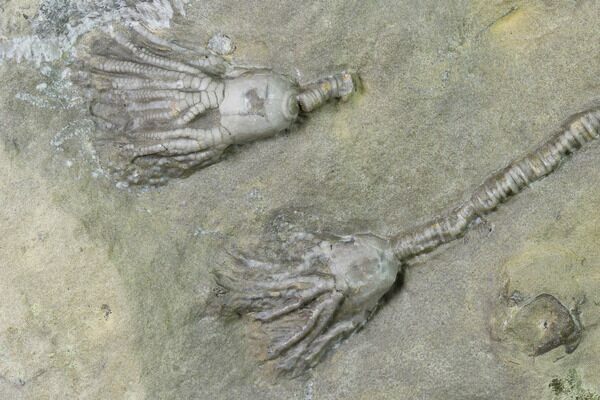
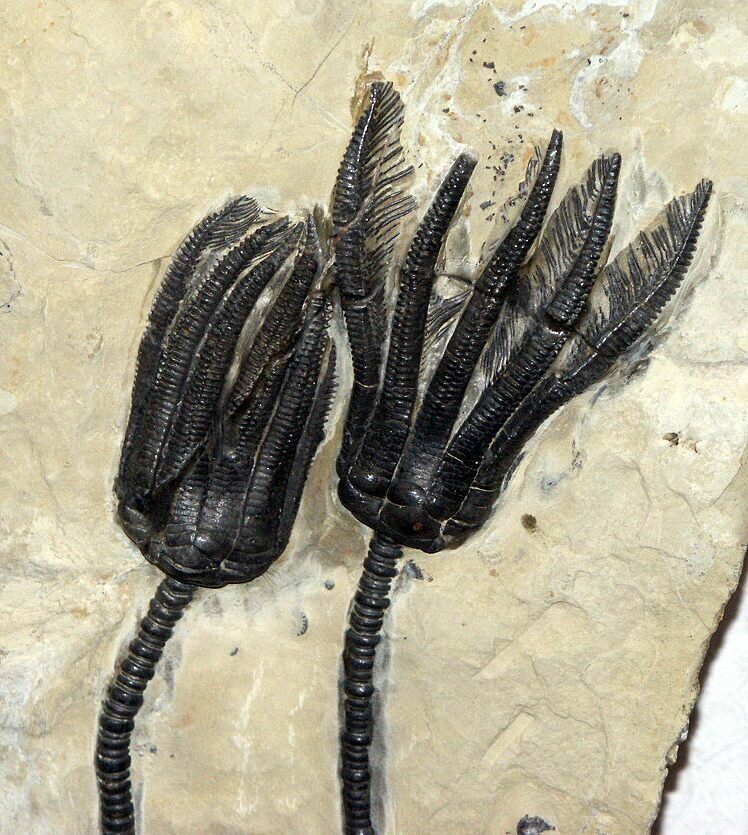
Articulated crinoid fossils from the Lodgepole Formation in Montana
Many Lodgepole crinoids are preserved in limestone with minimal distortion, suggesting rapid burial in relatively calm marine settings. These fossils provide crucial insights into crinoid anatomy, growth patterns, and community structure, and vividly illustrate how crinoids flourished on Mississippian carbonate platforms, forming dense underwater meadows across the ancient seafloor.
Holzmaden, Germany, is famous for its Early Jurassic Posidonia Shale, a deposit celebrated for some of the finest fossil preservation on Earth. Crinoids from Holzmaden—particularly the giant species Seirocrinus subangularis—are remarkable not only for their completeness, but for their immense size. When alive, some specimens reached lengths of over 50 feet (15 meters), making them among the largest crinoids ever known.
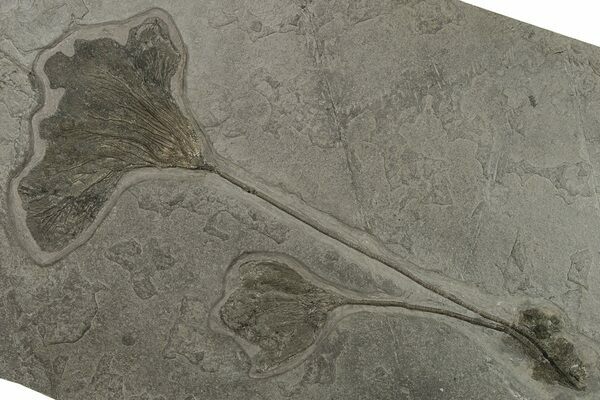
Pyrite replaced Seirocrinus crinoid fossils from Holzmaden, Germany
Preservation at Holzmaden is often enhanced by pyritization, a process in which skeletal and soft tissues were replaced or coated with pyrite under oxygen-poor conditions. This results in fossils with striking metallic detail, capturing delicate arms and attachment structures rarely preserved elsewhere. Many Seirocrinus specimens are found attached to fossilized driftwood, revealing a floating or semi-floating lifestyle in deeper Jurassic seas.
Morocco is one of the world’s most productive regions for fossil crinoids, with material originating primarily from late Silurian to early Devonian marine deposits along the northern margin of Gondwana. Among the most distinctive Moroccan crinoids are those of the genus Scyphocrinites, easily recognized by their unusual bulb-shaped root structure known as a lobolith. These crinoids lived roughly 420–390 million years ago, during a critical interval of early crinoid evolution.
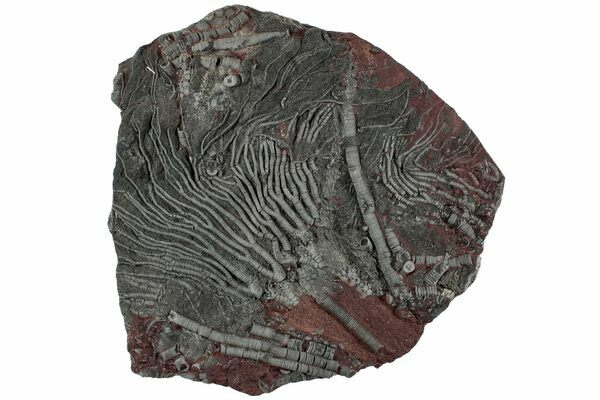
A fossil Scyphocrinites crinoid from Morocco
Fossils of Scyphocrinites from Morocco are commonly preserved as calyxes, stems, and isolated loboliths weathered from limestone and shale, with complete specimens being rare. Morocco has become the primary global source for these crinoids due to long-established commercial fossil collection, making Scyphocrinites widely available to museums, educators, and private collectors. While much of this material enters the commercial market, Moroccan crinoids have also played an important role in research and public education about early Paleozoic marine ecosystems.
The story of crinoids begins long before their elegant arms filled ancient seas. Their earliest ancestors likely emerged during the Cambrian Period, more than 500 million years ago, when animal life was rapidly diversifying in Earth’s oceans. These early echinoderms were simple, soft-bodied creatures experimenting with radial symmetry, segmented skeletons, and new ways of feeding in the water column. From this evolutionary experimentation arose the basic body plan that would eventually give rise to crinoids—animals built to harvest food from moving currents rather than chase it.
By the Ordovician Period, true crinoids had appeared, distinguished by their stalked bodies and feathery arms arranged in five-fold symmetry. This design proved remarkably successful. Anchored to the seafloor, early crinoids extended their arms into passing currents, capturing plankton with efficiency that allowed them to flourish in vast numbers. Over time, natural selection refined their skeletal plates, arm branching, and attachment strategies, giving rise to a growing diversity of forms adapted to different depths and water energies.
Crinoids reached their greatest abundance during the Mississippian Period, when warm, shallow seas covered much of the continents. Entire underwater landscapes were dominated by crinoid “forests,” with stalked species rising several feet above the seafloor. It was during this time that many of the classic fossil crinoids known today evolved, leaving behind thick limestone deposits composed largely of their disarticulated skeletons.
The end-Permian mass extinction brought this golden age to an abrupt end, wiping out the majority of crinoid lineages. Yet crinoids proved resilient. During the Mesozoic Era, surviving groups adapted to changing oceans by abandoning permanent stalks, becoming more mobile and flexible. These evolutionary shifts led to the emergence of feather stars—free-moving crinoids capable of crawling or swimming to escape predators.
Today’s crinoids are the living descendants of this long evolutionary journey. Though fewer in number and largely hidden in deep waters, they preserve a body plan shaped by hundreds of millions of years of natural selection. From tentative Cambrian ancestors to modern survivors of the deep sea, crinoids stand as one of the most enduring and recognizable lineages in the history of marine life.
Crinoids may look elegant and almost plant-like at first glance, but a closer look reveals why they have long fascinated—and unsettled—human observers. With their grasping arms, segmented skeletons, and radial symmetry, crinoids possess a distinctly otherworldly appearance. It is precisely this combination of organic beauty and alien strangeness that helped inspire the visual language of one of science fiction’s most iconic creatures.
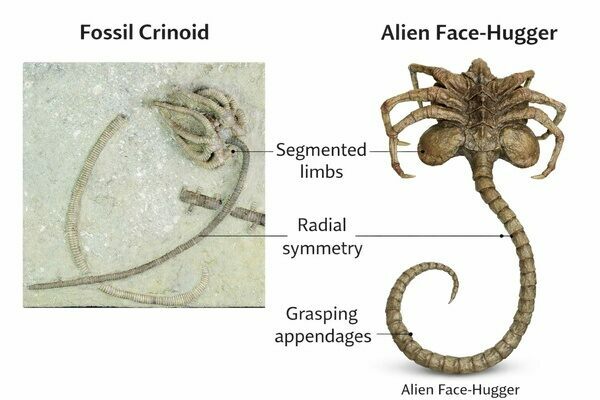
A crinoid next to an Alien Face-Hugger
During the design process for the Alien film franchise, artists and designers drew heavily from real-world biology to create creatures that felt believable yet unsettling. Marine invertebrates—particularly echinoderms like crinoids—played an important role in shaping these designs. The layered skeletal plates, jointed segments, and radiating limbs of crinoids echo many of the biomechanical elements seen in the Xenomorphs, lending them an ancient, evolutionary authenticity rather than a purely fantastical look.
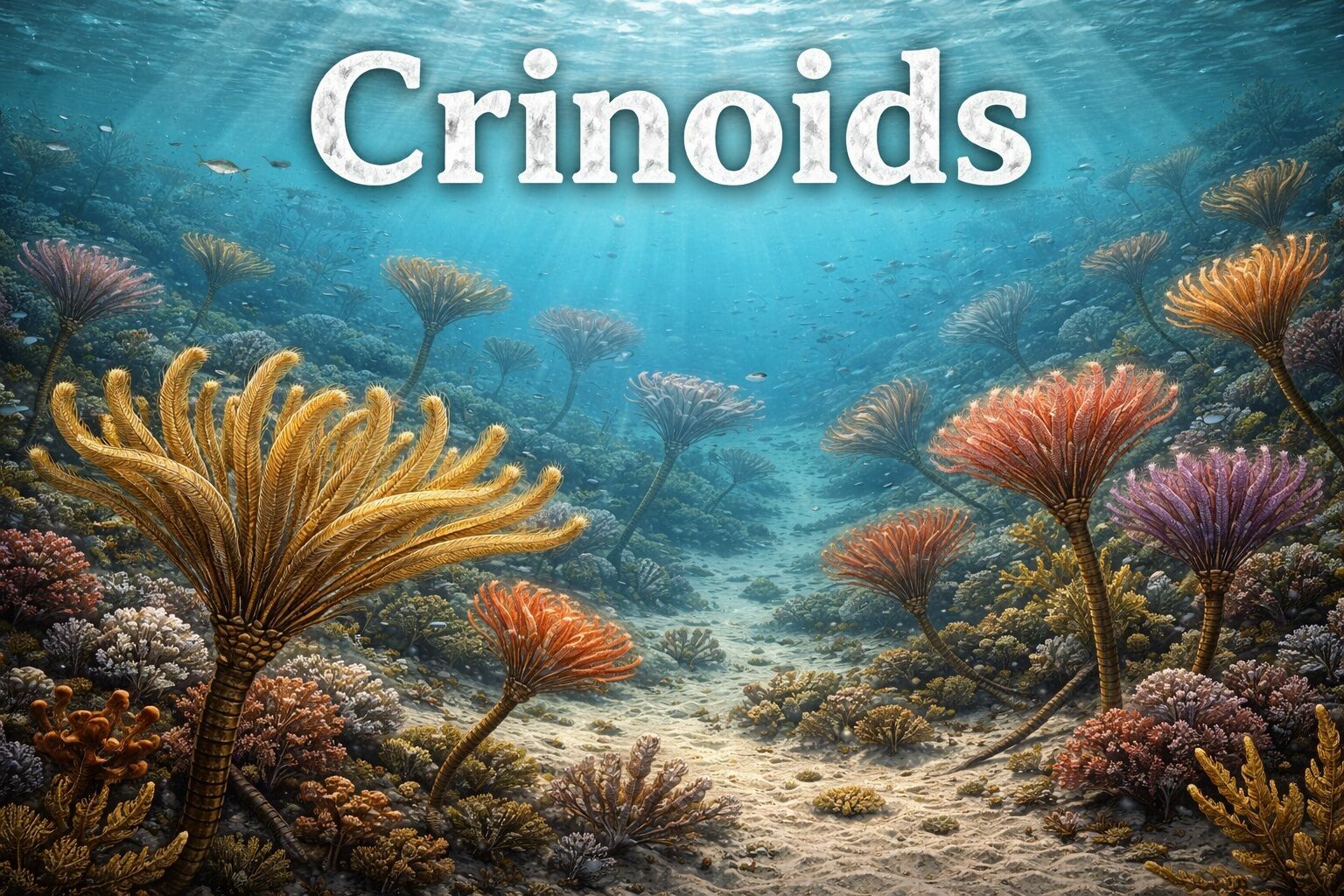
A reconstruction of an ancient seafloor during the Paleozoic Era, where towering crinoids—often called sea lilies—formed dense underwater forests, filtering nutrients from warm, shallow seas hundreds of millions of years ago.
Often called sea lilies because of their graceful, flower-like appearance, crinoids are not plants at all. They are animals—members of the echinoderm family, making them relatives of starfish, sea urchins, and sand dollars. Their lineage stretches back more than 480 million years, making crinoids among the oldest complex animals still alive today. At their peak during the Paleozoic Era, they were so abundant that entire limestone formations across North America and Europe are composed largely of their skeletal remains.
A living crinoid was both elegant and efficient. From a central body called the calyx, dozens of feathery arms radiated outward, each lined with tiny tube feet used to capture plankton drifting past in ocean currents. Many species anchored themselves to the seafloor with long, jointed stalks, swaying gently like underwater flowers. Others abandoned their stalks entirely, becoming free-moving feather stars capable of crawling—or even swimming—through the water with slow, pulsing motions that feel uncannily alive.

It’s this combination of beauty and strangeness that makes crinoids so captivating. Their five-fold symmetry, segmented skeletons, and grasping arms look almost engineered, as if designed by an artist rather than shaped by evolution. When James Cameron and his team were developing the biomechanical horror of the Aliens franchise, crinoids—along with other echinoderms—served as inspiration for creatures that felt organic, ancient, and unsettling. Few people realize that some of the most iconic movie monsters owe their look to animals that once thrived hundreds of millions of years ago on Earth.
Crinoids also boast some truly astonishing records. The longest known crinoid stem ever discovered measured nearly 130 feet long, far larger than any species alive today. While modern oceans still host around 700 living species, ancient seas once supported thousands, forming dense underwater forests that provided shelter and food for countless other organisms.
Most crinoid fossils are found as individual columnals—disc-shaped segments from the stalk that separated after death and scattered across the seafloor. Complete fossils, with arms and crowns intact, are rare and prized, often preserved only when rapid burial protected them from decay and scavengers. These exceptional specimens give us a glimpse of what ancient oceans truly looked like.
From medieval legends that mistook crinoid fossils for holy beads, to Hollywood science fiction that borrowed their unsettling beauty, crinoids bridge the gap between deep time and modern imagination. Every crinoid fossil is more than a piece of stone—it’s a fragment of an ancient world that was as strange, dramatic, and awe-inspiring as anything ever dreamed up on screen.
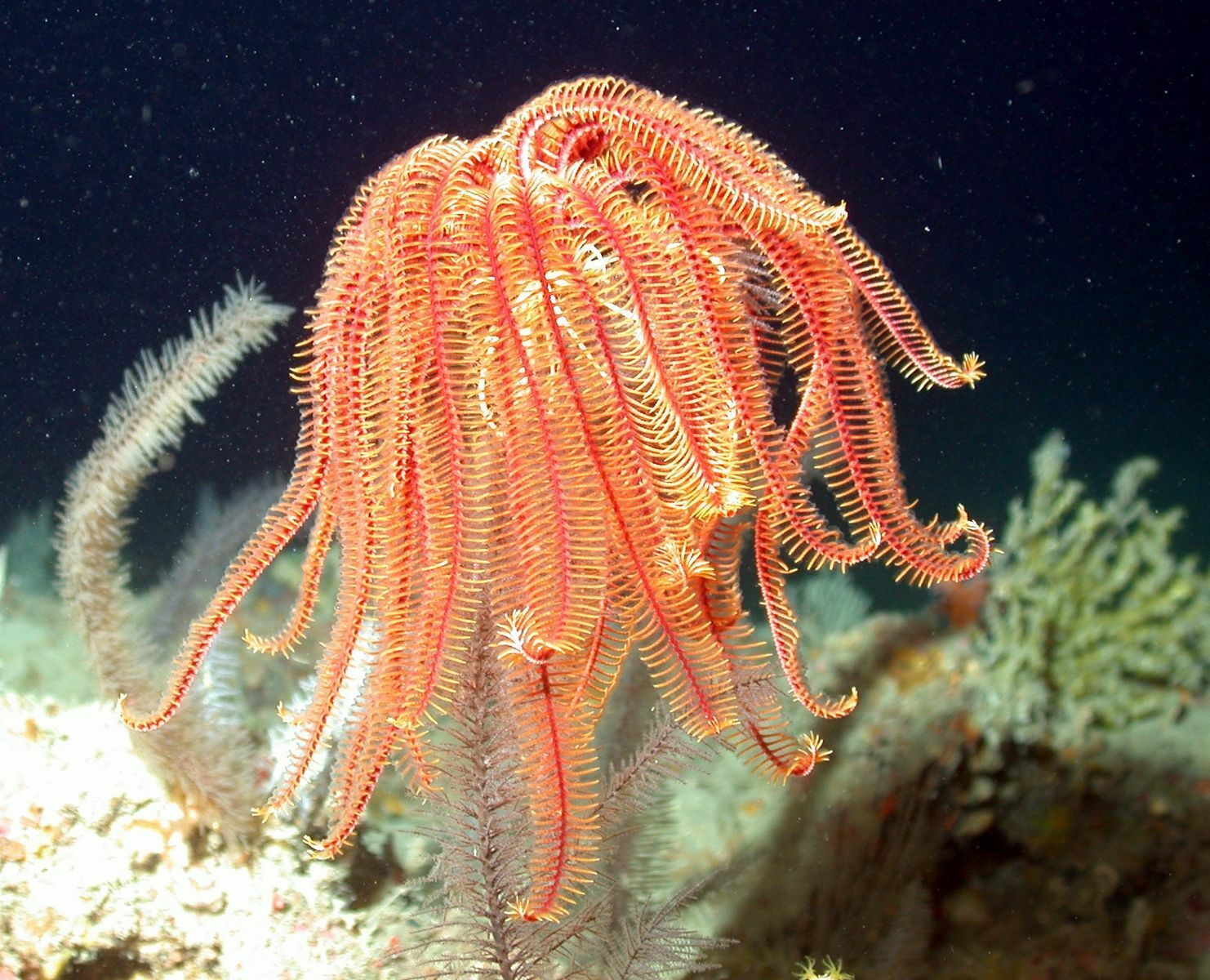
A modern day stalked crinoid in the Gulf of Mexico. Photo from NOAA library.
Scientists suggest two possibilities for the origin of crinoids. The first hypothesis suggests that crinoids evolved from the blastozoan eocrinoids and cystoids. Eocrinoids were from the Early Cambrian and were the earliest echinoderms with a stalk, and arms. The group Gogiida is often referenced and is recognized by its vase-shaped body. Cystoids had stems and were similar to crinoids, but had 3 ambulacral areas on the outside of an ovoid body. A difference between the anatomy of crinoids and blastoids is that blastoids have a flower bud-shaped compartment that holds the vital organs and is called a theca, rather than a calyx. A crinoid calyx is cup-shaped. The calcareous plates that protect the outside of the theca and calyx are often referred to as thecal plates. These plates are used to identify species. The term is also used to describe dinoflagellate anatomy.
Another hypothesis is that crinoids evolved from edrioasteroids. Edrioasteroidea may have emerged as early as the Ediacaran. These organisms had a theca and 5 ambulacral arms in the body wall. It is difficult to define the exact origin for the crinoids because all possible ancestral groups share key traits such as directly attaching to substrates. Other traits include radial symmetry and calcareous plates.
An exquisite 340 million year old fossil crinoid (Macrocrinus mundulus) from Crawfordsville, Indiana.
The Ordovician was the first period that crinoids experienced adaptive radiation. The second period of adaptive radiation occurred in the Triassic, following the Permian mass extinction (250 mya). Flexible arms and motility became widespread in the Triassic. The traits are believed to have evolved due to pressure from predators such as benthic echinoids.
Crinoids were not the only successful stalked and filter-feeding echinoderms of the Paleozoic. Blastoids were also highly diverse and abundant. Crinoids were their most diverse in the Paleozoic, peaking in abundance and diversity in the Mississippian. Blastoids, however well suited to the Paleozoic, did not survive through the end of the Permian. Crinoids evolved new survival strategies for the environments of the Mesozoic.
Anatomy
Crinoids have the pentaradial symmetry that is a characteristic of echinoderms. The three main sections of a crinoid give it the lily-like appearance. These sections are the segmented column or stem, the calyx where the body cavity and digestion occurs, and the arms which filter food from the environment. Most crinoids live attached to substrate, though there are free swimming species in the fossil record. There are several crinoid species alive today which swim freely as adults.
A fossil of a typical crinoid, showing (from bottom to top) the stem, calyx, and arms with cirri
Crinoids can very basically be described as upside-down starfish with a stems. The stem of a crinoid extends down from what would be the top of a starfish, leaving the mouth of the organism opening skyward, with the arms splayed out. However, crinoid arms look articulated and feathery. The stalk extends down from the aboral surface of the calyx. The stalk column has holdfasts which attach the animal to substrate. A holdfast does just as its name implies. Many living species have a vestigial stalk.
Stalked crinoids have been observed moving, but not on ocean currents. In 2005, a living species of stalked crinoid near Grand Bahama Island was observed moving itself across the sea floor. Before the recording, the fastest motion on record was 2 ft/hr, though some scientists think that faster speeds are possible. Paleozoic crinoids were stationary. Motility developed later in response to predation.
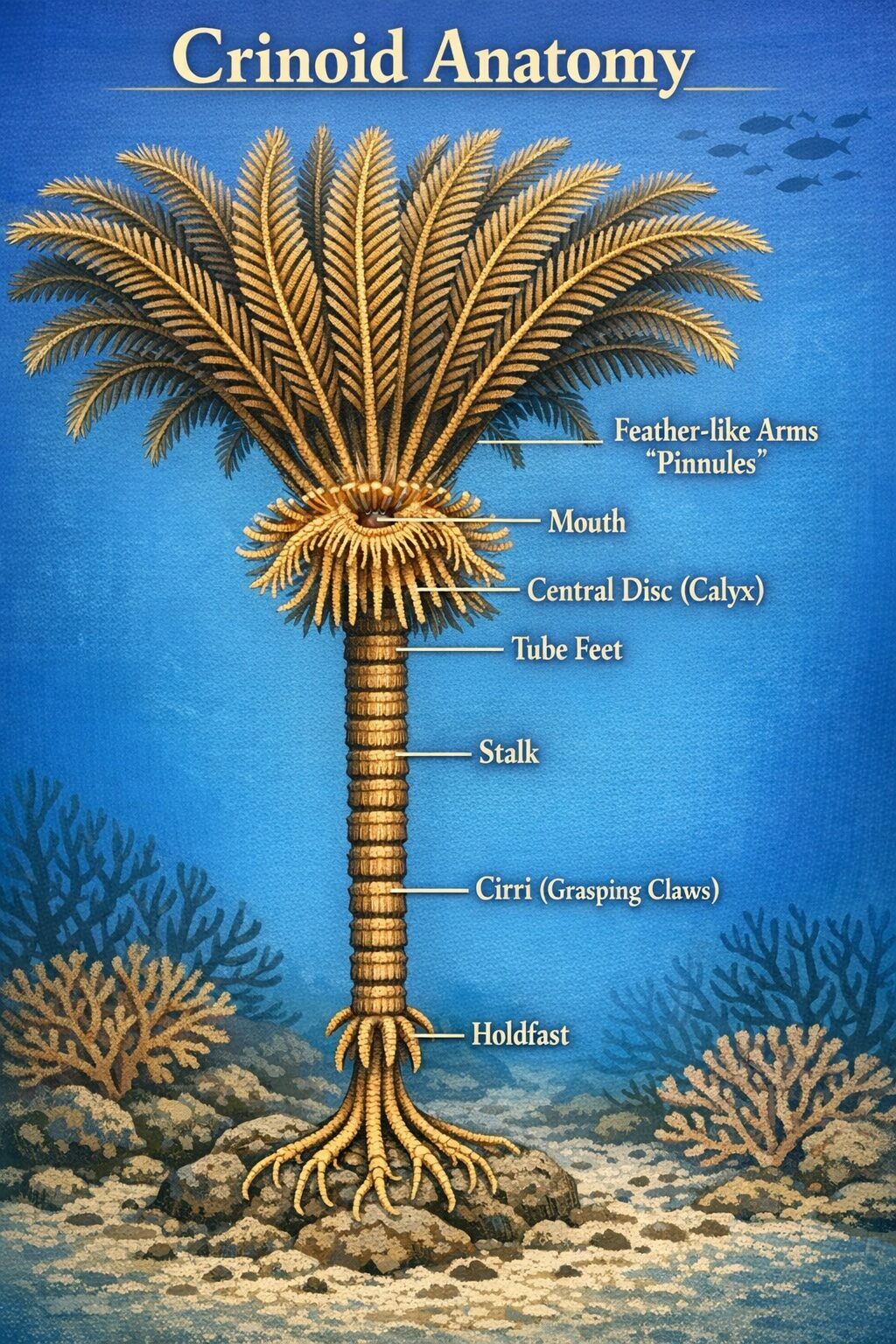
Diagram: Crinoid Anatomy
Stem
The crinoid column is also called a stem or stalk. The stem is made from disc-shaped pieces of endoskeleton which are stacked upon each other and are hollow in the middle. They are held together by ligaments which decomposed rapidly after death. The hollow shapes inside of the discs include: elliptical, circular, pentagonal, and star-shaped. Column discs which are square-shaped have 5 holes in them. Fossil discs are commonly found in Paleozoic limestone deposits.
The stem is constructed from a biomineral complex made from calcium carbonate crystals in a sponge-like microstructure. The three-dimensional microstructure is called stereom. In the embryo, the stereom is produced by mesenchymal cells, which makes stereom an endoskeletal feature of echinoderms. The calcium carbonate crystals which are aligned in the stereom structure, plus the stereom lattice, together create what are called ossicles. Sclerocytes excrete ossicles. Ossicles are held together by collagenous ligaments and are covered by epidermis. The ligaments provide a variety of postures for the organism without using extra muscular energy. Though covered by tissue, the ossicles of echinoderms have the function of an exoskeleton.
Appendages
Some species have special appendages emerging from the bottom of the calyx or along the stem. These appendages are not used for feeding, but are types of holdfasts. They are called cirri. Cirri are used for attaching crinoids to different things, perhaps even to other crinoids. Cirri can be embedded into mud to stabilize the column. Cirri have different characteristics depending on the species. Cirri can act as a hook, or wrap around an object. Another type of holdfast is a button-like place on the bottom of the stem that can strongly adhere to substrate such as coral.
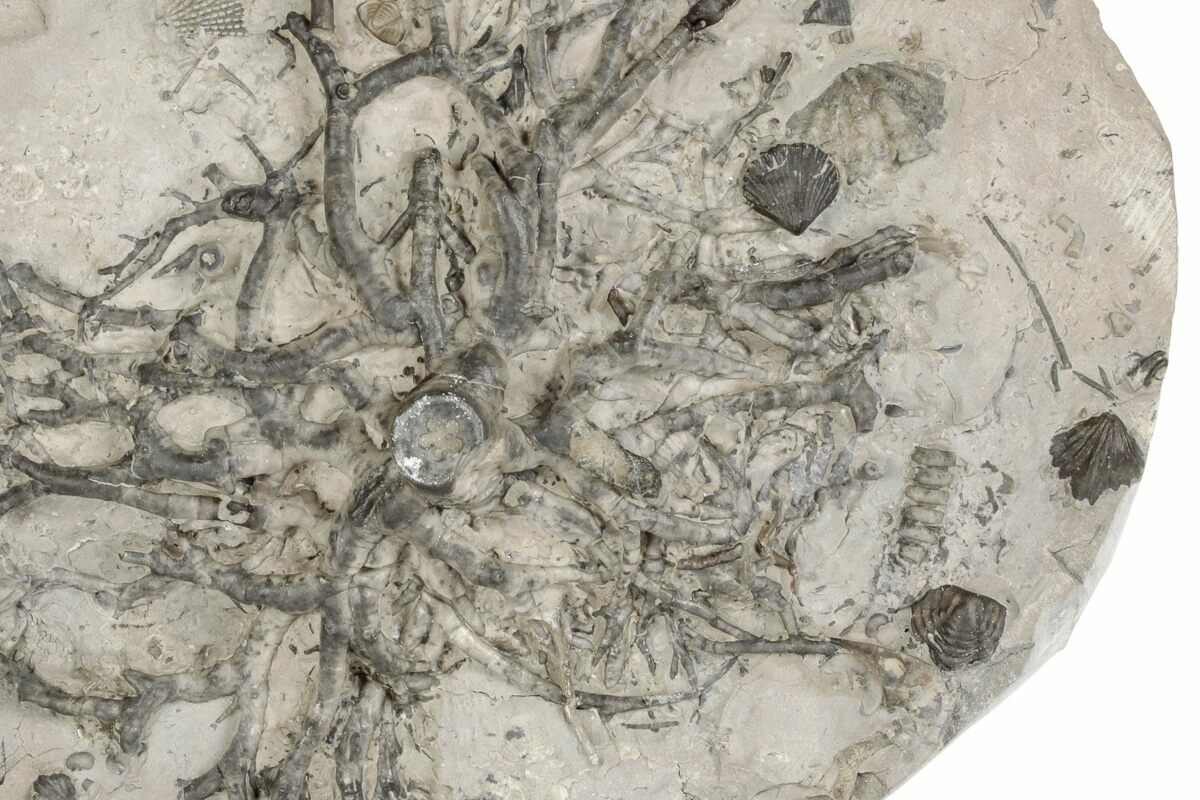
A fossilized holdfast of the crinoid Eucalyptocrinites which would have anchored it to the substrate.
The arms, or brachials, of the crinoid can splay open for filter feeding. There are typically five arms found on the fossil types, though some living species can have many more arms- always in multiples of five. Smaller ossicles form the structure of the arms. The arms of the crinoid have tube feet and cilia on them which move food along the ambulacral canal of each arm. From each canal, food is transported by cilia into the mouth. The arms and calyx are called the crown.
Calyx
The calyx is a cup-shaped body part which contains the u-shaped digestive system and the organs for reproduction. Five sided, calcareous plates create the lower cup of the calyx. The plates are in rows of five and radiate around the calyx. The mouth is atop the dorsal cup, and the anus is beside it. The tegmen is the skyward surface of the calyx. The tegmen has five ambulacral areas which includes a deep groove in each area. Arms extend from the grooved areas. Tube feet are arranged along pinnules which project from the jointed arms. The visual effect makes the arms appear feathery and allows the crinoid to comb the water for suspended food. The hydraulic pressure in each tube foot is controlled with a water vascular system connected to the body cavity.
The body cavity consists of connective tissue and narrow canals which extend into the arms and column. The haemal system of crinoids is a network of fluid filled sinuses. These sinuses are placed among the connective tissue. A group of sinuses surround the oesophogus. The fluid filled spaces extend toward the bottom of the calyx where glandular tissue is located. These spaces are where nutrients are transported to cells of the body. The sinuses also act as an excretory and respiratory system. Tube feet are thinly walled and allow oxygen to be absorbed by crinoids. Coelomocytes are phagocytic cells and are responsible for capturing waste.
Feeding and Diet
The tube feet which project from the pinnules are coated with sticky mucus. The mucus captures particles of food that floats by. Once a food particle is captured, the tube feet move the particle into the ambulacral groove. From inside the groove, cilia move mucus and the particle toward the mouth.
There is an observed correlation, in some living species, with the number of branches on the arms pertaining to the abundance of food in the habitat. The more rich the food supply, the fewer the number of arms needed to obtain food. Ancient crinoids typically had 5 arms, though living species predominantly have arms which divide into two branches, which results in 10 arms.
Crinoids do not have a stomach, so food particles go from mouth to short esophagus and then to intestine. The intestine makes a single curve on the inside of the calyx and ends with a rectum and an anus at the margin of the tegmen.
Crinoids consumed bits of matter and small organisms. Nutrients were obtained from diatoms, plankton, detritus, larva, and anything that was the appropriate size to be trapped by the pinnules and moved into the ambulacral canal.
Nervous System
The nervous system of a crinoid consists of a nerve ring around the mouth with nerves that extend to each arm. There is another ring with branched nerves to each arm that is associated with senses, and a third network with a neural mass at the base of the calyx with extensions to each arm and the stalk. The third nerve network controls motor action.
Reproduction
Crinoids are male or female (dioecious). Crinoids have genital canals that produce gametes, but they do not have gonads. The canals are in some of the pinnules which break open to release sperm and eggs. The fertilized eggs eventually hatch in the water. The larva is barrel-shaped with ciliated bands and sensory hairs.. These are known as vitellaria larvae. The larva settles and attaches to substrate with an adhesive gland. Metamorphosis begins and the larva becomes a stalked adult. Crinoids living today can reproduce in about 10 to 16 months, and even the free-swimming species sometimes mature on the stalk before breaking away.
Environment
Crinoids were very successful in the Paleozoic. They were most abundant and diverse in the Mississippian when several continents were covered with shallow seas. Thick layers of limestone stratigraphy throughout North America and Europe are full of crinoid stems.
In the Ordovician, which began about 488 mya, sea levels were at an all-time high. The globe north of the equator was almost completely ocean. The supercontinent Gondwana was oriented in the southern hemisphere and it contained most of the land. The Taconic Orogeny is a notable event which occurred on a subduction zone as a volcanic island arc collided with the North American continent. The remnants of this collision are seen in eastern New York and Connecticut. The orogeny waned to conclusion in the Silurian. This event is significant to crinoid preservation. The erosion of the sediments produced by the orogeny supplied the surrounding sea with mud and clay which preserved fauna during bursts of undersea mudslides and rapid storm deposition.
Between 450 mya and 440 mya, there were two periods of extinction that together form the second largest mass extinction that has occurred on the planet. Triggers included the tectonic movement of Gondwana which had moved to the south polar region. A drop in CO2 levels also occurred. The result was a cooling of the planet which allowed the formation of glaciers. The glaciations then caused periodic drops in sea levels which adversely affected life living on the continental shelves.
The Silurian began about 444 mya. It was a warmer period, with fewer glaciations and higher sea levels, though glaciers still persisted on a united Gondwana in the southern hemisphere. The supercontinent Euramerica formed at the equator. Jawed and bony fish appeared in the seas, while vascular plants emerged on land. The climate was warmer and more stable than in the Ordovician.
The Devonian began 416-419 mya. In the Devonian, Euramerica and Gondwana became closer together and the climate was warm. Sea levels were high and shallow reefs and coral communities were abundant. The Devonian is known as the Age of Fish.
Plate tectonics continued to alter the continental landscape and crinoids continued to diversify and populate ocean habitats throughout the Carboniferous. The supercontinent Pangaea was along the equator in the Permian (299-250 mya).
At the beginning of the Permian, sea levels were relatively low and shallow marine habitats would have been greatly reduced. The climate was warming, though. As a result, glaciers that were present at the beginning of the Permian had disappeared by its end. The enormous landmasses promoted extreme variations in climate. At the end of the Permian, 90 percent of life in the sea had gone extinct. Crinoids emerged from the extinction as a few surviving groups. They adapted and diversified, and their descendants survive today.
Modern-Day Crinoids: Living Relics of Ancient Seas
Though crinoids are best known from the fossil record, they are far from extinct. Against all odds, these ancient animals survived multiple mass extinctions and still inhabit Earth’s oceans today—quietly thriving in places rarely seen by human eyes. Modern crinoids are living relics, offering a rare, direct connection between today’s seas and marine ecosystems that existed hundreds of millions of years ago.
Today, there are roughly 700 known living species of crinoids, most belonging to a group known as feather stars. Unlike many of their fossil ancestors, the majority of modern crinoids are unstalked, having shed their long stems during evolution. Instead of anchoring permanently to the seafloor, feather stars use claw-like appendages called cirri to grasp rocks, corals, or sponges—or to release their grip and crawl away when threatened. Some species can even swim short distances by rhythmically waving their arms, an eerie sight that reinforces their alien appearance.
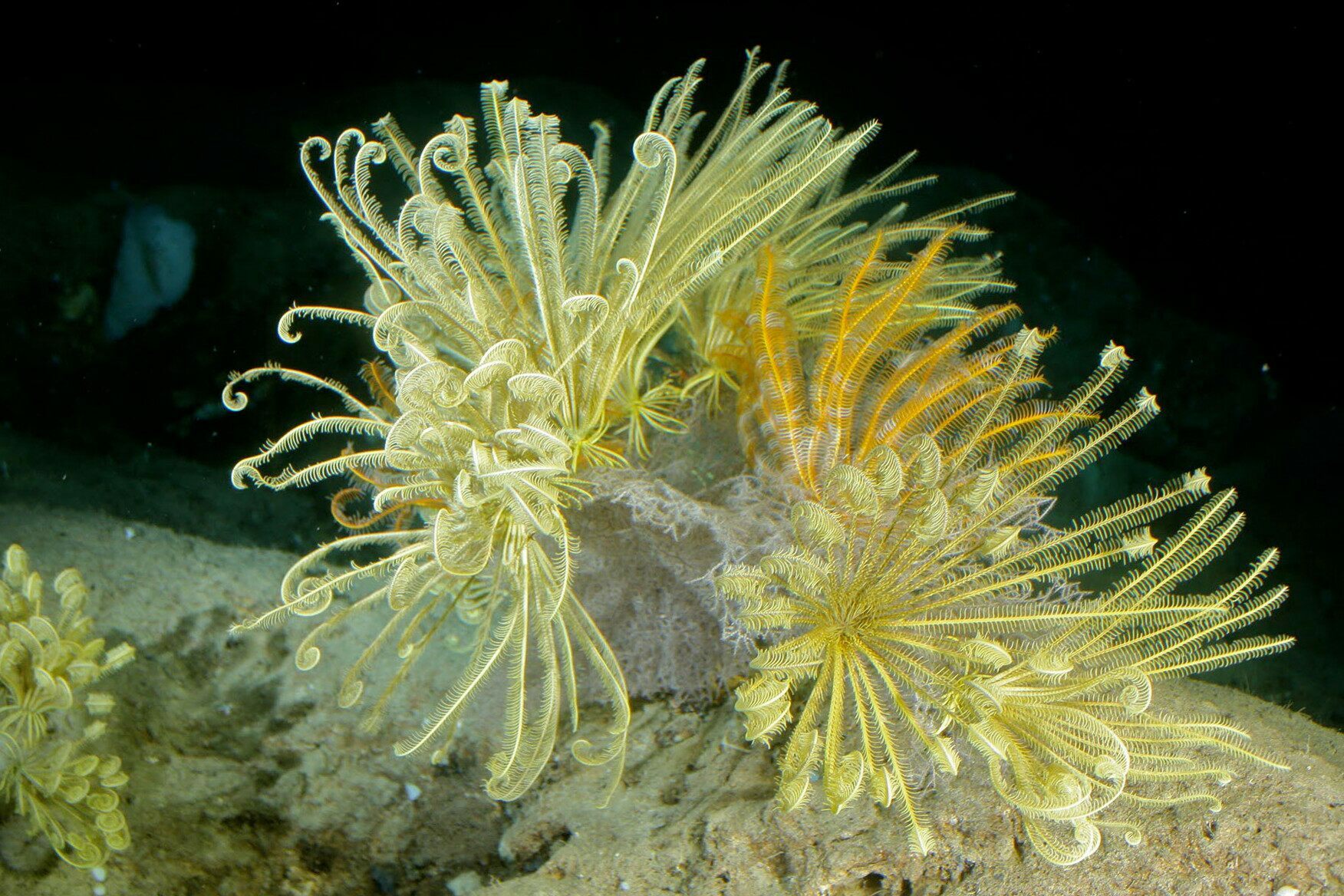
Brightly colored crinoids rest atop deep-sea black coral (Antipathes sp.) almost 300 meters (984 feet) beneath the waters off Roatán, Honduras.
Modern crinoids are found primarily in deep marine environments, often hundreds to thousands of feet below the surface, where stable conditions resemble ancient oceans. They are especially abundant in the Indo-Pacific region, but species also occur in the Caribbean, Atlantic, and Southern Oceans. A small number of stalked crinoids—once thought to be long extinct—still survive in deep waters, earning them the nickname living fossils.
The scientific rediscovery of living crinoids occurred in the 18th and 19th centuries, when deep-sea exploration expanded beyond coastal waters. Early naturalists were astonished to find animals nearly identical to Paleozoic fossils alive in modern seas. Expeditions such as the HMS Challenger voyage in the 1870s confirmed that crinoids were not just remnants of stone, but active participants in today’s marine ecosystems.
Modern crinoids remind us that extinction is not always the final chapter. While their ancient forests vanished long ago, their descendants still drift, cling, and feed in the darkness of the deep—silent survivors from one of Earth’s oldest animal lineages.
Important Fossil Crinoid Localities
Crawfordsville, Indiana, USA
Crawfordsville, Indiana, is widely regarded as one of the most important crinoid fossil localities in the world. The Mississippian-aged deposits of the region, dating to approximately 340 million years ago, have yielded an extraordinary diversity of crinoids, with more than 200 described species known from the area. This remarkable diversity makes Crawfordsville a cornerstone of crinoid taxonomy and paleontological research.
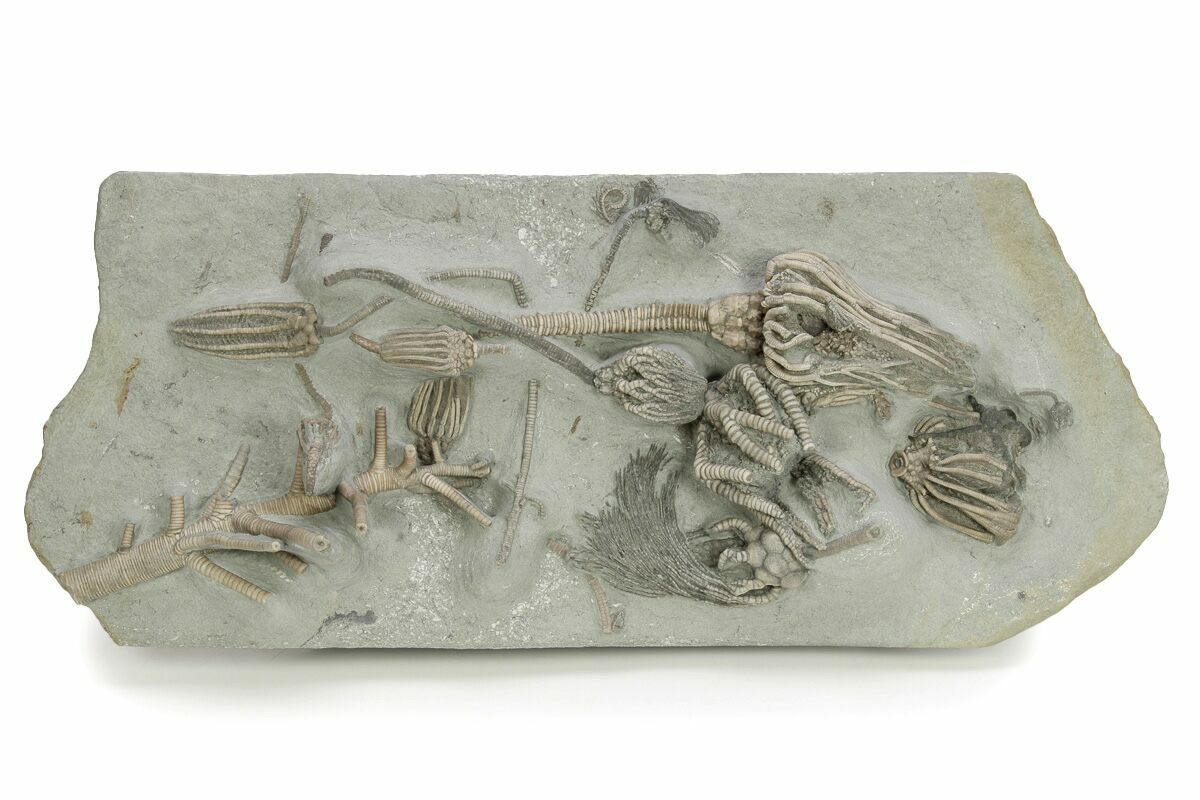
A spectacular plate of 8 crinoid species from Crawfordsville showing the diversity of this fossil site.
What truly sets Crawfordsville apart is the quality of preservation. Many crinoids are found fully articulated, with crowns, arms, calyxes, and stems intact and preserved in lifelike feeding positions. These fossils are thought to have been rapidly buried by submarine mudflows or storm-driven sediment events, freezing entire communities in place. Crawfordsville specimens became foundational to crinoid research in the late 19th and early 20th centuries and remain among the most prized examples of Paleozoic crinoid preservation.
Lodgepole Formation, Montana, USA
The Lodgepole Formation of Montana is another world-class Mississippian crinoid locality, renowned for producing exceptionally well-articulated and often complete crinoid specimens. Deposited in warm, shallow seas roughly 350–330 million years ago, the Lodgepole Limestone preserves entire crinoids with intact arms, calyxes, and long stems, rivaling the preservation quality seen in Crawfordsville.
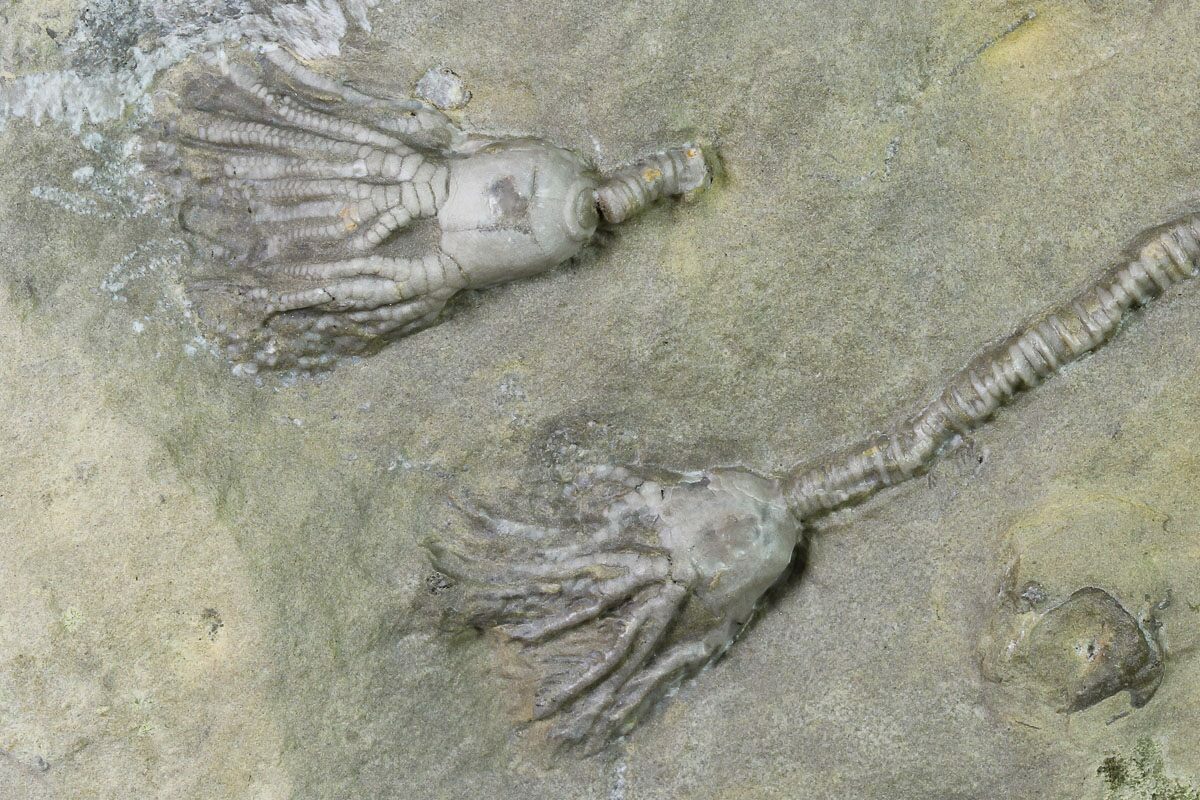
Articulated crinoid fossils from the Lodgepole Formation in Montana
Many Lodgepole crinoids are preserved in limestone with minimal distortion, suggesting rapid burial in relatively calm marine settings. These fossils provide crucial insights into crinoid anatomy, growth patterns, and community structure, and vividly illustrate how crinoids flourished on Mississippian carbonate platforms, forming dense underwater meadows across the ancient seafloor.
Holzmaden, Germany
Holzmaden, Germany, is famous for its Early Jurassic Posidonia Shale, a deposit celebrated for some of the finest fossil preservation on Earth. Crinoids from Holzmaden—particularly the giant species Seirocrinus subangularis—are remarkable not only for their completeness, but for their immense size. When alive, some specimens reached lengths of over 50 feet (15 meters), making them among the largest crinoids ever known.
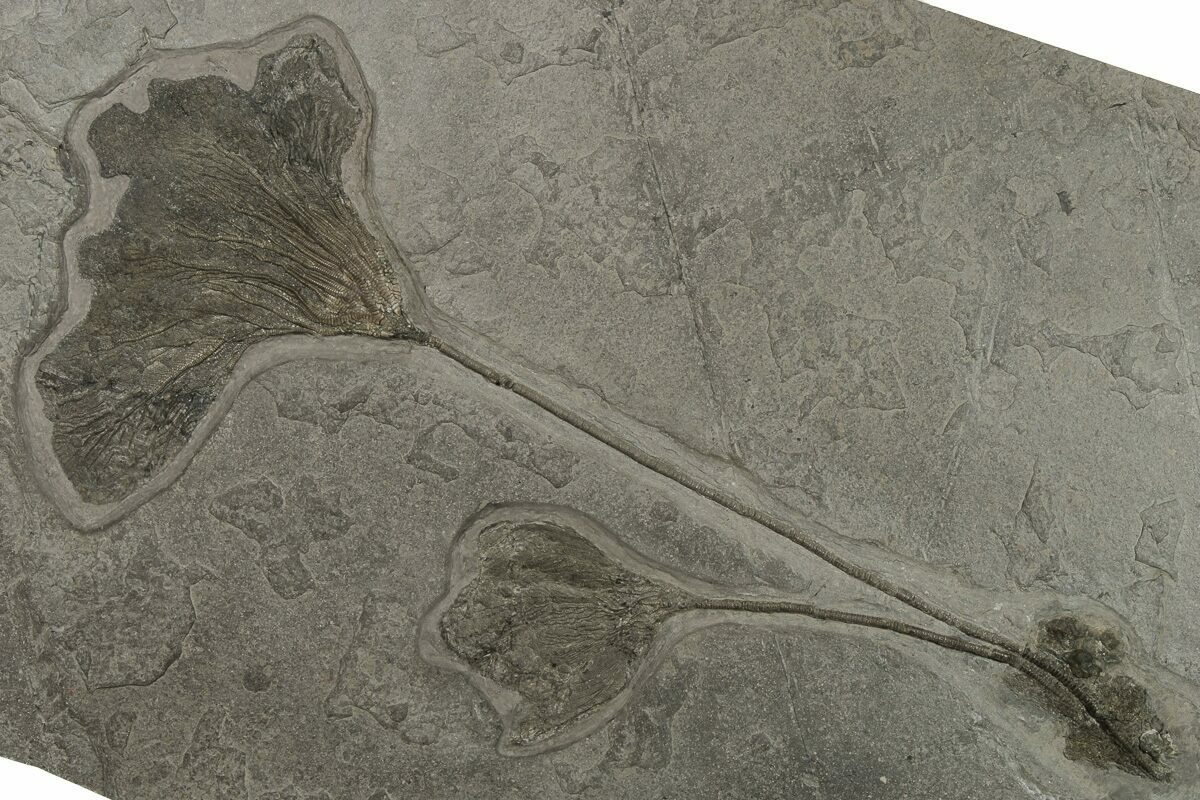
Pyrite replaced Seirocrinus crinoid fossils from Holzmaden, Germany
Preservation at Holzmaden is often enhanced by pyritization, a process in which skeletal and soft tissues were replaced or coated with pyrite under oxygen-poor conditions. This results in fossils with striking metallic detail, capturing delicate arms and attachment structures rarely preserved elsewhere. Many Seirocrinus specimens are found attached to fossilized driftwood, revealing a floating or semi-floating lifestyle in deeper Jurassic seas.
Morocco
Morocco is one of the world’s most productive regions for fossil crinoids, with material originating primarily from late Silurian to early Devonian marine deposits along the northern margin of Gondwana. Among the most distinctive Moroccan crinoids are those of the genus Scyphocrinites, easily recognized by their unusual bulb-shaped root structure known as a lobolith. These crinoids lived roughly 420–390 million years ago, during a critical interval of early crinoid evolution.
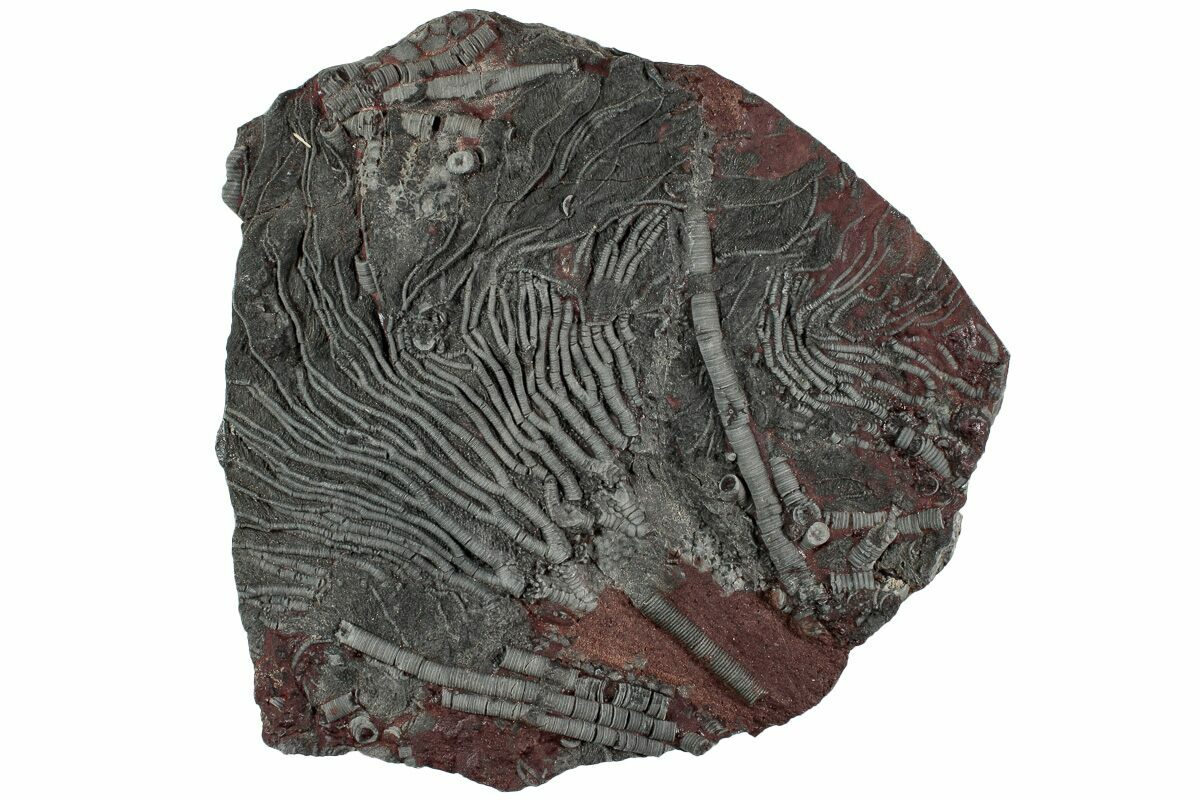
A fossil Scyphocrinites crinoid from Morocco
Fossils of Scyphocrinites from Morocco are commonly preserved as calyxes, stems, and isolated loboliths weathered from limestone and shale, with complete specimens being rare. Morocco has become the primary global source for these crinoids due to long-established commercial fossil collection, making Scyphocrinites widely available to museums, educators, and private collectors. While much of this material enters the commercial market, Moroccan crinoids have also played an important role in research and public education about early Paleozoic marine ecosystems.
Evolution of Crinoids: From Ancient Origins to Ocean Survivors
The story of crinoids begins long before their elegant arms filled ancient seas. Their earliest ancestors likely emerged during the Cambrian Period, more than 500 million years ago, when animal life was rapidly diversifying in Earth’s oceans. These early echinoderms were simple, soft-bodied creatures experimenting with radial symmetry, segmented skeletons, and new ways of feeding in the water column. From this evolutionary experimentation arose the basic body plan that would eventually give rise to crinoids—animals built to harvest food from moving currents rather than chase it.
By the Ordovician Period, true crinoids had appeared, distinguished by their stalked bodies and feathery arms arranged in five-fold symmetry. This design proved remarkably successful. Anchored to the seafloor, early crinoids extended their arms into passing currents, capturing plankton with efficiency that allowed them to flourish in vast numbers. Over time, natural selection refined their skeletal plates, arm branching, and attachment strategies, giving rise to a growing diversity of forms adapted to different depths and water energies.
Crinoids reached their greatest abundance during the Mississippian Period, when warm, shallow seas covered much of the continents. Entire underwater landscapes were dominated by crinoid “forests,” with stalked species rising several feet above the seafloor. It was during this time that many of the classic fossil crinoids known today evolved, leaving behind thick limestone deposits composed largely of their disarticulated skeletons.
The end-Permian mass extinction brought this golden age to an abrupt end, wiping out the majority of crinoid lineages. Yet crinoids proved resilient. During the Mesozoic Era, surviving groups adapted to changing oceans by abandoning permanent stalks, becoming more mobile and flexible. These evolutionary shifts led to the emergence of feather stars—free-moving crinoids capable of crawling or swimming to escape predators.
Today’s crinoids are the living descendants of this long evolutionary journey. Though fewer in number and largely hidden in deep waters, they preserve a body plan shaped by hundreds of millions of years of natural selection. From tentative Cambrian ancestors to modern survivors of the deep sea, crinoids stand as one of the most enduring and recognizable lineages in the history of marine life.
Crinoids and the Inspiration for Alien
Crinoids may look elegant and almost plant-like at first glance, but a closer look reveals why they have long fascinated—and unsettled—human observers. With their grasping arms, segmented skeletons, and radial symmetry, crinoids possess a distinctly otherworldly appearance. It is precisely this combination of organic beauty and alien strangeness that helped inspire the visual language of one of science fiction’s most iconic creatures.
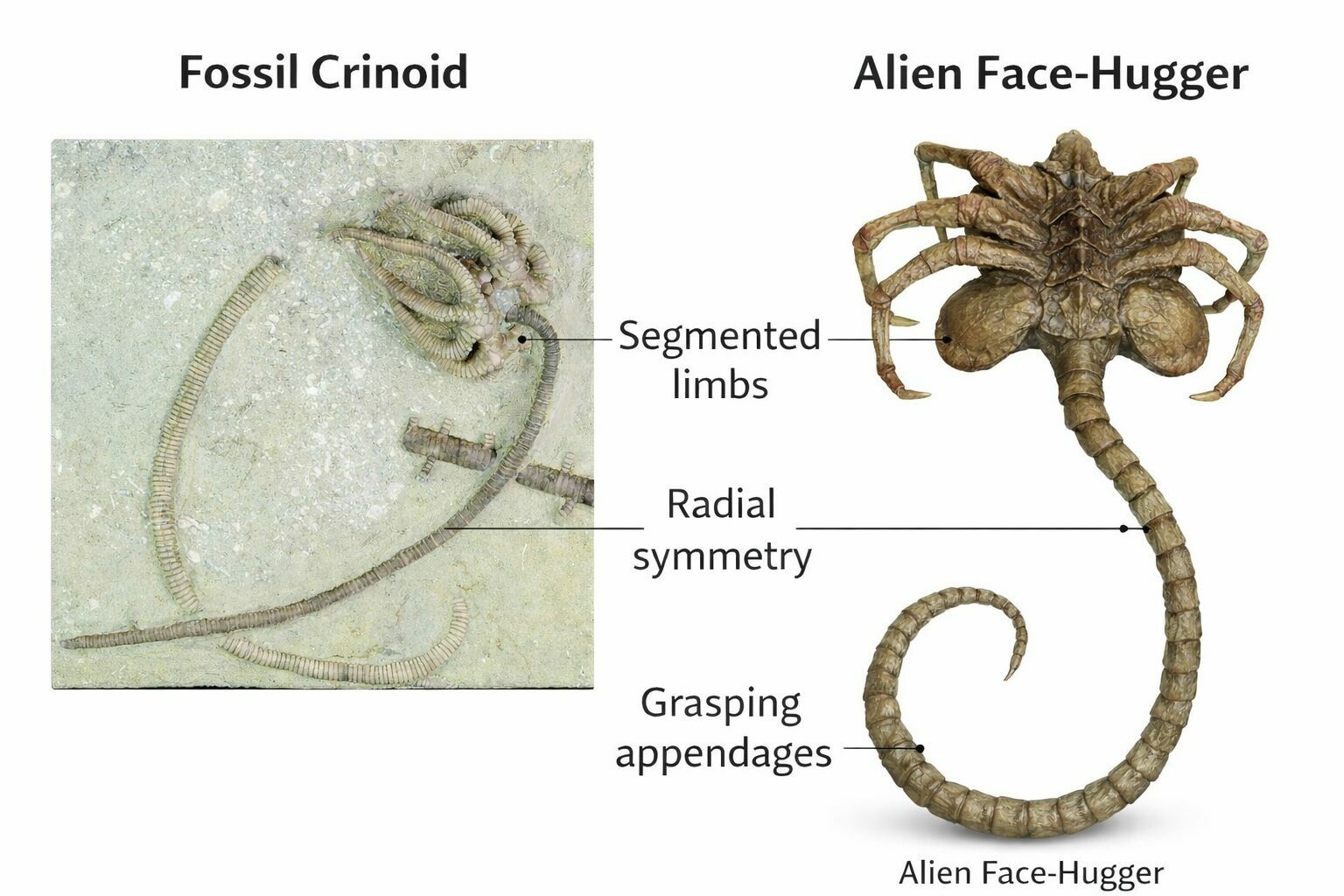
A crinoid next to an Alien Face-Hugger
During the design process for the Alien film franchise, artists and designers drew heavily from real-world biology to create creatures that felt believable yet unsettling. Marine invertebrates—particularly echinoderms like crinoids—played an important role in shaping these designs. The layered skeletal plates, jointed segments, and radiating limbs of crinoids echo many of the biomechanical elements seen in the Xenomorphs, lending them an ancient, evolutionary authenticity rather than a purely fantastical look.
RELATED ARTICLES
Indiana State Fossil - None, Crinoid (Elegantocrinus) Proposed

Cambrian Period: When Life Learned to Experiment

Trilobites: Ancient Arthropods of the Paleozoic Seas

Stromatolites: The Earth's Oldest Fossils

Ohio’s State Fossil - Isotelus, A Giant Among Trilobites
Kentucky State Fossil - The Brachiopod