 Reviews

Megalodon Size: How Big Was The Megalodon Shark?
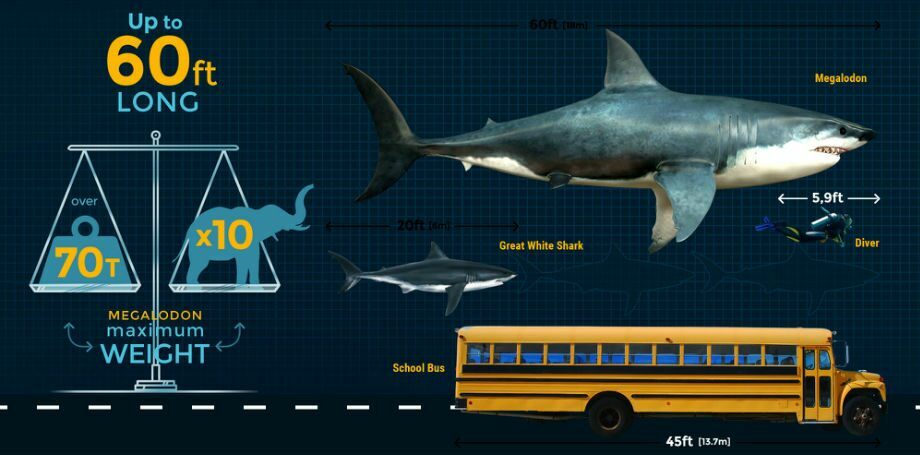
The Megalodon was the largest known predator in the history of the Earth, at least based on its weight. The sperm whale is a little bit longer, but also lighter. Over the years the size estimations of the Megalodon shark have changed, as the science surrounding it's evolution has progressed. One of the issues in estimating it's true size is that the skeletons of sharks are made out of cartilage which does not easily fossilize. This leaves teeth as the only common fossils from which scientists can compute the size for this massive shark.
Most current, scientifically accepted estimates for the Megalodon's maximum size fall into the 60-70 foot range, with a weight of 50-70 tons. Compare that to the Great White Shark that maxes out at about 21 feet and 3 1/2 tons.
The Historical Background
In 1909, Bashford Dean made the first attempt to reconstruct the Megalodon's jaw, in order to get a true estimation of size. Based on the jaw reconstruction, Megalodon was estimated to be 30 metres (98 feet) long. That was just the first thought on the size of Megalodon, though. Over time, the development of scientific methods led to better ways of determining the size of extinct animals based on fossil evidence and jaw reconstruction. The new ways of studying these issues led to improved knowledge about the structure of the jaw, and also about how muscles provide structure through the jaw and into the rest of the body.
After careful consideration of Dean's findings, the size of Megalodon was revised downward, to be about 70 percent of the original assumption (around 21 meters, or 68.6 feet). That size has held up relatively well through the modern day, and has been reaffirmed with newer techniques used for studying fossil evidence. Originally the Megalodon was believed to be closely related to the Great White, but as more fossil evidence has emerged, it's been discovered these two sharks are not in fact closely related. This lead to many of the original estimates being revisited.
That provided more quantitative options that could be considered for estimating its size, which gave scientists a better opportunity for accuracy. While there is no way to completely ensure that the size of Megalodon was what scientists believe it to be, all the evidence that has been found to this date points to an accurate depiction of its size as being approximately 60 feet in length.

Recent Scientific Publications on Megalodon Size (2021–2025)
In the last five years, paleontologists have moved beyond classic tooth-based length estimates by incorporating new data, refined methods, and more comprehensive comparisons with living sharks. One of the most influential recent papers is by Shimada, Motani, Wood, Sternes, and colleagues (2025), published in Palaeontologia Electronica. This study re-examined known vertebral specimens of Otodus megalodon alongside body proportions from 165 extinct and modern sharks to reassess not only its potential total length but also its overall shape and biology. Rather than assuming a great white–like body, the authors concluded that megalodon’s body was likely more elongated and hydrodynamically efficient than previously thought, and that exceptionally large individuals could have reached a total length of about 24.3 m (≈80 ft) under plausible interpretations of the fossil record. Their analysis also offered tentative estimates of weight and cruising speed, suggesting that the species may have weighed over 80 t and swum at speeds comparable to large modern sharks.
Earlier work in this period, such as Perez, Leder & Badaut (2021) published in Palaeontologia Electronica, helped sharpen the picture by refining tooth-based methods. Instead of relying on single tooth crown heights—which can vary dramatically depending on tooth position—these researchers used full dentition measurements and comparative models to estimate a maximum body length around ~20 m (65 ft). Their approach highlighted how traditional scaling methods could introduce large errors when extrapolated from isolated teeth alone and provided a more constrained size range using complete dental formulas.
Alongside these quantitative size studies, other recent work has focused on how body proportions influence both ecology and evolution. For example, research published in 2025 emphasizes that because O. megalodon lay outside the lineage of modern lamnid sharks, using great white analogues exclusively may misrepresent its body form; instead, a more slender profile—similar to large omnivorous sharks like the lemon shark—fits the available vertebral evidence better.
Taken together, these recent publications suggest a consensus emerging within the last few years: Otodus megalodon was not simply a giant great white, but a shark with unique proportions that allowed both immense size and efficient movement through ancient oceans. While estimates still vary, the most up-to-date research places typical large individuals somewhere between ~16 m (≈52 ft) and ~24 m (≈80 ft) in length, depending on the methods and assumptions used. Continued fossil discoveries and analytical refinements will likely keep refining this remarkable predator’s true scale.
Comparison With Modern Day and Extinct Animals
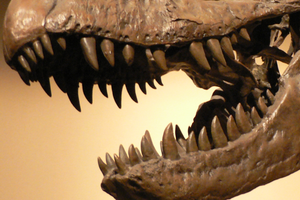
The Megalodon has been compared to the whale shark (around 12.65 metres, or close to 41.50 feet) and the scientific community has determined that Megalodon was larger, based on both weight and length. Megalodon was also far bigger than the great white shark, which would only be around half of Megalodon's size. Megalodon has also been found to be far larger than the gigantic theropod dinosaurs such as Spinosaurus, T-Rex, as well as the large ocean going marine reptiles such as Basilosaurus, and Tylosaurus. While all of those animals were at least 8 metres in length and often as large as 17.5 meters, they didn't match the length of Megalodon.
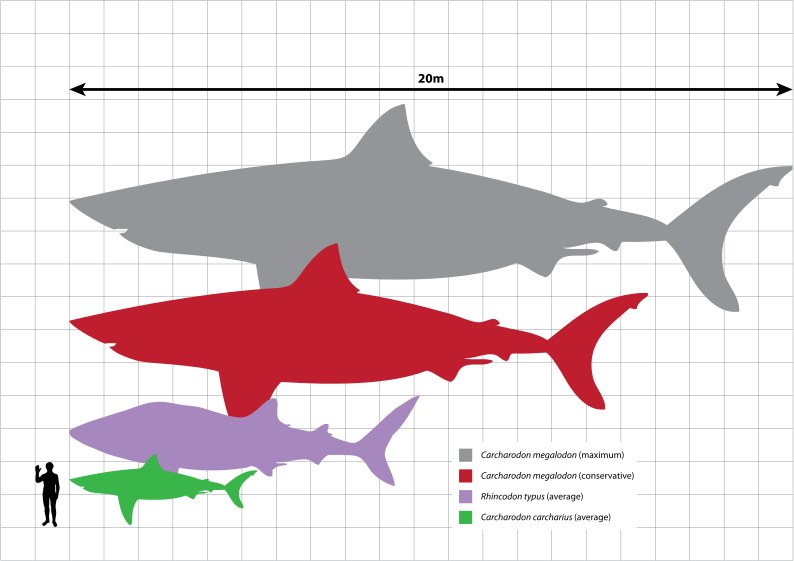
Megalodon size compared with a Whale Shark, modern Great White Shark and human.
While many dinosaurs were heavier than Megalodon, they were no match for it based on their overall length. Weight is just one way to measure size, as well, since many animals can be larger but still be relatively light based on their total body size. Such was the case for Megalodon. Although it was still quite heavy, it was not able to reach the kind of weight that some other animals achieved. Despite its lower weight, its overall length and powerful jaws made it a highly formidable predator, capable of taking down whales and other creatures that were larger or that weighed more.
Tooth Size Can be Used to Estimate Body Size
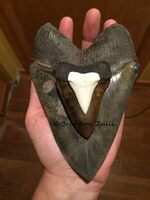
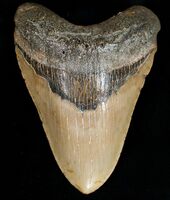
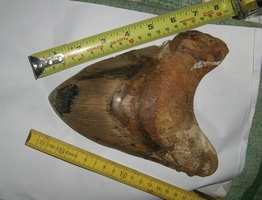
Among the great ways scientists used to determine the true size of Megalodon was a study of the size of its teeth. Some Megalodon teeth have a slant height of more than seven inches, which is a very large tooth. Using that tooth to determine the body size of the animal is something that has been done in living sharks today, and those calculations were then used to determine an overall, expected size for Megalodon. Still, there may be some inaccuracies. One of the biggest problems with determining the size of something like Megalodon is that sharks are made mostly of cartilage, not bone. Cartilage doesn't fossilize well, so finding intact specimens is not possible. Instead, it is only possible to find pieces, like vertebrae and teeth, that can be used to attempt reconstruction.
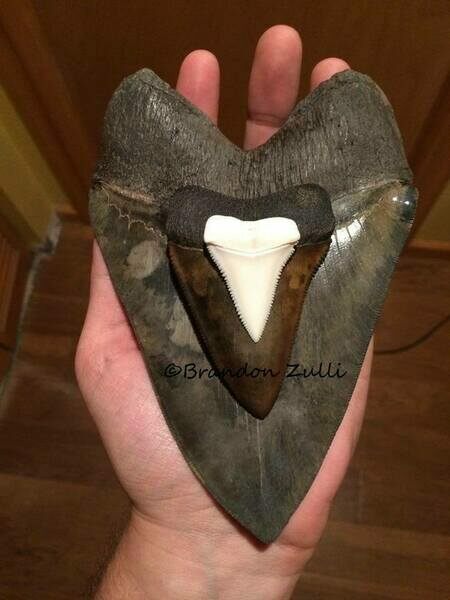
6 5/8" fossil Megalodon tooth, a 3 1/8" fossil Great White and a 1 1/2 inch modern day Great White. Photo Credit: Brandon Zulli
Some of the ways scientists attempt to measure Megalodon size include enamel height, root width, largest anterior tooth height, and crown height. Each one of those methods can result in different findings and different beliefs regarding the size of Megalodon. Because of all the different methods of studying teeth that have been used to determine the true size of Megalodon, scientists still cannot completely agree on how big Megalodon actually was. Opinions of Megalodon's size range from 52 feet all the way up to 82 feet, with most of the scientific consensus remaining on the lower end of that range.