 Reviews

Nanotyrannus Returns: New Research Proves It Wasn’t a Baby T. rex
For decades, paleontologists fiercely debated whether Nanotyrannus lancensis represented a real species or just a teenage Tyrannosaurus rex. That debate took a decisive turn in 2025, when a major study published in Nature provided the strongest evidence yet that Nanotyrannus was its own genus. Led by Lindsay E. Zanno and James G. Napoli, the research analyzed a nearly adult tyrannosaur skeleton from the Hell Creek Formation (specimen NCSM 40000) and revealed a suite of anatomical and developmental traits that simply don’t match the growth pattern of T. rex.
The study found that this animal had reached somatic maturity—a clear sign it wasn’t a juvenile. More importantly, its skull held more maxillary tooth positions than any known T. rex, and its internal cranial structures followed different developmental pathways altogether. Its body proportions also diverged: fewer tail vertebrae, proportionally larger arms, and a slimmer, more lightly built frame. These aren’t features a young T. rex would “grow out of”; they’re fixed traits that define a distinct species.
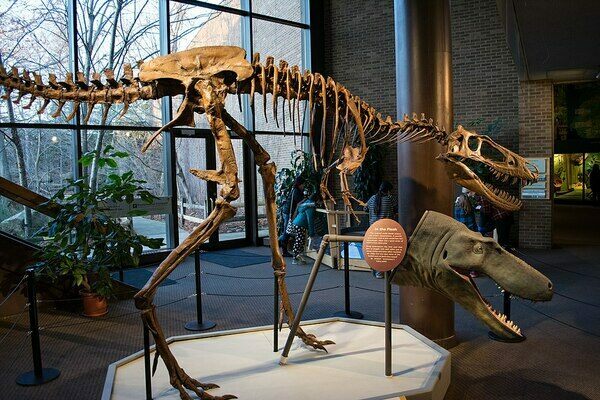
A lifelike museum display of the theropod dinosaur Nanotyrannus (nicknamed Jane), exhibited at the Cleveland Museum of Natural History.
When researchers fed the data into modern phylogenetic models, Nanotyrannus consistently landed outside the direct T. rex lineage. This not only confirms N. lancensis as valid, but also supports a newly proposed species, Nanotyrannus lethaeus. As Scientific American highlighted in its coverage, many fossils previously used to chart the growth of T. rex now appear to belong to a completely different dinosaur.
This reinterpretation reshapes our picture of the Hell Creek ecosystem. Rather than a landscape ruled solely by the king of tyrants, the late Cretaceous now appears to have hosted two coexisting tyrannosaurs: the colossal T. rex and a smaller, faster, more gracile predator. What were once thought to be “baby rexes” were actually adult hunters with their own ecological role. The Nature paper notes that decades of growth-series research on T. rex may need revision, as much of it relied on specimens now reclassified as Nanotyrannus.
Some paleontologists remain cautious, noting that larger sample sizes will strengthen the case even further. Still, the anatomical and developmental distinctions presented in the study are the clearest and most comprehensive evidence ever assembled in favor of Nanotyrannus being real. Institutions like the North Carolina Museum of Natural Sciences have already updated their public messaging to reflect the new consensus.
For museums, collectors, and dinosaur fans, this is a major shift. Displays, labels, and educational materials will evolve, and many smaller tyrannosaur fossils once sold or shown as juvenile T. rex specimens may now be recognized as something far more intriguing.
The long-running debate isn’t just cooling—it’s transforming. With the 2025 research, Nanotyrannus steps out of the shadow of T. rex not as a misunderstood youth, but as a sleek, separate predator of its own. The “little tyrant” is finally getting its name back.
The study found that this animal had reached somatic maturity—a clear sign it wasn’t a juvenile. More importantly, its skull held more maxillary tooth positions than any known T. rex, and its internal cranial structures followed different developmental pathways altogether. Its body proportions also diverged: fewer tail vertebrae, proportionally larger arms, and a slimmer, more lightly built frame. These aren’t features a young T. rex would “grow out of”; they’re fixed traits that define a distinct species.
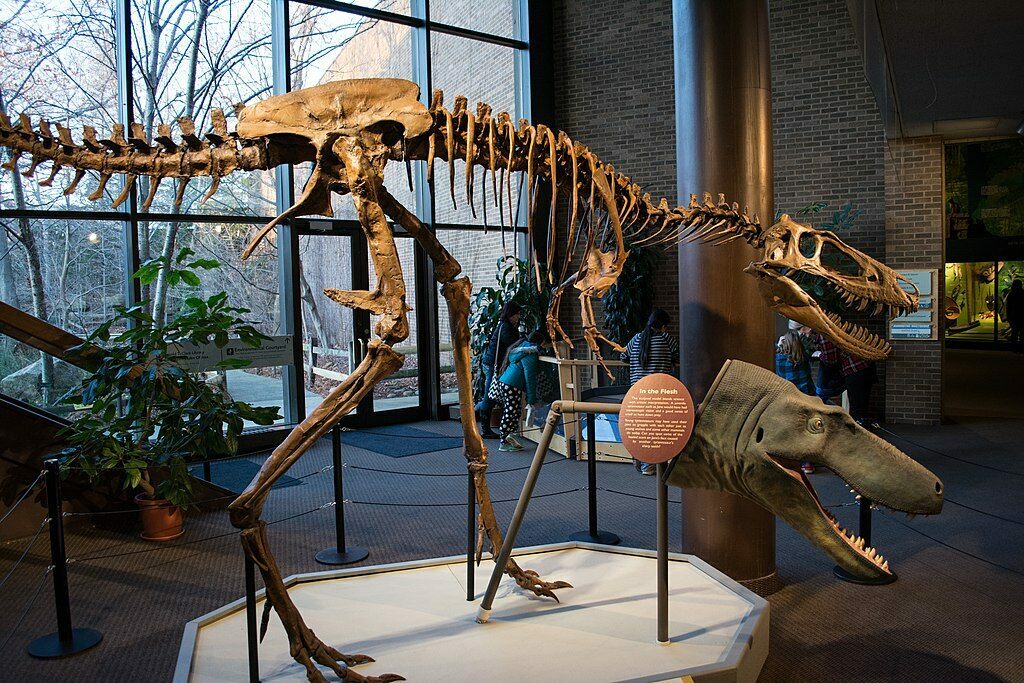
A lifelike museum display of the theropod dinosaur Nanotyrannus (nicknamed Jane), exhibited at the Cleveland Museum of Natural History.
When researchers fed the data into modern phylogenetic models, Nanotyrannus consistently landed outside the direct T. rex lineage. This not only confirms N. lancensis as valid, but also supports a newly proposed species, Nanotyrannus lethaeus. As Scientific American highlighted in its coverage, many fossils previously used to chart the growth of T. rex now appear to belong to a completely different dinosaur.
This reinterpretation reshapes our picture of the Hell Creek ecosystem. Rather than a landscape ruled solely by the king of tyrants, the late Cretaceous now appears to have hosted two coexisting tyrannosaurs: the colossal T. rex and a smaller, faster, more gracile predator. What were once thought to be “baby rexes” were actually adult hunters with their own ecological role. The Nature paper notes that decades of growth-series research on T. rex may need revision, as much of it relied on specimens now reclassified as Nanotyrannus.
Some paleontologists remain cautious, noting that larger sample sizes will strengthen the case even further. Still, the anatomical and developmental distinctions presented in the study are the clearest and most comprehensive evidence ever assembled in favor of Nanotyrannus being real. Institutions like the North Carolina Museum of Natural Sciences have already updated their public messaging to reflect the new consensus.
For museums, collectors, and dinosaur fans, this is a major shift. Displays, labels, and educational materials will evolve, and many smaller tyrannosaur fossils once sold or shown as juvenile T. rex specimens may now be recognized as something far more intriguing.
The long-running debate isn’t just cooling—it’s transforming. With the 2025 research, Nanotyrannus steps out of the shadow of T. rex not as a misunderstood youth, but as a sleek, separate predator of its own. The “little tyrant” is finally getting its name back.