 Reviews

Top 10 Paleontology & Fossil Stories of 2025
Paleontology in 2025 proved once again that Earth still holds extraordinary stories in stone, amber, and microscopic cellular archives. Over the past year, fossil finds and scientific breakthroughs captured global attention, reshaped evolutionary family trees, revealed ancient behavior, and even pushed the boundaries of molecular preservation. From predatory dinosaurs and injured sauropods to Cambrian larvae with internal organs intact — and a Jurassic fossil forest finally stepping into the public spotlight — 2025 delivered a sweeping reminder that fossils are not just relics of form, but time capsules of ecology, motion, and biology at every scale.
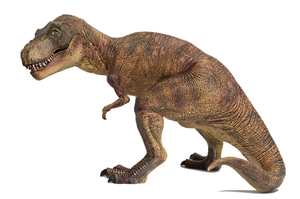
For decades, Nanotyrannus lancensis occupied one of the most controversial footnotes in dinosaur science, frequently dismissed as a juvenile T. rex. In 2025, new histological sampling and skeletal comparisons from the famous “Dueling Dinosaurs” specimen demonstrated that Nanotyrannus was not an immature rex, but a separate, fully grown tyrannosaur species living alongside T. rex in the Late Cretaceous of North America. The study leveraged growth-ring analysis in bones, jaw proportions, and distinct anatomical traits that could not be explained by juvenile development alone, delivering the strongest evidence yet that the genus represents a distinct branch of tyrannosaur evolution.
The confirmation carries implications far beyond a single species designation. Because tyrannosaurs are often known from incomplete skeletons and interpreted through growth models, this finding forces a major recalibration of how T. rex ontogeny is reconstructed, how many tyrannosaur species co-existed, and how they partitioned ecological niches. Establishing Nanotyrannus as a separate adult predator expands our understanding of dinosaur diversity at the end of the Mesozoic and underscores the power of bone microstructure to resolve debates that morphology alone could not settle.
🔗 Read Full story: North Carolina Museum Of Natural Sciences
Among the most dramatic vertebrate fossil announcements of 2025 was a massive Early Cretaceous spinosaurid recovered from Thailand’s ancient river deposits. Estimated at 25 feet long, the animal stalked tropical waterways 125 million years ago and shows enough skeletal differences from Spinosaurus and European spinosaurids to suggest a distinct Asian radiation of the family. The find includes one of the most complete spinosaurid assemblages in Asia, providing cranial and post-cranial data that illuminate how these fish-eating giants adapted to riverine ecosystems far from the Sahara and Europe.
Spinosaurids are among the most charismatic dinosaurs, but their global distribution and ecological range remain poorly sampled. This discovery fills a major biogeographic gap, showing that extreme body size and semi-aquatic specialization evolved repeatedly across continents. Its completeness allows paleontologists to test hypotheses about convergent evolution, skull hydrodynamics, and niche partitioning in tropical rivers, demonstrating that Asia played a bigger role in spinosaur evolution than previously recognized.
🔗 Read Full story: LiveScience
In a discovery that rivals the best of the Cambrian Lagerstätten, 2025 brought the announcement of Youti yuanshi, a tiny 520-million-year-old arthropod larva from China preserved with internal organs intact — including digestive glands and regions interpreted as early neural structures. Unlike typical shelly fossils, this specimen preserves anatomy normally lost to decay, giving a rare developmental snapshot from the period when arthropods first diversified into one of Earth’s dominant animal groups.
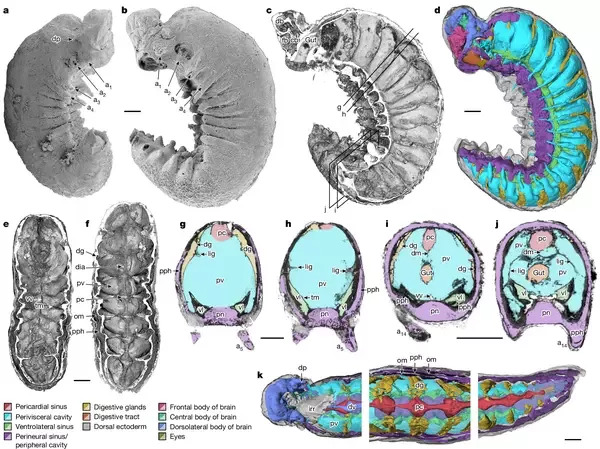
Anatomical overview of Youti yuanshi.
This fossil is transformative because it unites embryology, evolution, and the deep-time record. Soft-tissue preservation from such ancient strata is extraordinarily rare, and larval forms even more so. By capturing the internal body plan of an early arthropod, scientists can now anchor hypotheses about how segmented nervous systems, organ differentiation, and digestive complexity evolved at the dawn of animal life, refining both the timing and the anatomical pathways of early arthropod evolution.
🔗 Read Full story: People.com
Bolivia’s Torotoro National Park emerged as one of the most discussed fossil stories of 2025 after researchers documented almost 18,000 dinosaur footprints, swim traces, and tail drag impressions at Carreras Pampa. The site records overlapping movements of multiple species along a Cretaceous coastal margin, preserving a behavioral fossil record on a scale rarely matched anywhere in the world. These are trace fossils, but collectively they form a “motion archive” capturing how dinosaurs walked, swam, paused, and interacted with shifting tidal flats.
What makes the find so important is not just the number of tracks but the type of tracks. Swim traces and tail drags provide direct evidence of dinosaurs moving through water, helping scientists test locomotion models and interpret mass-mortality and migration scenarios along ancient shorelines. The scale of the site also validates the growing scientific emphasis on trace fossils as behavioral data sources — not just supplements to body fossils — proving that footprints can answer questions bones never could.
🔗 Read Full story: Sci.news
A 2025 study found that bright orange bone-colonizing lichens in Canadian badlands can serve as biological beacons for locating underlying dinosaur bones during drone-based surveys. The orange pigments create spectral contrasts detectable from the air, helping paleontologists rapidly target promising rocks across huge expanses of remote terrain.
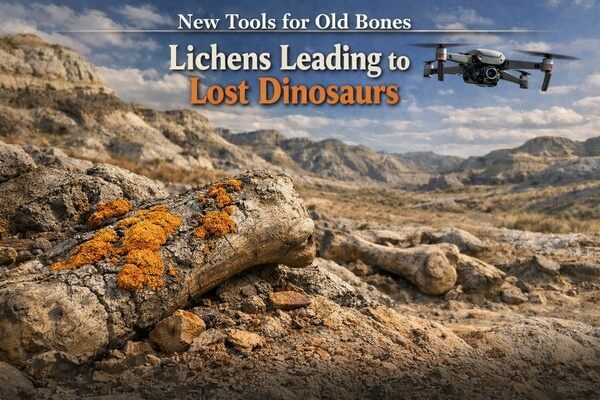
Using drones to locate lichen covered dinosaur bones.
This discovery signals a shift in field methods, blending biology, remote sensing, and paleontology. Traditional fossil prospecting is slow and ground-intensive; using lichens as “natural fossil flags” allows for faster and less invasive surveys. The method could change how paleontologists scout fossil-bearing formations in remote regions, improving discovery efficiency and reducing environmental disturbance while expanding the practical value of ecological indicators preserved in modern landscapes.
🔗 Read Full story: DiscoverWildlife.com
A widely discussed 2025 paper proposed that some giant marine lizards that ruled Cretaceous oceans — may have ventured into or adapted to freshwater systems, expanding their ecological range beyond the open sea. This idea stems from new fossil associations and sedimentary contexts suggesting tolerance of lower-salinity habitats.
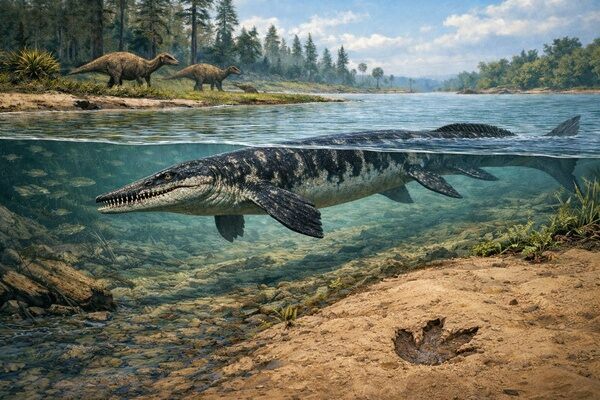
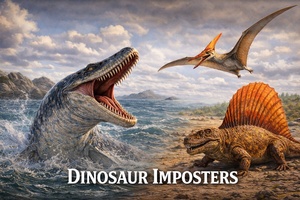
Did Mosasaurs enter fresh water Cretaceous rivers?
If validated by future discoveries, the finding changes how paleontologists interpret marine reptile dispersal and niche flexibility at the end of the Age of Dinosaurs. Mosasaurs are critical index predators for reconstructing Maastrichtian ocean ecosystems; showing they could traverse inland waterways reveals new predator-prey interactions, dispersal pathways, and ecosystem connectivity between oceans and continental interiors.
🔗 Read Full story: Sci.News
Scientists extracted and sequenced ancient RNA from 39,000-year-old woolly mammoth tissues in 2025 — a breakthrough because RNA degrades much faster than DNA and almost never fossilizes. This marks one of the first successful recoveries of gene-expression material from deep time.
RNA reveals physiology, gene regulation, and cellular activity that DNA alone cannot show. This milestone pushes paleontology beyond anatomy into molecular biology, allowing future researchers to ask questions about metabolism, cold adaptation, and cellular stress in Pleistocene megafauna. It also validates that under exceptional conditions, short-lived biomolecules can survive for tens of thousands of years, opening new frontiers in molecular paleontology.
🔗 Read Full story: NPR
A looping 310-foot trackway from the Jurassic of Colorado captivated both the public and the scientific community in 2025 after analysis suggested the sauropod that made it was limping. The irregular spacing and pressure depth of the footprints form one of the clearest examples of individualized dinosaur physiology ever preserved in a single trackway, offering a rare record of injury or biomechanical stress in a giant long-necked dinosaur.
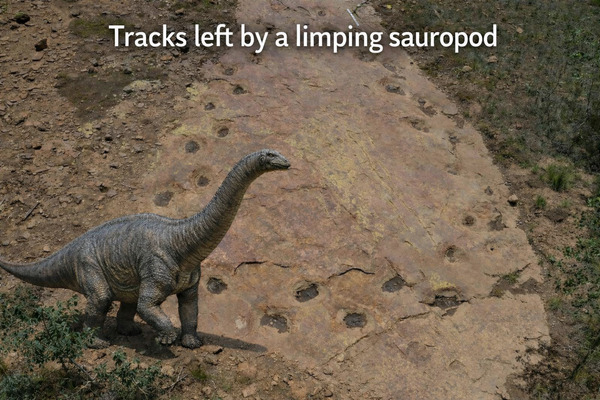
Limping Sauropod Dinosaur Trackway In Colorado
Trackways typically establish species presence, direction, or speed. This one goes further, preserving the health and movement signature of a single dinosaur. Evidence of limping gives paleontologists a chance to model gait compensation, weight distribution, and biomechanics in sauropods — animals that are otherwise known mostly from bones, not motion. It demonstrates how trace fossils can preserve not just behavior but condition, expanding the interpretive resolution of the fossil record.
🔗 Read Full story: Phys.org
India announced the public debut of a Jurassic fossil-wood gallery showcasing 230-million-year-old petrified logs from Telangana. These fossils record ancient conifer-rich forests that flourished soon after the breakup of Gondwana, preserved in volcanic-influenced sediments. The display represents one of the few times Jurassic forests have been documented from wood fossils dense enough to reconstruct a regional landscape-scale flora.
Large petrified forests are invaluable climate archives, recording rainfall patterns, forest density, and atmospheric conditions. This site offers data from the era when dinosaurs first rose to dominance, providing context for the vegetation that supported early dinosaur ecosystems. Bringing the fossils into museum space also democratizes access, helping both the public and researchers engage with ancient flora on a macroscopic scale rather than relying solely on microfossil cores or fragmentary plant impressions.
🔗 Read Full story: Times Of India
A new nimravid species was announced from northern China in 2025, clarifying the evolution of cat-like predators that were not true felids but filled similar apex-carnivore niches in the Oligocene. Known from jaw and tooth material, the species expands Asia’s record of early hyper-carnivorous mammals.
This find was popular because saber-tooth predators fascinate the public, but it’s scientifically important because nimravids sit outside the true cat family tree. Each new species helps researchers track how predatory specializations evolved before the rise of modern cats, refining timelines for convergent evolution in canines, feliforms, and hyper-carnivorous mammals that dominated Paleogene ecosystems.
🔗 Read Full story: Sci.News
As explosive as 2025 was, 2026 is already primed to roar even louder. Scientists are preparing to publish new tyrannosaur growth studies that may refine predator diversity even further, while major digs in South America and Southeast Asia continue to hint at oversized species still waiting for names. Advances in fossil protein sequencing and bone micro-analysis are expected to unlock new biological details from iconic specimens, and renewed attention on ancient forests and early land plants may reveal how ecosystems rebounded after ancient climate shocks. If 2025 taught us anything, it’s that paleontology thrives on surprises — and 2026 looks ready to deliver them in abundance.
1) Nanotyrannus Confirmed as a Distinct Dinosaur Species
For decades, Nanotyrannus lancensis occupied one of the most controversial footnotes in dinosaur science, frequently dismissed as a juvenile T. rex. In 2025, new histological sampling and skeletal comparisons from the famous “Dueling Dinosaurs” specimen demonstrated that Nanotyrannus was not an immature rex, but a separate, fully grown tyrannosaur species living alongside T. rex in the Late Cretaceous of North America. The study leveraged growth-ring analysis in bones, jaw proportions, and distinct anatomical traits that could not be explained by juvenile development alone, delivering the strongest evidence yet that the genus represents a distinct branch of tyrannosaur evolution.
The confirmation carries implications far beyond a single species designation. Because tyrannosaurs are often known from incomplete skeletons and interpreted through growth models, this finding forces a major recalibration of how T. rex ontogeny is reconstructed, how many tyrannosaur species co-existed, and how they partitioned ecological niches. Establishing Nanotyrannus as a separate adult predator expands our understanding of dinosaur diversity at the end of the Mesozoic and underscores the power of bone microstructure to resolve debates that morphology alone could not settle.
🔗 Read Full story: North Carolina Museum Of Natural Sciences
2) Spinosaurid Longer Than a Pickup Truck Found in Thailand
Among the most dramatic vertebrate fossil announcements of 2025 was a massive Early Cretaceous spinosaurid recovered from Thailand’s ancient river deposits. Estimated at 25 feet long, the animal stalked tropical waterways 125 million years ago and shows enough skeletal differences from Spinosaurus and European spinosaurids to suggest a distinct Asian radiation of the family. The find includes one of the most complete spinosaurid assemblages in Asia, providing cranial and post-cranial data that illuminate how these fish-eating giants adapted to riverine ecosystems far from the Sahara and Europe.
Spinosaurids are among the most charismatic dinosaurs, but their global distribution and ecological range remain poorly sampled. This discovery fills a major biogeographic gap, showing that extreme body size and semi-aquatic specialization evolved repeatedly across continents. Its completeness allows paleontologists to test hypotheses about convergent evolution, skull hydrodynamics, and niche partitioning in tropical rivers, demonstrating that Asia played a bigger role in spinosaur evolution than previously recognized.
🔗 Read Full story: LiveScience
3) 520-Million-Year-Old Larval Fossil Preserves Internal Organs
In a discovery that rivals the best of the Cambrian Lagerstätten, 2025 brought the announcement of Youti yuanshi, a tiny 520-million-year-old arthropod larva from China preserved with internal organs intact — including digestive glands and regions interpreted as early neural structures. Unlike typical shelly fossils, this specimen preserves anatomy normally lost to decay, giving a rare developmental snapshot from the period when arthropods first diversified into one of Earth’s dominant animal groups.
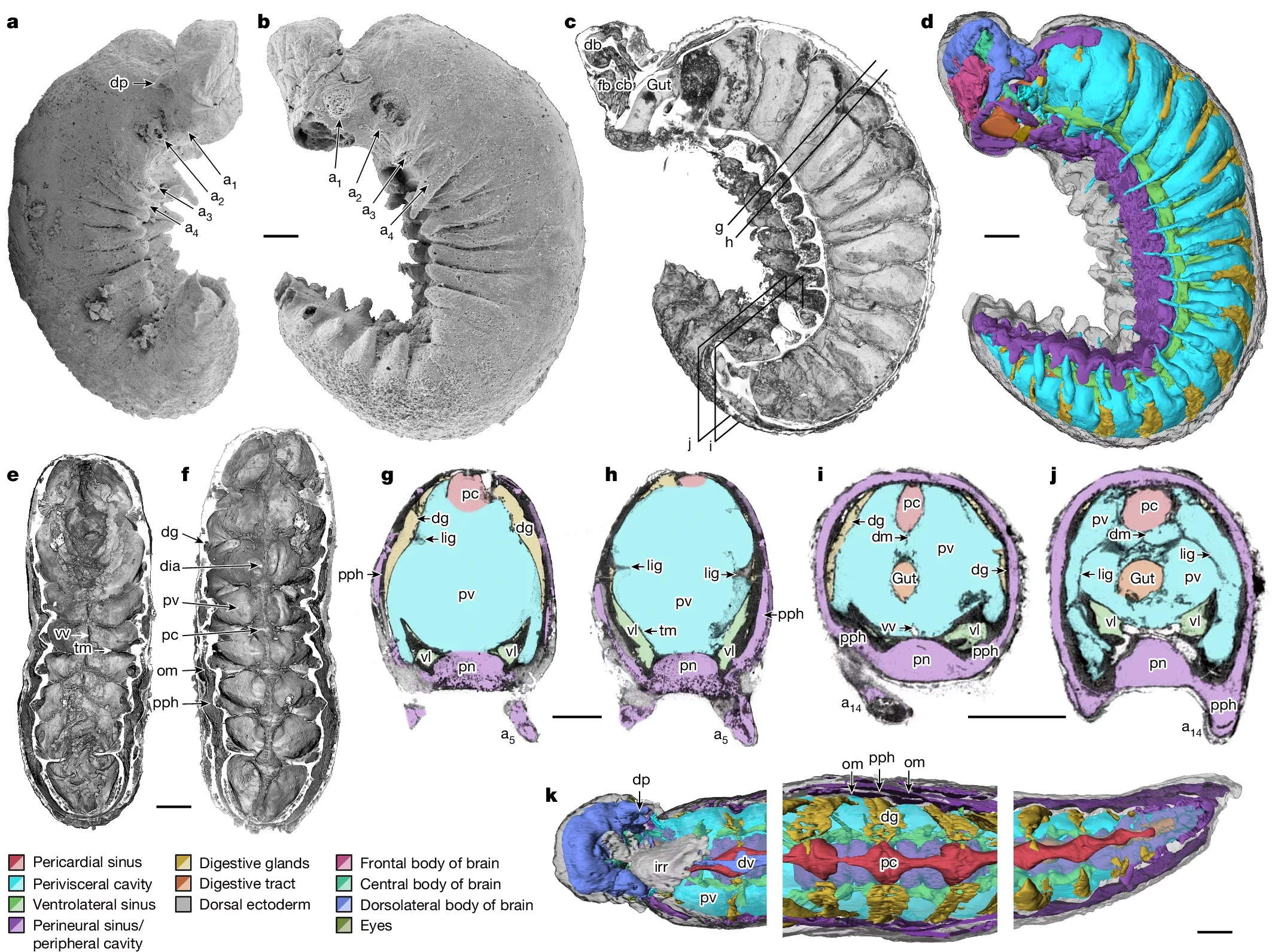
Anatomical overview of Youti yuanshi.
This fossil is transformative because it unites embryology, evolution, and the deep-time record. Soft-tissue preservation from such ancient strata is extraordinarily rare, and larval forms even more so. By capturing the internal body plan of an early arthropod, scientists can now anchor hypotheses about how segmented nervous systems, organ differentiation, and digestive complexity evolved at the dawn of animal life, refining both the timing and the anatomical pathways of early arthropod evolution.
🔗 Read Full story: People.com
4) Nearly 18,000 Dinosaur Trackways Documented in Bolivia
Bolivia’s Torotoro National Park emerged as one of the most discussed fossil stories of 2025 after researchers documented almost 18,000 dinosaur footprints, swim traces, and tail drag impressions at Carreras Pampa. The site records overlapping movements of multiple species along a Cretaceous coastal margin, preserving a behavioral fossil record on a scale rarely matched anywhere in the world. These are trace fossils, but collectively they form a “motion archive” capturing how dinosaurs walked, swam, paused, and interacted with shifting tidal flats.
What makes the find so important is not just the number of tracks but the type of tracks. Swim traces and tail drags provide direct evidence of dinosaurs moving through water, helping scientists test locomotion models and interpret mass-mortality and migration scenarios along ancient shorelines. The scale of the site also validates the growing scientific emphasis on trace fossils as behavioral data sources — not just supplements to body fossils — proving that footprints can answer questions bones never could.
🔗 Read Full story: Sci.news
5) Orange Lichens + Drone Surveys Used to Locate Fossil Bones in Canada
A 2025 study found that bright orange bone-colonizing lichens in Canadian badlands can serve as biological beacons for locating underlying dinosaur bones during drone-based surveys. The orange pigments create spectral contrasts detectable from the air, helping paleontologists rapidly target promising rocks across huge expanses of remote terrain.
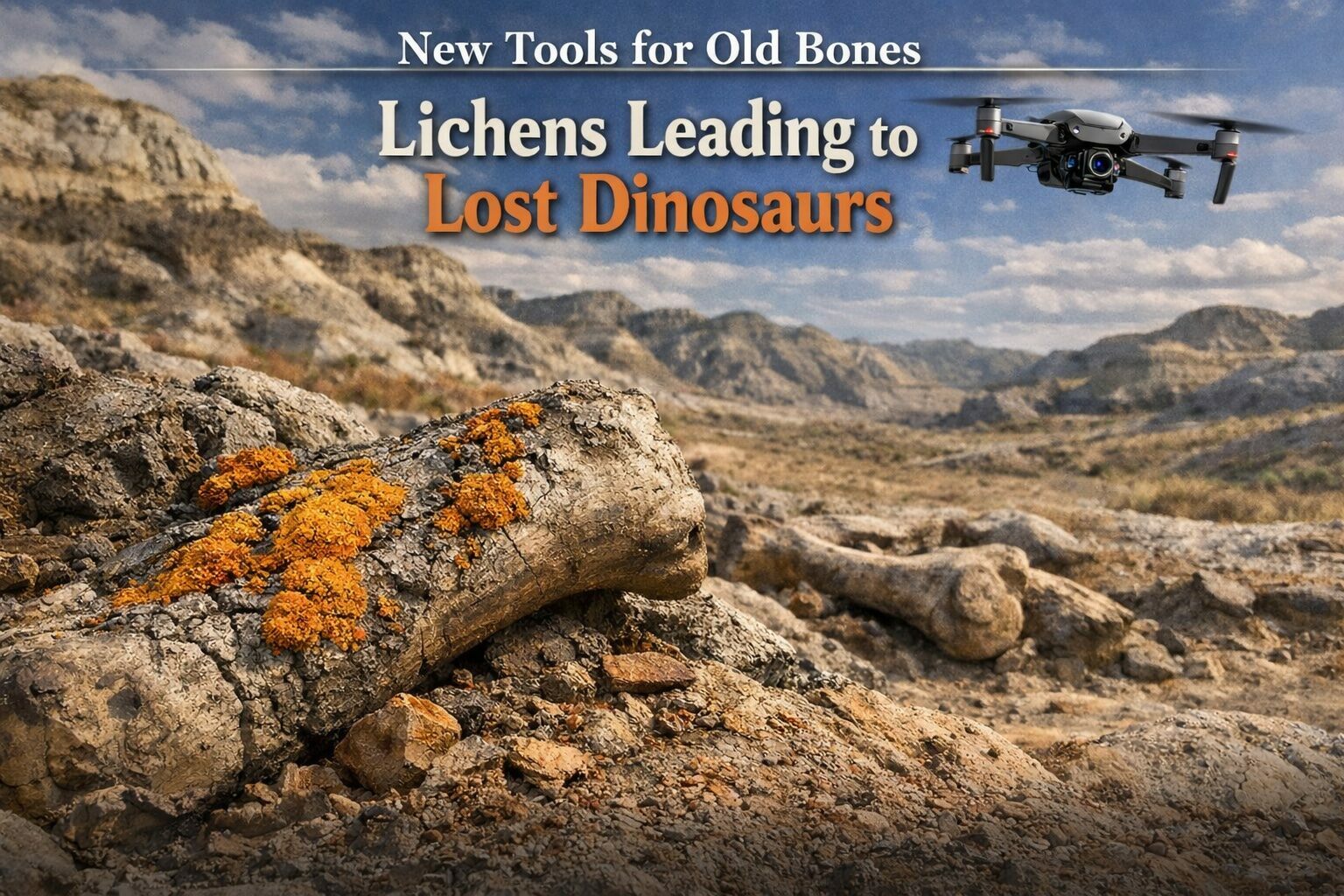
Using drones to locate lichen covered dinosaur bones.
This discovery signals a shift in field methods, blending biology, remote sensing, and paleontology. Traditional fossil prospecting is slow and ground-intensive; using lichens as “natural fossil flags” allows for faster and less invasive surveys. The method could change how paleontologists scout fossil-bearing formations in remote regions, improving discovery efficiency and reducing environmental disturbance while expanding the practical value of ecological indicators preserved in modern landscapes.
🔗 Read Full story: DiscoverWildlife.com
6) Mosasaurs Potentially Inhabited Freshwater Environments
A widely discussed 2025 paper proposed that some giant marine lizards that ruled Cretaceous oceans — may have ventured into or adapted to freshwater systems, expanding their ecological range beyond the open sea. This idea stems from new fossil associations and sedimentary contexts suggesting tolerance of lower-salinity habitats.
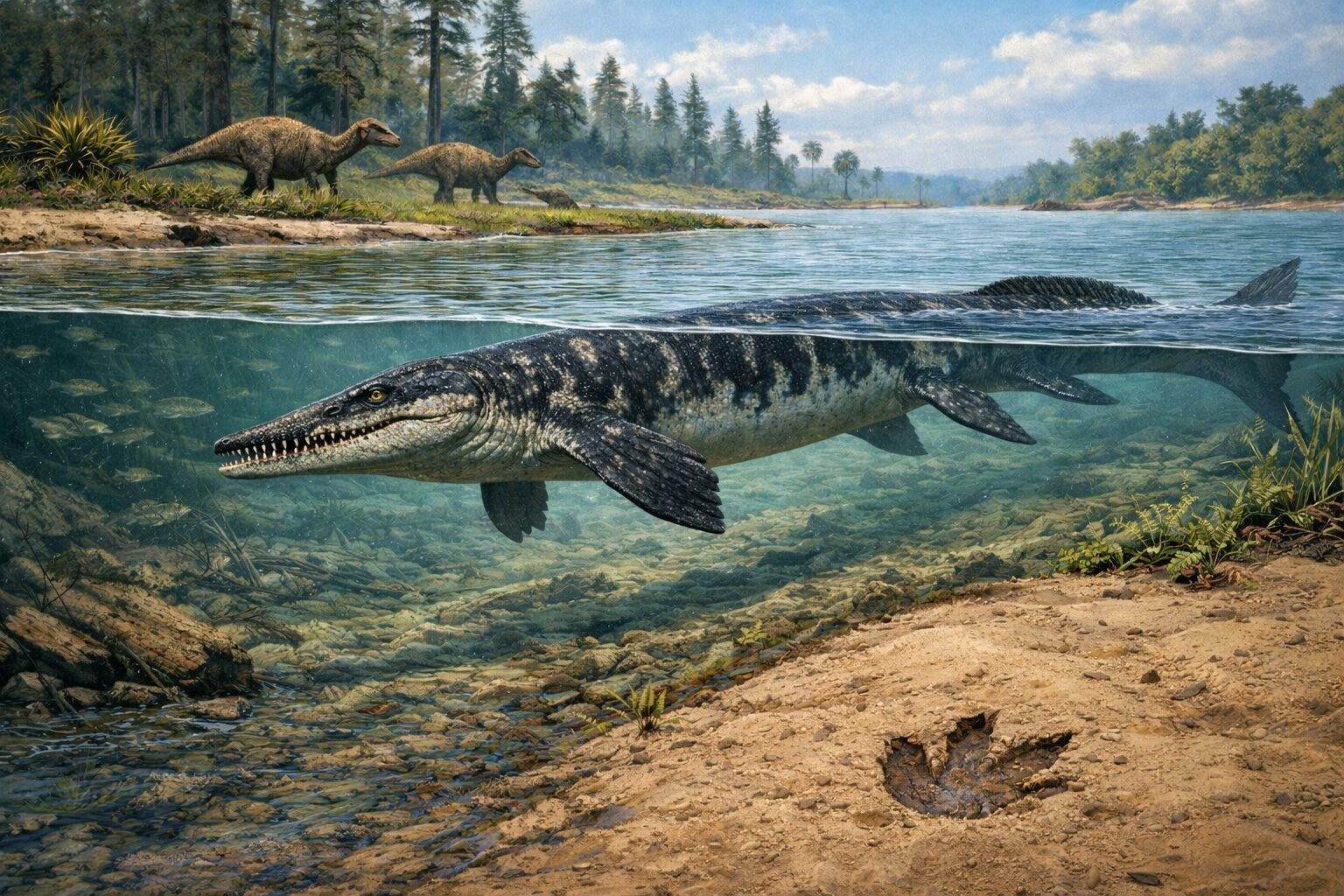
Did Mosasaurs enter fresh water Cretaceous rivers?
If validated by future discoveries, the finding changes how paleontologists interpret marine reptile dispersal and niche flexibility at the end of the Age of Dinosaurs. Mosasaurs are critical index predators for reconstructing Maastrichtian ocean ecosystems; showing they could traverse inland waterways reveals new predator-prey interactions, dispersal pathways, and ecosystem connectivity between oceans and continental interiors.
🔗 Read Full story: Sci.News
7) Ancient RNA Sequenced from 39,000-Year-Old Woolly Mammoth Tissues
Scientists extracted and sequenced ancient RNA from 39,000-year-old woolly mammoth tissues in 2025 — a breakthrough because RNA degrades much faster than DNA and almost never fossilizes. This marks one of the first successful recoveries of gene-expression material from deep time.
RNA reveals physiology, gene regulation, and cellular activity that DNA alone cannot show. This milestone pushes paleontology beyond anatomy into molecular biology, allowing future researchers to ask questions about metabolism, cold adaptation, and cellular stress in Pleistocene megafauna. It also validates that under exceptional conditions, short-lived biomolecules can survive for tens of thousands of years, opening new frontiers in molecular paleontology.
🔗 Read Full story: NPR
8) Limping Sauropod Trackway Discovered in Colorado
A looping 310-foot trackway from the Jurassic of Colorado captivated both the public and the scientific community in 2025 after analysis suggested the sauropod that made it was limping. The irregular spacing and pressure depth of the footprints form one of the clearest examples of individualized dinosaur physiology ever preserved in a single trackway, offering a rare record of injury or biomechanical stress in a giant long-necked dinosaur.
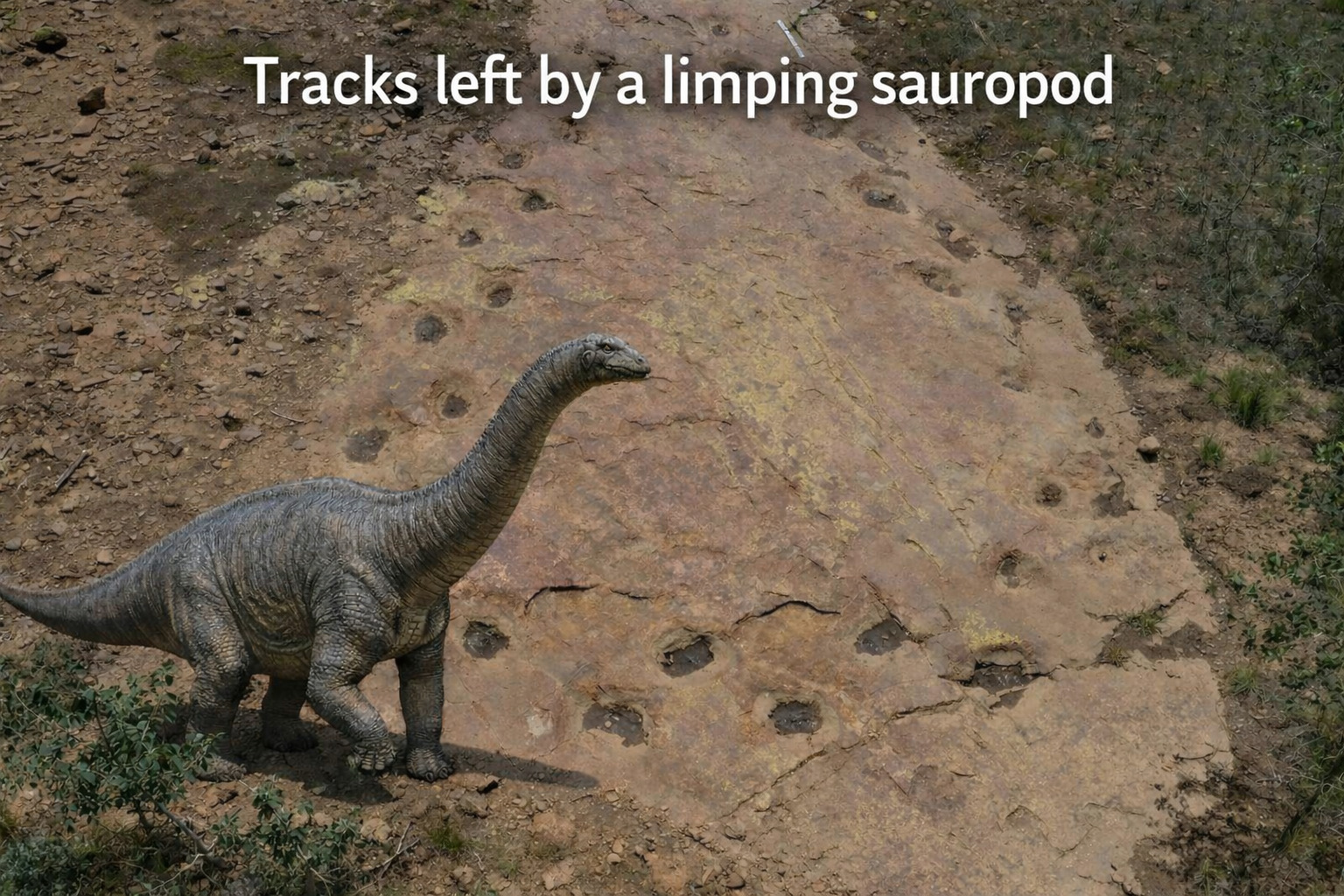
Limping Sauropod Dinosaur Trackway In Colorado
Trackways typically establish species presence, direction, or speed. This one goes further, preserving the health and movement signature of a single dinosaur. Evidence of limping gives paleontologists a chance to model gait compensation, weight distribution, and biomechanics in sauropods — animals that are otherwise known mostly from bones, not motion. It demonstrates how trace fossils can preserve not just behavior but condition, expanding the interpretive resolution of the fossil record.
🔗 Read Full story: Phys.org
9) Jurassic Petrified Forest Goes Public In India
India announced the public debut of a Jurassic fossil-wood gallery showcasing 230-million-year-old petrified logs from Telangana. These fossils record ancient conifer-rich forests that flourished soon after the breakup of Gondwana, preserved in volcanic-influenced sediments. The display represents one of the few times Jurassic forests have been documented from wood fossils dense enough to reconstruct a regional landscape-scale flora.
Large petrified forests are invaluable climate archives, recording rainfall patterns, forest density, and atmospheric conditions. This site offers data from the era when dinosaurs first rose to dominance, providing context for the vegetation that supported early dinosaur ecosystems. Bringing the fossils into museum space also democratizes access, helping both the public and researchers engage with ancient flora on a macroscopic scale rather than relying solely on microfossil cores or fragmentary plant impressions.
🔗 Read Full story: Times Of India
10) New “False Saber-Toothed Cat” (Nimravid) Species Identified in China
A new nimravid species was announced from northern China in 2025, clarifying the evolution of cat-like predators that were not true felids but filled similar apex-carnivore niches in the Oligocene. Known from jaw and tooth material, the species expands Asia’s record of early hyper-carnivorous mammals.
This find was popular because saber-tooth predators fascinate the public, but it’s scientifically important because nimravids sit outside the true cat family tree. Each new species helps researchers track how predatory specializations evolved before the rise of modern cats, refining timelines for convergent evolution in canines, feliforms, and hyper-carnivorous mammals that dominated Paleogene ecosystems.
🔗 Read Full story: Sci.News
Looking Ahead...
As explosive as 2025 was, 2026 is already primed to roar even louder. Scientists are preparing to publish new tyrannosaur growth studies that may refine predator diversity even further, while major digs in South America and Southeast Asia continue to hint at oversized species still waiting for names. Advances in fossil protein sequencing and bone micro-analysis are expected to unlock new biological details from iconic specimens, and renewed attention on ancient forests and early land plants may reveal how ecosystems rebounded after ancient climate shocks. If 2025 taught us anything, it’s that paleontology thrives on surprises — and 2026 looks ready to deliver them in abundance.