Reviews

Tyrannosaurus Rex (T-Rex) - The Last King of the Dinosaurs
Near the very end of the Age of Dinosaurs, when the world was still wild with strange giants and primeval forests stretched to the horizon, a predator walked the land that would become the most famous dinosaur of all time. Tyrannosaurus rex—the “tyrant lizard king”—was not merely another carnivore in the prehistoric record. It was the final, towering monarch of the Cretaceous, an apex predator so powerful and iconic that it has come to represent dinosaurs themselves in the human imagination.
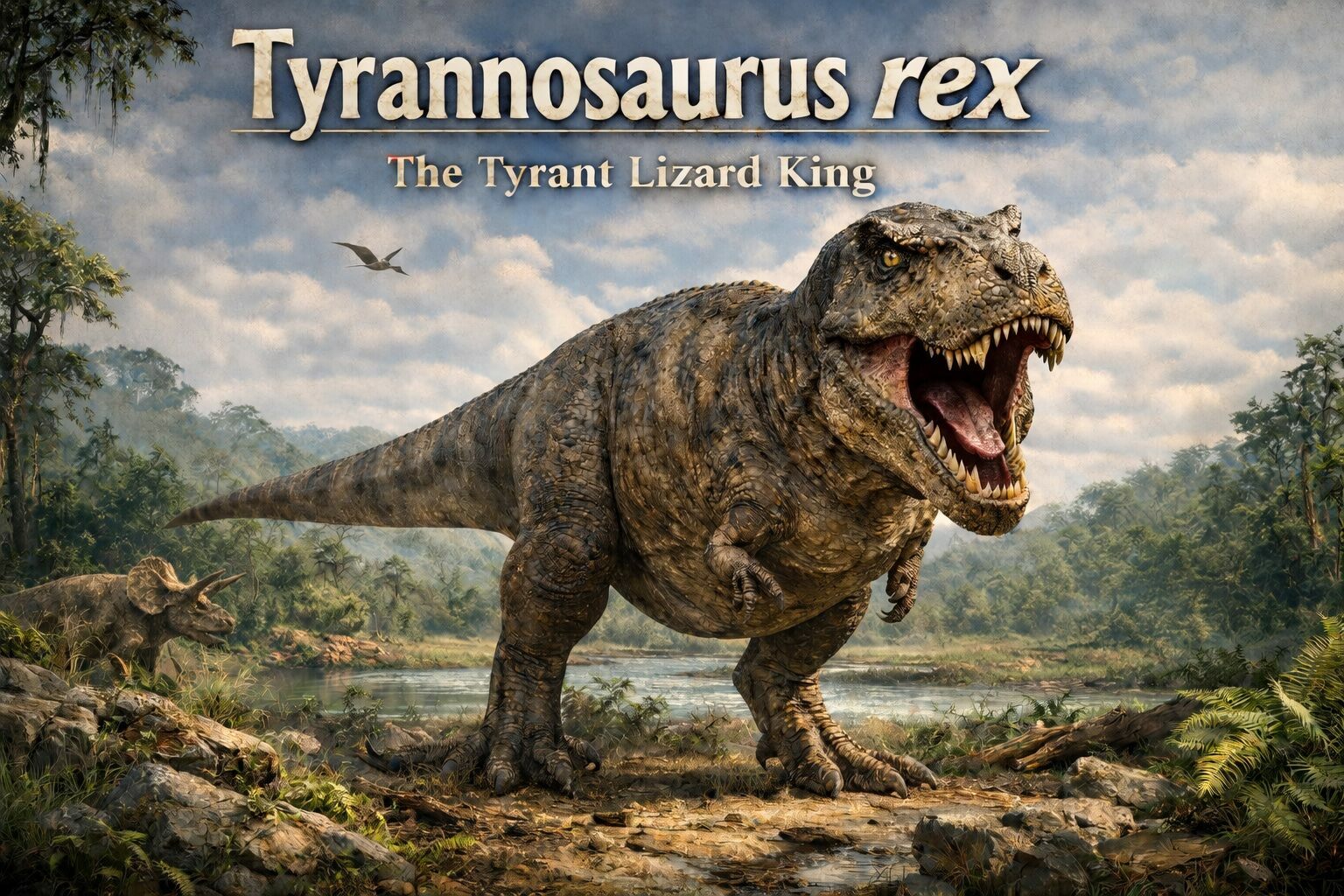
T. rex lived roughly 68 to 66 million years ago, during the last two million years of the dinosaurs’ reign, just before a catastrophic asteroid impact ended the Mesozoic Era forever. It ruled over what is now western North America, a landscape of humid river valleys, swampy floodplains, and lush subtropical forests teeming with life. This was a world of enormous prey animals: herds of duck-billed Edmontosaurus, heavily armored Ankylosaurus, and the legendary horned giant Triceratops, one of the few creatures capable of standing its ground against the tyrant king.
What made Tyrannosaurus rex so extraordinary was not just its size, though it was immense. Adults stretched more than 40 feet long, stood as tall as a second-story window at the hips, and weighed as much as an elephant—possibly even more in the largest individuals. But its true power came from its design: a predator built for domination. Its skull was a masterpiece of natural engineering, massive yet reinforced with strong bone struts, and armed with teeth that were not delicate blades but thick, crushing spikes. Some of these teeth reached over a foot in length, designed not only to slice flesh but to shatter bone.
The bite of T. rex may have been the most powerful of any land animal that ever lived. Modern studies estimate it could exert forces exceeding 12,000 pounds, enough to pulverize the bones of prey and leave deep puncture marks still visible on fossilized skeletons today. In fact, paleontologists have found Triceratops bones with healed bite wounds—evidence that some victims survived attacks, offering a rare glimpse into real predator-prey struggles from deep time.
Despite its terrifying reputation, Tyrannosaurus rex was not simply a brute. It was also highly intelligent by dinosaur standards and equipped with exceptional senses. Its forward-facing eyes gave it strong depth perception—similar to a hawk or a big cat—making it a precise hunter. Even more impressive was its sense of smell, which may have been among the most powerful ever recorded in a terrestrial animal. Some researchers believe T. rex could detect carcasses or prey from miles away, meaning it likely played a dual role as both hunter and scavenger, dominating its ecosystem in every possible way.
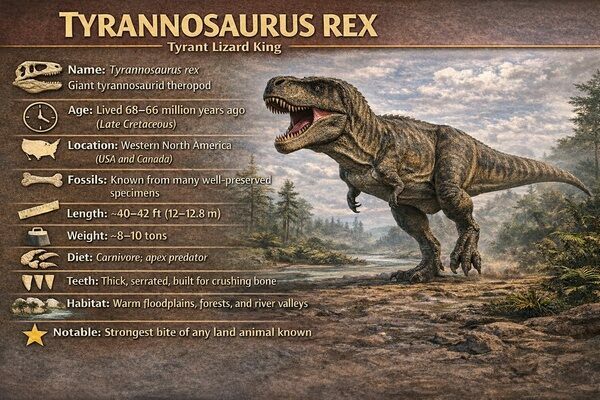
T-Rex Infographic
And then there are its famously small arms—perhaps the most joked-about feature in dinosaur history. Yet those arms were far from useless. Each was packed with muscle and ended in two strong claws, capable of gripping with surprising force. The tyrant’s real killing tools, however, were its jaws, neck, and immense body, which made it one of the most formidable predators evolution ever produced.
The story of Tyrannosaurus rex began not in the Cretaceous, but in the dusty badlands of the American West during the early 20th century. In 1902, fossil hunter Barnum Brown, working for the American Museum of Natural History, uncovered the first major remains in Montana. A few years later, in 1905, paleontologist Henry Fairfield Osborn officially named the species Tyrannosaurus rex. The name itself was dramatic and unforgettable, and it instantly captured public fascination.
Since then, T. rex has become one of the best-studied dinosaurs in history. Spectacular skeletons like “Sue”, “Stan”, and “Scotty” have revealed astonishing details: healed injuries from violent battles, evidence of rapid teenage growth spurts, and even hints that tyrannosaurs may have interacted socially. Each new fossil discovery reshapes what we know, reminding us that this animal was not a movie monster, but a living, breathing apex predator at the very edge of extinction. Tyrannosaurus rex was the last great king of the dinosaurs—an evolutionary masterpiece, a ruler of a lost world, and one of the most awe-inspiring creatures ever to walk the Earth.
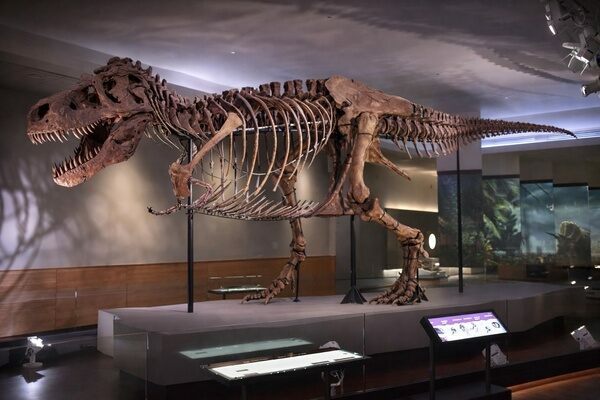
A skeleton of "Sue" the T-Rex on display at the Chicago Field Museum.
The discovery of Tyrannosaurus rex is inseparable from one of the most thrilling chapters in the history of paleontology—a time when the American West was still a rugged frontier and dinosaur fossils were being uncovered at an unprecedented pace. The late 19th and early 20th centuries were an era of fossil fever, when museums competed fiercely to find and display the largest and most dramatic prehistoric creatures ever known.
Long before T. rex was officially named, fragmentary bones from giant carnivorous dinosaurs had been found across North America, but scientists often struggled to understand exactly what they belonged to. Early discoveries of large theropods were sometimes misidentified or assigned to other genera because paleontology was still a young science. Dinosaurs were known to be ancient reptiles, but the true diversity and scale of these animals was only beginning to emerge.
The earliest fossils that may have belonged to Tyrannosaurus were uncovered in the 1890s. In 1892, paleontologist Edward Drinker Cope, one of the central figures of the infamous “Bone Wars,” described a couple of large vertebrae and named them Manospondylus gigas. At the time, no one realized these bones represented what would later be recognized as Tyrannosaurus rex. The remains were too incomplete, and the dinosaur world was still poorly understood.
It would take another decade before the tyrant king began to step into the scientific spotlight.
The true story of Tyrannosaurus rex began in 1902, when legendary fossil hunter Barnum Brown—often called one of the greatest dinosaur collectors of all time—was working in the badlands of Montana for the American Museum of Natural History in New York. Brown uncovered the remains of a massive carnivorous dinosaur unlike anything previously known. The bones were enormous: parts of a skull, teeth, vertebrae, and limb elements that suggested an animal far larger than earlier theropods such as Allosaurus. Brown returned in 1905 and discovered even more substantial remains, confirming that this predator was something extraordinary.
At first, however, this dinosaur was not immediately recognized under the famous name we know today. When Henry Fairfield Osborn—museum president and one of the most influential paleontologists of his era—first studied the initial material, he believed it belonged to a different species. In an earlier description, Osborn assigned some of the remains to a dinosaur he called Dynamosaurus imperiosus, meaning “powerful lizard emperor.” It was only after additional fossils were recovered and compared that Osborn realized these bones represented the same remarkable predator.
Later in 1905, Osborn officially renamed and reclassified the animal as Tyrannosaurus rex, the “tyrant lizard king”. The name was intentionally dramatic, and it perfectly captured the public imagination. From the very beginning, T. rex was viewed not just as another dinosaur, but as the ultimate carnivore—the pinnacle of predatory evolution.
The American Museum of Natural History quickly mounted a skeleton, and Tyrannosaurus rex became a star attraction almost overnight. Unlike many dinosaurs known only from scattered bones, T. rex was represented by increasingly complete fossil material, giving scientists a rare opportunity to piece together its massive frame. Its enormous skull, powerful jaws, and towering height captured both scientific curiosity and public imagination, cementing its place as one of the most famous prehistoric predators ever discovered.
During the early decades of the 20th century, however, much of what people believed about T. rex was still speculative. It was often portrayed as an upright, tail-dragging monster—an image that dominated museum displays, films, and popular culture for generations. As paleontology advanced, new fossil finds and improved research techniques gradually transformed that outdated view. Over time, scientists revealed a more dynamic and lifelike animal, reshaping our understanding of this iconic dinosaur and ensuring its legend continued to evolve.
The late 20th century brought a golden age of Tyrannosaurus research, fueled by spectacular fossil finds. One of the most important discoveries occurred in 1990, when fossil hunter Sue Hendrickson uncovered the most complete adult T. rex skeleton ever found in South Dakota. The specimen, later nicknamed “Sue,” was about 90% complete and revealed unprecedented details about tyrannosaur anatomy, injuries, and growth. Sue showed that T. rex lived a violent life: broken ribs, infected wounds, and signs of trauma hinted at battles with prey—or even with other tyrannosaurs.
Other famous specimens soon followed:
“Stan”, discovered in 1987, provided one of the best-preserved skulls and helped scientists study bite mechanics and facial injuries.
“Scotty,” discovered in Canada, may represent the largest known T. rex by mass, proving these animals could grow even bigger than once believed.
Each new skeleton added depth to the tyrannosaur story, revealing variation among individuals and offering clues about their biology.
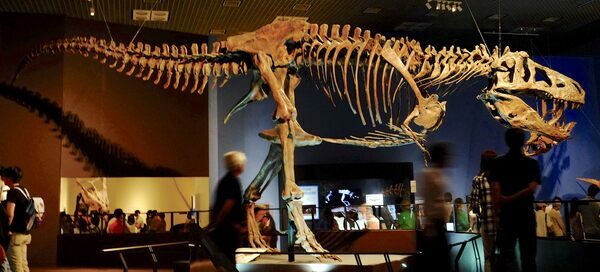
A cast of Scotty the largest known T-Rex.
The body of Tyrannosaurus rex was not simply large—it was a masterpiece of evolutionary design. Every part of its anatomy, from its massive skull to its thickened tail, reveals an animal shaped by millions of years of natural selection into one of the most formidable predators ever to walk on land.
The most striking feature of Tyrannosaurus rex was its enormous skull, which could exceed five feet (1.5 meters) in length. This skull was not only large—it was extraordinarily strong. The bones of the skull were fused and reinforced with thick struts, allowing it to withstand tremendous stresses during feeding. At the same time, the skull contained large openings, or fenestrae, which reduced weight without sacrificing strength. This combination of power and efficiency is often compared to modern engineering designs such as bridges or aircraft frames.
The jaws were deep and muscular, capable of delivering the most powerful bite force ever measured in a terrestrial animal. Unlike predators such as Allosaurus, which had thinner, blade-like teeth for slicing flesh, T. rex had teeth designed for crushing. The teeth of Tyrannosaurus rex were legendary—thick, conical, serrated, and built to endure enormous pressure. Some of the largest teeth reached over 12 inches (30 cm) in total length, including the root.
Rather than acting like knives, these teeth functioned more like railroad spikes. They could puncture prey, tear away chunks of flesh, and even crush bone. Fossil evidence shows that T. rex routinely bit through the ribs, hips, and skulls of its prey, leaving behind tooth marks that can still be studied today. In fact, tyrannosaur coprolites—fossilized dung—have been found containing pulverized bone fragments, proving that T. rex digested bone as part of its diet.
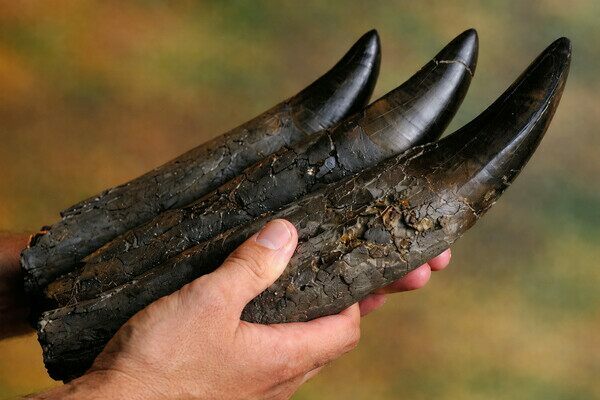
Bananas Of Death: Including the root, T-Rex teeth can be up to a foot long.
Behind the skull was an incredibly powerful neck. T. rex did not rely on delicate jaw movements. Instead, it likely used its entire head and neck as a brutal feeding apparatus. Massive neck muscles anchored to strong vertebrae allowed the animal to wrench its head backward, tearing flesh from carcasses. Some paleontologists compare this feeding motion to that of modern crocodilians, though on a far larger scale. The neck was essentially the engine that powered the tyrant’s bite, helping transform the skull into a bone-crushing weapon.
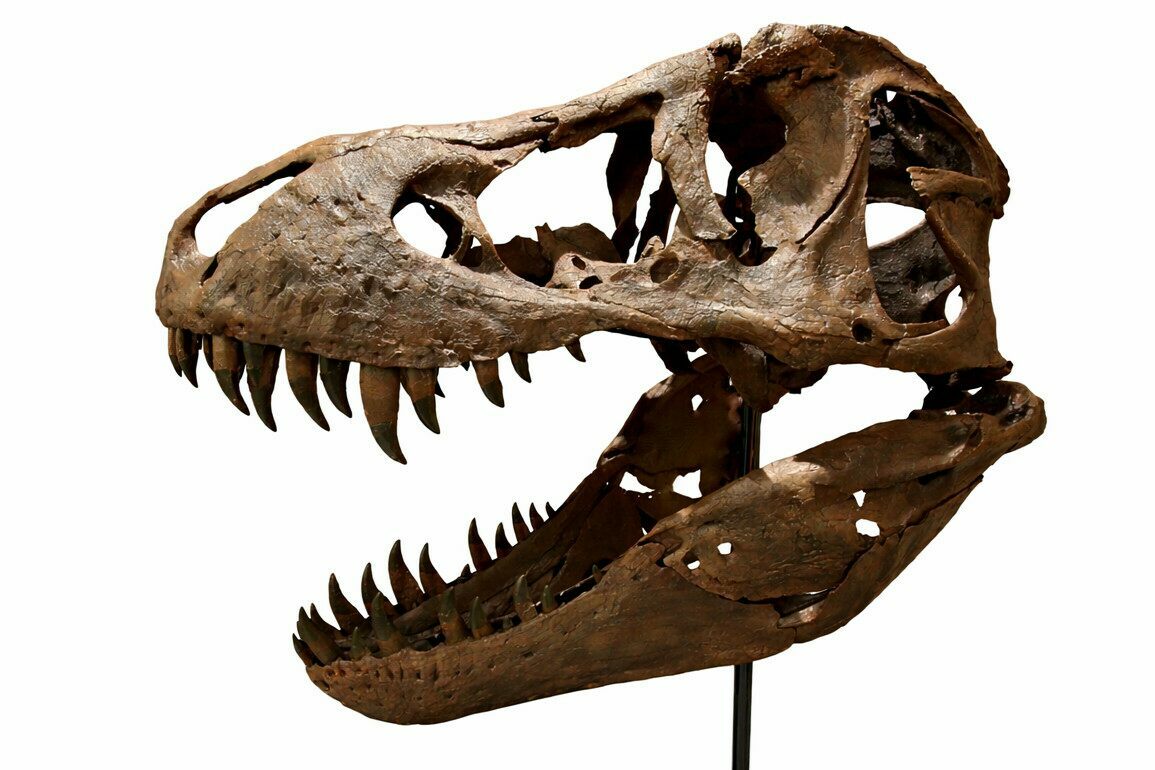
Tyrannosaurus rex wasn’t just a giant set of jaws—it was a sensory specialist. Paleontologists know this because fossil skulls preserve clues about the brain and senses. CT scans of T. rex skulls allow scientists to create digital endocasts, revealing which brain regions were most developed. In tyrannosaurs, the areas linked to smell and vision are especially large.
Its forward-facing eyes are obvious from the angle of the eye sockets, which point inward rather than outward. That arrangement creates strong binocular overlap, giving T. rex excellent depth perception. Researchers have even modeled its field of view and found it may have rivaled modern birds of prey, an advantage for judging distance when striking prey with a single bite.
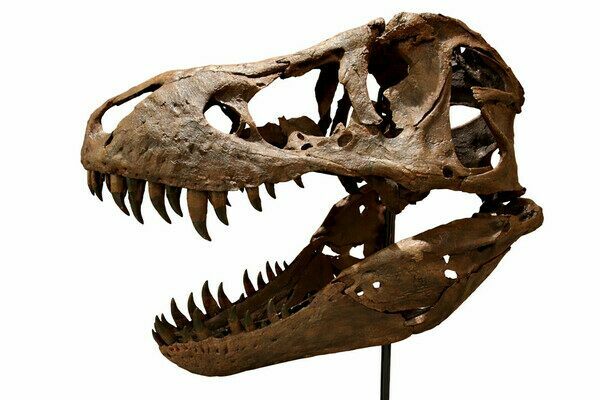
The skull of "Stan" the T-Rex
Smell may have been even more impressive. Endocasts show huge olfactory bulbs, the brain structures that process scent. In living animals, enlarged olfactory bulbs correlate closely with powerful smell, so scientists infer that T. rex could detect odors at great range. Its large, complex nasal cavity also suggests plenty of space for scent-detecting tissue.
All of this paints a picture of an apex predator that was not only strong, but highly aware—able to spot prey, judge distance, and likely locate carcasses or wounded animals from far away. T. rex dominated its world through brains and senses as much as brute force.
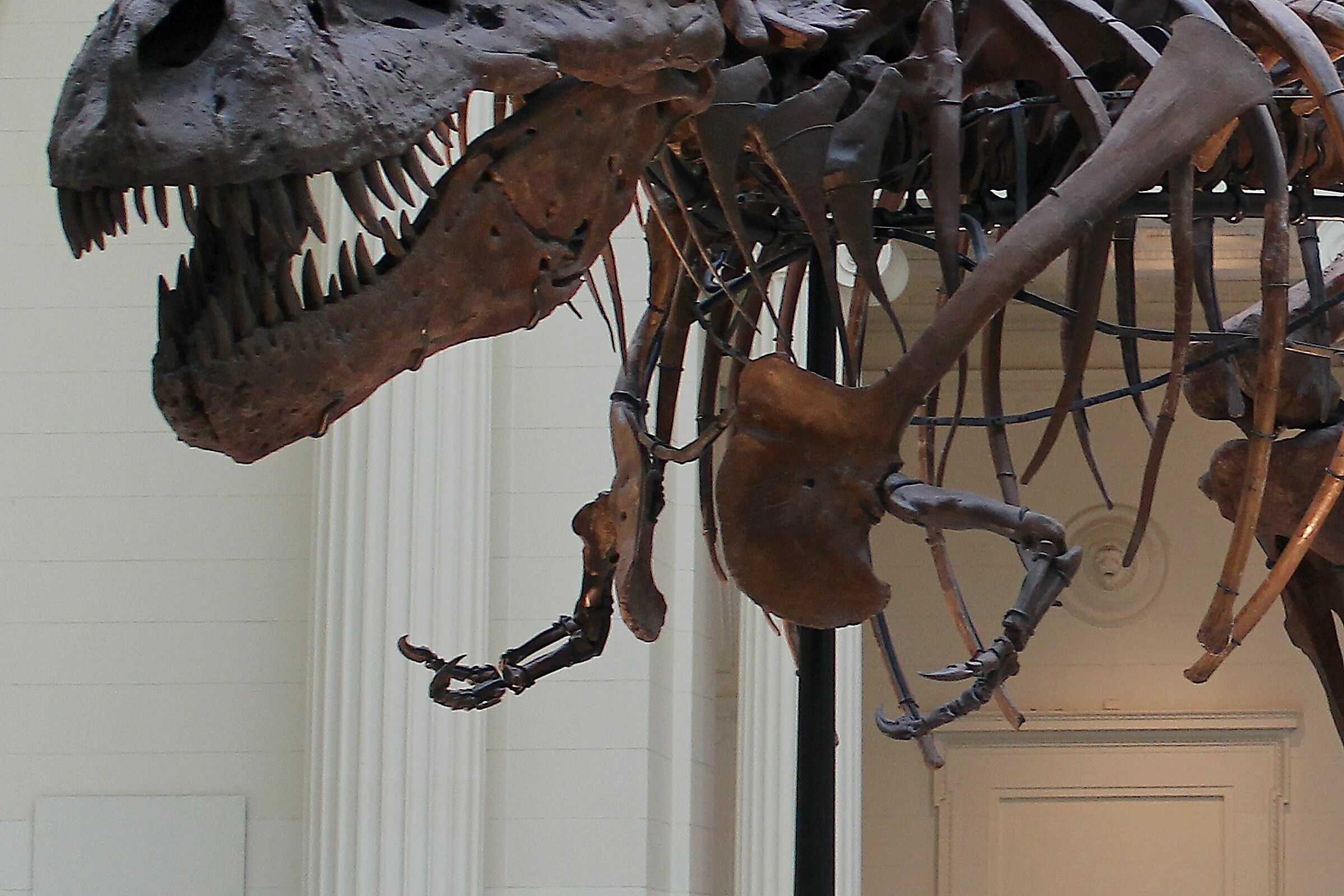
No anatomical feature of Tyrannosaurus is more famous—or more misunderstood—than its tiny arms. While comically short in proportion to its body, the arms were far from weak. Each forelimb was packed with muscle and ended in two clawed fingers. Studies suggest these arms could lift several hundred pounds. They may have been used for:
Gripping struggling prey at close range
Holding onto mates during reproduction
Helping the animal rise from the ground
Rather than being useless, the arms were simply no longer the tyrant’s primary weapon. Evolution had shifted the killing role almost entirely to the jaws.
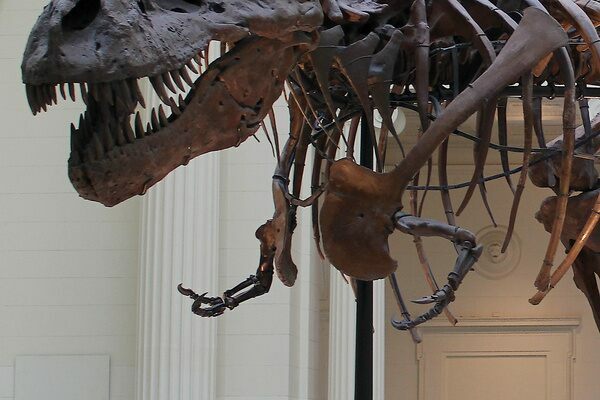
A look at the itty, bitty arms on Sue the T-Rex.
T. rex had a deep, broad torso, giving it a “barrel-chested” appearance. This body shape supported enormous internal organs and powerful muscles. The ribcage was thick, and the entire body was built for strength rather than speed. Unlike slimmer predators, Tyrannosaurus was a heavyweight brawler—capable of wrestling down large prey with sheer mass. This robust build also suggests a high-energy lifestyle requiring substantial food intake, which explains why it targeted the largest herbivores of its environment.
The hind limbs of T. rex were long, muscular, and designed for efficient movement. Each step was powered by massive thigh muscles, allowing the animal to walk with authority across its territory. While early depictions imagined T. rex sprinting at extreme speeds, modern biomechanics suggest it was not a fast runner. Instead, it was likely capable of moderate speeds—perhaps 15–20 mph—more than enough for ambush attacks against massive prey. Its feet were equipped with strong toes and claws for traction, and its body was balanced perfectly over the hips.
One of the most important anatomical features of T. rex was its long, thick tail. Far from being a dragging appendage, the tail acted as:
A counterbalance to the heavy skull
An anchor for massive leg muscles
A stabilizer during movement
The tail made Tyrannosaurus a perfectly balanced predator, able to move with surprising agility despite its size.
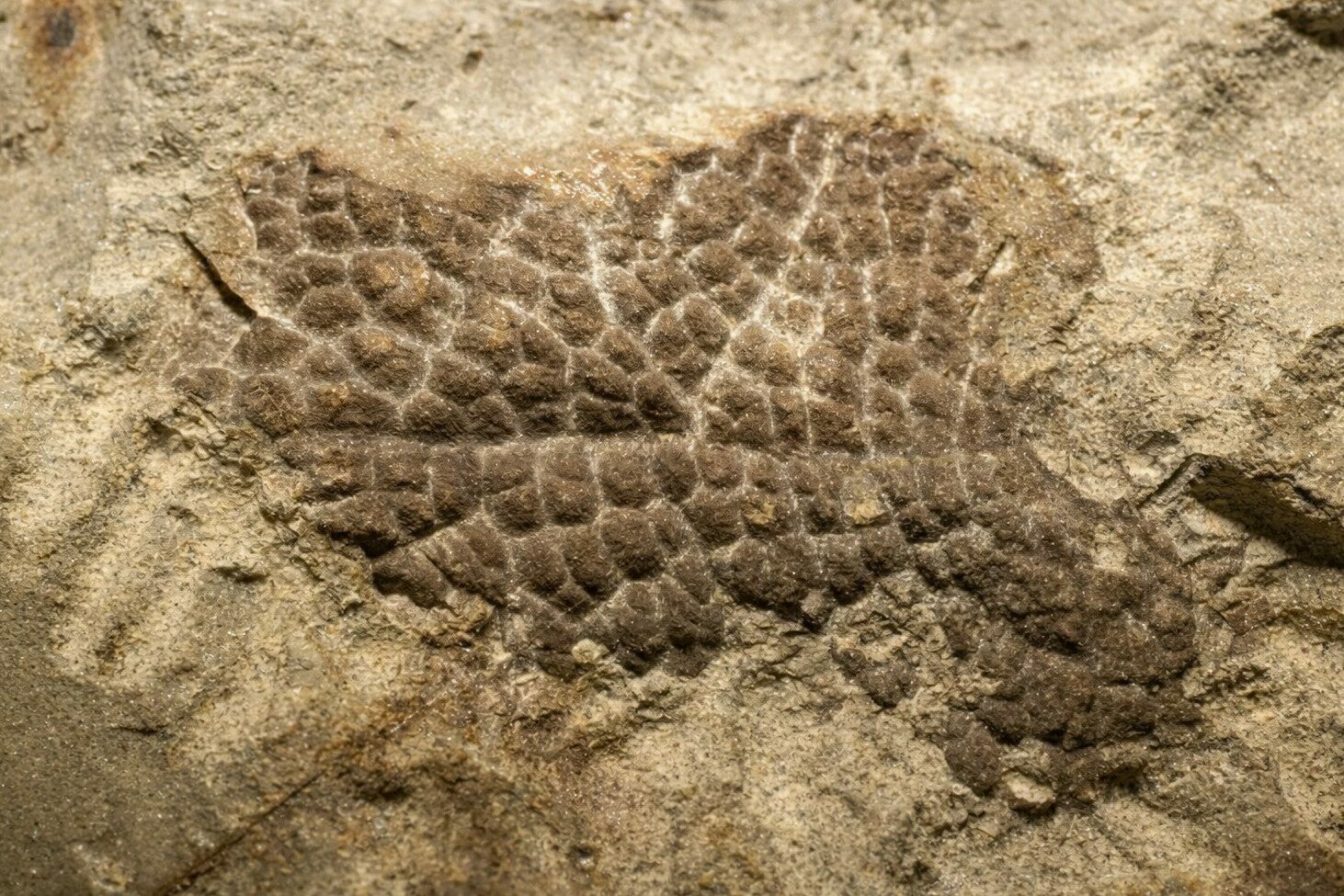
We know that many of T. rex’s close relatives—especially smaller tyrannosaurs like Dilong and Yutyrannus—were covered in feathers or feather-like filaments. These discoveries strongly suggest that feathers were common within the tyrannosaur family, at least early in their evolutionary history. However, the evidence for T. rex itself is more complicated. Several fossil specimens of large tyrannosaurs preserve skin impressions, and these show a surface covered in scales rather than feathers. These patches of scaly skin come from different parts of the body, implying that adult T. rex was not fully feathered like some of its smaller cousins.
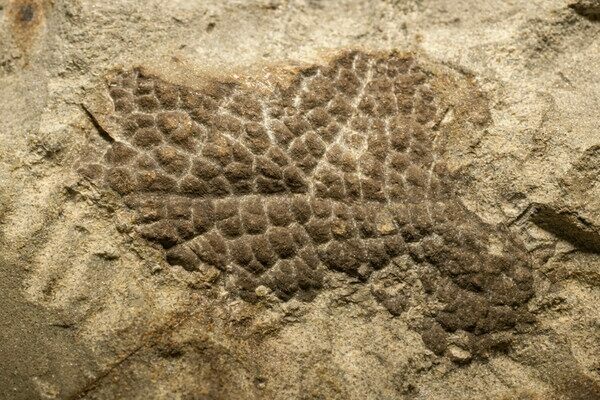
Fossilized skin from the neck of a Tyrannosaurus rex, showing its scaly texture. — Black Hills Institute of Geological Research
Because of this, most scientists currently think that fully grown T. rex was probably mostly scaly, especially across much of its body. That said, it is still possible that juveniles—or even adults in certain regions like the neck or back—may have had a light coating of downy fuzz. Young animals often need more insulation, and a partial feather covering could have helped smaller, growing tyrannosaurs retain body heat.
In the end, the question remains open. As new fossils are discovered and new techniques are developed to study skin and soft tissue, the mystery of whether the “tyrant king” wore feathers, scales, or a mix of both continues to be one of the most exciting areas of dinosaur research today.
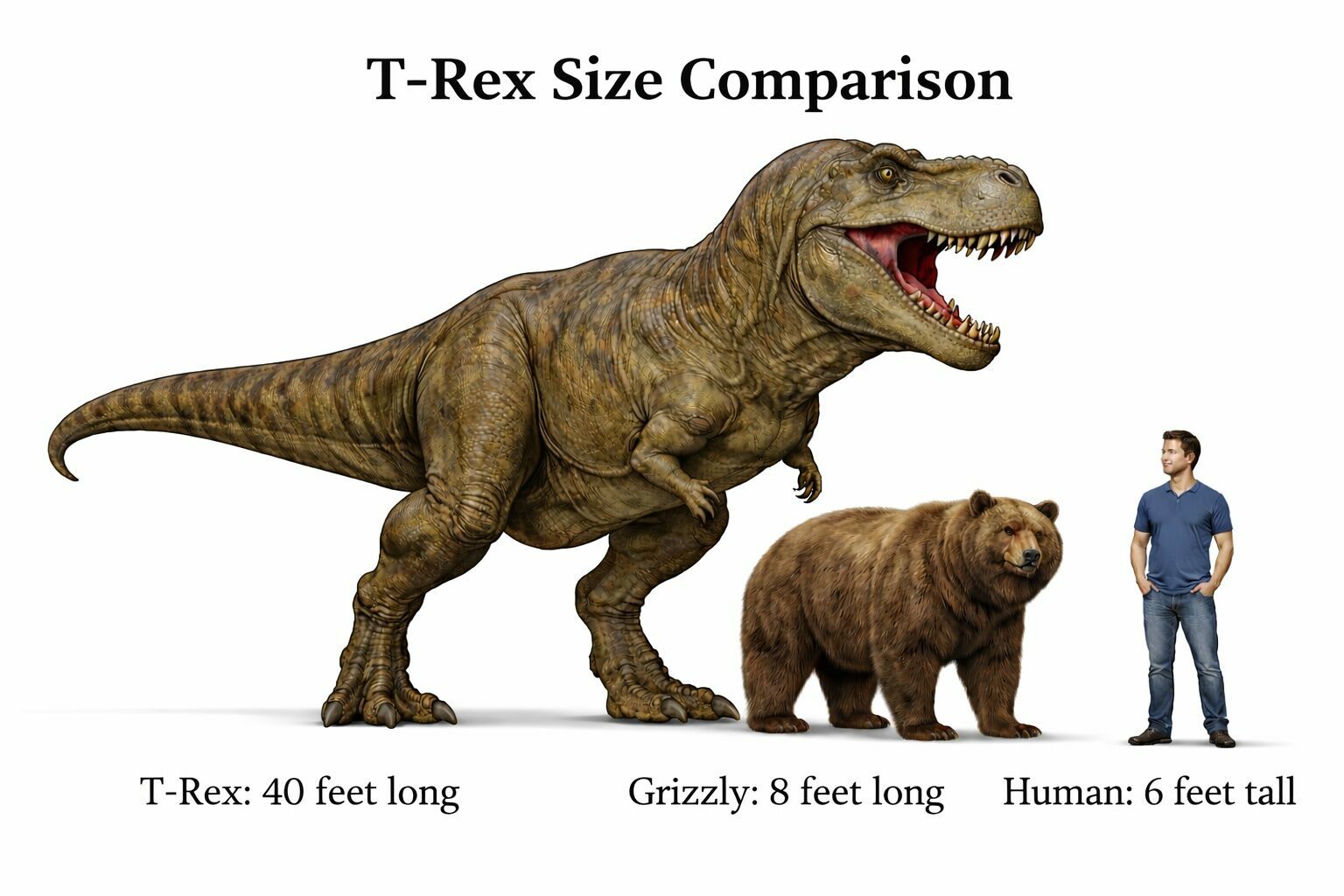
Tyrannosaurus rex was not just a top predator—it was truly a giant, ranking among the largest land carnivores to ever walk the Earth. Even by dinosaur standards, its size was extraordinary. Fully grown adults measured about 40–43 feet long (12–13 meters), roughly the length of a modern city bus or a large semi-truck with its trailer. Standing at the hips, T. rex reached 12–13 feet tall (3.5–4 meters), meaning its head could tower over most humans even without lifting its neck. In sheer mass, estimates place it around 8–10 tons, with the biggest individuals possibly weighing even more—about as heavy as a large African elephant or two full-sized pickup trucks.
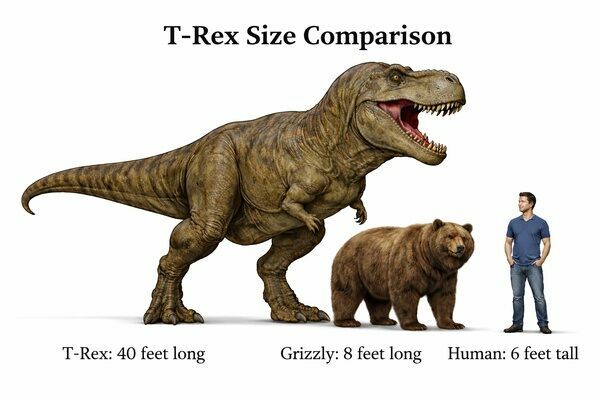
T-Rex size compared to a grizzly bear and human.
To put that into perspective, if a T. rex were standing beside a grizzly bear, the bear would barely reach its hip. And compared to modern predators like lions or crocodiles, T. rex was operating on an entirely different scale.
Its size was matched by one of the most fearsome weapons in the history of life: its jaws. The bite force of T. rex may have exceeded 12,000 pounds, far greater than any living land animal today. For comparison, a lion’s bite force is around 650 pounds, and even the massive saltwater crocodile reaches “only” about 3,700 pounds. T. rex’s bite was powerful enough to crush bone, shatter thick dinosaur limb shafts, and leave deep puncture wounds that are still visible in fossilized prey remains. This combination of immense size, muscular build, and bone-crushing bite made Tyrannosaurus rex one of the most dominant and intimidating predators the planet has ever produced.
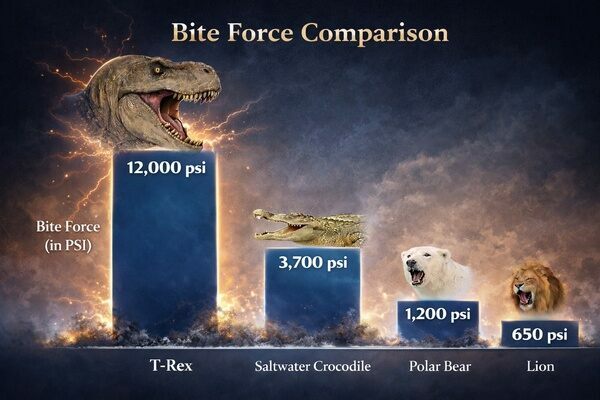
T-Rex bite force compared to a crocodile, polar bear and lion.
Few questions about Tyrannosaurus rex capture the imagination quite like this one: could the tyrant king actually run? For more than a century, popular culture has portrayed T. rex as a thunderous, sprinting monster, charging across the landscape at highway speeds and shaking the earth with every footfall. Films and documentaries have often shown it racing after prey with terrifying agility, a living avalanche of muscle and teeth. That image is thrilling—but the truth, as paleontology so often reveals, is far more complex, and arguably even more interesting.
To understand Tyrannosaurus speed, you first have to picture what this animal truly was. T. rex was not a sleek pursuit predator like a cheetah, built for lightness and rapid acceleration. It was a multi-ton heavyweight, closer in build to a tank than a sprinter. An adult could weigh as much as an elephant, carrying that enormous mass on two pillar-like hind limbs while balancing an immense skull at the front of its body like a wrecking ball. The question, then, is not simply whether it could move quickly. The deeper question is whether an animal of that size could run at high speed without risking catastrophic injury.
Early reconstructions of dinosaurs didn’t help. In the early 20th century, Tyrannosaurus was often depicted standing upright like a kangaroo with its tail dragging behind, which made it seem slow and awkward. Later, as scientists recognized that dinosaurs held their bodies horizontally, the image flipped dramatically. Now T. rex was imagined as a fast-moving predator capable of chasing down hadrosaurs in open pursuit. For decades, speculation about its speed ran wild, with some estimates suggesting it could reach more than 30 miles per hour. But speculation is not evidence, and modern paleontology approaches the problem very differently.
The greatest limiting factor on Tyrannosaurus speed is its sheer size. Running is not just “moving faster”—it is repeatedly launching your body into the air and catching yourself again with every stride. For small animals, this is easy. For a predator weighing nine or ten tons, it becomes extremely dangerous. The forces placed on bones, joints, and muscles during high-speed running would have been immense, and a fall at full speed could have been catastrophic, potentially fatal. For an apex predator, a broken leg is often a death sentence. Researchers have calculated that at extreme speeds, the stresses on a tyrannosaur’s legs might exceed what bone could safely withstand. In other words, the tyrant king may simply have been too heavy to sprint like the monsters of Hollywood.
In recent decades, scientists have turned to biomechanics, physics, and computer simulations to estimate what was actually possible. These models account for muscle mass, stride length, body weight, balance, and the mechanical limits of bone strength. Most modern studies suggest that adult T. rex was not a high-speed runner, but instead likely capable of reaching speeds somewhere between 10 and 20 miles per hour, perhaps slightly more in short bursts. That may sound modest compared to movie portrayals, but in reality it is still terrifying. A creature the size of Tyrannosaurus moving faster than a human can sprint, armed with jaws powerful enough to crush bone, did not need to be a racehorse to be deadly. T. rex wasn’t built for long chases—it was built for power, efficiency, and dominance, a predator that only needed to catch you once.
Tyrannosaurus rex didn’t start life as a giant. Like many large animals, it went through dramatic changes as it matured—transforming from a relatively small hatchling into one of the most massive land predators ever known. Paleontologists study growth patterns by examining annual growth rings preserved in fossil bones, similar to the rings seen in trees. These rings allow scientists to estimate how old an animal was when it died and how quickly it grew. For years, researchers believed that T. rex reached its full adult size by around 25 years of age based on earlier growth ring counts.
However, new research published in 2026 has revised this timeline significantly. By analyzing 17 T. rex specimens—from juveniles to enormous adults—and using advanced statistical modeling, researchers have found that T. rex likely continued growing **well into its late 30s, reaching full size at around 35–40 years old. This means that the growth phase of these dinosaurs was longer and more gradual than previously thought, with a prolonged subadult stage before their bones stopped accumulating major new mass.
Despite this extended growth period, T. rex did experience a phase of rapid weight gain during its teenage years—especially between approximately ages 14 and 29—when individuals could put on hundreds to over a thousand pounds per year. During this phase, juveniles were lighter, more agile, and likely occupied a different ecological niche than adults. As growth slowed in later years, their bodies became more robust and adapted to the role of apex predator.
Interestingly, growth rates may have fluctuated depending on resource availability and environmental conditions. Some years of sparse food likely slowed growth, while richer conditions accelerated it—a kind of flexible strategy that would have helped T. rex survive through changing ecosystems.
To imagine the life of Tyrannosaurus rex is to imagine dominance, but also constant struggle. This was not a fantasy monster roaming endlessly victorious through the Late Cretaceous. It was a real animal, bound by the same rules of survival as every other living thing. Its world was one of danger, competition, hunger, and injury, and every day was shaped by a single, unforgiving truth: to remain the apex predator, it had to eat. Failing to secure food meant weakness, and weakness—especially for an animal of such immense size—could be fatal.
The Late Cretaceous landscape was rich in enormous herbivores, but none of them were easy prey. Tyrannosaurus shared its environment with some of the most heavily defended animals that ever walked the Earth. Triceratops carried long, lethal horns and a massive bony frill that could absorb tremendous punishment. Ankylosaurs were living tanks, wrapped in armor and armed with tail clubs capable of shattering bone. Even the duck-billed hadrosaurs, which lacked obvious weapons, were powerful animals that often traveled in herds and could easily overwhelm a predator through sheer size and numbers. For Tyrannosaurus, hunting was never a casual act—it was a high-risk confrontation between giants where a single mistake could lead to serious injury or death.
Modern evidence paints Tyrannosaurus as both hunter and scavenger, a predator that took advantage of every opportunity available. For much of the 20th century, scientists fiercely debated whether T. rex was an active killer or merely a lumbering scavenger living off the work of others. Today, that argument has largely faded. The reality is far more realistic, and far more compelling: Tyrannosaurus was almost certainly both. It possessed all the tools of a hunter—forward-facing eyes that provided depth perception, powerful legs for closing distance, and jaws built to kill—but it also had the senses of a scavenger, especially an extraordinary sense of smell. Its massive olfactory system suggests it could detect carcasses from miles away, and in a world where a single dead dinosaur represented tons of meat, ignoring scavenging would have been wasteful. When Tyrannosaurus arrived at a carcass, few animals could challenge it. Intimidation alone may have been enough to drive smaller predators away.
When Tyrannosaurus did hunt, the encounter must have been sudden and violent. It was not built for long-distance pursuit like a wolf or cheetah. Instead, it was designed for ambush and overwhelming force. One can imagine it moving deliberately through forested floodplains or along riverbanks, its massive body balanced by its tail, its head held forward as it searched for movement. When the moment came, it would strike with terrifying speed, closing the distance in seconds and delivering a bite capable of crushing bone instantly. Its jaws were not just weapons for killing—they were instruments of domination. A single well-placed bite to the hip, neck, or torso could shatter vertebrae or destroy limbs, bringing even the largest herbivores crashing to the ground.
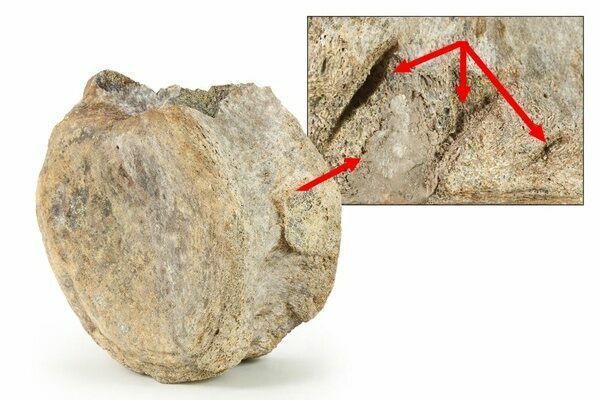
Deep tooth marks in a fossil Triceratops vertebra, possibly left by a Tyrannosaurus rex
Yet the life of Tyrannosaurus was not only defined by its prey. It was also shaped by rivals of its own kind. Fossils reveal that tyrannosaurs lived violently, even among themselves. Many skulls preserve deep bite marks, punctures, and healed fractures that match the teeth of other tyrannosaurs, not the weapons of their prey. These injuries suggest fierce confrontations—possibly over territory, mates, or access to food. Some wounds healed, meaning the animals survived brutal encounters. Tyrannosaurus was not fragile; it was built to endure punishment. Its life was likely a constant cycle of conflict, feeding, recovery, and renewed struggle.
There is also the unsettling possibility that Tyrannosaurus engaged in cannibalism. Bite marks on tyrannosaur bones themselves indicate that individuals sometimes fed on the bodies of their own species. In a harsh and competitive ecosystem, even the tyrant king could become food. Survival did not allow for sentiment, only opportunity.
Finally, there is the lingering mystery of Tyrannosaurus social behavior. For decades, it was imagined as a solitary predator, stalking its territory alone like a tiger. But recent discoveries complicate that picture. Some fossil sites preserve multiple tyrannosaur individuals together, hinting that they may have gathered around carcasses, tolerated one another at feeding sites, or moved through shared territories. Whether they hunted cooperatively like wolves remains uncertain, but these finds suggest that Tyrannosaurus may have been more socially and behaviorally complex than the classic lone-monster image allows.
To understand Tyrannosaurus rex, it must be placed back into its living world, not imagined as an isolated skeleton in a museum hall. T. rex lived during the final chapter of the Cretaceous Period, about 68–66 million years ago, in what is now western North America. This was not an open, dry landscape, but a warm, humid, and densely vegetated environment shaped by rivers, swamps, and coastal floodplains. Seasonal flooding constantly reshaped the land, creating a dynamic ecosystem rich in plant life and enormous animals.
This world is preserved in the Hell Creek Formation, one of the most important fossil sites on Earth. At the time, the region lay near sea level and not far from the Western Interior Seaway, a vast inland ocean that split the continent in two. The climate was warmer and wetter than today’s Great Plains, supporting forests of conifers and flowering plants, with ferns and cycads lining riverbanks. It was in this lush, ever-changing environment that Tyrannosaurus rex dominated.
But the tyrant king did not rule an empty land. It shared its world with some of the most formidable animals ever to exist. Triceratops was a massive, horned herbivore capable of defending itself with deadly force, making any encounter between predator and prey a clash of titans. Herds of Edmontosaurus moved across the floodplains in great numbers, providing an important food source but also presenting risks due to their size and group behavior. Ankylosaurus, heavily armored and armed with a powerful tail club, may have been one of the most dangerous animals T. rex ever faced.
The Hell Creek ecosystem may have been even more complex than it first appears. Some fossils suggest the presence of a smaller tyrannosaur, often called Nanotyrannus, though many scientists believe these specimens represent juvenile or teenage T. rex rather than a separate species. Either way, tyrannosaurs likely filled multiple predatory roles within the same environment at different stages of life.
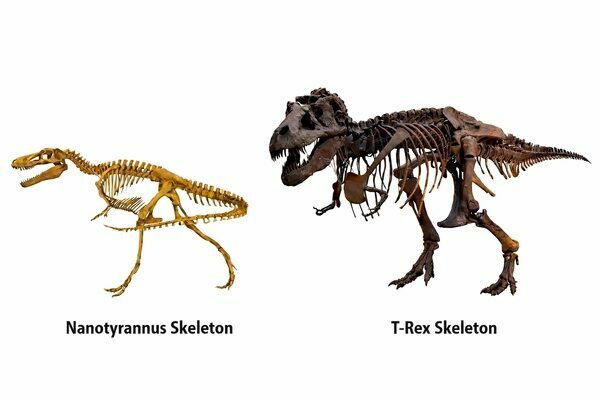
A cast of a adult Nanotyrannus skeleton next to a T-Rex skeleton. Notice how much more robust the bones of the T-Rex are.
Beyond dinosaurs, the region was home to crocodilians, turtles, fish, early birds, small mammals, and other predators, all woven into a complex food web. At its peak, Tyrannosaurus rex sat firmly at the top, shaping the behavior of everything around it. Herds scattered, smaller predators retreated, and even the largest herbivores remained alert to its presence.
This was a thriving ecosystem—but one living on borrowed time. T. rex was among the last of the dinosaurs, ruling a world that would vanish abruptly when an asteroid struck 66 million years ago. The forests burned, the climate collapsed, and the Hell Creek floodplains fell silent. What remains are the fossils—fragments of a lost world, preserving the story of the greatest predator at the very end of the Age of Dinosaurs.
Tyrannosaurus rex did not appear suddenly at the end of the Cretaceous as an evolutionary fluke. It was the culmination of a long, gradual transformation that unfolded over tens of millions of years. To understand the tyrant king, it helps to look far back in time, to an era when its ancestors were small, agile predators rather than dominant giants.
The earliest tyrannosauroids lived during the Jurassic Period, more than 150 million years ago, and were modest in size. Animals such as Guanlong from China were lightly built and far from the top of the food chain, living in ecosystems dominated by larger predators like allosaurs. Yet even these early forms show the beginnings of the tyrannosaur body plan, including skull features that would later support powerful jaws.
As the Cretaceous progressed, tyrannosaurs steadily grew larger and more specialized. Their skulls deepened, their teeth thickened, and their bite forces increased dramatically. Instead of relying on long arms and slashing claws, they evolved into predators that killed with their heads, using crushing jaws as their primary weapons. At the same time, their arms became smaller and less important, reflecting this shift in hunting strategy.
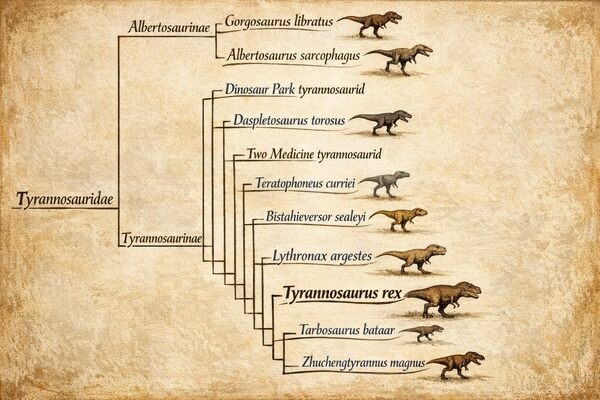
Cladogram of Tyrannosauridae based on the phylogenetic analysis conducted by Loewen and colleagues in 2013
Fossils also reveal that many early tyrannosaurs were feathered. Species such as Dilong and the large Yutyrannus preserve evidence of feather-like coverings, showing that tyrannosaurs came from feathered ancestry. Whether adult T. rex retained any feathers remains uncertain, but its evolutionary roots are clear.
By the Late Cretaceous, tyrannosaurs had become the dominant predators across the northern continents. In Asia, animals like Tarbosaurus filled a role similar to T. rex, while in North America, species such as Albertosaurus and Daspletosaurus represent earlier stages along the path to the tyrant king. This evolutionary trend culminated near the very end of the Cretaceous with Tyrannosaurus rex, the largest, most heavily built, and most powerful tyrannosaur of them all.
Debates over fossils like the controversial Nanotyrannus—whether it was a separate species or simply a juvenile T. rex—highlight how dynamic tyrannosaur evolution was. Rather than a single static form, tyrannosaurs filled multiple roles across time and growth stages, ultimately producing one of the most formidable land predators in Earth’s history.
In recent years, paleontologists have begun exploring an intriguing and surprisingly difficult question: how many Tyrannosaurus rex were actually alive at one time? Because dinosaurs left behind only scattered fossils, scientists cannot count individuals directly. Instead, they rely on ecological modeling, using what we know about body size, predator populations, and modern ecosystems to estimate how many tyrannosaurs a prehistoric landscape could realistically support.
A major study published in 2021 by Charles Marshall and colleagues approached this problem with computer simulations and ecological theory. Their results suggest that, at any given moment during the species’ existence, there may have been around 20,000 adult T. rex spread across North America. The models allowed for a wide range—from roughly 1,300 to 328,000—but the researchers viewed 20,000 as a reasonable middle estimate. They also noted that this figure might even be conservative, since a population that small could be especially vulnerable to disease outbreaks or sudden environmental disruptions.
When the study expanded its scope beyond a single snapshot in time, the numbers became even more striking. Over the more than million-year span that Tyrannosaurus existed, the researchers estimated roughly 127,000 generations, which could translate to a total of about 2.5 billion individual T. rex living before the species ultimately went extinct. In other words, while Tyrannosaurus fossils are rare, the animal itself may once have been a regular presence across its range for an immense stretch of time.
The study also offered a sense of geographic scale. If about 20,000 adult tyrannosaurs were alive at once, an area the size of modern California might have supported several thousand individuals, while a region as small as Washington, D.C. would only have had room for a couple of adults. These estimates apply only to fully grown animals, since juveniles likely filled different ecological roles and may have existed in much greater numbers than the adults dominating the top of the food chain.
One of the most important implications of this work is just how unlikely fossil preservation truly is. The researchers suggested that the odds of any single Tyrannosaurus becoming fossilized may have been extraordinarily low—on the order of one in tens of millions—helping explain why such an iconic animal is still known from relatively few specimens.
Not everyone agrees on how precise these calculations can be. In 2022, Meiri questioned the reliability of the estimates, pointing to uncertainties in metabolism, survival rates, habitat needs, and range size. Marshall and colleagues acknowledged that the uncertainties may be larger than originally reported, but emphasized that their framework can be updated as new evidence improves our understanding.
T. rex lived roughly 68 to 66 million years ago, during the last two million years of the dinosaurs’ reign, just before a catastrophic asteroid impact ended the Mesozoic Era forever. It ruled over what is now western North America, a landscape of humid river valleys, swampy floodplains, and lush subtropical forests teeming with life. This was a world of enormous prey animals: herds of duck-billed Edmontosaurus, heavily armored Ankylosaurus, and the legendary horned giant Triceratops, one of the few creatures capable of standing its ground against the tyrant king.
What made Tyrannosaurus rex so extraordinary was not just its size, though it was immense. Adults stretched more than 40 feet long, stood as tall as a second-story window at the hips, and weighed as much as an elephant—possibly even more in the largest individuals. But its true power came from its design: a predator built for domination. Its skull was a masterpiece of natural engineering, massive yet reinforced with strong bone struts, and armed with teeth that were not delicate blades but thick, crushing spikes. Some of these teeth reached over a foot in length, designed not only to slice flesh but to shatter bone.
The bite of T. rex may have been the most powerful of any land animal that ever lived. Modern studies estimate it could exert forces exceeding 12,000 pounds, enough to pulverize the bones of prey and leave deep puncture marks still visible on fossilized skeletons today. In fact, paleontologists have found Triceratops bones with healed bite wounds—evidence that some victims survived attacks, offering a rare glimpse into real predator-prey struggles from deep time.
Despite its terrifying reputation, Tyrannosaurus rex was not simply a brute. It was also highly intelligent by dinosaur standards and equipped with exceptional senses. Its forward-facing eyes gave it strong depth perception—similar to a hawk or a big cat—making it a precise hunter. Even more impressive was its sense of smell, which may have been among the most powerful ever recorded in a terrestrial animal. Some researchers believe T. rex could detect carcasses or prey from miles away, meaning it likely played a dual role as both hunter and scavenger, dominating its ecosystem in every possible way.
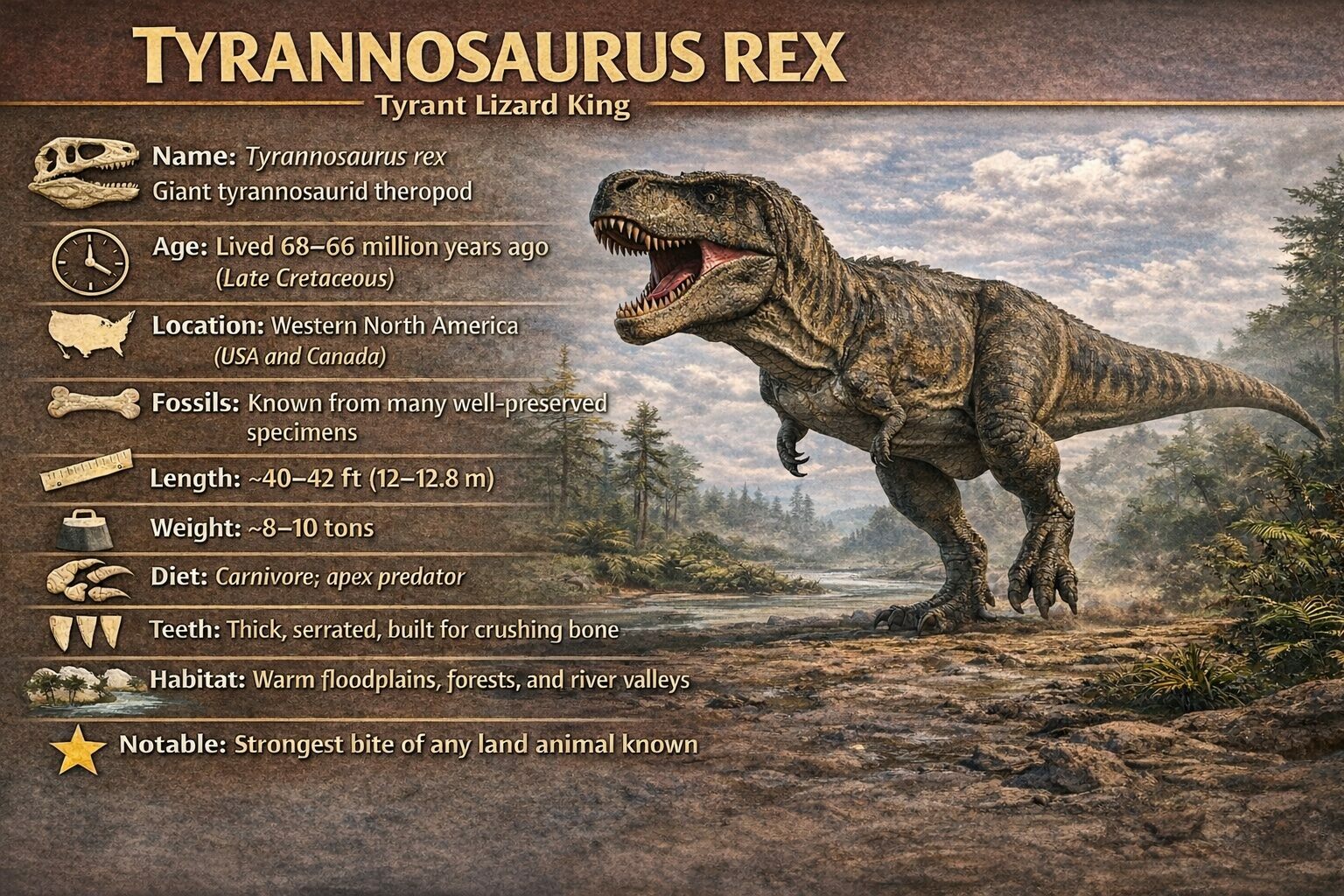
T-Rex Infographic
And then there are its famously small arms—perhaps the most joked-about feature in dinosaur history. Yet those arms were far from useless. Each was packed with muscle and ended in two strong claws, capable of gripping with surprising force. The tyrant’s real killing tools, however, were its jaws, neck, and immense body, which made it one of the most formidable predators evolution ever produced.
The story of Tyrannosaurus rex began not in the Cretaceous, but in the dusty badlands of the American West during the early 20th century. In 1902, fossil hunter Barnum Brown, working for the American Museum of Natural History, uncovered the first major remains in Montana. A few years later, in 1905, paleontologist Henry Fairfield Osborn officially named the species Tyrannosaurus rex. The name itself was dramatic and unforgettable, and it instantly captured public fascination.
Since then, T. rex has become one of the best-studied dinosaurs in history. Spectacular skeletons like “Sue”, “Stan”, and “Scotty” have revealed astonishing details: healed injuries from violent battles, evidence of rapid teenage growth spurts, and even hints that tyrannosaurs may have interacted socially. Each new fossil discovery reshapes what we know, reminding us that this animal was not a movie monster, but a living, breathing apex predator at the very edge of extinction. Tyrannosaurus rex was the last great king of the dinosaurs—an evolutionary masterpiece, a ruler of a lost world, and one of the most awe-inspiring creatures ever to walk the Earth.
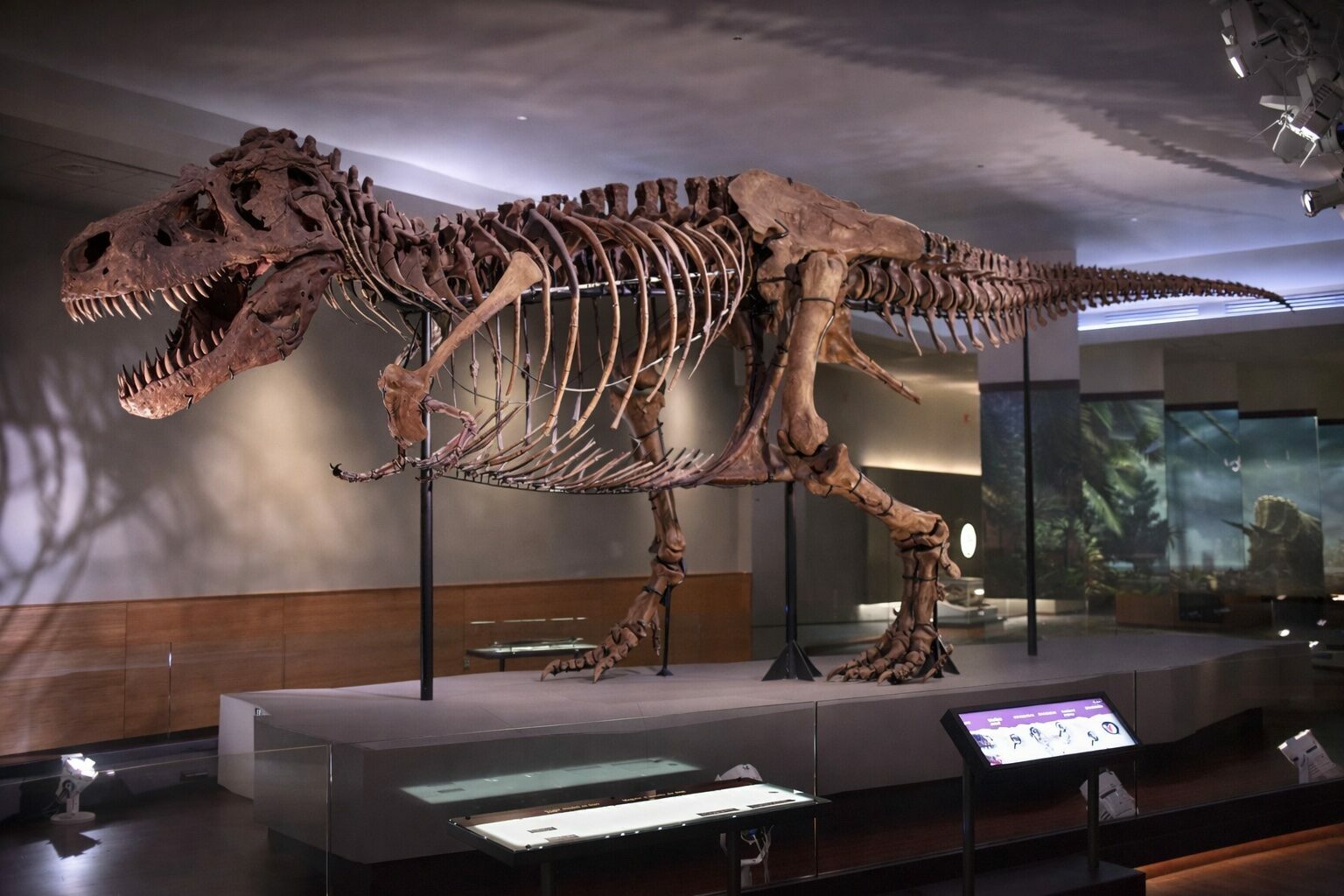
A skeleton of "Sue" the T-Rex on display at the Chicago Field Museum.
History and Discovery
The discovery of Tyrannosaurus rex is inseparable from one of the most thrilling chapters in the history of paleontology—a time when the American West was still a rugged frontier and dinosaur fossils were being uncovered at an unprecedented pace. The late 19th and early 20th centuries were an era of fossil fever, when museums competed fiercely to find and display the largest and most dramatic prehistoric creatures ever known.
Long before T. rex was officially named, fragmentary bones from giant carnivorous dinosaurs had been found across North America, but scientists often struggled to understand exactly what they belonged to. Early discoveries of large theropods were sometimes misidentified or assigned to other genera because paleontology was still a young science. Dinosaurs were known to be ancient reptiles, but the true diversity and scale of these animals was only beginning to emerge.
The First Hints of a Giant Predator
The earliest fossils that may have belonged to Tyrannosaurus were uncovered in the 1890s. In 1892, paleontologist Edward Drinker Cope, one of the central figures of the infamous “Bone Wars,” described a couple of large vertebrae and named them Manospondylus gigas. At the time, no one realized these bones represented what would later be recognized as Tyrannosaurus rex. The remains were too incomplete, and the dinosaur world was still poorly understood.
It would take another decade before the tyrant king began to step into the scientific spotlight.
Barnum Brown and the Birth of T. rex
The true story of Tyrannosaurus rex began in 1902, when legendary fossil hunter Barnum Brown—often called one of the greatest dinosaur collectors of all time—was working in the badlands of Montana for the American Museum of Natural History in New York. Brown uncovered the remains of a massive carnivorous dinosaur unlike anything previously known. The bones were enormous: parts of a skull, teeth, vertebrae, and limb elements that suggested an animal far larger than earlier theropods such as Allosaurus. Brown returned in 1905 and discovered even more substantial remains, confirming that this predator was something extraordinary.
At first, however, this dinosaur was not immediately recognized under the famous name we know today. When Henry Fairfield Osborn—museum president and one of the most influential paleontologists of his era—first studied the initial material, he believed it belonged to a different species. In an earlier description, Osborn assigned some of the remains to a dinosaur he called Dynamosaurus imperiosus, meaning “powerful lizard emperor.” It was only after additional fossils were recovered and compared that Osborn realized these bones represented the same remarkable predator.
Later in 1905, Osborn officially renamed and reclassified the animal as Tyrannosaurus rex, the “tyrant lizard king”. The name was intentionally dramatic, and it perfectly captured the public imagination. From the very beginning, T. rex was viewed not just as another dinosaur, but as the ultimate carnivore—the pinnacle of predatory evolution.
The Rise of a Dinosaur Icon
The American Museum of Natural History quickly mounted a skeleton, and Tyrannosaurus rex became a star attraction almost overnight. Unlike many dinosaurs known only from scattered bones, T. rex was represented by increasingly complete fossil material, giving scientists a rare opportunity to piece together its massive frame. Its enormous skull, powerful jaws, and towering height captured both scientific curiosity and public imagination, cementing its place as one of the most famous prehistoric predators ever discovered.
During the early decades of the 20th century, however, much of what people believed about T. rex was still speculative. It was often portrayed as an upright, tail-dragging monster—an image that dominated museum displays, films, and popular culture for generations. As paleontology advanced, new fossil finds and improved research techniques gradually transformed that outdated view. Over time, scientists revealed a more dynamic and lifelike animal, reshaping our understanding of this iconic dinosaur and ensuring its legend continued to evolve.
Modern Discoveries and Famous Skeletons
The late 20th century brought a golden age of Tyrannosaurus research, fueled by spectacular fossil finds. One of the most important discoveries occurred in 1990, when fossil hunter Sue Hendrickson uncovered the most complete adult T. rex skeleton ever found in South Dakota. The specimen, later nicknamed “Sue,” was about 90% complete and revealed unprecedented details about tyrannosaur anatomy, injuries, and growth. Sue showed that T. rex lived a violent life: broken ribs, infected wounds, and signs of trauma hinted at battles with prey—or even with other tyrannosaurs.
Other famous specimens soon followed:
Each new skeleton added depth to the tyrannosaur story, revealing variation among individuals and offering clues about their biology.
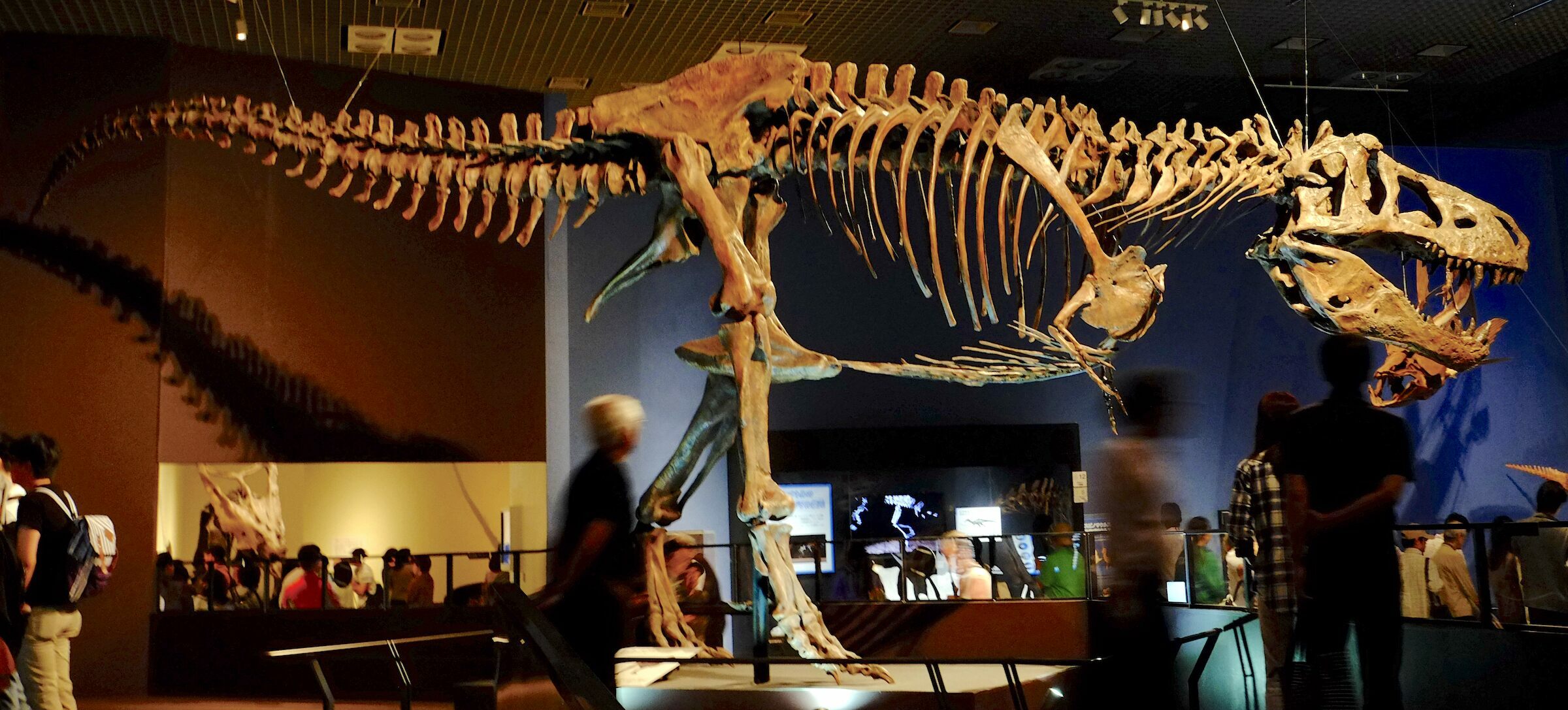
A cast of Scotty the largest known T-Rex.
Anatomy of a Super-Predator
The body of Tyrannosaurus rex was not simply large—it was a masterpiece of evolutionary design. Every part of its anatomy, from its massive skull to its thickened tail, reveals an animal shaped by millions of years of natural selection into one of the most formidable predators ever to walk on land.
The Skull: A Weapon of Bone and Muscle
The most striking feature of Tyrannosaurus rex was its enormous skull, which could exceed five feet (1.5 meters) in length. This skull was not only large—it was extraordinarily strong. The bones of the skull were fused and reinforced with thick struts, allowing it to withstand tremendous stresses during feeding. At the same time, the skull contained large openings, or fenestrae, which reduced weight without sacrificing strength. This combination of power and efficiency is often compared to modern engineering designs such as bridges or aircraft frames.
The jaws were deep and muscular, capable of delivering the most powerful bite force ever measured in a terrestrial animal. Unlike predators such as Allosaurus, which had thinner, blade-like teeth for slicing flesh, T. rex had teeth designed for crushing. The teeth of Tyrannosaurus rex were legendary—thick, conical, serrated, and built to endure enormous pressure. Some of the largest teeth reached over 12 inches (30 cm) in total length, including the root.
Rather than acting like knives, these teeth functioned more like railroad spikes. They could puncture prey, tear away chunks of flesh, and even crush bone. Fossil evidence shows that T. rex routinely bit through the ribs, hips, and skulls of its prey, leaving behind tooth marks that can still be studied today. In fact, tyrannosaur coprolites—fossilized dung—have been found containing pulverized bone fragments, proving that T. rex digested bone as part of its diet.
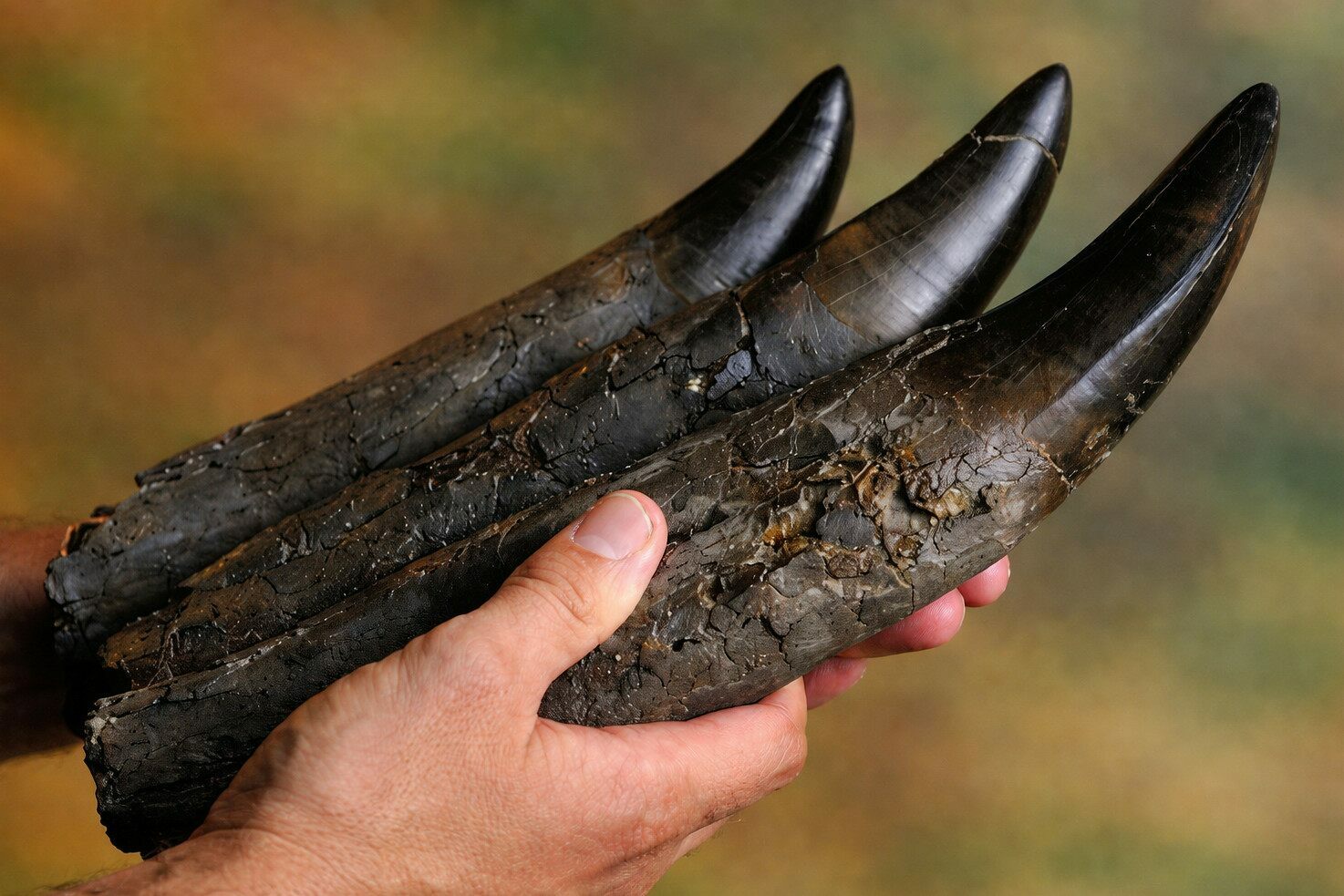
Bananas Of Death: Including the root, T-Rex teeth can be up to a foot long.
The Neck: Built for Violence
Behind the skull was an incredibly powerful neck. T. rex did not rely on delicate jaw movements. Instead, it likely used its entire head and neck as a brutal feeding apparatus. Massive neck muscles anchored to strong vertebrae allowed the animal to wrench its head backward, tearing flesh from carcasses. Some paleontologists compare this feeding motion to that of modern crocodilians, though on a far larger scale. The neck was essentially the engine that powered the tyrant’s bite, helping transform the skull into a bone-crushing weapon.
The Brain and Senses: A Predator That Could Perceive Its World
Tyrannosaurus rex wasn’t just a giant set of jaws—it was a sensory specialist. Paleontologists know this because fossil skulls preserve clues about the brain and senses. CT scans of T. rex skulls allow scientists to create digital endocasts, revealing which brain regions were most developed. In tyrannosaurs, the areas linked to smell and vision are especially large.
Its forward-facing eyes are obvious from the angle of the eye sockets, which point inward rather than outward. That arrangement creates strong binocular overlap, giving T. rex excellent depth perception. Researchers have even modeled its field of view and found it may have rivaled modern birds of prey, an advantage for judging distance when striking prey with a single bite.
The skull of "Stan" the T-Rex
Smell may have been even more impressive. Endocasts show huge olfactory bulbs, the brain structures that process scent. In living animals, enlarged olfactory bulbs correlate closely with powerful smell, so scientists infer that T. rex could detect odors at great range. Its large, complex nasal cavity also suggests plenty of space for scent-detecting tissue.
All of this paints a picture of an apex predator that was not only strong, but highly aware—able to spot prey, judge distance, and likely locate carcasses or wounded animals from far away. T. rex dominated its world through brains and senses as much as brute force.
The Arms: Small but Not Useless
No anatomical feature of Tyrannosaurus is more famous—or more misunderstood—than its tiny arms. While comically short in proportion to its body, the arms were far from weak. Each forelimb was packed with muscle and ended in two clawed fingers. Studies suggest these arms could lift several hundred pounds. They may have been used for:
Rather than being useless, the arms were simply no longer the tyrant’s primary weapon. Evolution had shifted the killing role almost entirely to the jaws.
A look at the itty, bitty arms on Sue the T-Rex.
The Chest and Body: A Barrel of Muscle
T. rex had a deep, broad torso, giving it a “barrel-chested” appearance. This body shape supported enormous internal organs and powerful muscles. The ribcage was thick, and the entire body was built for strength rather than speed. Unlike slimmer predators, Tyrannosaurus was a heavyweight brawler—capable of wrestling down large prey with sheer mass. This robust build also suggests a high-energy lifestyle requiring substantial food intake, which explains why it targeted the largest herbivores of its environment.
Legs and Locomotion: Strength Over Speed
The hind limbs of T. rex were long, muscular, and designed for efficient movement. Each step was powered by massive thigh muscles, allowing the animal to walk with authority across its territory. While early depictions imagined T. rex sprinting at extreme speeds, modern biomechanics suggest it was not a fast runner. Instead, it was likely capable of moderate speeds—perhaps 15–20 mph—more than enough for ambush attacks against massive prey. Its feet were equipped with strong toes and claws for traction, and its body was balanced perfectly over the hips.
The Tail: The Counterbalance of a Titan
One of the most important anatomical features of T. rex was its long, thick tail. Far from being a dragging appendage, the tail acted as:
The tail made Tyrannosaurus a perfectly balanced predator, able to move with surprising agility despite its size.
Skin and Feathers: What Did T. rex Look Like?
We know that many of T. rex’s close relatives—especially smaller tyrannosaurs like Dilong and Yutyrannus—were covered in feathers or feather-like filaments. These discoveries strongly suggest that feathers were common within the tyrannosaur family, at least early in their evolutionary history. However, the evidence for T. rex itself is more complicated. Several fossil specimens of large tyrannosaurs preserve skin impressions, and these show a surface covered in scales rather than feathers. These patches of scaly skin come from different parts of the body, implying that adult T. rex was not fully feathered like some of its smaller cousins.
Fossilized skin from the neck of a Tyrannosaurus rex, showing its scaly texture. — Black Hills Institute of Geological Research
Because of this, most scientists currently think that fully grown T. rex was probably mostly scaly, especially across much of its body. That said, it is still possible that juveniles—or even adults in certain regions like the neck or back—may have had a light coating of downy fuzz. Young animals often need more insulation, and a partial feather covering could have helped smaller, growing tyrannosaurs retain body heat.
In the end, the question remains open. As new fossils are discovered and new techniques are developed to study skin and soft tissue, the mystery of whether the “tyrant king” wore feathers, scales, or a mix of both continues to be one of the most exciting areas of dinosaur research today.
Size & Power
Tyrannosaurus rex was not just a top predator—it was truly a giant, ranking among the largest land carnivores to ever walk the Earth. Even by dinosaur standards, its size was extraordinary. Fully grown adults measured about 40–43 feet long (12–13 meters), roughly the length of a modern city bus or a large semi-truck with its trailer. Standing at the hips, T. rex reached 12–13 feet tall (3.5–4 meters), meaning its head could tower over most humans even without lifting its neck. In sheer mass, estimates place it around 8–10 tons, with the biggest individuals possibly weighing even more—about as heavy as a large African elephant or two full-sized pickup trucks.
T-Rex size compared to a grizzly bear and human.
To put that into perspective, if a T. rex were standing beside a grizzly bear, the bear would barely reach its hip. And compared to modern predators like lions or crocodiles, T. rex was operating on an entirely different scale.
Its size was matched by one of the most fearsome weapons in the history of life: its jaws. The bite force of T. rex may have exceeded 12,000 pounds, far greater than any living land animal today. For comparison, a lion’s bite force is around 650 pounds, and even the massive saltwater crocodile reaches “only” about 3,700 pounds. T. rex’s bite was powerful enough to crush bone, shatter thick dinosaur limb shafts, and leave deep puncture wounds that are still visible in fossilized prey remains. This combination of immense size, muscular build, and bone-crushing bite made Tyrannosaurus rex one of the most dominant and intimidating predators the planet has ever produced.
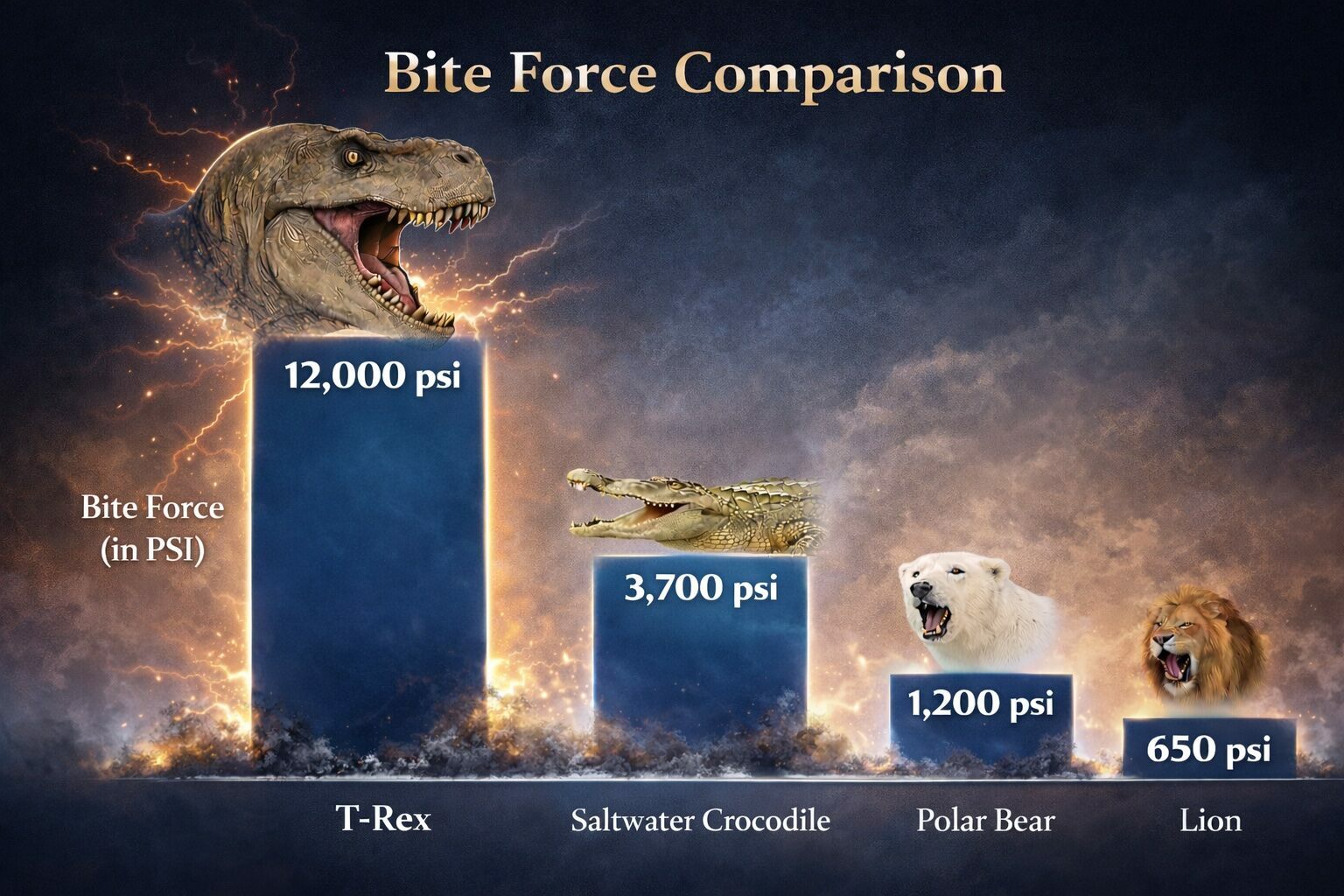
T-Rex bite force compared to a crocodile, polar bear and lion.
Speed: How Fast Could Tyrannosaurus rex Move?
Few questions about Tyrannosaurus rex capture the imagination quite like this one: could the tyrant king actually run? For more than a century, popular culture has portrayed T. rex as a thunderous, sprinting monster, charging across the landscape at highway speeds and shaking the earth with every footfall. Films and documentaries have often shown it racing after prey with terrifying agility, a living avalanche of muscle and teeth. That image is thrilling—but the truth, as paleontology so often reveals, is far more complex, and arguably even more interesting.
To understand Tyrannosaurus speed, you first have to picture what this animal truly was. T. rex was not a sleek pursuit predator like a cheetah, built for lightness and rapid acceleration. It was a multi-ton heavyweight, closer in build to a tank than a sprinter. An adult could weigh as much as an elephant, carrying that enormous mass on two pillar-like hind limbs while balancing an immense skull at the front of its body like a wrecking ball. The question, then, is not simply whether it could move quickly. The deeper question is whether an animal of that size could run at high speed without risking catastrophic injury.
Early reconstructions of dinosaurs didn’t help. In the early 20th century, Tyrannosaurus was often depicted standing upright like a kangaroo with its tail dragging behind, which made it seem slow and awkward. Later, as scientists recognized that dinosaurs held their bodies horizontally, the image flipped dramatically. Now T. rex was imagined as a fast-moving predator capable of chasing down hadrosaurs in open pursuit. For decades, speculation about its speed ran wild, with some estimates suggesting it could reach more than 30 miles per hour. But speculation is not evidence, and modern paleontology approaches the problem very differently.
The greatest limiting factor on Tyrannosaurus speed is its sheer size. Running is not just “moving faster”—it is repeatedly launching your body into the air and catching yourself again with every stride. For small animals, this is easy. For a predator weighing nine or ten tons, it becomes extremely dangerous. The forces placed on bones, joints, and muscles during high-speed running would have been immense, and a fall at full speed could have been catastrophic, potentially fatal. For an apex predator, a broken leg is often a death sentence. Researchers have calculated that at extreme speeds, the stresses on a tyrannosaur’s legs might exceed what bone could safely withstand. In other words, the tyrant king may simply have been too heavy to sprint like the monsters of Hollywood.
In recent decades, scientists have turned to biomechanics, physics, and computer simulations to estimate what was actually possible. These models account for muscle mass, stride length, body weight, balance, and the mechanical limits of bone strength. Most modern studies suggest that adult T. rex was not a high-speed runner, but instead likely capable of reaching speeds somewhere between 10 and 20 miles per hour, perhaps slightly more in short bursts. That may sound modest compared to movie portrayals, but in reality it is still terrifying. A creature the size of Tyrannosaurus moving faster than a human can sprint, armed with jaws powerful enough to crush bone, did not need to be a racehorse to be deadly. T. rex wasn’t built for long chases—it was built for power, efficiency, and dominance, a predator that only needed to catch you once.
Growth Rates and Life History
Tyrannosaurus rex didn’t start life as a giant. Like many large animals, it went through dramatic changes as it matured—transforming from a relatively small hatchling into one of the most massive land predators ever known. Paleontologists study growth patterns by examining annual growth rings preserved in fossil bones, similar to the rings seen in trees. These rings allow scientists to estimate how old an animal was when it died and how quickly it grew. For years, researchers believed that T. rex reached its full adult size by around 25 years of age based on earlier growth ring counts.
However, new research published in 2026 has revised this timeline significantly. By analyzing 17 T. rex specimens—from juveniles to enormous adults—and using advanced statistical modeling, researchers have found that T. rex likely continued growing **well into its late 30s, reaching full size at around 35–40 years old. This means that the growth phase of these dinosaurs was longer and more gradual than previously thought, with a prolonged subadult stage before their bones stopped accumulating major new mass.
Despite this extended growth period, T. rex did experience a phase of rapid weight gain during its teenage years—especially between approximately ages 14 and 29—when individuals could put on hundreds to over a thousand pounds per year. During this phase, juveniles were lighter, more agile, and likely occupied a different ecological niche than adults. As growth slowed in later years, their bodies became more robust and adapted to the role of apex predator.
Interestingly, growth rates may have fluctuated depending on resource availability and environmental conditions. Some years of sparse food likely slowed growth, while richer conditions accelerated it—a kind of flexible strategy that would have helped T. rex survive through changing ecosystems.
Bahavior & Lifestyle
To imagine the life of Tyrannosaurus rex is to imagine dominance, but also constant struggle. This was not a fantasy monster roaming endlessly victorious through the Late Cretaceous. It was a real animal, bound by the same rules of survival as every other living thing. Its world was one of danger, competition, hunger, and injury, and every day was shaped by a single, unforgiving truth: to remain the apex predator, it had to eat. Failing to secure food meant weakness, and weakness—especially for an animal of such immense size—could be fatal.
The Late Cretaceous landscape was rich in enormous herbivores, but none of them were easy prey. Tyrannosaurus shared its environment with some of the most heavily defended animals that ever walked the Earth. Triceratops carried long, lethal horns and a massive bony frill that could absorb tremendous punishment. Ankylosaurs were living tanks, wrapped in armor and armed with tail clubs capable of shattering bone. Even the duck-billed hadrosaurs, which lacked obvious weapons, were powerful animals that often traveled in herds and could easily overwhelm a predator through sheer size and numbers. For Tyrannosaurus, hunting was never a casual act—it was a high-risk confrontation between giants where a single mistake could lead to serious injury or death.
Modern evidence paints Tyrannosaurus as both hunter and scavenger, a predator that took advantage of every opportunity available. For much of the 20th century, scientists fiercely debated whether T. rex was an active killer or merely a lumbering scavenger living off the work of others. Today, that argument has largely faded. The reality is far more realistic, and far more compelling: Tyrannosaurus was almost certainly both. It possessed all the tools of a hunter—forward-facing eyes that provided depth perception, powerful legs for closing distance, and jaws built to kill—but it also had the senses of a scavenger, especially an extraordinary sense of smell. Its massive olfactory system suggests it could detect carcasses from miles away, and in a world where a single dead dinosaur represented tons of meat, ignoring scavenging would have been wasteful. When Tyrannosaurus arrived at a carcass, few animals could challenge it. Intimidation alone may have been enough to drive smaller predators away.
When Tyrannosaurus did hunt, the encounter must have been sudden and violent. It was not built for long-distance pursuit like a wolf or cheetah. Instead, it was designed for ambush and overwhelming force. One can imagine it moving deliberately through forested floodplains or along riverbanks, its massive body balanced by its tail, its head held forward as it searched for movement. When the moment came, it would strike with terrifying speed, closing the distance in seconds and delivering a bite capable of crushing bone instantly. Its jaws were not just weapons for killing—they were instruments of domination. A single well-placed bite to the hip, neck, or torso could shatter vertebrae or destroy limbs, bringing even the largest herbivores crashing to the ground.
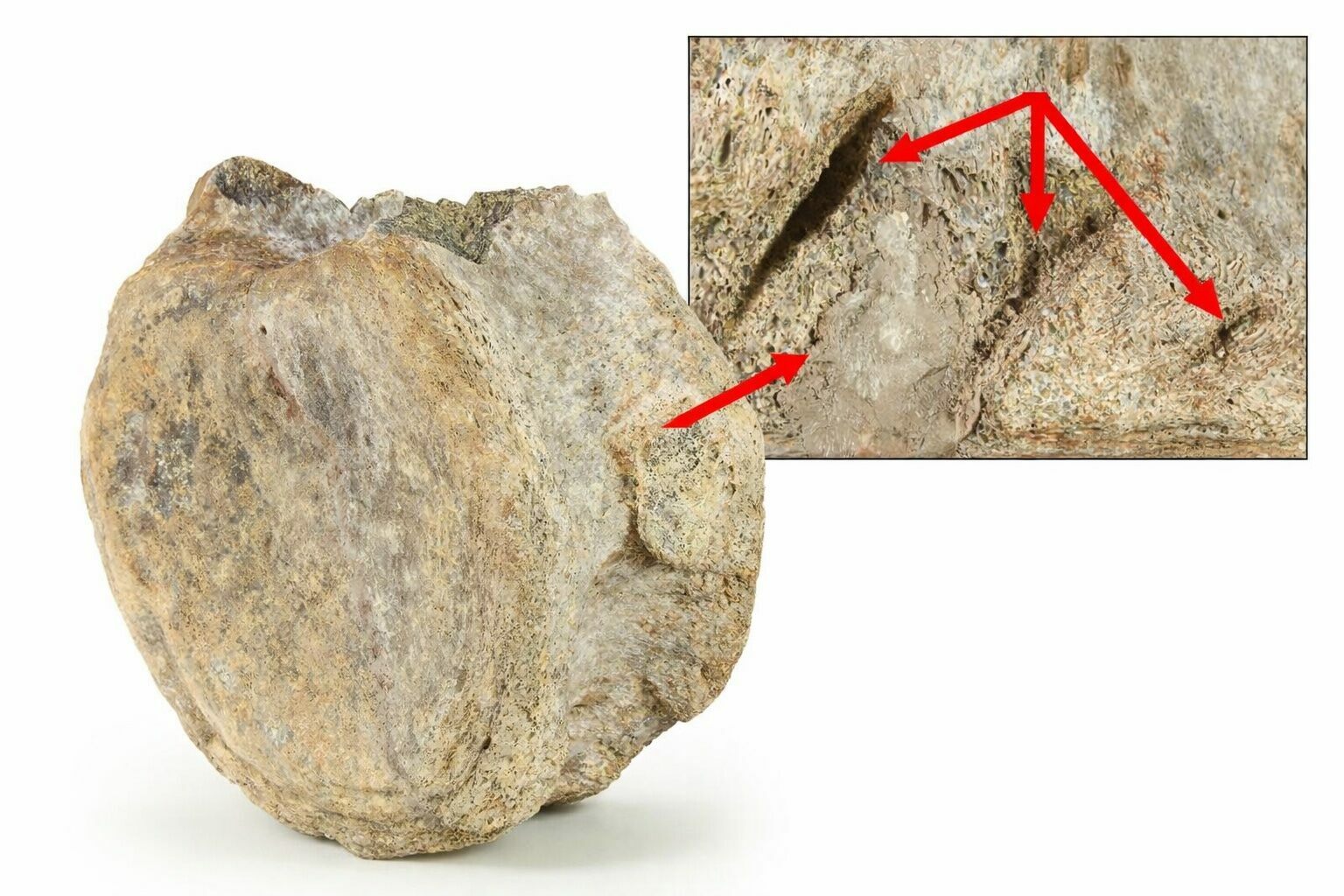
Deep tooth marks in a fossil Triceratops vertebra, possibly left by a Tyrannosaurus rex
Yet the life of Tyrannosaurus was not only defined by its prey. It was also shaped by rivals of its own kind. Fossils reveal that tyrannosaurs lived violently, even among themselves. Many skulls preserve deep bite marks, punctures, and healed fractures that match the teeth of other tyrannosaurs, not the weapons of their prey. These injuries suggest fierce confrontations—possibly over territory, mates, or access to food. Some wounds healed, meaning the animals survived brutal encounters. Tyrannosaurus was not fragile; it was built to endure punishment. Its life was likely a constant cycle of conflict, feeding, recovery, and renewed struggle.
There is also the unsettling possibility that Tyrannosaurus engaged in cannibalism. Bite marks on tyrannosaur bones themselves indicate that individuals sometimes fed on the bodies of their own species. In a harsh and competitive ecosystem, even the tyrant king could become food. Survival did not allow for sentiment, only opportunity.
Finally, there is the lingering mystery of Tyrannosaurus social behavior. For decades, it was imagined as a solitary predator, stalking its territory alone like a tiger. But recent discoveries complicate that picture. Some fossil sites preserve multiple tyrannosaur individuals together, hinting that they may have gathered around carcasses, tolerated one another at feeding sites, or moved through shared territories. Whether they hunted cooperatively like wolves remains uncertain, but these finds suggest that Tyrannosaurus may have been more socially and behaviorally complex than the classic lone-monster image allows.
Paleoecology and the World of Tyrannosaurus rex
To understand Tyrannosaurus rex, it must be placed back into its living world, not imagined as an isolated skeleton in a museum hall. T. rex lived during the final chapter of the Cretaceous Period, about 68–66 million years ago, in what is now western North America. This was not an open, dry landscape, but a warm, humid, and densely vegetated environment shaped by rivers, swamps, and coastal floodplains. Seasonal flooding constantly reshaped the land, creating a dynamic ecosystem rich in plant life and enormous animals.
This world is preserved in the Hell Creek Formation, one of the most important fossil sites on Earth. At the time, the region lay near sea level and not far from the Western Interior Seaway, a vast inland ocean that split the continent in two. The climate was warmer and wetter than today’s Great Plains, supporting forests of conifers and flowering plants, with ferns and cycads lining riverbanks. It was in this lush, ever-changing environment that Tyrannosaurus rex dominated.
But the tyrant king did not rule an empty land. It shared its world with some of the most formidable animals ever to exist. Triceratops was a massive, horned herbivore capable of defending itself with deadly force, making any encounter between predator and prey a clash of titans. Herds of Edmontosaurus moved across the floodplains in great numbers, providing an important food source but also presenting risks due to their size and group behavior. Ankylosaurus, heavily armored and armed with a powerful tail club, may have been one of the most dangerous animals T. rex ever faced.
The Hell Creek ecosystem may have been even more complex than it first appears. Some fossils suggest the presence of a smaller tyrannosaur, often called Nanotyrannus, though many scientists believe these specimens represent juvenile or teenage T. rex rather than a separate species. Either way, tyrannosaurs likely filled multiple predatory roles within the same environment at different stages of life.
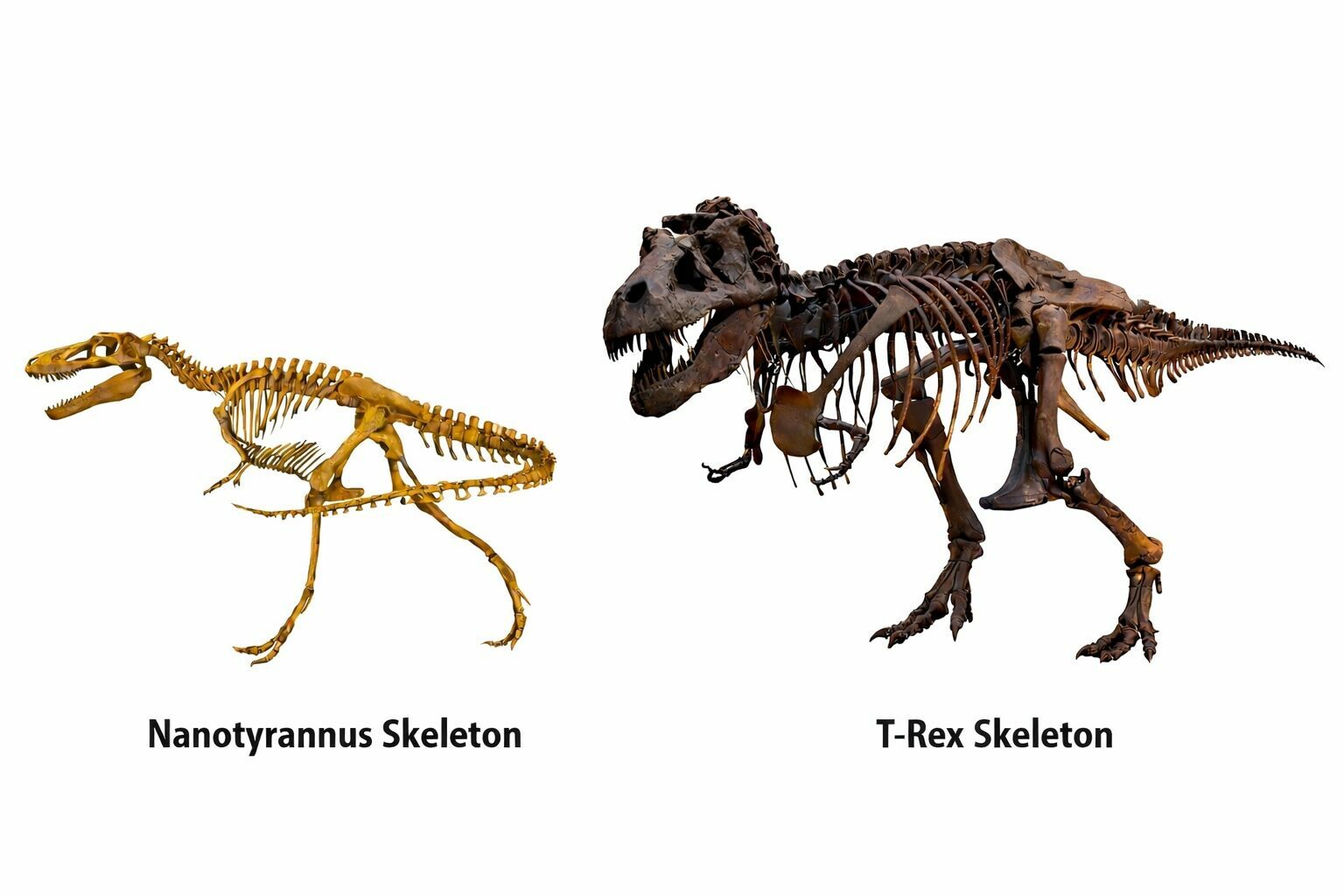
A cast of a adult Nanotyrannus skeleton next to a T-Rex skeleton. Notice how much more robust the bones of the T-Rex are.
Beyond dinosaurs, the region was home to crocodilians, turtles, fish, early birds, small mammals, and other predators, all woven into a complex food web. At its peak, Tyrannosaurus rex sat firmly at the top, shaping the behavior of everything around it. Herds scattered, smaller predators retreated, and even the largest herbivores remained alert to its presence.
This was a thriving ecosystem—but one living on borrowed time. T. rex was among the last of the dinosaurs, ruling a world that would vanish abruptly when an asteroid struck 66 million years ago. The forests burned, the climate collapsed, and the Hell Creek floodplains fell silent. What remains are the fossils—fragments of a lost world, preserving the story of the greatest predator at the very end of the Age of Dinosaurs.
Evolution and Origins: The Rise of the Tyrant King
Tyrannosaurus rex did not appear suddenly at the end of the Cretaceous as an evolutionary fluke. It was the culmination of a long, gradual transformation that unfolded over tens of millions of years. To understand the tyrant king, it helps to look far back in time, to an era when its ancestors were small, agile predators rather than dominant giants.
The earliest tyrannosauroids lived during the Jurassic Period, more than 150 million years ago, and were modest in size. Animals such as Guanlong from China were lightly built and far from the top of the food chain, living in ecosystems dominated by larger predators like allosaurs. Yet even these early forms show the beginnings of the tyrannosaur body plan, including skull features that would later support powerful jaws.
As the Cretaceous progressed, tyrannosaurs steadily grew larger and more specialized. Their skulls deepened, their teeth thickened, and their bite forces increased dramatically. Instead of relying on long arms and slashing claws, they evolved into predators that killed with their heads, using crushing jaws as their primary weapons. At the same time, their arms became smaller and less important, reflecting this shift in hunting strategy.
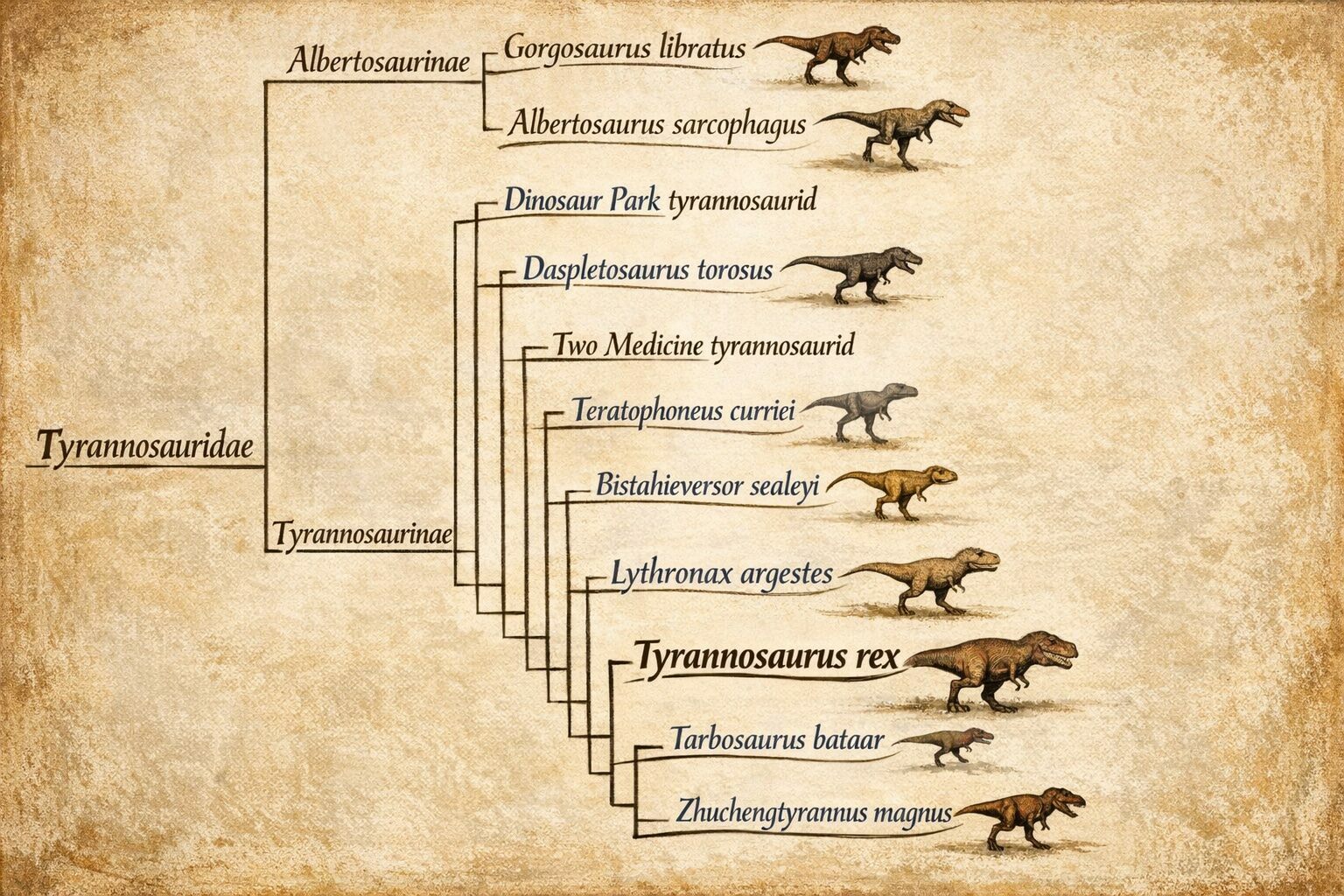
Cladogram of Tyrannosauridae based on the phylogenetic analysis conducted by Loewen and colleagues in 2013
Fossils also reveal that many early tyrannosaurs were feathered. Species such as Dilong and the large Yutyrannus preserve evidence of feather-like coverings, showing that tyrannosaurs came from feathered ancestry. Whether adult T. rex retained any feathers remains uncertain, but its evolutionary roots are clear.
By the Late Cretaceous, tyrannosaurs had become the dominant predators across the northern continents. In Asia, animals like Tarbosaurus filled a role similar to T. rex, while in North America, species such as Albertosaurus and Daspletosaurus represent earlier stages along the path to the tyrant king. This evolutionary trend culminated near the very end of the Cretaceous with Tyrannosaurus rex, the largest, most heavily built, and most powerful tyrannosaur of them all.
Debates over fossils like the controversial Nanotyrannus—whether it was a separate species or simply a juvenile T. rex—highlight how dynamic tyrannosaur evolution was. Rather than a single static form, tyrannosaurs filled multiple roles across time and growth stages, ultimately producing one of the most formidable land predators in Earth’s history.
T-Rex Population Estimates
In recent years, paleontologists have begun exploring an intriguing and surprisingly difficult question: how many Tyrannosaurus rex were actually alive at one time? Because dinosaurs left behind only scattered fossils, scientists cannot count individuals directly. Instead, they rely on ecological modeling, using what we know about body size, predator populations, and modern ecosystems to estimate how many tyrannosaurs a prehistoric landscape could realistically support.
A major study published in 2021 by Charles Marshall and colleagues approached this problem with computer simulations and ecological theory. Their results suggest that, at any given moment during the species’ existence, there may have been around 20,000 adult T. rex spread across North America. The models allowed for a wide range—from roughly 1,300 to 328,000—but the researchers viewed 20,000 as a reasonable middle estimate. They also noted that this figure might even be conservative, since a population that small could be especially vulnerable to disease outbreaks or sudden environmental disruptions.
When the study expanded its scope beyond a single snapshot in time, the numbers became even more striking. Over the more than million-year span that Tyrannosaurus existed, the researchers estimated roughly 127,000 generations, which could translate to a total of about 2.5 billion individual T. rex living before the species ultimately went extinct. In other words, while Tyrannosaurus fossils are rare, the animal itself may once have been a regular presence across its range for an immense stretch of time.
The study also offered a sense of geographic scale. If about 20,000 adult tyrannosaurs were alive at once, an area the size of modern California might have supported several thousand individuals, while a region as small as Washington, D.C. would only have had room for a couple of adults. These estimates apply only to fully grown animals, since juveniles likely filled different ecological roles and may have existed in much greater numbers than the adults dominating the top of the food chain.
One of the most important implications of this work is just how unlikely fossil preservation truly is. The researchers suggested that the odds of any single Tyrannosaurus becoming fossilized may have been extraordinarily low—on the order of one in tens of millions—helping explain why such an iconic animal is still known from relatively few specimens.
Not everyone agrees on how precise these calculations can be. In 2022, Meiri questioned the reliability of the estimates, pointing to uncertainties in metabolism, survival rates, habitat needs, and range size. Marshall and colleagues acknowledged that the uncertainties may be larger than originally reported, but emphasized that their framework can be updated as new evidence improves our understanding.